The Whitlingham Bird Report for 2025 is now available to download from the Bird Reports page or from here

Showing posts with label Bullfinch. Show all posts

BRECKLAND: West Stow country park

17th February 2016

For Cathy's birthday we headed across the border to West Stow in Suffolk. Here there is a reconstructed Anglo Saxon village along with a finds museum. Each of the huts is constructed in a different way, as part of experimental archeology, so that historians can compare different theories, which seems like a good way of investigating these things. Arriving early afternoon, we first had lunch in the cafe, before heading to the visitors centre. Outside are two large planter pots filled with examples of Breckland flora. This seems to be a good idea, to raise awareness and familiarity with these rare and specialist species, although due to the time of year nothing was flowering.


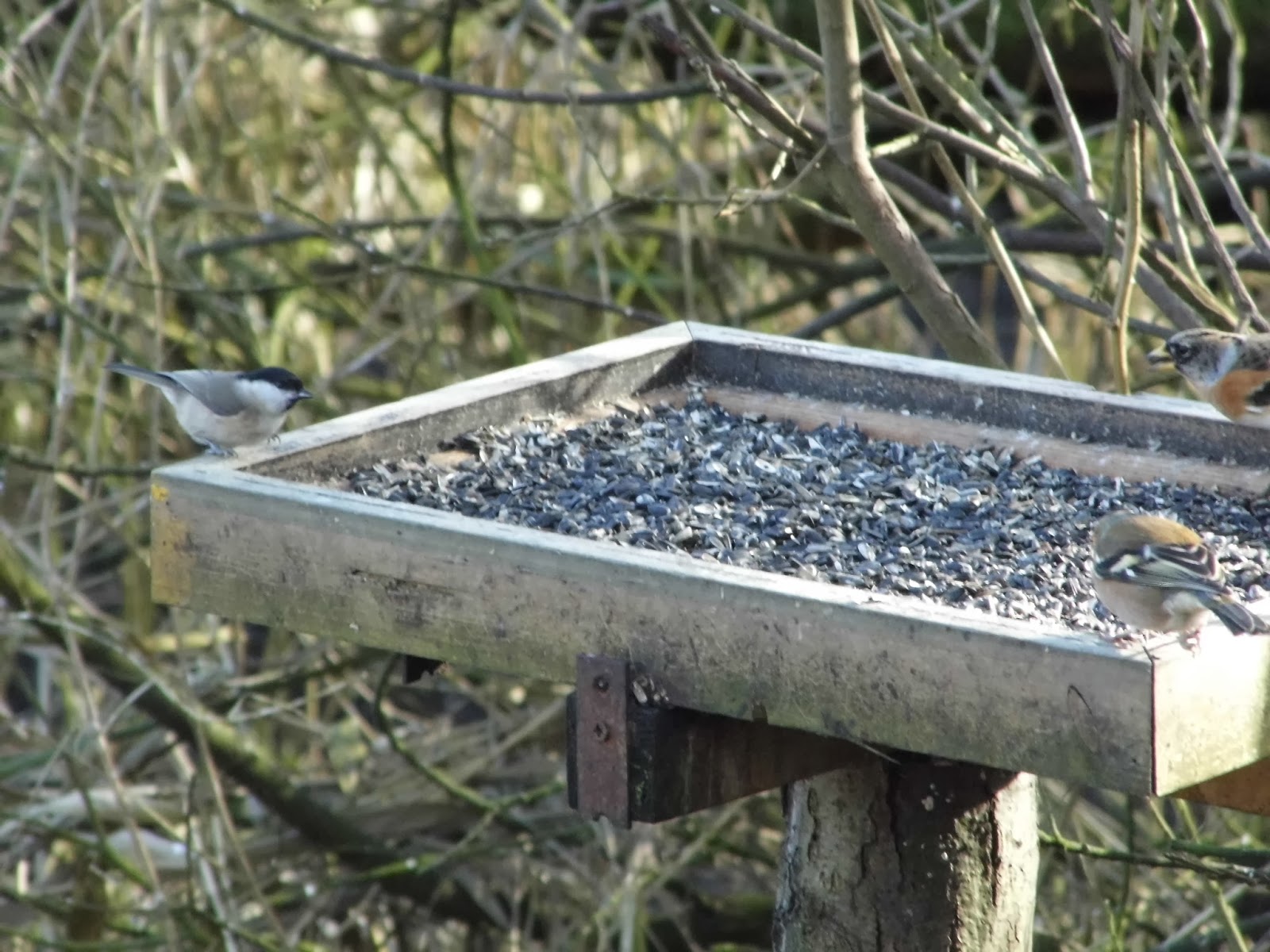
Having watched a short video clip about the site, we headed off an looked around the huts. Whilst looking round I saw some finches perched on a nearby hedge. I raised my binoculars and noticed they were Bullfinches, twelve in total. I think this may well be the most I've ever seen in one flock. After having a look around the village we headed to the museum, pausing on the way to watch birds coming to an area of feeders (Marsh Tits and Coal Tits being the highlights).


After looking around the museum we had a brief walk out into the country park. A flock of Siskin flew over our heads and off towards Lackford. We saw two Muntjacs and various common bird species before heading back to the car park.


NORFOLK: Sculthorpe Moor Bullfinches

15th February 2014

Despite the squally weather Cathy, Margaret & I headed out to do a bit of birding. We diverted via Ber Street to check if the Waxwing was still present and it was, although more obscured than yesterday. Handily a birder was already there and pointed it out half hidden amongst some apples.

We then went to Sculthorpe Moor to see some Bullfinches. This had been the plan a fortnight ago until the Whitlingham hibernaculum check - I went to look at the bats instead on the understanding that we would go to Sculthorpe soon and would find Cathy seven Bullfinches (four males, three females).

From the visitors' centre we stopped to shelter from the rain at the first set of feeders and were rewarded with a Coal Tit and a pair of Bullfinches. There wasn't much showing from the Woodland Hide, so we carried on, seeing some Scarlet Elf Cups near the river. Continuing along the boardwalk we were glad the river wasn't an inch higher as it had already flooded much of the area either side of the path. At the Whitley Hide we were treated to close views of loads of Chaffinch, Greenfinch and Brambling, whilst several Reed Buntings favoured the left hand bird table. After a while a pair of Bullfinches arrives, followed by a second pair. Somewhat strangely another male flew in and Cathy's request list was complete - we saw seven Bullfinches in her desired male/female combination. Hopefully these premonition skills will be used again later in the year.


We took a circuitous way home, calling in at Cley Spy for me to get a new tripod head and the heading along the coast road for the first time since the floods, seeing a Little Egret and a Marsh Harrier.

WHITLINGHAM: More spring birds

27th April 2013

Well it's finally spring, traditionally the most bird-filled time to be at Whitlingham and the most likely to turn up an interesting species of non-wildfowl. Standing in the car park I heard Swifts (90), and looking up saw a small flock flying against the grey cloud. Walking through towards the broads I heard my first Reed Warbler (91) of the year singing from the hedge along the gas compound. I kept listening out for warblers as I walked along the north shore, stopping to see a Bullfinch at the top of one of the willows.


Further along I decided to make an effort to see a Cetti's Warbler, having only heard them so far this year. After a short vigil by the riverbank I did manage to get some rubbish views of one in the bramble scrub (92). Further along I saw the first of at least six Whitethroats (93). Further round and a scan of Thorpe Marsh didn't add anything, so I continued round to the south shore. Here I met Simon whilst scanning a couple of Terns, at least one of which was a Common Tern (94). He told me that he had seen a Wheatear at Thorpe earlier in the day. Being a species that I haven't seen locally I went to the woodland car park to scan across in the hope that it would be visible. Despite trying several different viewpoints (all obscurred to a certain extent by trees) there was no sign of the Wheatear.

So, six more birds until the patch hundred - I'm guessing Common Sandpiper, Cuckoo, Gropper, Garden Warbler, Lesser Whitethroat and Marsh Harrier are the most likely. Of course a Wheatear or something new would be even better... 


Everything looks better with a yacht

NORWICH: Winter thrushes at Carey's Meadow

3rd April 2013

I was actually woken up this morning by the dawn chorus, one of the sacred seals of spring, and like yesterday there was actually some blue sky visible during the day. I walked down to Carey's Meadow, a nice piece of warbler habitat, to see if there had been any change in the bird life. A pair of Bullfinches called to each other, but still no chiffing or chaffing. As I approached the river I heard the harsh 'chacking' call of a Fieldfare, and saw several along with some Redwings in the riverside trees. There was my answer - it's still winter in the avian kingdom.

WHITLINGHAM: More spring migrants

3rd April 2012

Whilst out I received a text from Adam, saying he had found two Firecrests at Whitlingham.  As far as I'm aware there haven't been any previous records of Firecrest here (please contact me if you do know of any, I like to keep my records as accurate as possible).  I headed down to have a look that afternoon in the hope that they would still be around.  On my way I stopped off at the woodland viewpoint and scanned Thorpe Marshes, finding two Little Ringed Plovers and a summer-plumaged Dunlin on the scrape.  Carrying on I did a quick search of the area where the Firecrests had been seen, then picked a spot to settle down and keep watch.  Unfortunately I neither saw nor heard any, but I did see three Blackcaps (beating my earliest record by two days), a Willow Warbler and a lovely Bullfinch.


Having descended from the woods I scanned Thorpe again from a different angle, and was rewarded with a Green Sandpiper making its way around the shingle spit.  Walking back towards the broad a Marsh Tit was giving its spring call.  Finally on the meadows just past the visitors centre a Green Woodpecker was on the grass, as was a dark and nicely patterned female Pheasant vaguely resembling a female Black Grouse. Presumably its a tenebrosus type, the first I've seen in the area.

Yeah, I know there's a fence in the way.  When I tried to look through at a different angle it ran out into the field in that silly way that Pheasants do.

NORFOLK: Marlingford & Sculthorpe

3rd March 2012

A visit to Marlingford Mill produced a good range of species late morning.  When we arrived the American Wigeon was out of sight in the river, but eventually it did work its way back up the bank, to start with just as a head visible above the grass, then finally the whole bird in front of the alders.  Whilst waiting I found a Kingfisher along the river, a pair of Grey Wagtails hopped about on shingle in the channel and a Nuthatch flew onto a nearby tree.  Earlier a Little Egret had been sat at the top of a tree, and a small group of Egyptian Geese were feeding on the marshes.

We proceeded onto Sculthorpe Moor, where we spent a very pleasant couple of hours.  Marsh Tits were calling from several areas of the wet woodland, and a Treecreeper worked its way up a tree near the path.  Walking along the river Cathy found a Toad, which was making a squeaking noise, something that I can't remember ever hearing before.  Further along we found many more that were also making this noise.  From the Whitley Hide we admired a pair of Bullfinches and saw a Field Vole beneath one of the bird tables.  A period of sunshine brought four Buzzards soaring up over the far hide.  On our way back we saw more Toads, another vole and lots of Scarlet Elf Cup fungus.