The Whitlingham Bird Report for 2025 is now available to download from the Bird Reports page or from here

Showing posts with label Foxley Wood. Show all posts

MID NORFOLK: New fungi and much more at Foxley Wood

15th January 2022

The fungus study group don't usually hold a field meeting during January but were convinced to do so this year. This proved to be both a popular and productive decision, with around 30 members meeting up and recording around 120 species. As you would expect for the time of year much of these were either growing on wood or were microfungi on plants, but there were interesting examples of each. It looks like at least two of my finds turned out to be new for Norfolk - a young specimen of an oysterling with brown hair tufts on the cap was Scaly Oysterling (Crepidotus calolepis) and some small clear wart-like growths on Exidia plana were the mycoparasitic fungus Heteromycophaga glandulosae, whilst some small cocoa-bean like growths on an Ash branch were Hysterographium fraxini were also of note.


At a foray last year Stewart Wright had introduced us to the tiny black 'sundial' like projections under Alder leaves caused by Ophiognomonia alni-viridis. After he found the related species Gnomonia gnomon on Hazel leaves I asked if there were any others we should be looking for, and we managed another two - Ophiognomonia setacea on Oak and O. intermedia on Silver Birch. There is also a rare/under-recorded one on dead Rose leaves for me to look for elsewhere.


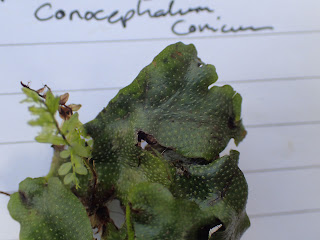
Foxley is an excellent reserve for many groups of species, and Rob Yaxley kindly pointed out some bryophytes as we went round, including the liverwort Conocephalum conicum and Big Shaggy-moss Rhytidiadelphus triquestris. Rob also identified a millipede that I'd spotted underneath a fallen branch as Brachydesmus superus.


New macro moths are always a bonus, and having seen a rather tatty specimen on the ground I was pleased when someone found a fresher looking Spring Usher. There was a new micro moth species too, when Stewart found an occupied leaf mine in Greater Stitchwort containing the larva of Three-colour Groundling, Caryocolum tricolorella. The light was beginning to fade as we walked back to the cars, allowing several group members to use their UV torches to illustrate the luminescence of Sulphur Tuft.


NORFOLK: Even more October fungi

 Late October 2020

With a few days off work we decided to go for a few family walks in woodland areas fairly close to Norwich, namely Foxley, Strumpshaw and Harrison's Wood (Sprowston). We saw a nice range of fungi across these differing sites, including Trooping Funnels, Parrot Waxcaps, Fly Agarics, Crab Brittlegill, Dark Honey Fungus and many more. Bullfinches were particularly common at Foxley - I heard at least eight there.


Trooping Funnels

Parrot Waxcap and a club - probably Apricot Club

Waxcap sp - probably Parrot Waxcap

Coprinellus impatiens - probably
Crab Brittlegill
Shaggy Parasol
Dark Honey Fungus
Dead Man's Fingers and Candlesnuff Fungus

MID NORFOLK: Foxley Wood - return of the Purple Emperor

Late July 2019

In recent years the Purple Emperor butterfly has been spreading away from core populations in the East Midlands, with new records (or new modern records) at sites in Northamptonshire, Cambridgeshire, Suffolk, and more recently Norfolk. Whilst there had been occasional sightings in the past, records of both male and female Purple Emperors at Sheringham Park, combined with sightings nearby at Beeston Common in the past three years had suggested that they were present in low numbers and probably breeding nearby.

With this background, I was rather surprised when Butterfly Conservation released a press release to announce the official return of the Purple Emperor. Partly it seemed odd wording (either its back or it isn't, the official part seems redundant, rather like most uses of the word literally), but also this was before any sightings had been reported from Norfolk in 2019, so why now? All became clearer about a week later. Photos of Purple Emperors started to be shown on social media - clearly they were now present somewhere else, but there was a seemingly unecessary secrecy about it. This didn't last long - the location was Foxley Wood, the location of the last Norfolk population that died out in the early 1970s. The reason for initially keeping it quiet wasn't revealed. Foxley is a great place and thanks to sympathetic woodland management seems in a good place for the population to rebuild. The NWT wrote about the return here: https://www.norfolkwildlifetrust.org.uk/news-and-articles/news/all-news/2019-07-17-the-emperor-returns

Patrick Barkham also wrote about the Foxley Purple Emperors for the Guardian. One of the interesting bits here is the local who remembers last seeing them in 1971 - pertinent only because one prominent Purple Emperor finder was keen on the theory that they had been present but unreported in woods across East Anglia for the past 50 years, a theory rejected by almost all local naturalists (partly because there was no real evidence for it and partly because it was a bit insulting to suggest that nobody else was seeing them despite these woods being well watched and visited sites) https://www.theguardian.com/environment/2019/jul/30/butterflywatch-the-return-of-the-dazzling-purple-emperor

Anyway, with a few hours free one morning we went on a family visit to Foxley, hoping to see a Purple Emperor. It was during a hot period so not ideal whether for either us or the butterflies, but not long after arriving we did see a Purple Emperor as it flew majestically out of a large Oak, across the ride we were on and off towards an area of sallows. We also saw several Purple Hairstreaks and at least five Silver-washed Fritillaries.

The Hogweed was covered in insects - sadly I can't identifiy many of the flies, but there was also some common hoverfly species too plus Chrysotoxum bisinctum. Elsewhere in the wood I found a leafmine of the sawfly Heterarthrus wuestneii on Field Maple, which might be a new record for the site, and got excited by a large greyish Longhorn Beetle. I assumed it was something I'd never seen before, so was surprised when my database showed a previous record. That was from Tasburgh the previous month and the explanation was simple, this was a Variable Longhorn beetle, and the one I'd found looked nothing like the yellowy-brown seen the previous month. 


MID NORFOLK: Foxley Wood fungus foray

16th December 2017

The last fungus study group foray of the year was held at Foxley Wood, and there was a respectable turnout given the icy weather and various illnesses going around. We were also joined by Rob Yaxley, who has been getting more interested in fungi this autumn, and also used to visit Foxley regularly.

Steve found some Crepidouts epibyrus growing on leaves near the car park, before we headed off towards the older part of the woods. Our first stop was a log pile, where some Leafy Brain fungus was of note. We continued on into an area of mature Hazel, where we spread out to find as much as possible. Twig Parachute, Spring Hazelcup and some frozen Witches' Butter were the highlights here.


A bit further along the path were some Crimped Gill brackets, a species only added to the Norfolk list in the past five years but now relatively common, a late Fly Agaric, some Green Elf Cups and the contorted variant of Pipe Club. There were two new species for me, Dingy Twiglet and the sclerotia of Typhula phacorrhiza.


We had a room at Bawdeswell village hall booked for lunch, a planning meeting and a presentation of notable fungal finds this year, so after a couple of hours we turned back and headed for Bawdeswell. The village hall was very modern and the staff friendly - certainly worth considering if you are looking for a venue out this way. We thrashed out a prospective foray programme for next year and went over some of the interesting things that members of the group had found.

Many thanks go to Steve Pinnington for organising the forays this year, and of course to Tony Leech and everyone else who has attended and helped identify all of the species we find.

MID-NORFOLK: Foxley insects and plants

11th June 2016

After the moth traps had been opened at Foxley, the Norfolk Wildlife Trust warden led a walk around the wood. He was able to tell us about the history and management of the different areas of the wood, which is the sort of thing you can't get from just walking around on your own. Inevitably I wandered along staring into the undergrowth for insects, and this time I had a partner in crime as Stewart Wright was there looking for leaf-mining lepidoptera.

My two best finds both evaded the camera - my first Eared Leafhopper jumped away and my first Tortoise Shieldbug dropped off its blade of grass and I couldn't find it amongst the leaflitter. At the other end of the scale Stewart found a case of the micro moth Infurcitinea argentimaculella, only the fourth Norfolk record. This larva of this species makes a case then camouflages it with lichen. It's so good I could barely see it even when I was looking straight at it. I have highlighted it on the photo below.


Other interesting sightings on the way round included a Six-spot Burnet Moth caterpillar and several empty pupae, an Oak Eggar moth caterpillar, attractive micro moths Alabonia geofrella, Micropterix aruncella & Micropterix calthella. Plant-wise we were shown Midland Hawthorn and Wild Service Tree, and saw loads of Common-spotted Orchids, a couple of Twayblades and some Greater Butterfly Orchids.

 Six-spot Burnet moth caterpillar
 A case made by the larvae of the moth Psyche casta
Greater Butterfly Orchid

MID-NORFOLK: Foxley Wood moth night

11th June 2016

This weekend the evenings were designated as National Moth Night(s), and moth-trapping events were held across the country by Butterfly Conservation. Yes I'm aware there are some slight contradictions there. Anyway, the main Norfolk event was held at Foxley Wood NWT reserve, the largest area of ancient* woodland in Norfolk. The event was well attended, with around 30 people present, and we saw about 70 species of moth. This total was a bit low for the time of year (and across seven traps), but still included a good variety and large numbers of some species.

A Brindled White-spot was the scarcest species found, but there were several other species that I had not seen before, including Grey Arches, Plain Golden Y and Pale-shouldered Brocade.

 Ingrailed Clay - a very variable species
 Poplar Hawk Moth - probably the commonest hawk moth
 Beautiful Golden Y
 Blood-vein
Brindled White-spot

* later we went on a walk with the warden, who told us that rather than ancient woodland, Foxley could be considered primal woodland. This term, which I hadn't really come across before, means that the area had been continuously wooded since the last ice age retreated. In England, 'ancient woodland' means woodland present since before 1600.