The Whitlingham Bird Report for 2025 is now available to download from the Bird Reports page or from here

Showing posts with label Moss. Show all posts

WHITLINGHAM: March WeBS count and some Bonfire moss

9th March 2024

Some nice weather for the March WeBS count and I had a good chat with Ed Mackrill part way round. A brief bit of Chiffchaff song from the wood near the pumphouse was my first singing one of the year and on the island two pairs of Cormorants were on nests. There were still good numbers of Tufted Duck, plus a drake Goldeneye and two Pochard. A Reed Bunting called from near the Little Broad and there was still a small flock of Redpolls in the area. The only non-avian species of note was 'Bonfire Moss' Funaria hygrometrica growing on an old burnt area. This is a common species and has been recorded here by the Norfolk & Suffolk Bryological Group, but was a new one for me apparently.


NORWICH: April Earlham Cemetery visits

Early April 2023

I visited Earlham Cemetery twice in April, firstly for an event organised by the Friends of Earlham Cemetery to look at mosses, and secondly for a few hours on a sunny day looking for hoverflies. Most of the mosses were species that I had seen before, but a couple pointed out by East Norfolk bryophyte recorder Mary Ghullam that I hadn't seen were Hooded Bristle-moss (Orthotrichum cupulatum) and Streblotrichum convolutum (=Barbula convoluta).


On my second visit I failed to find any Criorhina species, but did find a few new bits and bobs. I typically don't pay much attention to bluebottle and greenbottle type flies because many need close examination for ID, but I had seen pictures of one called Eudasyphora cyanella that has a small area of white at the front of the thorax, and I amanged to find one of those. I also saw the tephritid fly Tephritis formosa, a leafhopper Acericerus heydenii, the bug Stygnocoris fuligineus and a caterpillar of the Tree Lichen Beauty moth.


NORWICH: February lichen, moss and aphids

Early February 2023

A few random sightings whilst walking around Norwich. In Wensum Park I had a closer look at some pale 'splats' on the concrete step handrails and think that the lichen involved is Aspicilia calcarea, which would be a new one for me. I hunted around for two of Leif Bersweden's 'Couch to 10 mosses' species - Common Tamarisk Moss (Thuidium tamariscinum) and Springy Turf Moss (Rhytidiadelphus squarrosus). I couldn't find the former, which is more associated with woodland, but did manage to find the latter in St Augustine's Churchyard. Whilst looking for the tamarisk moss I did find lots of Common Feather-moss (Kindbergia praelongia). Back at home some aphids had started to appear on the outside of the house. The small ones were Cinara tujafilina (this is a species associated with cypresses - I mistakenly thought these were Cinara cupressi nymphs when I first saw them last year) and some very large (for aphids) Cinara confinis.


MID-NORFOLK: Brisley church wildlife safari

14th January 2023

There are not usually many outdoor wildlife events in January, but on the 14th county lichen recorder Rob Yaxley hosted a family wildlife safari at Brisley church. It was raining as we drove out to Brisley, but there was still a reasonable turnout for the event. After a brief talk in the church we went outside and had a look for some of the mosses and lichens present on the walls of the church and on the gravestones. Some of the highlights included the lichens Myriolecis (Lecanora) crenulata, Physcia tribacia and Bacidia rubella, plus the moss Orthotrichum anomalum. We then went back into the church for tea and biscuits, followed by a look in the old crypt room and a look at some bat droppings. We were made to feel very welcome and more events are planned for later in the year, so do keep an eye out for details of them.


MID NORFOLK: New fungi and much more at Foxley Wood

15th January 2022

The fungus study group don't usually hold a field meeting during January but were convinced to do so this year. This proved to be both a popular and productive decision, with around 30 members meeting up and recording around 120 species. As you would expect for the time of year much of these were either growing on wood or were microfungi on plants, but there were interesting examples of each. It looks like at least two of my finds turned out to be new for Norfolk - a young specimen of an oysterling with brown hair tufts on the cap was Scaly Oysterling (Crepidotus calolepis) and some small clear wart-like growths on Exidia plana were the mycoparasitic fungus Heteromycophaga glandulosae, whilst some small cocoa-bean like growths on an Ash branch were Hysterographium fraxini were also of note.


At a foray last year Stewart Wright had introduced us to the tiny black 'sundial' like projections under Alder leaves caused by Ophiognomonia alni-viridis. After he found the related species Gnomonia gnomon on Hazel leaves I asked if there were any others we should be looking for, and we managed another two - Ophiognomonia setacea on Oak and O. intermedia on Silver Birch. There is also a rare/under-recorded one on dead Rose leaves for me to look for elsewhere.


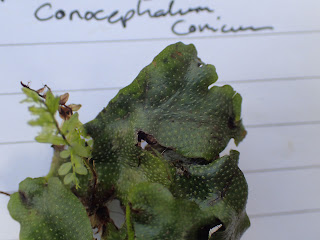
Foxley is an excellent reserve for many groups of species, and Rob Yaxley kindly pointed out some bryophytes as we went round, including the liverwort Conocephalum conicum and Big Shaggy-moss Rhytidiadelphus triquestris. Rob also identified a millipede that I'd spotted underneath a fallen branch as Brachydesmus superus.


New macro moths are always a bonus, and having seen a rather tatty specimen on the ground I was pleased when someone found a fresher looking Spring Usher. There was a new micro moth species too, when Stewart found an occupied leaf mine in Greater Stitchwort containing the larva of Three-colour Groundling, Caryocolum tricolorella. The light was beginning to fade as we walked back to the cars, allowing several group members to use their UV torches to illustrate the luminescence of Sulphur Tuft.


CENTRAL NORFOLK: Buxton Heath invertebrate selection

Mid-April 2021

Buxton Heath is probably our closest NWT reserve bar Thorpe Marshes, and has the added attraction for family walks of having horses, a favourite of my daughter. This area holds a wide range of insects, such that during spring and summer it would almost be a suprise not to see something new. During our couple of hours we saw six Buzzards kettling above the woods, a couple of Crossbills flying over, a Stonechat and a Meadow Pipit. I saw four new species, two of which are probably things that I have seen but not recorded in the past - Heather Beetle and Juniper Haircap moss. The other two were the larval stage of the Ling Case-bearer moth (Coleophora pyrrhulipennella) and a spider, Zora spinimana.


NORWICH: Some mosses for the end of February

Last week of February 2021

This week's excursions were limited to a walk around the local park and the walk into work, neither of which resulted in any bird additions to the year list. A sunny spell did bring out a few insects though, with my first hoverfly of the year (Eristalis tenax), butterfly (Peacock) and bumblebee (too fast to be sure what species). Greenfinches and Chaffinches were also singing locally, whilst a Robin popped into the back garden on several days.

On Twitter Leif Bersweden had started posting information about common mosses, using the hashtag #couchto10mosses which encouraged me to look at some of the moss covered walls I passed, and I found a couple of the species mentioned, Wall Screw-moss (Tortula muralis) and Capillary Thread-moss (Bryum capillare).

Capillary Thread-moss (Bryum capillare)
Wall Screw-moss (Tortula muralis)
Unknown moss sp.

WHITLINGHAM: Woodland plants and fungi

4th March 2017

After dropping Cathy off in the city I headed off to Whitlingham for a few hours. One of the first things I noticed upon arrival was a Reed Bunting singing from the far shore of the Great Broad, the first time I've heard them this year. There were plenty of Black-headed Gulls on the pontoon still, but no ringed birds. Duck numbers have decreased again (although some were probably across the river at Thorpe) - there were probably still over a hundred Tufted Ducks, but only a handful of Gadwall and I didn't see a single Pochard. Next weekend is WeBS weekend, so I didn't do a proper count this week, and instead headed off to the woods.

It was good to hear a bit more birdsong than on my previous visits this year, Nuthatch, Goldcrest and Coal Tit were of note. I went and had a look at the Hard Shield Fern to compare it against the Soft Shield Fern that I had found here recently. Up until a few years ago I'd never seen either, and here they are growing in the same wood! A search of some nearby Box bushes turned up the second gall that I had seen at Catton Park. A walker kindly recommended that I took the low path through the woods where there was a large drift of Snowdrops around the cottage.


Coming out of the woods I walked along the riverbank, noticing a straggly moss growing on tree roots along the riverline. I had a note that a species had been found in this habitat during a Bryological Group meeting in 2000, and a check at home confirmed that it was the same species, Cinclidotus fontinaloides, which was a new one for me. On my way back I noticed Lemon Disco fungus growing on a fallen branch, and some naturalised Crocuses in a small area of woodland.


SOUTH NORFOLK: Ashwellthorpe moss meeting

6th November 2016

On Sunday I headed to Ashwellthorpe Lower Wood for a joint NNNS/Norfolk & Suffolk Bryology Group 'Mossing for Beginners' session. We began by comparing pleurocarpous and acrocarpous growth forms of mosses, and separating mosses and liverworts (not always as straightforward as you would think). Having not done much moss recording in the past, around half of the species we saw were new to me, but it was also useful to re-aquaint myself with some of the commoner species. Two of the most interesting species were the moss Homalia trichomanoides and the liverwort Pellia andiivifolia, pictured below.

 Homalia trichomanoides
 Pellia andiivifolia

The rain and cold meant that there weren't many insects about, but a Feathered Thorn was nice to see, particularly as I had only seen one before. There was also quite a bit of fungi about, including a branch full of Green Elf Cups. Whilst others were looking at mosses growing on some branches, I noticed one of the 'hand-writing' lichens, and some Two-toothed Door Snails were also present.


We stopped for lunch on a large log, and nearby there were lots of King Alfred's Cakes and Dryad's Saddle. Andy found some Spurge Laurel, and later we were able to compare it to Wood Spurge. Along the edge of the wood we heard and then saw a Kingfisher, seeming very incongruous on the edge of a small pond. There was time for a few more interesting fungi, in particular the bright reddish-orange Pluteus aurantiorugosus growing on a fallen log.