The Whitlingham Bird Report for 2025 is now available to download from the Bird Reports page or from here

Showing posts with label 30 things. Show all posts

30 THINGS: 12/30 - Merveille de Jour and other moths

2nd November 2014

For a number of years one of the moths I was most interested in seeing was the Merveille de Jour, a green-and-black patterned moth that can be found in the autumn. I've never caught one, and regular lament the fact. Last night I was making one of my regular mothy complaints when David Norgate announced that he had just caught one if I was interested. I certainly was, so Cathy and I headed round on Sunday morning and weren't disappointed by the Merveille de Jour, which was excellent. David has also kindly kept some other moths from the previous night, including a December Moth, Spruce Carpet and Green-brindled Crescent, all of which were also new moths for me

 At last! Merveille de Jour
Green-brindled Crescent
December Moth - stubbier than I had imagined!

30 THINGS: 11/30 Parrot Waxcap + Earlham Cemetery fungi

18th October 2014

Every month the Friends of Earlham Cemetery hold a walk around the cemetery to look for whatever the season has to offer. This one was led by Ian and focussed on fungi. Ian knew that I wanted to see Parrot Waxcap this autumn, and had kindly done a recce in the morning and located a couple of specimens. When I saw them I appreciated the effort - locating a small green fungus amongst the grass is no mean feat! The group spent around 2 hours walking on our tour, and despite the relatively dry autumn we still saw over 40 species. Some of the more interesting species included Striated Earthstar, Sessile Earthstar, Parrot Waxcap, Meadow Waxcap, Meadow Coral, Earthtongues and Sulphur Knight. There were also large amounts of the coral fungus Ramaria flaccida and Dog Stinkhorn.

Striated Earthstar
Sessile Earthstar
Parrot Waxcap
Meadow Coral
Earthtongue sp.
Sulphur Knight
Ramaria flaccida

30 THINGS: 10/30 Earthstar sp.

23rd September 2014

Just over a week ago Ian Senior found some earthstars in Earlham Cemetery which looked different from the ones he had seen there previously. As I hadn't seen any earthstars around Norwich I was keen to have a look, particularly as they were one of my '30 things to look for'. Ian kindly emailed me directions, so after work Cathy & I went to have a look. They took some finding, as they were along the edge of a path and had been knocked over. Definitely a new species for me as I have only seen the larger Collared Earthstar, but the actual species is still being confirmed (they are probably Sessile Earthstars).


Earlham Cemetery also hosts the last remaining fungus on this years target list (Parrot Waxcap), but unfortunately the best areas for Waxcaps had recently been mown. Amongst the grassy debris I did find a couple of Blackening Waxcaps, which I haven't seen around Norwich before. There were a few other bits and bobs too - Cathy found lots of earthballs and one tree stump was surrounded by Giant Polypore.


YARE VALLEY: Strumpshaw Moths & S-f Catchfly

12th July 2014

This morning Cathy, Margaret & I went to Strumpshaw Fen for a moth morning. We had been to one here previously in August, so I was hoping that the difference in date would result in some new moths. Ben had put two traps out, one in the woodland and one in the fen to ensure a bit of variety. In all we recorded just over 60 species, including ever popular species like Poplar Hawk, Elephant Hawk and Garden Tiger. A Pine Hawk Moth was a bit of a surprise. We did see some new species too: Dark Umber, Dark Sword-grass, Small Wainscot, Fen Wainscot and Bordered Beauty. Thanks to Ben & Strumpshaw for putting on this event.

Pine Hawk Moth
Elephant Hawk Moth
Dark Umber
Dark Sword-grass
Small Wainscot

Before going home we made a diversion to inspect some poplars in case there were any emerging Hornet Moths. I didn't see any, or any sign of exit holes on the trees I examined. I know of a couple of sites near the coast that are good for Hornet Moths but if anyone knows of a site near Norwich then please get in touch! We then went onto a nearby site for another one of my target species for this year, Small-flowered Catchfly. I found a number of plants, mostly over, but a few still showing the delivate white-and-pink flowers.

Small-flowered Catchfly

WHITLINGHAM: Another rare fungus

5th July 2014

A quick follow up from Saturday at Whitlingham - whilst looking around the meadow near the barn county fungus recorder Tony Leech noticed an interesting bracket fungus on the end of one of the logs. It was a Gloeophyllum sp, and we presumed that it was one of the two species that have been seen at Whitlingham previously (G. trabeum or G. sepiarum). This would have been good in itself, but when Tony checked it at home he identified it as Gloeophyllum abietinum, a new species for Norfolk!


BRECKLAND: Speedwell search & Stone Curlews

12th April 2014

Chronologically the next species on my list of 30 Interesting Things was one or more of the rare Speedwells that can be found in the Brecks. Cathy & I went to a site near Thetford, where we searched along the edges of a path for the tiny blue flowers. We did find two speedwells, but neither were rare - most of the plants were Ivy-leaved Speedwell, whilst the other turned out to be Common Field Speedwell. We did see a Goldcrest and heard a Blackcap in the nearby pines.

Before going back we moved on to Weeting Heath, where we got good views of two Stone Curlews from west hide and had a chat with one of the wardens. I didn't have my 'scope with me to take any photos, but I notice that Craig Shaw also visited Weeting yesterday and he has got a good photo of the Stone Curlews on his blog here: http://craigshawsbirdingblog.blogspot.co.uk/2014/04/brecks.html

30 INTERESTING THINGS - 3/30 Hard Shield Fern

23rd February 2014

This week had seen a small influx of early migrant birds to Norfolk, so I headed down to Whitlingham in the hope of breaking my earliest patch record for Willow Warbler or Sand Martin. The weather was overcast with a few showers, but this can be handy for 'dropping' migrants, so I didn't resent the rain. On the Little Broad ten drake Shoveler were still present, along with a dwindling number of Gadwall. There was no sign of last weeks Egyptian goslings, which doesn't bode well for them. The most interesting bird on the Great Broad was a hybrid Canada x Greylag Goose near the main island.


With no migrants other than the now widespread Chiffchaffs, I headed further along into the woods. On my way along a woman stopped to tell me she had just seen a Hedgehog walking across the road ahead, but it had gone by the time I got there (I have only seen a squashed one here). There was plenty of birdsong, including a drumming Great Spotted Woodpecker, two Nuthatches, Song Thrush and lots of Wrens. The woods were carpeted with Dog's Mercury, Moschatel and Early Dog's Violet were also in flower.


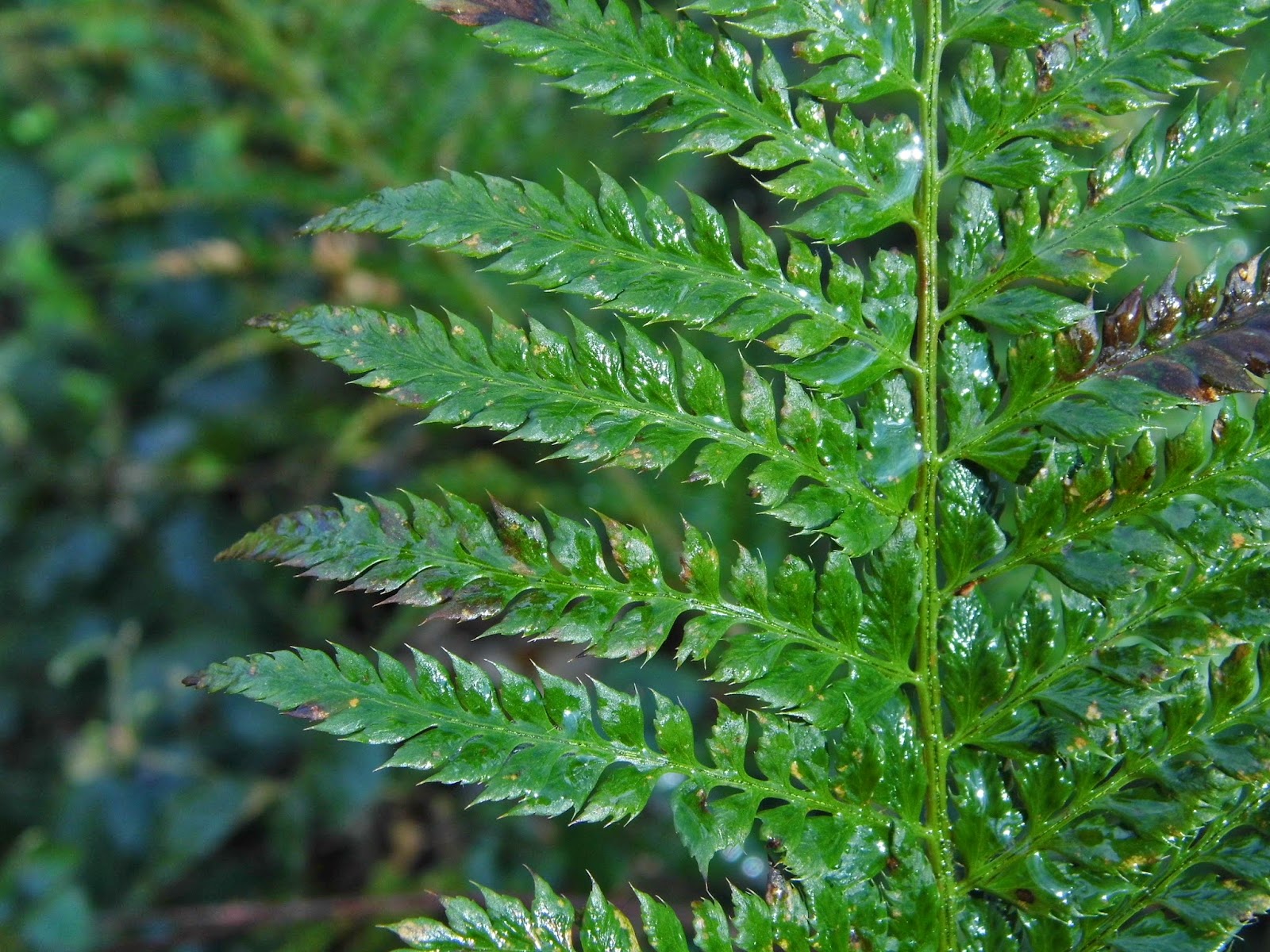
Having asked for sites for Hard Shield Fern, a species I have never (knowingly) seen, I was told of several places, including Whitlingham Wood. Jeremy had kindly told me that there was a record from the woods in 2011, so I paid particular attention to the clumps of ferns, most of which are Male Fern. I had almost completed a circuit of the woods, not hearing any migrants along telegraph pole alley, when I noticed a different fern near the top of the steep steps. A closer look revealed it as my target species, Hard Shield Fern. I know I've looked at that clump of ferns before, but just never realised what it was!


30 INTERESTING THINGS - 1/30 Winter Stalkball

18th January 2014

Cathy, Margaret & I went to the North Norfolk coast today, and after a pleasant walk around Titchwell (seeing Water Rail, lots of Pintail and a selection of commoner waders) we headed on to Holme to look for the first of my '30 interesting things'.

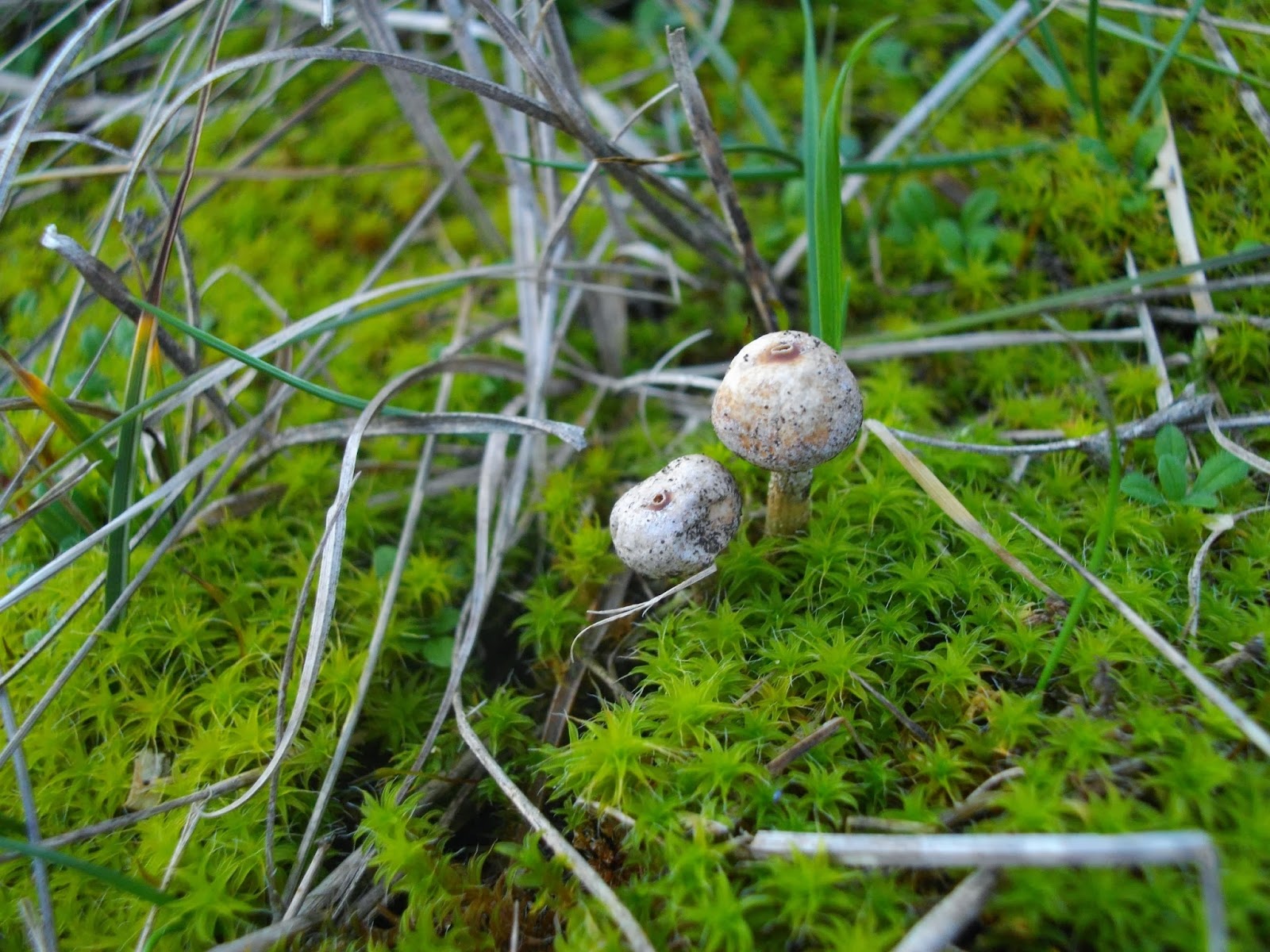
The target was Winter Stalkball. Unless you are particularly interested in fungi you are unlikely to have heard of the stalkballs, but you may well have heard of their commoner relatives, the puffballs. Puffballs are mostly spherical, and when their spores mature they are puffed out and spread by the wind when the puffball is fully mature or is disturbed (for example by an animal or heavy rain). Puffing spores into the air is a good strategy, but clearly the higher the puffball, the further the spores can go. Some puffballs have a thick stipe* to help raise them higher, such as this Common Puffball, seen at Whitlingham this autumn.


There is a small group of species that have gone one better and developed a long stipe relative to the main 'ball'. The best known of these is the Sandy Stiltball, which despite being rare and indeed protected by law, is known from several sites in the county, including one on the edge of Norwich. I have previously blogged about it here. The Sandy Stiltball can grow up to around 40cm tall, but the Winter Stalkball that we were looking for only grows up to 5cm tall. In fact, the top of one looks rather similar to a sun-bleached rabbit dropping! In Norfolk Winter Stalkballs are only found at a few coastal dune systems, and are easily overlooked, so I was grateful to Rob for his help, allowing me to connect with this interesting species.


Winter Stalkballs

* 'Stipe' is the usual mycologist's** term for a stalk
** A mycologist is someone who studies fungi.

30 Interesting things for 2014

Later this month is my 30th birthday, and I had been wondering what sort of wildlife-related activity would be an appropriate celebration. January isn't a great month for going out, with the short hours of daylight and lack of plant and insect life, so I decided to indulge in a year-long search for 30 interesting species.

Picking the species was trickier than I thought. I wanted it to be a mixture of all of the different groups that I'm interested in, but I had to take into account time constraints amongst other things. Anyway, my provisional list is below. Some species I should be able to see without any problems, some will take a bit of research, whilst others may require local knowledge or specialist group help. Will I see all 30? Probably not, but hopefully it will be fun trying!

Birds
1. Colour-headed Yellow Wagtails - I haven't seen any of the scarcer ones, and even the hybrids are interesting birds. Hopefully there should be some in late April in the Eye field or east coast paddocks.
2. White-winged Black Tern - I'm yet to see one in Norfolk yet, and a possible Whitlingham bird too, either in May or August.
3. Long-tailed Skua - Some sea-watching time will be needed for this one...
4. Pallas' Warbler - I still haven't seen one of these yet.

Mammals
5. Natterer's Bat - I had a probable at Whitlingham a couple of years ago, it would be nice to confirm it though - Seen, Trowse Hibernaculum with Norwich Bat Group
6. Barbastelle Bat - A species I haven't seen yet but present in NE Norfolk. Dipped
7. Bottle-nosed Dolphin - I haven't seen any dolphins before, we have a trip to see them in Wales booked for the spring - Seen, New Quay, Wales with Carl Chapman
8. Yellow-necked Mouse - A scarce species in Norfolk, but one of the sites with them usually has a small-mammal trapping day each year.

Amphibians
-- I would like to see Natterjack, but I don't really fancy wandering about the dunes at night. I am also interested in trying to see Marsh Frog in Norfolk - I know there used to be several colonies including one in the Tas Valley, but the most up-to-date information I can find on these is from the 1980s. Does anyone know of any Marsh Frog sites in Norfolk with public access?

Dragonflies
Having seen all of the usual Norfolk dragonflies the closest lifer for me would be White-legged Damselfly. However I would like to get some decent photos of Willow Emerald.
9. Willow Emerald - Get some decent photos. Photographed at Strumpshaw 24/08/14.

Butterflies
Like Dragonflies I have seen the regular Norfolk ones - the closest lifer for me is Marbled White, which should be a reasonable trip.
10. Marbled White - Devil's Dyke.
11. White Admiral - One of my favourite butterflies but one I've never managed to get a photograph of. Fingers crossed this should be simple at Holt C.P. Photographed at Holt CP.

Moths
12. Hornet Moth - I haven't seen any of the Hornet or Clearwing moths - I hope to see one of these at the North Norfolk coast.
13. Scorched Wing Moth - There are loads of fairly common moths I haven't seen, but this seems a reasonable one to look for.
14. Merveille de Jour - I've wanted to see one of these for ages. We don't seem to get them near the garden I trap in, but Justin has kindly offered to let me know when he catches one this autumn.

Orthoptera
15. Great Green Bush Cricket - I have looked for these before and although we heard them, we didn't see any. Seen at Reedham, 24/08/14.

Orchids
16. Frog Orchid - I meant to look for these last year at their known Suffolk site.
17. Lizard Orchid - Hopefully I can see these whilst looking for Marbled Whites.
18. Pale or white form of another Orchid - There are lots, the alba form of Green-winged Orchid would be nice to see.
19. Common Fragrant Orchid - this has fairly recently been promoted to full species, and the NNNS orchid guide says that it occurs in Norfolk, but I haven't been able to find any sites yet. Updated advise is that this species may have occurred in Norfolk previously, but no current sites.

Flowering plants
There are loads of flowering plants in Norfolk that I'd like to see, including the Bladderworts and Yellow Bird's-nest, however I settled on:
20. Spiked Speedwell - or any of the specialist Breckland Speedwells, it's a place I haven't seen many plants.
21. Purple Broomrape - Common in several places along the North Norfolk coast - I failed to find it at Overstrand a few years ago.
22. Chaffweed - Only found at one site in Norfolk. The good news is that it is near Norwich, but the bad news is that the site is threatened with development. You can out more here: http://friendsofthorpewoodlands.blogspot.co.uk/. Unfortunately Chaffweed is a small green plant, so finding it in a large woods may be tricky.
23. Small-flowered Catchfly - A rare Red Campion-like plant that grows in several places around the county. Seen, Strumpshaw area.
24. Maiden Pink - Another Breckland species I'd like to see.

Ferns
25. Hard Shield Fern - scarce in Norfolk so I need to find some good places to look. Seen, Whitlingham Woods (thanks to Jeremy Halls)
26. Narrow Buckler Fern - fairly common but a fern lifer, so provided I can identify it then it could be something to pick whilst hunting for the other species.

Fungi
27. Scaly or Winter Stalkball - Scarce stalked puffball species. Either would be great, but as they often occur at the same sites I may even luck in on both. Winter Stalkball seen at Holme (thanks to Rob Smith)
28. A scarce bracket fungus. There are quite a few possibles here, I haven't seen Hoof Fungus, Phellinus hippophaeicola (grows on Sea Buckthorn) or Ganoderma resinaceum for starters... Gloeophyllum abeitinum (a 1st for Norfolk) seen at Whitlingham (thanks to Tony Leech).
29. Any Earthstar except G. triplex - Again lots to choose from. Beaked Earthstar is the best bet as it sometimes grows in Earlham Cemetery, although there weren't any fruiting bodies in 2013.
30. Parrot Waxcap - A fairly common Waxcap, present at Earlham Cemetery although I spectacularly failed to find it on multiple occasions in 2013.

So there we have it, my 30 to look for. Hopefully looking for these will provide some interesting blog entries, and if you can recommend any sites for some of the trickier species then please get in touch.