The Whitlingham Bird Report for 2025 is now available to download from the Bird Reports page or from here

Showing posts with label Holme Dunes. Show all posts

NORTH NORFOLK: A visit to Holme

4th June 2022

At the start of June there was a moth trap opening at Holme Dunes NWT reserve, so we decided to go and have a look. There are quite a few coastal species that I am yet to see, and that is still the case as the cool and windy conditions meant only low numbers of mostly common species were caught. Hedge Shade, Isotrias rectifasciana, was the only 'new' species.

After the trap opening we went for a walk on the beach, the highlight of which was finding two empty sand grain tubes made by a Pectinaria sp.

After lunch we went to a short walk around the reserve. I heard my first Cuckoo of the year, and was also pleased to see the coccinea form of Early Marsh Orchid (probably my favourite orchid). Back in the car park we looked at some low growing plants, Mossy Stonecrop, Subterranean Clover and Bird's-foot Clover, whilst also finding a Fallen's Leatherbug and lots of Nysius species, probably N. huttoni.


Before leaving I found a Scaeva selenetica hoverfly and some Cavariella theobaldi aphids on Wild Parsnip.


NORTH NORFOLK: Poronia at Holme


22nd January 2017

Last week I had received an email from Mark Joy, a wildlife enthusiast and photographer from Lincolnshire. He has been putting a lot of time and effort into photographing fungi recently, and had spent a couple of days at Holme Dunes checking rabbit droppings for Poronia erici, the fungus that Cathy & searched for after Christmas. All of his hard work had paid off when he found pellets with the fungus on in three locations along the dunes, and he very kindly sent me directions on how to find them.

When I left Norwich it was a bright sunny day, although the frost was harsh and reminded me of our earlier trip. Arriving at the visitors centre I had a chat with Gary and Rob, who had both seen the Poronia at two of Mark’s locations, so Rob headed off with me to speed up the finding process. He soon located a lone rabbit pellet with two Poronia erici fruiting bodies by the side of the path, along with some Winter Stalkballs. I diverted up to look over the Broadwater for the Ferruginous Duck that is present at the moment, but it was out of sight and the bright sunlight meant checking the ducks was almost impossible.


We moved on to the second area, where a location photo and some marker sticks from Mark helped locate the pellet in question. Nearby Andy Brown was seawatching, and came over to have a look at the Poronia. Before heading back I returned to the Broadwater, and despite Andy bringing his ‘scope over there was still no sign of the Ferruginous Duck. There was still one site left to check out, and Gary & Rob hadn’t managed to locate this one. Looking around I eventually figured out that it was left of the path from the car park, and found Mark’s pine cone markers. This pellet was the most impressive of the three, with multiple fruiting bodies on it.


I’m particularly grateful to Mark for his hard work and directions, and also to Rob for speeding up the hunt by showing me two of the locations.

NORTH NORFOLK: Holme & Titchwell fungi

28th December 2016 

After my successful pre-Christmas jaunt to see Poronia punctata at Holt, I hoped to see the related species Poronia erici at Holme before going back to work after the Christmas break. Poronia erici is a rare, tiny species that grows on rabbit dung, making it particularly hard to find, even where it does occur. I had heard that it had been seen this winter, so thought it worth a go. 

We woke to a hard frost, given the estate a rather belatedly Christmassy feel, but by the time we came to leave the ice had melted and been replaced by a dense fog. At the back of my mind was the risk that the hunt for rabbit pellets could descend into a foggy farce, but confident that it would be clearer at the coast we carried on. By the time we reached Brancaster there was no trace of the fog. At Holme we drove carefully down the bumpy track (we later saw Rob attending to the thankless task of patching up some of the potholes) and parked up at the end. The hut, visitors centre and café were all shut, although there were few cars so they weren’t missing out. In contrast the coast footpath was busy, albeit with some rather well-dressed walkers. 

We walked along the edge of the pines, stopping briefly to look at some Collared Earthstars. Reaching the area where the Poronia had been seen a few years ago we set about checking the rabbit pellets, and immediately found a problem. The grassy areas were still frosted over, creating a threefold problem – many of the pellets were frozen to the ground, some were covered in ice and the white ice grains meant much more checking than in normal conditions. Cathy found an interesting small brown circle that could have been an old fruiting body, but having never seen pictures of anything other than pristine ones I couldn’t be sure. I’ve got used to getting funny looks from passers-by over the years, but Cathy was drawing funny looks as she turned rabbit droppings over with a stick, so after having a look at some Scaly Stalkballs we took that as a sign to cut our losses and head for Titchwell and a warm drink. 

 Collared Earthstar
 Bit of different-coloured vegetation or possibly old Poronia fruiting body
 Ear Pick fungus
 Scaly Stalkball

We didn’t spend long at Titchwell, but there was quite a bit of fungi on the path between the car park and the café, in particular a sizeable clump of Candlesnuff Fungus, a newly emerging Common Inkcap and some very early Scarlet Elf Cups. We then drove home through some of the worst fog I've had to drive through, which wasn't very pleasant.


NORTH NORFOLK: Moths and a Gatekeeper aberration

16th July 2016

One of my target species this year is the Lappet Moth. Lappets are quite rare in Norfolk, and our hopes for seeing one were pinned on the open day at Holme NOA where one was caught last year. We arrived at the headquarters of the Norfolk Ornithologists Association to see a small group assembled ready to go through some traps. The first moths we were shown had been caught on the outside of one of the traps, and were a positive start - two of them were new for me, Kent Black Arches and Small Emerald.

The first trap we went through had been brought from Hunstanton, and contained mostly common species. The first Holme trap had a few nice species in, including several Ruby Tigers, but nothing new. There were two more traps to check, so we went to have a look. A Pine Hawkmoth and some Early Thorns were of note, and a Shore Wainscot was another new moth. Unfortunately there was no Lappets, but there we go. Back at the observatory we were shown a Barred Red that Trevor had caught, and some Large Thorns that had been bred from eggs.

Whilst with the traps a female Common Crossbill had been calling from a pine tree nearby, and back at the car park a Grasshopper Warbler reeled from close by. "It was showing well in that Hawthorn 30 seconds ago" was the message from other birders.


After lunch we called in at Holt Country Park to look for a plant I'd been told about, but there we failed to find it and after staring at leaf litter for a while we decided to give up. Near our car I had seen the hoverfly Seriocomyia silentis and there were two other sightings of note. Firstly my first Gatekeeper of the year was made more interesting by the presence of some extra black dots. Lepidopterists have long been fascinated by anything a bit out of the ordinary, and gave many of them names. This Gatekeeper appears to be an aberration named 'ab excessa.' The second interesting species was a slime mould, but a rather unusual looking one, probably from the genus Stemonitis, growing on some piling at the back of the car park.


NORTH NORFOLK: Plants and a Soldier Beetle

2nd June 2016

On Thursday I went to the North Norfolk coast with dad. The weather was overcast and drizzly, so we saw very few insects, but did manage a few interesting bits and bobs. We started off at Holme Dunes, where there were a few Early Marsh Orchids along the entrance track. We also saw two small species of clover growing in the car park, Suffocated Clover and Bird's-foot Clover. These species had been mentioned recently in a blog by the North-west Norfolk Naturalists. [Edit] Note that it was Suffocated Clover that I saw, not Subterranean Clover as I had initially written - apologies for any confusion caused.


From here we headed to Thornham, stopping for lunch at Shuck's restaurant, based in a Yurt. The food was very good, albeit rather fancy for my taste (for example several options were served with aioli, which I'd never even heard of). They also gave you the choice of rustic or stealth chips. As much as I wanted to see what on earth stealth chips were, I was concerned they would attack me whilst I wasn't looking, so I settled for rustic ones.

The weather hadn't improved, so we decided to drive along the coast road and call in at Holt Country Park. When I used to come here regularly as a kid I had seen Bird's Nest Orchids here, but we failed to find any on this occasion - perhaps I was looking in the wrong place, or perhaps we just overlooked them. I did see one new species, a small soldier beetle that landed on Dad's hand, Rhagonycha limbata.


NORTH-WEST NORFOLK: Holme fungi extravaganza

26th October 2014

At the start of the year when I was coming up with my target species for the year there were quite a few fungi, and in the end I settled up with a few either/or species. Several of the ones that I hadn't seen can be found at Holme Dunes NWT reserve, where this year Rob Smith and a group of local naturalists have been putting in a concerted recording effort. So far they have recorded over 2000 species between them, and the blog of their exploits is well worth a read - it can be found here. Anyway, Rob had very kindly offered to show me some of the dune specialties that I hadn't seen, and in return I hoped to identify some new species for their list.

I arrived at Holme just before 10:30 to find Rob, Andy and Adrian waiting for me at the visitors centre. After introductions we headed off for the pines to see what we could find. My first target was Scaly Stalkball, a relative of the Winter Stalkball that I had seen in February. On the way we stopped to admire an array of Collared Earthstars (Geastrum triplex), lots of Milky Bonnets (Hemimycena lactea) and a Hare's Ear (Otidea onotica). Emerging from the pines we puzzled over a couple of interesting bracket fungi and saw Snowy, Dune and Blackening Waxcaps (Hygrocybe virginea, conicoides and conica). Before moving on we inspected some Rabbit pellets for nail fungi without success, before arriving at the Scaly Stalkballs (Tulostoma melanocyclum).


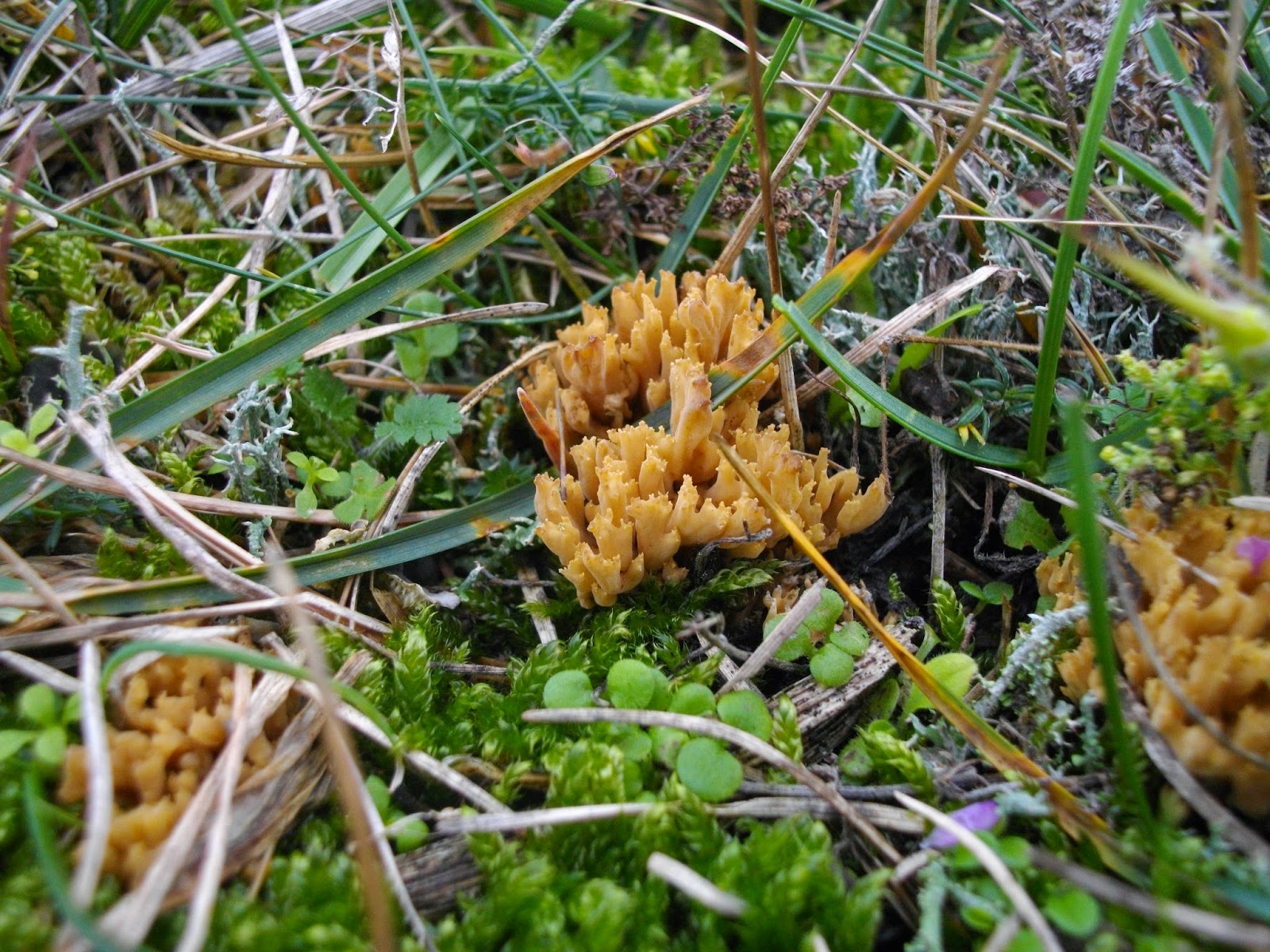
Now into the dunes, we were looking for Dune Stinkhorn (Phallus hadriani). A stick marked the spot, but where was the fungus? It was still there, but it had been completely dessicated ("well it is a cold day" was muttered!) We carried on, seeing many more Dune Waxcaps and then another couple of sand specialists, Dune Cavalier (Melanoleuca cinerifolia) and Dune Brittlestem (Psathyrella ammophila) before heading back to the pines. Here we met Karla, who had just photographed a coral fungus. She offered to show us, and we went and had a look. It was small and beige, beneath the pines and the tips discoloured a blue/green, which I believe makes it Ramaria abietina. Nearby we also saw a few Sessile Earthstars and some Liver Milkcaps (Lactarius hepaticus), the milk of which discoloured bright yellow on white tissue.


After a quick bite to eat we went out into the west dunes, walking past a clump of Inocybe sp. We soon located the other species I had particularly wanted to see, Sea Buckthorn Bracket (Phellinus hippophaeicola). Several other species were seen along the path, including a rather out-of-place Collared Earthstar, before I spotted another species of Coral sp. growing amongst the short-cut grass. There were no nearby trees, and this one had brown tips to the branches. A couple of Blackening Waxcaps that were completely black were nice to see, and we also saw a numerous yellowy 'toadstool' type growing in marshy grassland that we couldn't identify. The last fungus of the day was a new one for me - Field Bird's Nest (Cyathus olla) - previously I had only seen Common Bird's Nest.


Many thanks to Rob, Andy, Adrian and Karla for the time, company and local knowledge, which contributed to an excellent days mycology.