The Whitlingham Bird Report for 2025 is now available to download from the Bird Reports page or from here

Showing posts with label Titchwell. Show all posts

NORTH NORFOLK: Titchwell Semipalmated Sandpiper

21st July 2019

A family trip to Titchwell, my first visit of the year. The weather was nice, and as we walked down the main path I noticed a Bloody-nosed Beetle at the side. We soon saw the Dunlin flock, and after a scan through managed to locate the Semipalmated Sandpiper that had been found a few days before. This was my first new bird of the year (the result of now much birding in spring rather than having a large list it should be pointed out) and it was nice to share it with Cathy & Rose, who was lifted up to view through the telescope and then pointed out at the distant flock to show where she had been looking. A Curlew Sandpiper and Spotted Redshank were also present on the freshmarsh, and we got good views of a Spoonbill that flew overhead. I'd noticed a few clegs landing on us as we stood around, and not wanting her to get bitten we moved on, noting a few more invertebrates as we headed back.


NORTH NORFOLK: Snowy owl and strandline creatures

10th March 2018

Those readers with Twitter accounts will have probably been unable to escape the knowledge that a Snowy Owl arrived in Norfolk last week on the coat-tails of the beast from the east. The initial sighting near King's Lynn was greeted with scepticism as it was reported in the evening rather than at the time, but confirmation arrived on Thursday when birders showed a photo of the owl taken at Heacham beach to staff at Titchwell.

On to Friday afternoon and the Snowy Owl was found on Scolt Head Island, thankfully visible from Burnham Deepdale so most birders weren't tempted to attempt to wade or swim across to the island. I was busy on Friday, but knowing how much I'd like to see it, Cathy agreed that I could go and have a look on Saturday afternoon.

By Saturday the Snowy Owl had relocated to Thornham Point, giving a choice of viewing between Thornham Harbour and walking along the beach from Titchwell. I chose the latter, but only after finding that several of the minor roads north from Docking were still blocked by snow (this being several days after the EDP had carried a story saying that the last snow-blocked road in Norfolk had been cleared). Fortunately I managed to find a space in the very full Titchwell car park, and set off along the west bank path.

On my way down towards the beach I met Dave White, who provided mixed news. The Snowy Owl was still present but distant, and he estimated it was a 20 minute walk along the beach. It was quite close to the shoreline, so if the tide got any higher it might fly off. With this in mind I power-walked down to the beach and westwards for what seemed like an age, before finding the crowd of birders watching the owl. It was absolutely worth it, the Snowy Owl sat looking around and engaged in a couple of short flights up onto a post and back down again. Even at range it was a characterful and enchanting beastie.


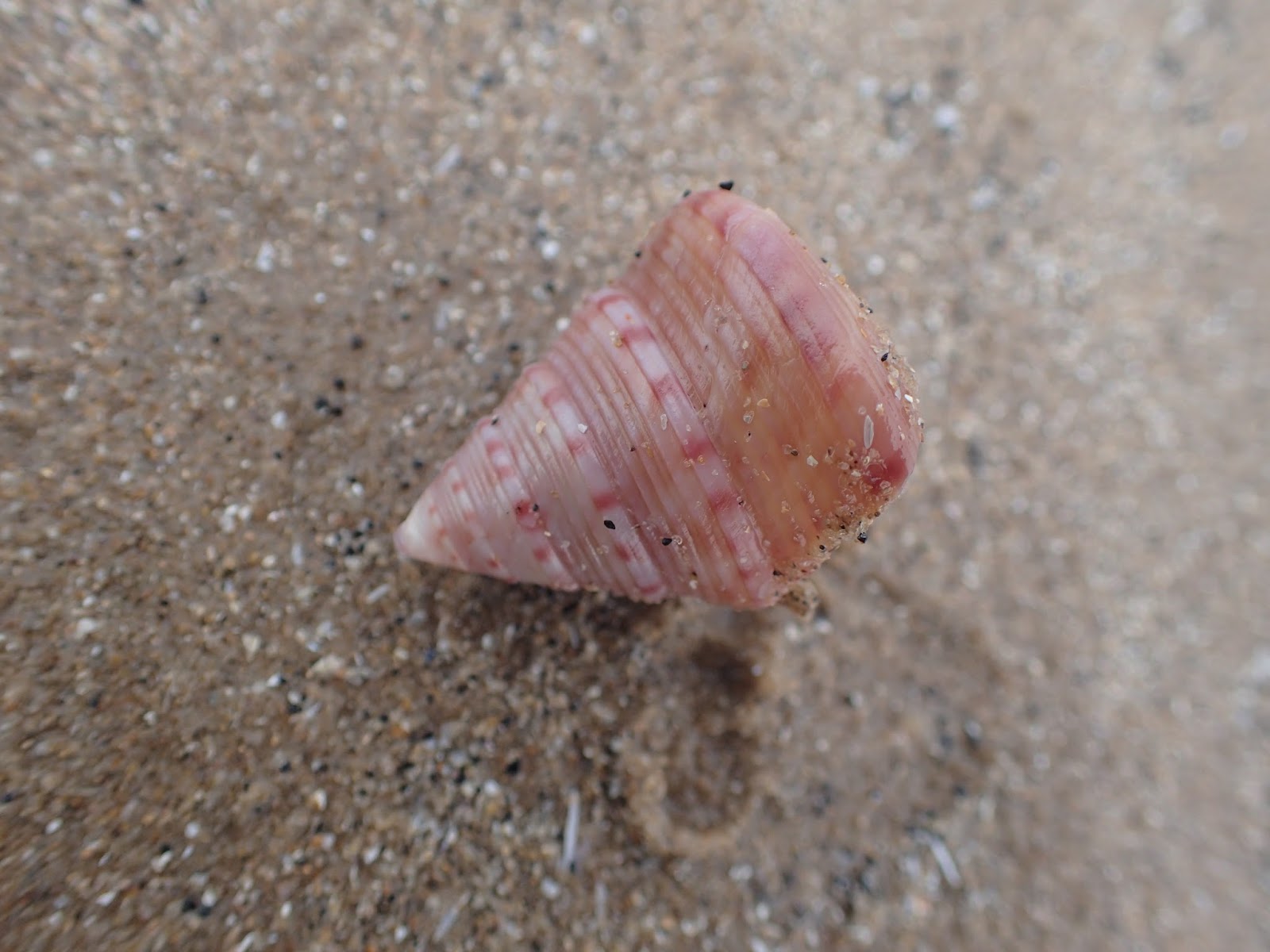
There had been quite a bit reported offshore, but wanting to get back to wife and daughter I contented myself by walking back along the strandline and photographing the various shells to identify later. There were quite a lot of Common Sunstars amongst a few Starfish, several Green Sea Urchins and large numbers of crab remains. There were clearly several species, but most of the soft tissue had been eaten, presumably by gulls. I did notice several orange ones that looked the wrong shape for Edible crabs - spider crabs maybe? If you recognise it then please leave a comment or send me an email. Shells included whelks, oysters, razors, tellins, periwinkles Painted Top Shells and some sort of slipper limpet.

 Crab sp.


 Slipper Limpet
 Common Sunstar
 Painted Top Shell
 Green Sea Urchin
 Sea Potato


On the way back I noticed a Smooth Newt walking across the path. It was in danger of getting squashed, so I scooped it up and moved it to the edge of the path. A group were watching the regular Woodcock near the car park, and somebody kindly showed me it in their telescope as picking it up from scratch usually takes a while ("you see that twig, well another twig comes off at an angle..."). Thanks to the RSPB, whose infrastructure seemed to be holding firm despite the huge visitor numbers, and to the majority of birders that didn't try to get too close and flush the bird. Today (11th March) it is currently at Snettisham RSPB reserve if you want to see it.


WEST NORFOLK: Wensum valley & TItchwell

13th February 2018

Adam & I decided to do a leisurely bit of birding along the Wensum valley and north-west of the county. Our first port of call was Sparham Pools, and here it became apparent that the previous night had been colder than we thought, with the edges of the lake still frozen. Walking along the perimeter we saw a large flock of Fieldfares in an adjacent field, and I heard my first drumming Great-spotted Woodpecker of the year. There was no sign of any Goosanders, a few Shoveler being the most interesting birds on the lake. Something brown moving across the ice caught our eye, but it turned out to be a bunch of leaves being blown steadily across the ice!

Our next stop was at Guist, where a few Greylags and Egyptian Geese were in the fields near the river. We stopped again near Choseley, where the fields were full of Brown Hares and Lapwing, which was good to see.

Arriving at Titchwell before lunchtime we walked along the path from the car park and stopped to look at some fungi, including Alder Goblet (Ciboria caucus) and Scarlet Elf Cup (Sarcoscypha austriaca). A large flock of mostly Chaffinches also included at least two Bramblings and some Greenfinches. They were coming to the feeders then flying down to the ditches to drink.


The water level was high on the freshmarsh, but there was a group of Avocets in addition to the ducks and Brent Geese. On the todal section there were lots of Redshanks, but when we returned they had been joined by a large flock of Knot plus some Dunlin and a Ringed Plover. On the beach we saw Bar-tailed Godwit, Grey Plover and Sanderlings, with Goldeneye, Common Scoter and Red-breasted Mergansers offshore. Red-crested Pochards and more Brambling were on the Meadow Trail.

After lunch at the cafe we drove along some of the back roads near Ringstead looking for Pink-footed Geese. We found a flock, but there were no interloping other species or neck-collared birds. Our final stop of the day was at Flitcham. For once the Little Owl was showing well from the bird hide, and another birder pointed out two Egyptian Goose goslings amongst the vegetation. We couldn't pick out any Tree Sparrows amongst a finch flock, but it was starting to rain so it seemed a good point to return home.


TARGET SPECIES: Dune Tiger Beetle

10th August 2017

When deciding where to go for our wedding anniversary this year, Cathy very kindly said that we should go somewhere to see one of my target species, so we went to Titchwell to look for Dune Tiger Beetles. In something of a change the weather was actually quite pleasant, so we were abe to have a nice walk in the sunshine.

Heading along the main path we stopped briefly to look at the Spoonbills and scan the nearest islands, but then kept on towards the beach. Just before we reached the dunes I noticed some small Colletes bees (probably C. fodiens) on some Ragwort, but then noticed several Epeolus bees, interesting looking parasitic bees associated with Colletes. I managed to get quite a few photos of them, but all but one of the pictures were of males, and with this species pair it is only the females that are field-identifiable. I think my photo is enough to show that it is a Black-thighed Epeolus, but I have sent the photos to a bee expert for checking. I also noticed another small bee with greenish eyes, that might be Osmia spinicornis. If I sound tentative with these IDs it is because I am - this year I have paid much more attention to solitary bees and I'm learning quickly, but still lack the experience to know if I'm right or not!

 Colletes sp
 Epeolus sp (female)
 Epeolus sp (male)
Osmia spinicornis (probably)

Once on the beach we walked west along the line where the dunes meet the beach, scanning the ground for beetles. For much of the way along we were constantly distracted by Dune Robberflies, but eventually I spotted my target, Dune Tiger Beetle. It ran off, but with a bit of fieldcraft I managed to get excellent views.


Once we had both seen the beetle we walked over to some exposed pools. On the way Cathy showed me how to tell the sex of a crab using the triangle on the underside of the carapace, something that I had been unaware of. As well as a number of small crabs, shrimps and Gobies we saw several good-sized Starfish and several jellyfish, at least one of which was a Blue Jellyfish.


On the way back I saw a new rhopalid bug, Stictopleurus punctatonervosus, on a Ragwort plant by the pathside.


EAST ANGLIA: Virtual Bird Race

13th May 2017

As mentioned in a previous post, this year there was a twist to our annual May bird race, namely that we would be competing against other teams, so it was actually a race. As the teams were not limited to staying in Norfolk (indeed there was a finishline at Halesworth in Suffolk), we decided to shed our self-imposed staying in Norfolk rule. Some other teams had spent the past week carrying out recces to possible locations and organising 'spotters', but our work commitments restricted us to a couple of messages about the route we would take on Facebook. What follows is a description of the highs and lows of our day - it's going to be a long post so perhaps make yourself a drink.

We started off at 1am, much earlier than normal. The reason for this was that we had decided to head to the Nene Washes in Cambridgeshire, aiming to hear Corncrake. This is a species that I'd not seen or heard in the wild before, and as the birds here are descendents from a relatively recent reintroduction scheme, there is a reasonable arguement for saying I still haven't. As it is I like to see a bird before adding it to my life list, so these hae gone onto an appendix, rendering the arguement null and void, however importantly Ian Dearing (one of the organisers of Bird Race Challenge) had confirmed prior to the event that for bird race purposes they were countable.

There was little to see on the journey across Norfolk, a Fox near King's Lynn being the only sighting of note. That all changed as we approached the Nene Washes, when we spotted a Badger at the side of a minor road. Further along we saw two more, including one that trotted sheep-like along the road in front of the car before darting off into the hedge. This was only my third sighting of live Badgers, so was particularly pleasing. Another Fox was also seen nearby. Gary and Alysia in the front of the car saw a Tawny Owl fly up into a tree, but Adam and I in the back missed it. Bird race rules state that all members of a team must see a species for it to count, so it stayed off for now.

Our Tawny Owl stop did result in the first two birds of the day being added to our list. Some Woodpigeons noisily left a tree, and a Little Grebe called from nearby. Carrying on down the road we parked up and set off along a footpath that runs along a large expanse of washland. A Bittern boomed loudly, which is always a pleasing sound - we heard or saw at least four birds during the day. The wetland warblers were in good song, Cetti's and Reed were numerous, whilst Sedge and Grasshopper were also heard. Various other common species called, but finally we heard the 'crex crex' call of Crex crex - the Corncrake. Our main target heard, and a new experience for Alysia and I.

Corncrake was our 17th bird of the day, the 18th was a Barn Owl, and we were endebted to Gary for noticing our 19th bird, the 'whip whip' song of a Spotted Crake! We had two excellent birds on the list, plus things like Bittern and Grasshopper Warbler that can be tricky, but the time it would tkae to get to our first Breckland stop was a slight concern, and as a result we decided against a planned search for calling Long-eared Owls and headed straight for Santon Downham. As we passed Crimplesham I remarked it would be nice to have a bird on the list from here, perhaps a Robin or Blackbird would be singing? We slowed down, a Blackbird was singing from a telegraph pole. Predictive birding wins again. A Rook at Wereham took us to 21.

It was already light when we arrived at Santon, but then we were a fortnight later than our usual visits. Common woodland birds were added at a constant rate, Treecreeper and Cuckoo the best of the birds heard from the roadside. At the bridge Adam pointed out a Kingfisher, another decent bird to see early on. This is now a reliable sight for Mandarin, but there was a bonus in the form of a female with three ducklings. Garden Warbler and Lesser Redpoll were added to the list, but only Gary saw a Water Rail skulking in a dyke, so it joined Tawny Owl on the nearly list.

To dark and fast to get them in focus!

Last year we got great views of Lesser Spotted Woodpecker, but this year we were out of luck, despite spreading out along the path to focus on a section of woodland each. By this point we had seen most of the other likely woodland species (Nuthatch, Great-spotted Woodpecker, Marsh Tit), so eventually we gave up and headed back along the path, seeing Grey Wagtail on the way. Back at the bridge we met Chris, who pointed out two Otters in the river and told us about his sightings nearby. At this point we also bumped into the main Bird Race Challenge team, who seemed very cheery for that early in the morning! After brief introductions we each headed in opposite directions.


Next up we checked a couple of nearby clearings, seeing Woodlark and Tree Pipit, the latter saving us a trip to our usual site for them. It was then on to Lynford, where we first checked out Lynford Water, before heading into the arboretum. One of the first birds we saw was a Spotted Flycatcher, which then perched up with a second bird. We were pleased to see these declining birds, although as it turned out there were several around the county during the day. Some Crossbills and a singing Firecrest meant we reached 71 species by 08:00.

We added a few more birds on some nearby farmland, and also watched four Brown Hares chasing each other around, before heading for a quick look for Golden Pheasants. It was always going to be a long shot and so it proved, although I did get a chance for a quick look for insects, finding a Hornet.


After a short debate, we decided to go to Great Livermere to look for a Black-necked Grebe seen there recently. Unfortunately none of us had been before so we weren't quite sure where to view from. We did pick up Tree Sparrow and Grey Partridge nearby, and a white Peahen that we hoped would be added in the event of a tiebreak. We stopped at Great Livermere church, where thanks mainly down to luck we found a path down to the lake.  We added some gulls amongst other things, but no sign of the grebe. On the way back I remarked that the scrub looked good for Lesser Whitethroat, and before we exited the field Gary found one.


From here we headed to a bridge over the A11 where a White Stork was present in a nearby field. At least that was what we had been told, but we couldn't see it, and took to staring at a white and black thing (probably some rubbish), until another birder showed us a photo he had just taken of the Stork. It turns out it was visible, but only from a short stretch of path just at the edge of the bridge. We noticed a road close behind the Stork, but upon investigation it appeared to be a private Elvedon Estate track so we didn't get any closer views.


Next stop was Lakenheath Fen, where after availing ourselves of the facilities we went up to the washland viewpoint. A Glossy Ibis stood in the middle of the pool, Common Terns flew past and two Black-winged Stilts wandered about to our right. A Barn Owl flew past (we had heard one previously but nice to see nonetheless) and two Hobbies were visible in the distance.


By now we were a bit behind time, so headed off to Welney. Yellow Wagtail and Kestrel were seen on route (near Shippea Hill), the latter bringing up our 100 species at 11:35. In past years we have racked up a good number of additions at Welney, but this year we didn't. There was no sign of any Little Ringed Plover, Common Sandpiper or Garganey from the main hide, and we didn't have time to check out the others. Summering Whooper and Bewick's Swans were seen, along with Avocet and a surprise Red-crested Pochard, but moral had dropped a bit as we left.

We headed up to the North Norfolk coast, calling in at Flitcham hoping for Little Owl and Yellow-legged Gull. Both had been seen earlier in the day, and both were missing. Med Gull and Red Kite were some consolation, as we headed to Hunstanton to look for Fulmars. The tide was out, enabling us to add five wader species as well as Fulmar, before carrying on to Holme to look for a Pied Flycatcher reported from the car park. The gate attendant didn't know anything about it, and as we arrived Bob Cobbold told us the only bird currently in the car park trees was a Spotted Flycatcher. He actually used slightly fruitier language than that, but the meaning was the same.

As in the past few years there were Dotterel at Choseley, so we called in, saw them and left, to the slight bemusement of the other birders present. We arrived at Titchwell about 16:00, and knew we needed to add a lot of birds here to post a competitive total. It started well with a singing Wood Warbler in the car park, only my second Norfolk record of this species. We couldn't see or hear the reported Yellow-browed Warbler on the meadow trail, and nobody we spoke to had seen it, so we carried on down to the freshmarsh where Brent Goose became our 120th bird at 16:20. We couldn't find the reported Ruff or Little Stint, so headed down to the beach, where Little Tern, Sandwich Tern and Velvet Scoter were all decent additions.

After leaving Titchwell we headed further along the coast to Holkham, hoping for lingering Pink-footed Geese. We didn't see any, although a flypast Bittern was well worth seeing. Great White Egret was the only addition here, taking us to 129. We were in danger of not reaching last year's total of 140 despite the extra effort, so we had an important decision to make - did we stay in North Norfolk, go to Potter Heigham or keep to our original plan to head to Minsmere. In the end we opted for the latter, which did mean that no new birds were added until we reached Dunwich at 19:20.

From Dunwich Cliffs we saw our 130th bird, long overdue Sand Martins. Dartford Warbler and Stonechat were added on the heath nearby, and Kittiwakes flew offshore towards their nests on a platform near Sizewell. We 'scoped Barnacle Goose over at Minsmere, and a Water Rail called, taking us to 135 and renewing hope of a competitive total.

Back in the car we headed round to Minsmere and scanned for Stone Curlew from the watchpoint. We couldn't find any, but a Short-eared Owl was a bonus. Bearded Tits pinged nearby, and Whimbrel, Common Gull and Caspian Gull from East Hide ensured at least a personal best-equalling tally of 140 at 20:35. Back at the watchpoint and my 'scope was out of action as the quick release plate screw had broken off. Adam was scanning and called a Stone Curlew. We asked if it was one with long ears that hopped about, but a quick look down the 'scope showed he had indeed found one, so we apologised and headed off.


It had just gone dusk, so before leaving Minsmere we went down to Island Mere hide, hoping to hear the Savi's Warbler that had been present for a while there. We didn't, frustratingly, but calling Little Owl and Tawny Owl (it could have been bird #1, it ended up being #143) meant it wasn't a wasted spell. It was now dark, but we still had a few targets, including Nightingale, heard at Westleton Heath. Moving on to Dunwich we heard a distant Nightjar, but concerned that we might be deluding ourselves with the background noise we went back to Westleton where an unequivicol one was churring. A Nightingale sung loudly from beside the car.

It had just gone 22:00 and we had reached a new personal record of 145 species. We had one last bird to try for, Quail, in the fields around Westleton. We stopped and listened to no avail, so headed off to the finish line at the World Land Trust headquarters in Halesworth. When we arrived there was nobody there, so we didn't really know what to do. Just as we were pulling out the World Land Trust team arrived, so we followed them into the car park and asked if we could park there. "We're the Norfolk Loons" I announced, aware that Suffolk birders probably hear this whenever interloping Norfolk birders talk to them. Fortunately Dan was aware of our team name, and invited us in for a welcome hot drink.

The Bird Race Challenge team arrived as we were going in, and we all had a debrief chat with the other team members. John Burton then turned up, ostensibly to present the Bird Race trophy (the Nene egg signed by Peter Scott used as trophy in the original Country Life vs ffPS bird races), but also to give out champagne and tut at the birds we'd missed out on! We were all rather tired by this point, so I suggested we make a move and head back to Norwich. The results of the Virtual Bird Race were announced on Monday evening, and we had been soundly beaten by Jake and Drew, who managed an astonishing 158 species, so well done to them.

Thanks of course to my fellow team members, particularly Gary who did all of the driving, and to the World Land Trust for their hospitality.

Norfolk Loons 2017 - left to right: James Emerson, Gary White, Alysia Schuetzle and Adam Pointer. Photo taken by Andrew Whitelee.

The Virtual Bird Race and Bird Race Challenge aimed to raise money and awareness for a World Land Trust project to save the endangered Blue-throated Macaw, and the fundraising page is still open should anyone who hasn't donated wish to do so: https://www.justgiving.com/fundraising/NorfolkLoons

More sedate, non-sponsored activity will resume shortly.

NORTH NORFOLK: A January bird race

7th January 2017 

On Saturday Cathy & I joined Gary and Alysia for an early-January bird race day. We departed from Norwich at about 05:50, and arrived at Titchwell at 07:00, still in darkness. As we walked carefully down the main path we saw our first birds of the year, Woodpigeons roosting near the café. A Robin ran along the path and was confirmed after some squinting through binoculars. 

We made our way to the Parrinder Hide and settled in to wait for the light to improve. The most obvious birds were those that were large, close, noisy or pale-coloured, which accounted for things like Greylag, Teal and Shelduck. We were surprised by the large numbers of Goldeneye, and also saw a few Pintail further back. In terms of waders there was a Knot, some Ruff, Dunlin and Black-tailed Godwit, whilst some Curlew flew over. Starlings began to leave their roost amongst the reeds, and a Marsh Harrier flew into view. 

Once the light was good enough to confirm that we had seen as much as possible we checked the mud on the other side, adding Grey Plover and Redshank. Walking down the path to the tidal area of marsh we got close views of some Little Grebes, plus a Spotted Redshank and Bar-tailed Godwit. Cathy pointed out a Water Rail, which worked its way aloing the edge of a muddy island before swimming to the near bank. 

The tide was out, so we walked towards the shoreline, stopping to watch a Glaucous Gull flying west towards Thornham. A moribund Pink-footed Goose was a sad sight, but enabled us to get a close up view of the serated mandibles – not far off those toothed birds that used to be on Rhubard & Custard. There were lots of Oystercatchers and Brent Geese about, with Sanderlings, Turnstones and Ringed Plovers thrown in. The seaduck numbers off Titchwell have been impressive this winter, and we were not disappointed here. Several flocks of Long-tailed Ducks were present, including one close flock, plus lots of Common Scoters, a scattering of Velvet Scoter, an Eider and a few Red-breasted Mergansers. It was too foggy to see to the horizon, but we did manage to see a Red-throated Diver going eastwards. 


Heading back towards the meadow trail Alysia noticed a Stonechat on some fenceposts and Cathy found a Cetti’s Warbler working its way along the base of some reeds. After hearing them earlier we saw Reed Buntings and Snipe, and Gary picked out a Water Pipit on the drained pool to the west of the path. Patsys Pool held Gadwall, Tufted Duck and Coot, and a female Bullfinch showed nearby. We stopped at the feeders to look for some passerines, the highlights of which were Brambling, Greenfinch and Lesser Redpoll, Gary hearing the latter fly into the tops of the trees, where they showed briefly before flying across towards the car park. A Feral Pigeon was the last bird before we left, having seen a respectable 70 species. 

Next up was a trip to Thornham harbour, where a group of birders were watching the Twite flock. About 25 birds were present and showing quite close, before flying up to the coal barn. We also saw a Rock Pipit before heading off to have a look around the Choseley area. There wasn’t much around the barns except Red-legged Partridges, but we did see a Yellowhammer and Stock Dove at a farm nearby. Further along the coast we stopped for another scan, and I spotted my highlight of the day, a hunting Short-eared Owl. It worked its way back and forth over some rough grass, before dropping down on some prey. It immediately lowered its wings over it in a threat posture, which seemed an over-reaction up until the point a Kestrel flew in and stole the prey. 


Next up were two stops to look over the coastal strip between Gun Hill and Holkham. Egyptian Geese and Grey Partridges were close by, whilst four Lapland Buntings flew over heading towards the dunes. A Fieldfare and a Mistle Thrush called from hedgerows, and a flock of Golden Plover flew up. Closer to Holkham a Great White Egret showed from the neck up, whilst White-fronted Goose and Grey Heron were also added. We were short of woodland birds, so a walk in Holkham Park was in order, and Great-spotted Woodpecker, Nuthatch and Treecreeper were duly noted. By now Cathy wasn’t feeling well, and it was already apparent that we would struggle to fulfill our intended route.

Next up was Salthouse, and after a walk out to Gramborough Hill we saw a flock of around 30 Snow Buntings, along with several Guillemots offshore. We had just arrived back at the car when the Wigeon near the roadside flew up. Gary said “Peregrine”, but for some reason we all ignored him, thinking it was just a sort of “a Peregrine might have put those up” sort of comment. A moment later he asked why none of us were watching the Peregrine that was powering through the flock, and luckily there was enough time for us to get on it before it flew west towards Cley. 

Along the coast we arrived at Sheringham, and set off to look for Purple Sandpipers. Unfortunately it was high tide and they were out of sight. We enjoyed watching the Turnstones, and added Pied Wagtail and House Sparrow, but by now there wasn’t much time or light left. On the way back we saw Red Kite, my 107th and final bird of the day.

NORTH NORFOLK: Holme & Titchwell fungi

28th December 2016 

After my successful pre-Christmas jaunt to see Poronia punctata at Holt, I hoped to see the related species Poronia erici at Holme before going back to work after the Christmas break. Poronia erici is a rare, tiny species that grows on rabbit dung, making it particularly hard to find, even where it does occur. I had heard that it had been seen this winter, so thought it worth a go. 

We woke to a hard frost, given the estate a rather belatedly Christmassy feel, but by the time we came to leave the ice had melted and been replaced by a dense fog. At the back of my mind was the risk that the hunt for rabbit pellets could descend into a foggy farce, but confident that it would be clearer at the coast we carried on. By the time we reached Brancaster there was no trace of the fog. At Holme we drove carefully down the bumpy track (we later saw Rob attending to the thankless task of patching up some of the potholes) and parked up at the end. The hut, visitors centre and café were all shut, although there were few cars so they weren’t missing out. In contrast the coast footpath was busy, albeit with some rather well-dressed walkers. 

We walked along the edge of the pines, stopping briefly to look at some Collared Earthstars. Reaching the area where the Poronia had been seen a few years ago we set about checking the rabbit pellets, and immediately found a problem. The grassy areas were still frosted over, creating a threefold problem – many of the pellets were frozen to the ground, some were covered in ice and the white ice grains meant much more checking than in normal conditions. Cathy found an interesting small brown circle that could have been an old fruiting body, but having never seen pictures of anything other than pristine ones I couldn’t be sure. I’ve got used to getting funny looks from passers-by over the years, but Cathy was drawing funny looks as she turned rabbit droppings over with a stick, so after having a look at some Scaly Stalkballs we took that as a sign to cut our losses and head for Titchwell and a warm drink. 

 Collared Earthstar
 Bit of different-coloured vegetation or possibly old Poronia fruiting body
 Ear Pick fungus
 Scaly Stalkball

We didn’t spend long at Titchwell, but there was quite a bit of fungi on the path between the car park and the café, in particular a sizeable clump of Candlesnuff Fungus, a newly emerging Common Inkcap and some very early Scarlet Elf Cups. We then drove home through some of the worst fog I've had to drive through, which wasn't very pleasant.


NORTH NORFOLK: Great Knot

2nd July 2016

On Saturday afternoon I headed back to Titchwell, hoping to catch up with the Great Knot that has been accompanying the Knot flock for the past few weeks. As I drove between Docking and Brancaster the scene in front of me seemed the very definition of atmospheric. The water on the road was evaporating in the strong sunlight, and as I crossed the brow of the hill a Red Kite drifted over the road. Either side fluffy cumulous clouds hung in the sky, but ahead lines came down from menacing grey clouds, showing that it was raining hard offshore. A flash of lightning lit up the sky, reminding me uneasily that early in its stay the Great Knot had been spooked by a big storm.

It was about 16:30 when I reached Titchwell, and I was surprised to see how few people were around the car park and visitors centre. There were a few people standing on the main path scanning towards the Knot flock, so I set up my telescope and looked out. There were two tightly packed groups, so in the end I conceded and asked if the Great Knot was amongst them. It was, but right at the back and only the head and a bit of the back was visible. Relocating to the Parrinder Hide the Great Knot was more visible, albeit not more active. After a while (and one of those crunchy nature valley bars) I headed back to the main path, seeing a Spotted Redshank and a leg-ringed Avocet before heading home.


NORTH NORFOLK: Titchwell & Thornham

24th January 2015

This weekend was my birthday weekend, and as I hadn't been to the North Norfolk coast yet this year I went to Titchwell with Cathy & Margaret. We saw some Pintail and a nice range of waders, many of which showed close to the main path. One of the Avocets had a red and blue ring on one of the legs, but unfortunately the other leg wasn't visible so I couldn't find which scheme the bird was from. On our way back to the car a small group of birders was watching a Woodcock near the path, but it was only fleetingly visible so we eventually gave up trying to see it and carried on.


Before heading home we went further along the coast road to Thornham harbour. A flock of small birds were flying around, and we tracked them down nearby, confirming that they were Twite. They perched up in the Sueada, so no chance of checking them for rings. On our way back to Norwich we saw ten Grey Partridges and two Brown Hares.


Back in Norwich I saw a Peregrine fly over towards the Roman Catholic cathedral and we were just in time to drive underneath the Starling murmuration at the St Stephens roundabout.

NORTH NORFOLK: Moths & Butterflies

30th July 2014

Cathy, Margaret & I began the day at Titchwell to see the opening of the moth traps. Just over 30 species had been caught, most of them fairly common stuff, but there was a new moth for me in the form of Sharp-angled Peacock, along with my second Chinese Character.

After the moth trapping we walked down to Island Hide to look for the Spotted Crake. On the way Cathy noticed the constant buzzing sound of a Roesel's Bush Cricket, which we found at the edge of the path. We waited a little while for the Crake without success, and on our way back we saw two Wall butterflies. My infrequent coastal visits mean that I don't often see Walls anymore (when I was growing up we used to get them in the garden in North Walsham!) so it was a nice butterfly to see.

Blue-tailed Damselfly at Titchwell

After Titchwell we headed along to Cley visitors centre for lunch, noting the flock of Spoonbills on North Scrape. We then carried on to Holt Country Park, where I was hoping to photograph White Admirals and Silver Washed Fritillaries. When I had last came looking for the Fritillaries they had only just begun to establish themselves here and I got a couple of very brief views, so I was delighted to see that around 10 were on Buddleia in the car park. Photographing them proved a bit harder, as they seemed to prefer the higher buddleia flowers and some of them were rather tatty. We watched as one Silver-washed Fritillary flew across the car park being constantly orbited by another (presumably a male around a female?) - very interesting behaviour to watch. I didn't see the brassy variation valezina, although one of the females showed a decent green tinge.

Male Silver-washed Fritillary (deep orange colour)

Whilst watching the Fritillaries a White Admiral flew in. Probably my favourite butterfly, partly because of how exotic it looks despite the monochrome, but also for the stately manner that it flies, gliding sedately over the flapping masses of other butterflies. We saw three in the end, and I did get my photos. Cathy had brought a backpack with butterflies on it, which attracted a Comma in for close views. Walking over to the visitors centre I finally got a good Silver-washed Fritillary picture as one landed in front of me. We also saw some other interesting insects, including a male Wood Horntail. Just before leaving I noticed a Grayling in the car park, the first non-coastal one I've seen in Norfolk for a while.

Spot the real one...
Female Silver-washed Fritillary
Male Wood Horntail (the female is the more familiar yellow-and-black)
White Admiral