The Whitlingham Bird Report for 2025 is now available to download from the Bird Reports page or from here

Showing posts with label Mousehold Heath. Show all posts

NORWICH: Mousehold heath - a June invertebrate selection

There is a rare case-bearing moth, Coleophora saturatella, that feeds on Broom, so now and again I like to check the plants at Mousehold in the hope of finding it there. As expected by now I didn't find it, but there were plenty of other interesting things, some associated with Broom, but others more generalist.

Andrion regensteinense
Ditropis pteridis
Green Tiger Beetle
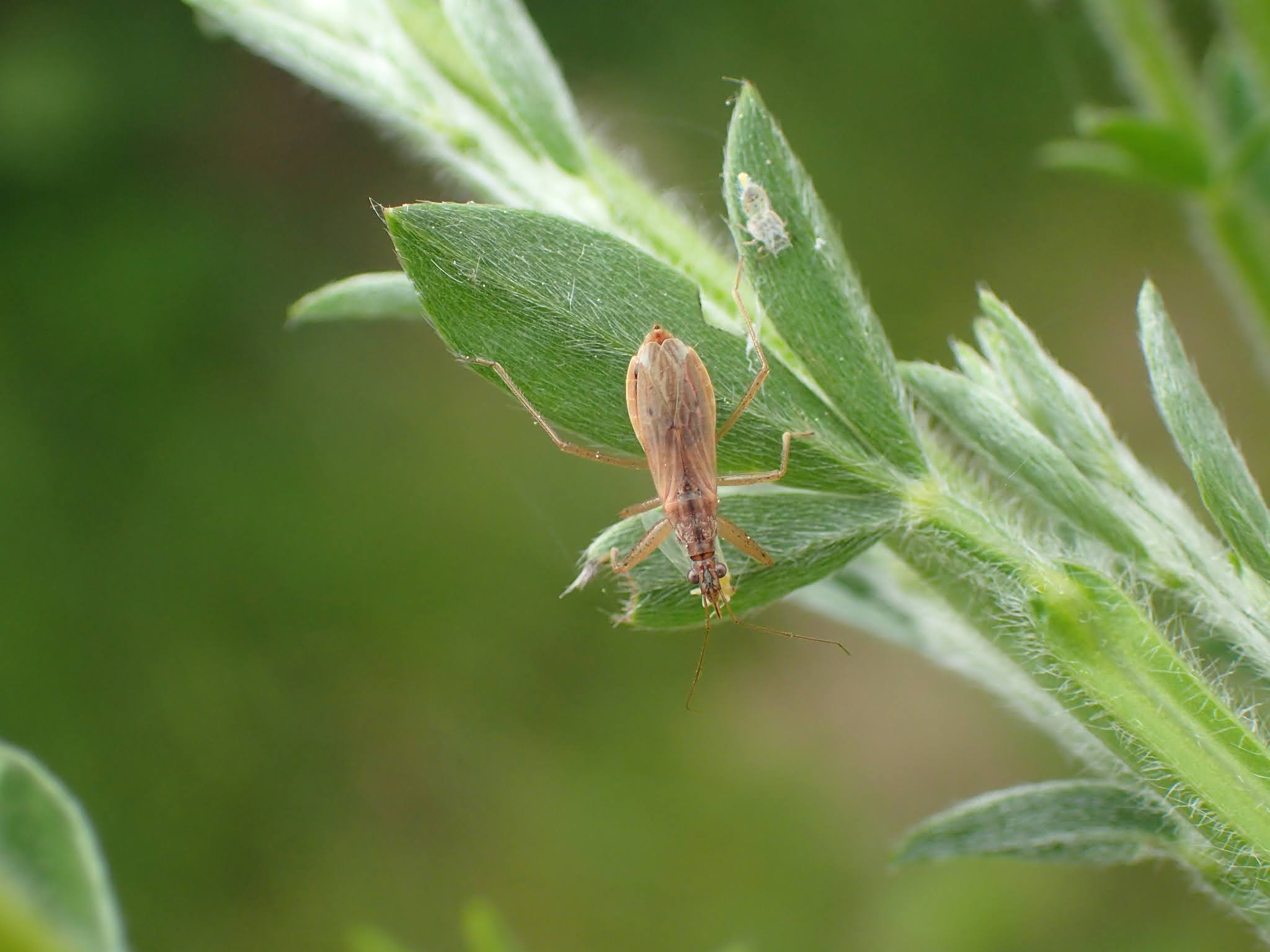
Common Damselbug (Nabis rugosus)
Norfolk Hawker - a common species in the broads but it seemed strange seeing one up on the heath
Prosternon tesselatum, a species of click beetle.

NORWICH: Early April at Mousehold Heath

Early April 2021

A family walk at Mousehold Heath was notable for the large number of Green Tiger Beetles seen - at least 20, probably quite a few more than that. They were very active, often first seen flying past and landing on a sandy bank. I kept an eye out for bees in the hope of finding my first Ashy Mining Bee, but only found a handful of species, including Orange-tailed Mining Bee. We also saw a couple of False Puffballs (Entiridium lycoperdon), slime moulds that form whitish half-spheres on tree trunks. Judging from social media it is having a good year. On our way back Cathy noticed a Treecreeper on a tree trunk close to the path, which showed very well.


NORWICH: Mousehold Heath Benzoin bracket and other fungi

Late October 2019

Every year there is a fungus foray at Mousehold, but it is midweek so I can't attend. After this years one I was browsing some photos from it when I noticed Benzoin Bracket (Ischnoderma benzoinum). Neil Mahler confirmed that this species had been seen on the forays since 2014(!) and was still present, growing on a stump near the Zaks car park. I decided that when I next had a bit of time free I'd stop by and have a look.


Arriving at the Zaks car park I immediately saw a huge swathe of Honey Fungus around a stump and the surrounding grassland. Checking a log nearby I noticed Redlead Roundhead and Stump Puffballs. There weren't many stumps in the area, so I found the Benzoin Bracket without too much trouble, although it was facing away from the grass so I had to check all the way round to find it.


I wanted to head on to Whitlingham, but spent another ten minutes in the woods near the car park and they were full of fungi. There was an area of Shaggy Parasols and Common Funnels, plus Mycena spp, Dead Man's Fingers and several other species. I looked at some old Bracken hoping to find Bracken Club fungus, and I thought I'd found some only for it to be a small white species growing on dead grass mixed in with the Bracken. Clouded Agaric was also seen, and interestingly a clump of Glistening Ink Caps showed the complete life stage from fresh to old to turned-to-ink. A very productive spell, and there would have been much more seen if I'd had time to go over more of the site.


NORWICH: Mousehold - mainly looking at birch

28th May 2018

After dropping Cathy & Rose off in the city I decided to spend an hour or so up at Mousehold Heath. Checking the birches I began to see Parent Bugs, so named because they stand and guard their eggs. At least 12 of them were found in a small area, undoubtedly a small proportion of the true number.


Whilst looking at the birches I started to find leaf mines, including some made by moths, sawflies and a weevil. Of these Eriocrania salopiella was new to both me and the 10km square, and Stigmella lapponica was also a good find. The sawfly mines were caused by Fenusa pumila, whilst a mine ending in a neat cut out circle was caused by Orchestes rusci. Pictured here in the same order -


I had hoped to see some bees that Jeremy & Vanna had seen around the pond, but there didn't seem to be much flying around, however I did find a Panzer's Nomad Bee, Nomada panzeri, which completed the set of three similar species for me. Another Alabonia geoffrella moth, Broom Beetle and Green Tiger Beetle completed an interesting trip to the heath.


NORWICH: Mousehold Wood Warbler

6th May 2018

Around Sunday lunchtime a Wood Warbler was found at Mousehold Heath. At one point this species actually bred at Mousehold (early 1990s?) along with things like Red-backed Shrike, but those days are long past and I'd only seen a couple in Norfolk. As I had other plans for the afternoon I initially agreed that I would go and look for it on bank holiday Monday, but after our evening meal Cathy suggested that as it was a nice evening I should go and have a look in case it wasn't there on the next day, which proved particularly wise as after an early morning sighting it then went missing.

I arrived at the Gurney Road car park to find a group of LARPers* or similar were about to begin a quest. I was about to head off north-west as per the bird news service directions when a local birder entered the car park and said that he had just been watching the Wood Warbler in trees south of the road. Several other birders, including Ricky, emerged from the woods and a small group of us headed across the clearing near the golf course. Unfortunately there was no sign of the Wood Warbler, those who had already got glimpses earlier in the day or were time-pressured left, leaving just Pete and I to search for it.

Having waited a bit longer near the trees where the Wood Warbler was last seen, we decided to cross back to the car park in case it had doubled back to its original location. As we started to take that path we met another birder returning, having spent an hour unsuccessfully looking for it, so instead we checked some mature trees along the edge of the woodland in case it had gone that way. There was no sign of it, although there was a nice display of Lycogala slime mould (L. terrestre or epidendrum).


We decided to have one last look south of the road, and headed back to the area where it was last seen. Whilst listening out I became aware of the many insects flying in the evening sunshine, including lots of Nomada bees, which seem to be having a good year (either that or I'm just more aware of them these days). Unfortunately they were very skittish, so I couldn't get close enough to identify them. I scanned a nearby Oak and noticed some lekking Green Longhorn moths (Adela reaumurella). This interesting behaviour usually takes place highup, as these were, and involves many moths circling around a stationary one. The hoverfly Epistrophe eligans and Birch Leaf Roller Weevil (Deporaus betulae) were also noted.


I was getting to the stage where I was going to have to give up and go home, when I heard a short burst of Wood Warbler song. Heading tentatively in the direction of the sound I heard a second burst, coming from a large Sycamore on the edge of the golf course. I looked around for Pete, who was further into the woods, and waved to attract his attention. Shortly after he reached me the Wood Warbler flew up into a large Oak and began to sing out in the open at the top. I tried to take a record shot, but in the end gave up and just enjoyed watching it. I texted out the location details in case anyone was still looking for it, by which time it had moved into a different Oak and stopped singing. A very enjoyable evening out and an excellent Norwich bird, so thanks to the finder.

Wood Warbler...honest


* LARP = Live Action Role Play. People dress up as fantasy characters and then act out a sort of game in real life. Of course it could have just been some very eccentric people.

NORWICH: Mousehold fungi and leaf mines

30th August 2017

Another brief local trip, this time to Mousehold Heath. It was raining so there were few insects about, so I focused my attention on fungi, leaf mines and galls. There was quite a bit of fungi about, but most of it was a small range of common species like Sulphur Tuft, Tawny Grisette, Ochre Brittlegill, Blusher and Common Earthball.

 Tawny Grisette
Ochre Brittlegills

Of the rest, a gall on Yew was new, as was an Agromyzid leaf mine in Silver Birch. I thought I'd found a new leaf-mine in Bracken, but it later turned out that there are two species that make near-identical mines so it remains an either/or. The highlight was a leaf beetle, Gonioctena olivacea, found on Broom.

 Taxomyia taxi
 Agromyza alnibetulae
 Leaf-mine in Bracken
Gonioctena olivacea

NORWICH: Mousehold solitary wasps

21st July 2016

As it was still hot after work on Thursday I headed up to Mousehold Heath to have a look for butterflies and anything else that might be of interest. Along one of the footpaths were a row of holes made by digger wasp spp. I watched them flying in and out, although they were tricky to observe, flying in close to their burrow and peering out before they emerged.


Before leaving I checked along one of the woodland edges where White Admirals have been reported before. I didn't see any, but did see a new hoverfly, Xylota sylvarum (although the angle makes it look a bit like X. xanthocnema here so I might get a second opinion). I also gathered a few leaf mines to try to key out.


NORWICH: Back to Mousehold Heath

31st December 2015

The last day of the year, and having dropped Cathy off in the city I carried on round and went to Mousehold Heath again. Having ascertained that I was in the wrong place when I looked before, I headed a bit further along the slope, searching birch trees as I went, and this time found the tree that had Plicatura crispa growing on (alongside Hairy Curtain Crust, Stereum hirsutum). The brackets were old, but still recognisable, including the gill-like folds underneath. Whilst looking at the fungi I could hear Goldcrests calling, and I picked out the sound of a Treecreeper moving through the trees with them. After checking a few birds I found the Treecreeper, and watching it spiralling up a nearby birch, which was a nice end to the years wildlife watching.


NORWICH: Mousehold Heath fungi & bugs

23rd December 2015

Whilst looking at some local wildlife blogs recently I noticed a post on Sean's blog (The Autistic Naturalist) that mentioned a bracket fungus potentially new to Norfolk that had been found at Mousehold Heath. The fungus in question was Plicatura crispa, a small fleshy bracket with folds underneath instead of gills or pores. Finding the one tree that it was going on was always going to be a bit tricky, but Sean kindly gave me directions to the right area, so when I had a bit of free time on Wednesday I headed up to the heath.

Arriving at Mousehold I headed past Zak's and into a small clearing, where I stopped to watch three Goldcrests flitting through the trees. I headed down a steep path until I had nearly reached the bottom of a valley in front of me. I knew that the Plicatura was growing on a tree trunk that also had a Stereum sp. on, and I found a likely looking tree with Stereum and some gone-over small brackets. I assumed this was the right place and that I was just a bit late, but having compared photos of this tree to the one on Sean's blog it seems likely that I was just in the wrong place.

Whilst I was there I had a look around the heath, seeing some common fungi. I then spotted some interesting small bracket-types growing on the end of a birch log. They were gilled underneath, with cross-veins between the gills, which is a fairly uncommon feature. I got it down to a couple of families, and a helpful person from the British Mycological Society identified it as Bitter Oysterling, Panellus stipticus. This species, which is more common on Oak, was new for me, although it has been found on Mousehold before, in 1980!


I did see another rather interesting thing whilst poking about. I struggle to identify Dryopteris ferns, and so when I saw a Male Fern sp. I took a closer look to see if it was Male Fern/Scaly Male Fern/Golden Scaly Male Fern. In doing so I turned over some fronds and found loads of bugs huddling together in groups. I was able to identify them as Birch Catkin Bugs. Rather odd to see them on ferns, but there were lots of Birch trees nearby, so presumably they are overwintering amongst the ferns.

You may need to click on the photo to see the bugs properly

NORWICH: Mousehold lichen

15th March 2013

Another walk across Mousehold and more excellent lichen. Sometimes known as 'Pixie cups', this is a Cladonia species (possibly Cladonia polydactyla).