The Whitlingham Bird Report for 2025 is now available to download from the Bird Reports page or from here

Showing posts with label Train Wood. Show all posts

NORWICH: Train Wood aphids

5th December 2021

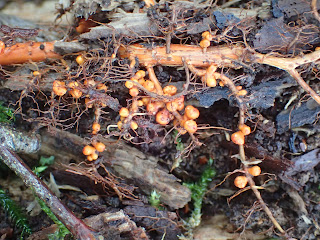
A damp walk along the river through Train Wood to Andersons Meadow and back. Level with Wensum Park four Little Grebes were on the river, with a low Buzzard flyover and a couple of Great Spotted Woodpeckers adding to the avian interest. There was a little bit of fungi about, but I mainly amused myself by turning over leaves, finding a couple of new aphid species in the form of Myzus varians on Clematis and Periphyllus testudinaceus on Norway Maple. I also saw some root nodules on Alder roots, which I think might class as a bacteria-induced gall but need to check that.


NORWICH: A selection of invertebrates (and a fungus) from Train Wood

Early July 2021

A very productive walk home via Train Wood led to sightings on an interesting chrysomelid beetle on St John's Wort and I finally managed to find a smut fungus that several other people had been noticing on False Oat Grass recently. A big group of Peacock caterpillars on nettles was nice to see too.

Dichrorampha petiverella
The leafhopper Eupteryx urticae and above it the psyllid Trioza urticae
Chrysolina hyperici
Ustilago avenae smut fungus
Peacock butterfly caterpillars

NORWICH: Train Wood and environs

2nd January 2020

Our Whitlingham trip on the first had come at a slight cost, with a nail in the tire. Unfortunately I didn't realise straight away and the tire was unrepairable, but fortunately when I did discover it I was at my in-laws nearby, as I didn't have a torch with me so changing it would have been tricky. Anyway, that meant that the next day was spent taking the car in to have a new tire fitted. Whilst I waited I went for a walk in Train Wood, adding a handful of extra birds to the previous day's total. A Coal Tit called from a conifer near the entrance, whilst a Long-tailed Tit flock roamed the wood. Having not seen Egyptian Geese at Whitlingham I noted a pair across the river at Wensum Park. I made a note of some plants in flower and some fungi, including a couple of small Scarlet Elf Cups.


Next along the path was Anderson's Meadow, and whilst recording Phytomyza chaerophylli, a common winter leaf miner in Cow Parsley, I noted some mines in Goosegrass. I had hoped it would be identifiable from the mine, but Barry Warrington advised me that it was likely to be an Aulagromyza but ideally wanted to be bred through for a firm ID.


It was a similar story further along at Sweetbriar. I spot checked a few ivy-covered trees in the hope of finding a small green spider that Vanna has found here recently, but was distracted by some leaf mines in Pendulous Sedge. They struck me as similar to the ones that I saw at Whitwell recently, that had been parasitised before pupation. At least one here did contain a puparium, which I photographed and hope that will be identified in due course. I then took walked across and joined the Marriott's Way path for a slow walk back home.


NORWICH: This weeks invertebrate update

w/c 21st May 2018

Another handful of insects noted on my daily commute, including some interesting webbing. Notes with the photos.

Meridon equestris - a variably-patterned hoverfly that mimics bumblebees. The larvae feed on bulbs of Daffodils and Bluebells for most of the year before the short-lived adults emerged. After seeing my first of the year near New Mills I found several more on my visits out.


Whilst checking a birch trunk for resting insects, I noticed that it was covered in sheets of silk. It didn't look like the work of caterpillars or spiders, so I was intrigued what could have caused it. Some internet research strongly suggests that it is down to Barklice. I'm not sure if several species do this in the UK, or if it is only Archipsocus nomas.


Whilst searching the same tree trunk I did notice two moths, which both turned out to be new for me. The top one is Birch Conch, Conchylis nana, and the second one is Common Birch Bell, Epinotia immundana.


Later in the week there was an emergence of Mayflies along the river, and on Friday I walked home via Train Wood, seeing clouds of them as well as a Holly Blue and a very smart pointy-faced Anasimyia lineata hoverfly.


NORWICH: Train Wood - a new bee and moth

2nd May 2018

It had been chucking it down with rain earlier in the day, but on my way home from work the sun was shining so I decided to take a detour on the way home to take in Train Wood. There was a lot of Alexanders and Cow Parsley in flower near the old railway station and there had clearly been an emergence of Bibio spp, with St Mark's Flies and Bibio anglicus (one of two species where the female has a bright red thorax) numerous on the flower.


I spotted a dead-looking Nomad bee so I picked it up, but it turned out it was just bedraggled and eventually it managed to stretch out. A close look determined it as Nomada marshamella, a common species but a new one for me. A bit further along I saw a micro moth with large feathered antennae. This was a male Incurvaria masculella, which like the Nomada was a new species for me, once again illustrating the huge number of species I've never seen that occur around the area I live and work in. A Red Currant leaf gall caused by Cryptomyzus ribis aphids was also of note.


NORWICH: Train Wood aphids and leaf mines

24th October 2017

Having left the lunchtime beer festival session, I had some free time before going to a talk by Alice Roberts at the Playhouse. Adam and I headed to Train Wood, ostensibly to look for fungi, but there wasn't much of it about. Probably the most interesting find here were some aphids - firstly Large Willow Aphid, but then a similar species that Robert Maidstone identified for me as Plocamaphis flocculosa. Amongst this later species was the larva of a Eupeodes hoverfly.


We did manage to find a bit of fungi, including one of the Eyelash fungi, Scutellinia sp.


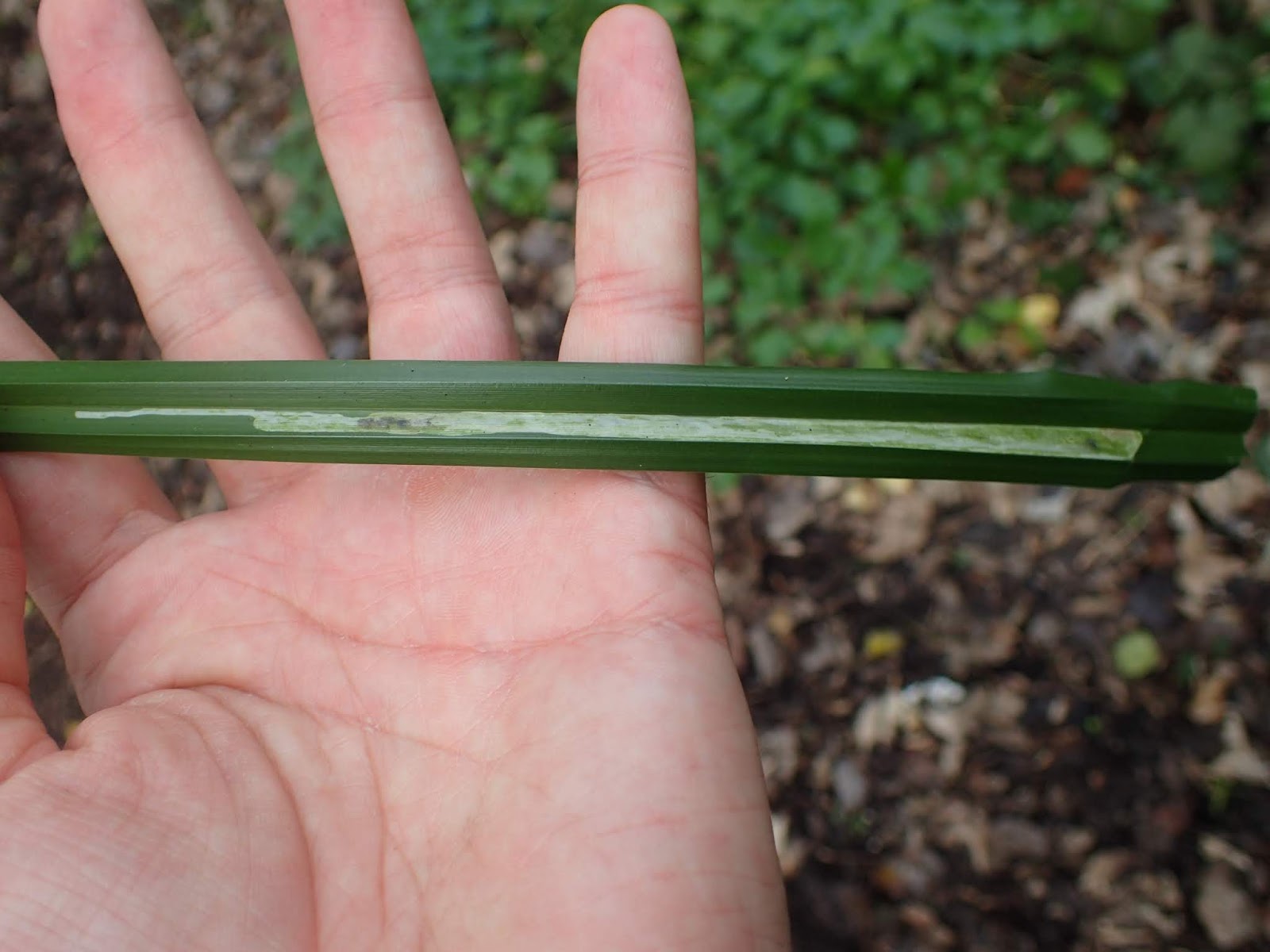
A few leaf mines were found, of which Red Hazel Midget (Phyllonorycter nicellii) was a new one, albeit unoccupied. In terms of agromyzids I recorded Amauromyza verbasci on Mullein and Phytomyza plantiginis on Ribwort Plantain, but a mine on Traveller's Joy was one of a species pair. 


NORWICH: Train Wood highlights

22nd August 2017

After work on Tuesday I decided to take a rather circuitous route home, taking in a bit of Train Wood. There wasn't much in the way of flowering plants in the wooded area, so I cut through and emerged onto the main tarmac path running behind the industrial estate. Here there was more to draw my attention, and amongst the numerous Canadian Goldenrod I found some stands of Tansy. As I don't see it too much I decided to focus on it, and this paid of with three new species for me - Tansy Aphid (if you look closely you can see the demonic red eyes), a Tansy leaf miner (Phytomyza tanaceti) and a plant bug, Megacoleus molliculus.


A bit further along I searched another clearing and came up with two more new species, another leaf miner (Agromyza frontella), this time in Hop Trefoil, and a rhopalid bug, Liorhyssus hyalinus.


To show that I was using some of my other senses I located a calling Great-spotted Woodpecker, then used my sense of smell to track down a group of Stinkhorns in the pathside vegetation. A very productive diversion home all in all.


NORWICH: Train Wood Bioblitz

27th May 2017

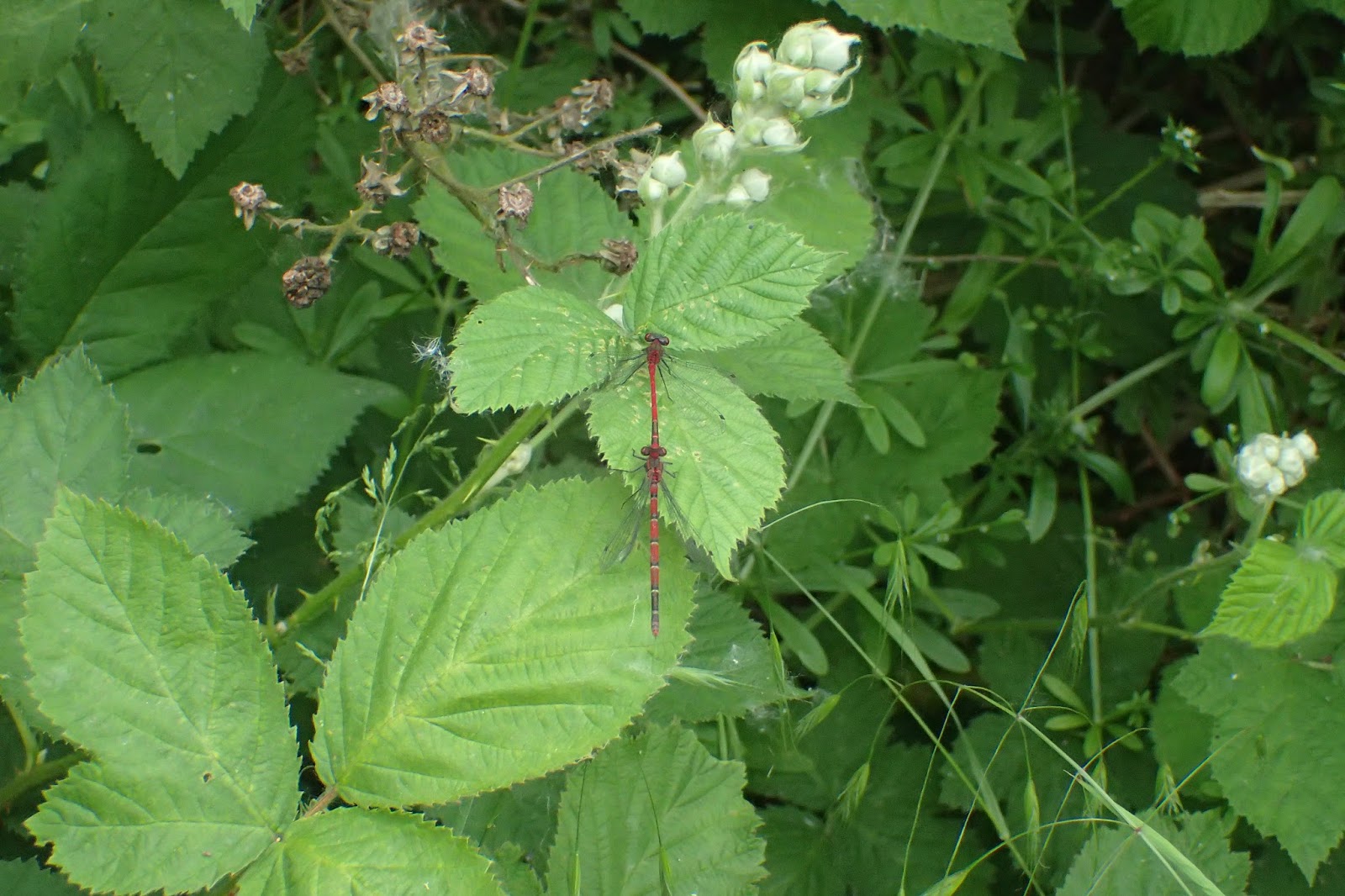
On Saturday Train Wood on the edge of Norwich held a bioblitz recording day. The wood marks the start of the Marriott's Way footpath, and the Friends of Train Wood have been doing stirling work in looking after and promoting the area. The Norfolk Wildlife Trust have also helped, and representatives of NBIS, Norfolk Bat Group and NNNS were also present. After a quick look in the brambles, finding Large Red & Azure Damselflies and a Dock Bug, I tagged on to a guided walk led by Nick Acheson, who quickly racked up over 100 species, mostly plants.


Part way along I left the walk to chat to Lindsey and Graham on the Norwich Bat Group stand (and Tony nearby). It was here that they showed me an insect they had found behind the stand, which turned out to be a Snakefly. There are four near-identical members of this family, but none of them are seen very often as they tend to stick to the canopy. One from Suffolk had been identified the previous week  from the pattern of veins, so I took some photographs and asked Norfolk invertebrate expert Tony Irwin for help. Unfortunately it turns out that the hindwings, hidden under the forewings, contain the key ID feature, so it could only be whittled down to one of two species. Still, regardless which one it was, still a very interesting thing to see.


After sheltering from a few thundery showers passing overhead, I set out to record some more invertebrates. Banded Demoiselles were common, and a Brown Argus was my first of the year. Mayflies, Birch Catkin Bugs and Woundwort Shieldbugs went down on the list, and at the river a couple of Hairy Dragonflies flew past me. Well done to everyone involved, who managed to record 300+ species and hopefully raise the profile of this county wildlife site.


On my way home I noticed some Common Ramping Fumitory growing on waste ground, a new plant for me, which was an excellent end to the day.


NORWICH: Train Wood birds & fungi

28th January 2017

I had to drop the car in for some new tyres on Saturday morning, so took the opportunity to have an hour or so in Train Wood, the start of the Marriott's Way off Barn Road in Norwich. After a slow start it turned out to be quite a productive visit.

After listening to some common woodland birds I followed a rough path close to the river and noticed that Opposite-leaved Golden Saxifrage was growing on the wet woodland floor. This unassuming, largely green plant is fairly scarce, I had only seen it previously at Wheatfen so was pleased to find it so close to the city centre.


Further along I stopped opposite Wensum Park. Around 70 Black-headed Gulls were loafing, and depsite the relatively small size of the park there were at least four pairs of Egyptian Geese! A Treecreeper called nearby, and further along a Great-spotted Woodpecker was in a riverside tree. Whilst searching for the woodpecker a Water Rail flew out from the bank and into a small reedy area near the metal bridge. Despite knowing that they had been seen here before, this was a new 'outer ring road' bird for me. On my way back I saw a couple of Little Grebes on the river, which were also of note this close to the city centre.

I was also paying attention to the fungi in the woodland area, and my eye was caught by some Scarlet Elf Cups, another species I've not seen here before. Whilst looking through a nearby log pile I noticed a tiny yellowy-cream fungus growing from a decaying Alder leaf. I recognised it as a member of the genus Typhula, but wasn't sure which one. After a closer look under the microscope and some guidance from county recorder Tony Leech I was able to confirm that it was Typhula setipes, a species only recorded in Norfolk nine times previously (because of the difficulty in seeing it rather than any great rarity I would suggest).