The Whitlingham Bird Report for 2025 is now available to download from the Bird Reports page or from here

SUFFOLK: Minsmere bioblitz

2nd June 2017

This week Minsmere have been holding a Bioblitz, and Cathy & I decided to visit on Friday to do a bit of recording. After some tea and cake in the cafe we started out, first looking at the Ant-lion pits. We were in luck, as Cathy spotted an Ant-lion larva moving over the surface, allowing us to see the odd-shaped body and large jaws.


After noting the Rosemary beetles near the toilet block we headed into the woods to the discovery centre where the bioblitz was being co-ordinated. On the way I spotted a Denticulate Leatherbug and we added a few other bugs and beetles on our way. When we reached the centre we found that it was only manned by a rogue Pheasant that wandered up to visitors and made chicken-like noises, so we re-traced our steps and went onto the reserve.


At the pond we saw a Norfolk Hawker and some Azure damselflies, then had a look at the short grassy area beyond. A Plain Gold moth drew my attention to Bird's-foot, a tiny but very attractive little flower, and alongside it a Common Groundhopper.


We called into North Hide, where we saw lots of Barnacle Geese with goslings, and rather unusually a pair of Bar-headed Geese, also with goslings. Back on the main path we saw my first Golden-bloomed Grey Longhorn of the year and a Plum Tortrix moth.


Walking the path to the beach I noticed some Grass Vetchling, a plant I've wanted to see for a while. A Bearded Tit was seen flying low across the reeds, and Sand Martins flew past. At the beach I spotted a couple of micro moths, which Andy Mackay was able to identify them for me as Homoeosoma sinuella and Aethes tesserana. A spell of sunshine brought out some Common Blue butterflies but there was thunder in the distance. On the walk back I noticed Pirri-pirri bur, an invasive non-native plant, but one that I'd not seen before. We managed to avoid the rain until Blythburgh - after that it absolutely hammered down.


NORTH NORFOLK: Beeston Bump & Common

31st May 2017

Another warm day, and I met Adam in North Walsham before heading up to North Norfolk for some wildlife watching. I had decided to spend some time in the Beeston area, hoping to see some migrating birds from the bump or in the scrub behind it, and then have a look for insects on Beeston Common.

As we walked up the western side of Beeston Bump I stopped to look at some plants, and noticed Sand Catchfly, a new species for me. The flowers weren't quite out, although whether they weren't yet in flower or had died off because of the heat wasn't obvious. Several Painted Ladies were also seen along the cliff edge. Most of the birds moving through the Alexanders were House Sparrows, and the sole pipit was a Meadow Pipit. At least five Buzzards were spiralling up over the woods.


On the way down I saw a patch of Red Valerian, and suggested that it would be worth checking for Hummingbird Hawk Moths. As we walked over Adam spotted one - although the association is well known so I can't claim any particular insight. Wild Clary and Kidney Vetch grew near the path down, and in the meadow we found two flowering spikes of Purple Broomrape. A Whitethroat and several Skylarks were the only birds of note.


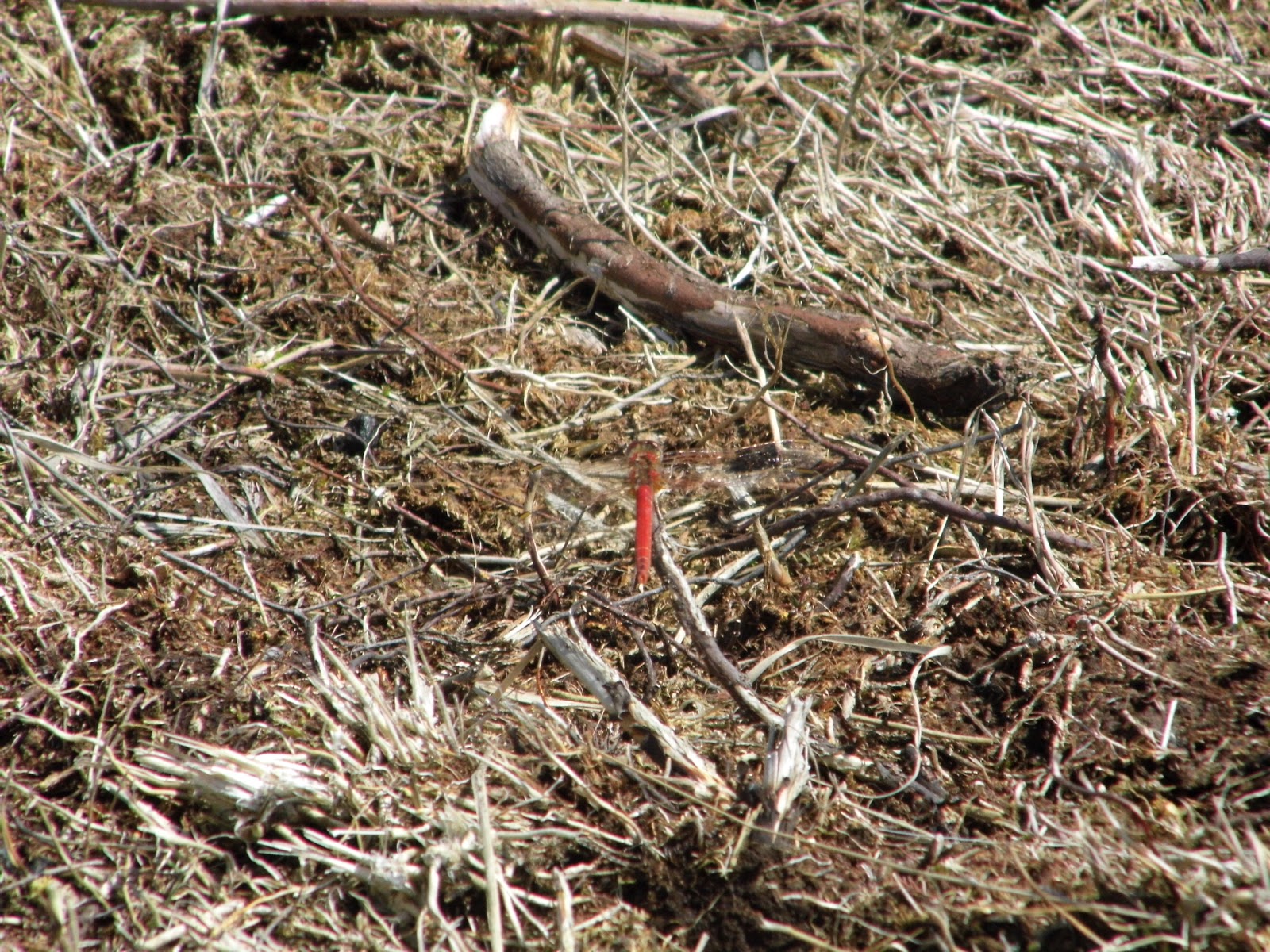
Crossing the railway line we walked round to the entrance to Beeston Common. We hadn't gone very far when we bumped into John Furse, who was looking for day-flying moths. After stopping to look at a Merodon equestris hoverfly we accompanied John out onto a footpath running across the middle of the marsh to look for a Red-veined Darter seen here recently. We encountered male and female Keeled Skimmers, the first that I had seen in the digital photography era - my last pictures of these were taken at Holt Lowes on a film camera (ask your parents). After a bit of searching Adam spotted the Red-veined Darter, and we managed to get a few photos of that too before it vanished.


After our dragonfly success we carried on around the site, not finding any other moths we were looking for although we did see a Marbled White-spot. Other species noted included Green Tiger Beetle, a Gorse Shieldbug laying eggs and my first Large Skipper of the year.


After lunch Adam & I had another short walk around a village pond, seeing a Little Grebe and another couple of Hummingbird Hawk Moths before heading home.

WHITLINGHAM: Hoverflies and other insects

28th May 2017

Whitlingham is always busy on hot summer days, so I avoided the majority of the crowds by going down to the woods instead. Having a quick look around the car park I found some Potato Leafhoppers and Wall Speedwell, before heading over to the river.


With birdlife rather quiet, my main target for the day was to look for day flying moths and hoverflies, and I started by catching a Platycheirus sp. These can be tricky to ID, but fortunately this was one of only three that have a pointy face, and I was able to confirm later that it was Platycheirus manicatus, a patch tick. Next I scrutinised a sunny patch of Germander Speedwell to look for Little Longhorn moths, but all I could find were some tiny black flies with red eyes (I'm not sure what they are - please leave a comment if you do). I checked quite a lot of Germander Speedwell, all with negative results for the moth.


Just before Whitlingham Marsh I diverted down a path with luscious vegetation because I remembered a sandy bank at one end that might hold some solitary bees. It was very light on bees, but very good for Volucella bombylans hoverflies, with both the red-tailed and white-tailed forms. I found a mating pair of the latter, looking odd as the upper hoverfly was flying around dragging the lower one upside down!


I was keeping an eye out for the hoverfly Dasyrphus venustus that has been seen here by Anne Crotty, but didn't have any luck. I did find some Anasimyia lineata, a new species for me (my sixth new hoverfly of 2017, breaking my target of five new ones). I also put out a pheromone lure to attempt to find White-barred Clearwing. This was purely speculative as it hasn't been recorded here previously, but perhaps no-one has tried before? Either way I didn't see any (I have previously tried to attract Red-tipped Clearwing here too without success), so I'll hopefully get time to try again somewhere else with more success.

NORWICH: Train Wood Bioblitz

27th May 2017

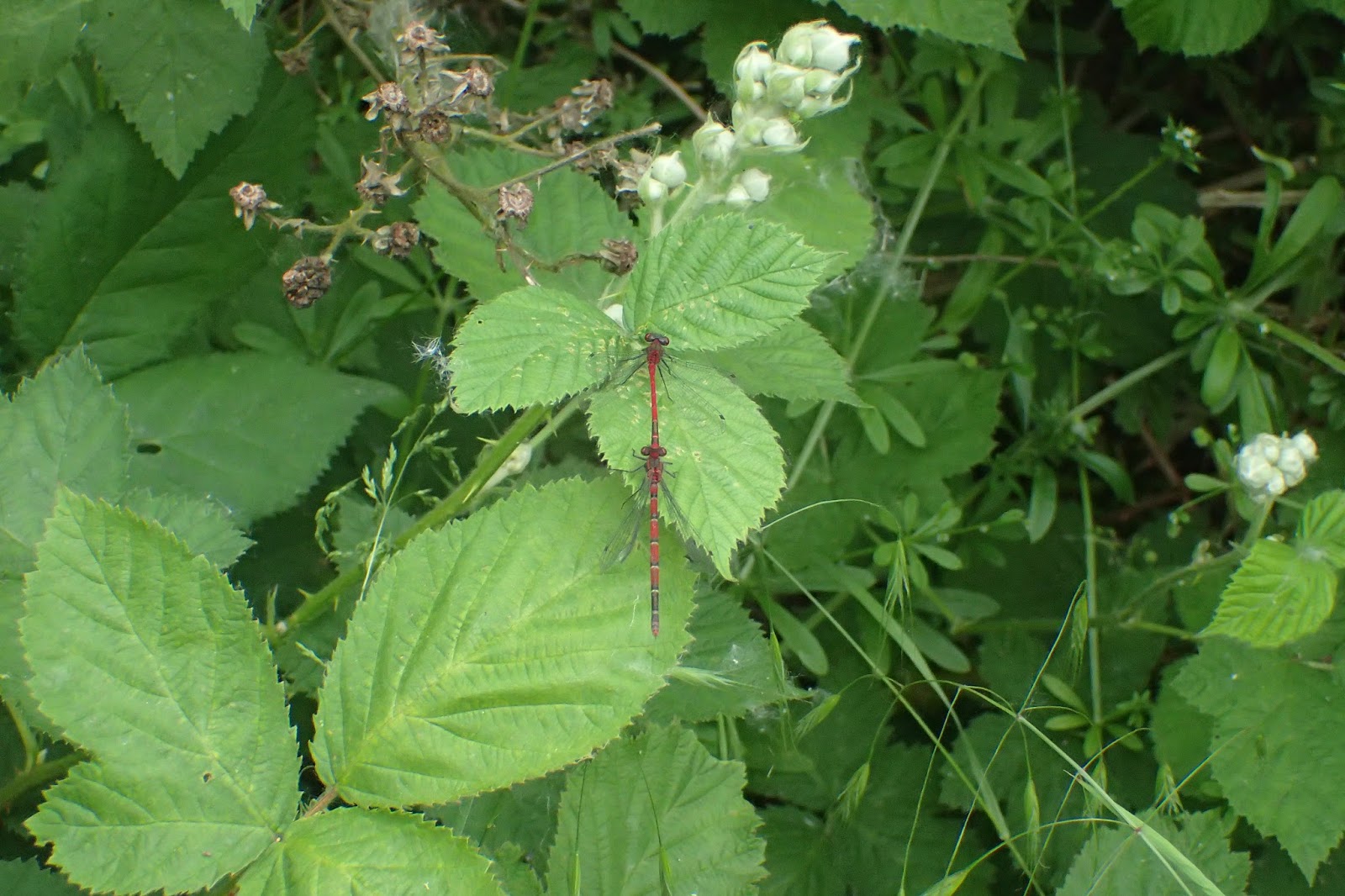
On Saturday Train Wood on the edge of Norwich held a bioblitz recording day. The wood marks the start of the Marriott's Way footpath, and the Friends of Train Wood have been doing stirling work in looking after and promoting the area. The Norfolk Wildlife Trust have also helped, and representatives of NBIS, Norfolk Bat Group and NNNS were also present. After a quick look in the brambles, finding Large Red & Azure Damselflies and a Dock Bug, I tagged on to a guided walk led by Nick Acheson, who quickly racked up over 100 species, mostly plants.


Part way along I left the walk to chat to Lindsey and Graham on the Norwich Bat Group stand (and Tony nearby). It was here that they showed me an insect they had found behind the stand, which turned out to be a Snakefly. There are four near-identical members of this family, but none of them are seen very often as they tend to stick to the canopy. One from Suffolk had been identified the previous week  from the pattern of veins, so I took some photographs and asked Norfolk invertebrate expert Tony Irwin for help. Unfortunately it turns out that the hindwings, hidden under the forewings, contain the key ID feature, so it could only be whittled down to one of two species. Still, regardless which one it was, still a very interesting thing to see.


After sheltering from a few thundery showers passing overhead, I set out to record some more invertebrates. Banded Demoiselles were common, and a Brown Argus was my first of the year. Mayflies, Birch Catkin Bugs and Woundwort Shieldbugs went down on the list, and at the river a couple of Hairy Dragonflies flew past me. Well done to everyone involved, who managed to record 300+ species and hopefully raise the profile of this county wildlife site.


On my way home I noticed some Common Ramping Fumitory growing on waste ground, a new plant for me, which was an excellent end to the day.


THORPE MARSH: Sunset moths, beetles and birds

22nd May 2017

Recently Ricky had been getting some great views of a Grasshopper Warbler at Thorpe Marsh, so I agreed to meet him there on Monday evening. He was running a bit late, which worked well for me as I was able to have a look for moths and beetles in the vegetation along the edge of the dykes. One species of moth was particularly common, although I haven't identified it. Presumably it is something I've seen before - I'll keep working on it.


A longhorn moth was easier to identify, it was the Meadow Longhorn, whilst I also saw my first Drinker Moth caterpillar of the year. Of the beetles there were quite a few Donacia simplex reed beetles, but also two new ones, Hydrothassa marginella (seen here photobombing a Donacia) and an odd-looking carabid Demetrias imperialis.


Once Ricky had arrived, along with Matt, Steve and Phil we took a stroll along the path in the direction of a distant reeling Grasshopper Warbler. We then heard a closer one behind us, and returning back a bit we got good views as it reeled from amongst the sedges. As the sun set I was preparing to go when a Hobby flew over us, an excellent end to the evening.


SOUTH NORFOLK: Tas valley plant walk

21st May 2017

My busy period of wildlife events continued on Sunday with a NNNS Wildflowers Revealed walk in the Tas Valley. Part of the idea was to look at some of the boulder clay specialities of this part of the county, although we were warned in the introduction that not many of these had been found during the recce the week before.

We met in the car park at Forncett St Stephen's church, and after a quick talk and one of Jo's cakes we moved off to have a look in the churchyard. As it happened the first plant we stopped to look at was one I haven't recorded before, Cornsalad. It is relatively common, but also has a number of very similar relatives that differ in the shape of the seeds, which might explain why I'd not felt safe recording it previously. Meadow Saxifrage and Hybrid Bluebell were seen, and some ID tips regarding Hairy Tare ID were given.


Along the edge of the churchyard we saw Bur Chervil, Rough Chervil, Barren Brome and Great Brome, and I stopped to photograph a micro moth on the hedge. The only comment I've had on it so far is that it looks like Rhyacionia pinivorana, new to me and the 10km square, but if you disagree then let me know!


We took a footpath down past a field of buttercups and stopped on a bridge over the river, where Mike waded in to get a sample of a Water Crowfoot sp. These are very similar, and require detailed examination to determine which species is involved. Some dried seedheads of Small Teasel were also of note here. I missed a Small Yellow Underwing moth found by Nick, but did see several species of ladybird and an interesting thin-leaved form of Hogweed.


We were now on the Tas Valley Way, which wound its way through a couple of farmyards. As we walked past the first one a few people stopped to look at the horses, an action that made at least one of the inhabitants of the farm surprisingly irate. It was explained to us that they had had lots of rural crime issues here of late, but parties of botanists keeping to the footpath would appear to be rather low on the list of miscreants. After a while we stopped and had lunch, enjoying a nice view across to Forncett St Mary. At this point I decided to leave the rest of the group to it, so after having a chat with Ian and having a look at a 16-spot Ladybird that landed on my leg, I took a different footpath and headed back to the car.


SOUTH NORFOLK: Swangey fungi

20th May 2017

On Saturday I took the opportunity to visit Swangey Fen with the Norfolk Fungus Study Group. This reserve is owned by the Norfolk Wildlife Trust but is normally closed to the public, so we met nearby and transferred into fewer cars before heading down a bumpy track to the small parking area.

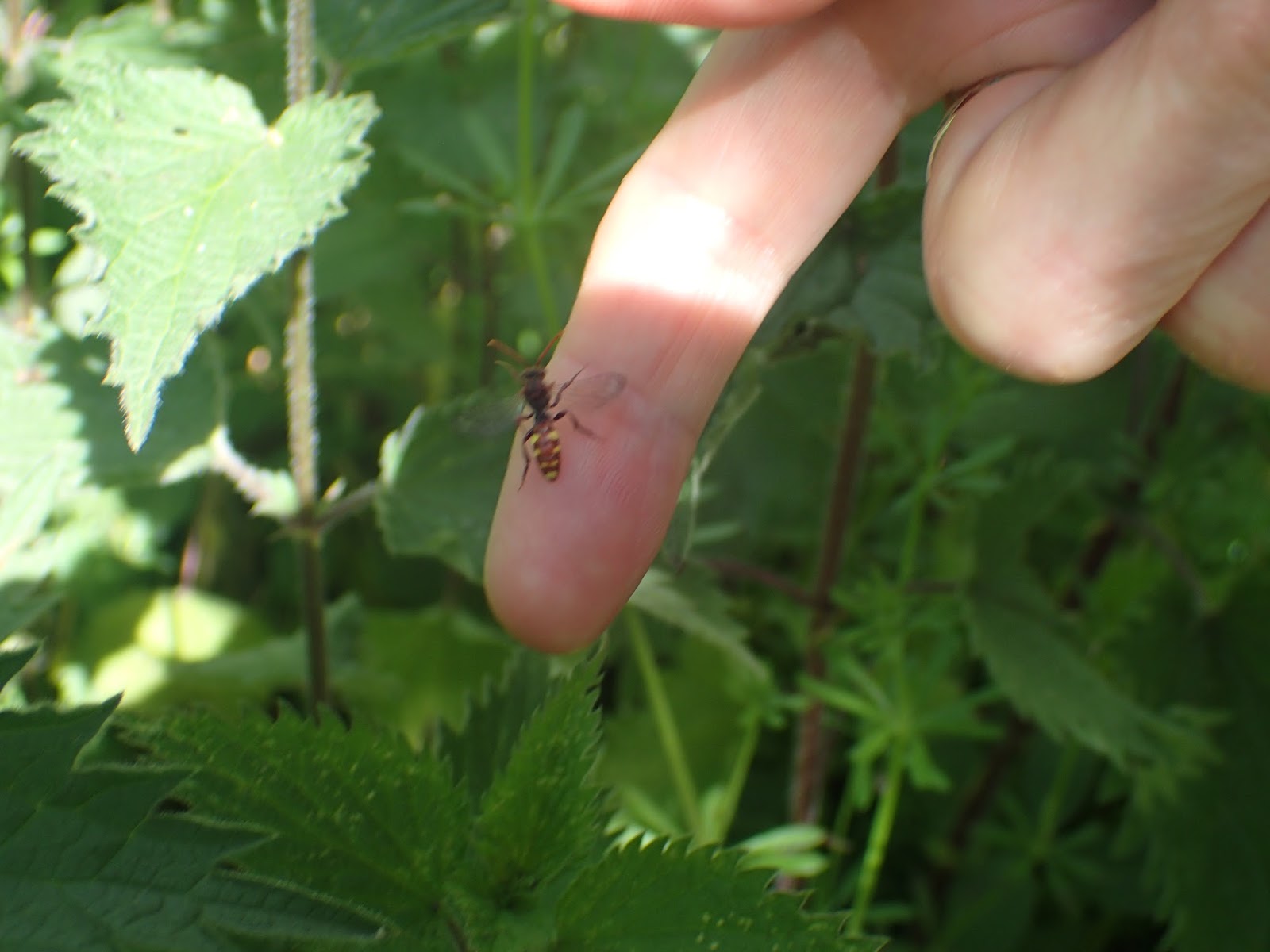
Heading into a wooded area we soon arrived at a sunny glade, where I noticed one of the reddish Nomada bees. I managed to get a few photos of it, but it turned out to be one of a group of similar species that require a good look at the tips of the mandibles to identify - needless to say I didn't get that close! Anne spotted some hoverflies feeding on a sap run on a nearby tree that turned out to be Ferdinandea cuprea, a species that I thought I had seen in the past but can't find any trace of in my records, so presumably new.


I hadn't missed much fungi whilst looking at the invertebrates, and indeed found a Scutellinia sp whilst wading across some mud. We were a bit surprised to find several toadstool types a bit further up, as they tend to be rather scarce in late spring and summer. Mycena acicula, Rickenella schwartzii, a Lactarius sp and a Naucoria sp were all seen along the path. Yvonne called me over to show me a moth she had found, which turned out to be a Grey Birch, another new species. Neil found a crust on Alder, Vuilleminia alni, which looks like it is new to Norfolk, if rather underwhelming to look at. The path at this point was getting very boggy, so we turned round and took a different path.


We stopped for lunch in a sunny spot, seeing lots of Azure and Large Red Damselflies. Close by some Ink Caps were growing on a pile of cut reed, and when I checked the next one along I saw a Glow-worm larva, which was a nice find. A Cuckoo called in the distance, and a dragonfly exuvia was on some emergent vegetation. Most of our finds in this section were rusts or resupinates, but the rust on Great Fen Sedge was of note because it is one of Kew's 'Lost and Found' fungi to look out for.


The last interesting species before we headed back was the Reed Mat Disco, Trichobelonium kneifii, a small yellow cup fungus that grows on damp reed. Four Red-breasted Carrion Beetles were seen, and whilst watching them we also saw a brood of young Pheasants.


Swangey Fen was a very intersesting place to visit, so thanks to the NWT for allowing us in to do our recording, and to Steve for sorting out the arrangements.

TARGET SPECIES: May Lily

19th May 2017

With a busy weekend ahead, I had arranged to go to the north Norfolk coast after work on Friday to see May Lily, another one of my target species for the year. I had previously searched for them without success, but this year John Furse had very kindly found their location and checked on them earlier in the month to ensure that some had begun to flower before I looked. We met nearby and convoyed to the edge of the heath, before taking a track to a small area of woods. Here May Lilies were growing on both sides of the path, and looking good despite the drizzly conditions.


After looking at the May Lilies we walked back, looking for moths as we went. The few that we did see well enough to ID were all Grey Gorse Piercers. I also found Coleophora cases on birch and rowan.