The Whitlingham Bird Report for 2025 is now available to download from the Bird Reports page or from here

WHITLINGHAM: November wildfowl count

19th November 2017

Time for the November WeBS count, and I was hoping to catch up with a Goldeneye, knowing that there had been up to three earlier in the week. I arrived to a country park split in half, partly bathed in warm sunshine and partly in shadow with glistening frost.

The broads had good numbers of ducks, but not much in the way of variety. Combined Little Broad/Great Broad/Thorpe Broad counts included:

Tufted Duck 343 (2016: 194, 2015: 141)
Gadwall 143 (2016: 112, 2015: 29)
Mallard 65 (2016: 64, 2015: 67)
Shoveler 12 (2016: 11, 2015: 0)
Coot 146 (2016: 254, 2015: 157)
Little Grebe 7 (2016: 11, 2015: 0)

As you can see from the figures below Tufted Duck numbers are much higher than last year, but Coot numbers are down (although similar to 2015). The undoubted highlight of my visit was watching two Kingfishers chasing each other in the sunshine, always a pleasure to see them. On the river the local Muscovy has cruising back and forth, and the Mallard x Pintail hybrid was on the Great Broad.


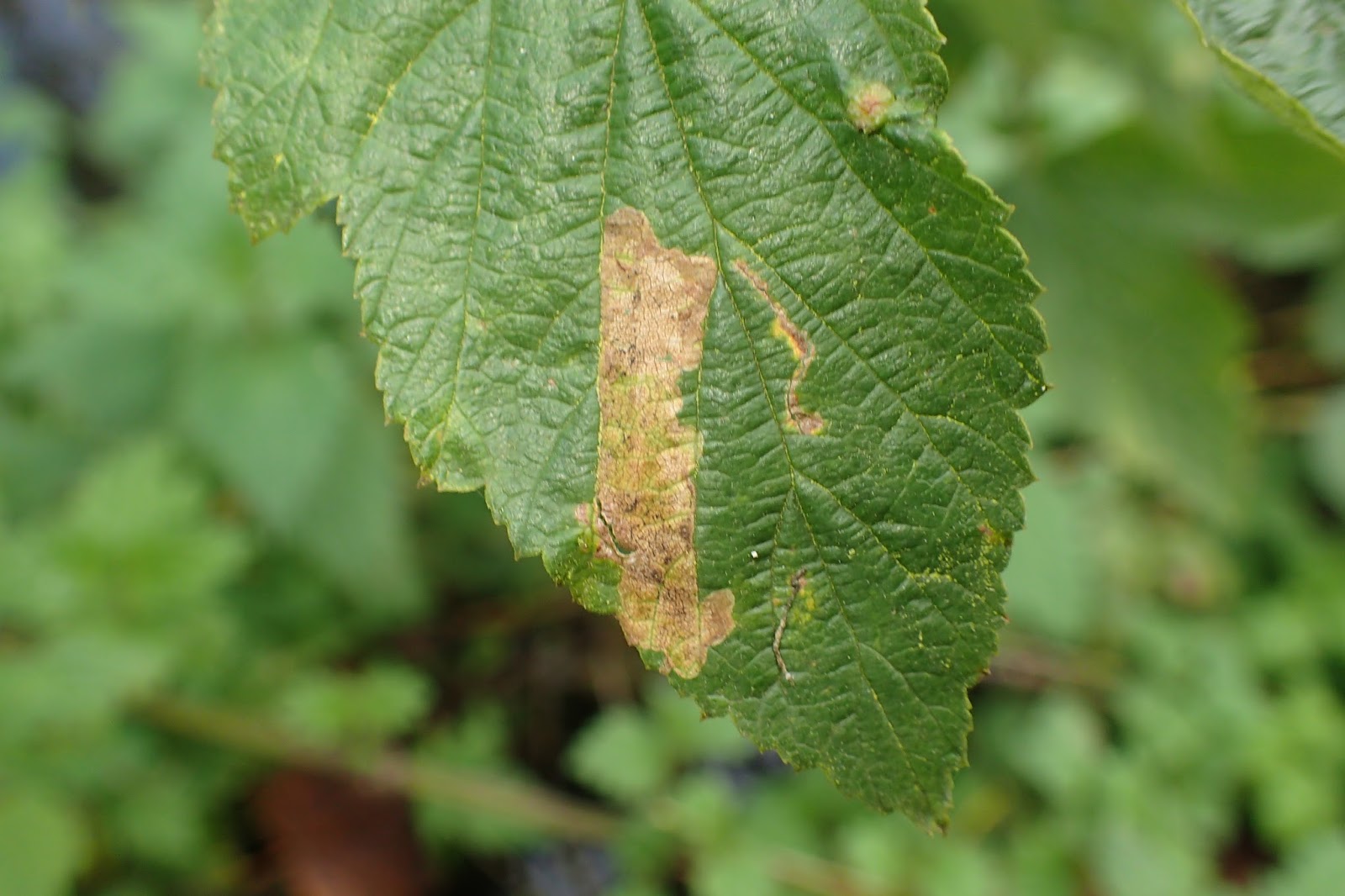
Apart from birds I saw Phytomyza chaerophylli on Cow Parsley and the two Hazel Stigmella mines, Stigmella floslactella and Stigmella microtheriella.

THORPE MARSH: Leaf miners and ducks

18th November 2017

On Saturday I popped down to Thorpe Marsh to look for some Bearded Tits that had been heard in the small reedbed on the previous day. After crossing the railway I decided to check some Cow Parsley for the leaf mine of Phytomyza chaerophylli, a common but overlooked species which I found in the first patch I checked.


Heading round towards the marsh I stopped near the reeds and listened for a while, but there was no sign of any Bearded Tits. It was rather windy, so I wasn't surprised not to see them. Whilst on my vigil I kept an eye on birds moving along the tall trees near the railway line. A flock of Fieldfares flew west, and a large Goldfinch flock with a scattering of Siskins were feeding in the Alders.

After a while I gave up and moved off, checking the flood and marsh before moving on to the broad. There were loads of ducks, including around 160 Tufted Duck and the returning Pochard x Ferruginous Duck.


On my way back it struck me that I couldn't recall any apple trees at Whitlingham, so I should check the crab apple near the mooring basin. This was a good idea, as I noticed some old mines of Apple Leaf-miner moth, Lyonetia clerkella.


NORWICH: Waterloo Park leaf mines and flies

11th November 2017

After a packed autumn this weekend was nominally a non-wildlife one, but on my way home from the city centre I decided to pop into Waterloo Park for a quick look round. It was too cold for many insects to be around the flowerbeds, but I headed to the end where there is a small arboretum-style area of trees. I picked out a couple of Hornbeams, and after a quick (unsuccessful) check for Hawfinches, I had a look at the leaves. I was instantly rewarded with three leaf mines; Nut-tree Pigmy (Stigmella microtheriella) which I have previously seen on Hazel, and two new ones, Hornbeam Midget (Phyllonorycter teneralla) and Dark Hornbeam Midget (Phyllonorycter esperella).


Further across I was checking a Silver Birch and was showered with Birch Catkin Bugs! There were a few flies on sunny tree trunks and leaves, including an orange Phaonia sp, something similar but skinnier and finally a Lance Fly sp (Lonchaidae). I should have probably come and checked out this area over the summer really.


NORTH NORFOLK: Bayfield fungus foray

5th November 2017

On Sunday the Norfolk Fungus Study Group met up at Natural Surroundings for a foray on the nearby Bayfield estate. Much of the route was on a permissive path, but we had also got permission to go into a nearby wood. I doubted that we would get anywhere near the numbers of species seen at Felbrigg, but once again was proven wrong as the final list again passed the 130 mark. There was a good turnout of mycologists, and Stewart was present so a few leaf mines got recorded too.

At the entrance to the woods Tim D found Rooting Shank, which was a good start as it showed that there were still large gilled species about. A few smaller brackets and jelly fungi followed, including Fenugreek Stalkballs, until we emerged into a clearing with a good range of species including Funeral Bell (a new one for me), Blueleg Brownies, Inky Mushroom and the cup fungus Peziza petersii.

Blueleg Brownies
 Rooting Shank
 Funeral Bell
 Fenugreek Stalkball
 Peziza petersii

We passed into the lakeside meadow, and split into several groups that ranged from slow moving to statuesque. According to the species list the latter must have recorded some Waxcaps, but the rest of us down near the lake managed a Stubble Rosegill, Milky Conecap and Bolbitius lacteus. A tiny but numerous yellow fungus on goose droppings drew interest - it was later identified as a mould, Pilaira moreaui.

 Pilaira moreaui on goose poo. I suspect it is under-recorded.

 Bolbitius lacteus, the best of the few things that I found.

We left the meadow, pausing to see some Walnut Orb Web Spiders found in the roadside wall by Tim H. Further along we entered another area of woodland where we stopped for lunch. This new area was mostly Beech and Oak, and we found a good range of Mycena and species on wood. There were a few beetles too, including Silpha atrata and Pterostichus niger.


Retracing our steps we walked back along a stretch of the main drive, checking the rotting Gunnera leaves. Two different clubs were found, one couldn't be identified by the other one was Redleg Club. Common Eyelash and Orange Bonnet were also see here.


In addition to all of the fungi, we also saw the millipede Blaniulus guttulatus, Agromyza idaeiana mines in Meadowsweet and the larvae of a scarce moth on Hartstongue Fern, Psychoides verhuella


WHITLINGHAM: Vis-mig 2 with added Hawfinch

29th October 2017

On Sunday I decided to forego the extra hour in bed caused by putting the clocks back and head once again to Whitlingham before dawn to look for migrating birds. It was a slow start with not much on the move, although I was pleased that the wind was still mostly westerly as the forecast strong northerly winds would have probably held most of the birds up.

Around dawn I saw Gary approaching. He asked me if I had seen the Hawfinch that flew out of the willows behind me and across the little broad a few minutes earlier. Ha ha I thought, until I realised that he wasn't joking. Even worse, I had seen a finch or bunting fly across as I scanned round, but as I hadn't heard it call I hadn't thought about it. Gary said that it hadn't flown high, so it might still be around, leaving me torn as to whether to stay and listen for passing birds or to try to relocate his Hawfinch.

Gary then set off for a walk around the site, starting with the south side of the Little Broad, so I stayed at my watchpoint for a bit. With just a few Redwings and Siskin flying over I decided that the best thing to do would be to check out the trees between the Little Broad and the river. After ten minutes or so I was rewarded as a Hawfinch called and I managed to pick it up as it flew off across the Little Broad. It had presumably been perched unseen in one of the trees nearby.

Filled with a mixture of delight and relief I decided to try to see if the Hawfinch had landed again. With no sign of it along the Little Broad I carried back along Whitlingham Lane, checking out the isolated trees in the grassland to the west of the broad, then on to Trowse Meadow. Here I encountered a problem, notably the river had burst its banks and flooded the meadow. There was no way I was going onto the meadow without wellies, so I headed back to the country park.


I decided to have another 20 minutes or so of migration watching before heading home, and had only been sat down a few minutes when I got a text from Gary, telling me another Hawfinch had just flown west past the conservation area. I still had my phone out when it flew past, straight in front of me and slightly above the treeline. Before leaving I again checked out the trees along the river, where an obliging Twin-spot Centurion was resting.


WHITLINGHAM: Vis-mig 1

27th Oct 2017

Vis-mig, for those not familiar with the term, means visible migration, and to see it you just have to pick a vantage point and look upwards. It helps if you are familiar with bird calls, because often you'll hear birds before you see them, and often you won't get very long views, so the calls are key to identifying what you are seeing. The first few hours from dawn at peak migration periods are usually the best time to look, and on a good day you can see thousands of birds passing over.

On Friday I headed to Whitlingham before dawn, to see what birds I could see passing over. There was a particular target in mind for me, Hawfinch. Usually the chance of just happening to see a Hawfinch flying over Norwich would be miniscule, but we are currently in an unprecedented period of Hawfinch migration - hundreds are flying over England every day, and Justin had one fly over the previous day.


Some of the first birds seen flying through were hundreds of Starlings, flying low westwards along the river. They moved as if in a murmuration, but unlike in the evenings there was no drifting back and forth, they were clearly on a mission to get back to the city. Several Redwings flew over, uttering their thin 'tseep' calls. Siskins and a Redpoll also flew over, followed by my first Fieldfares of the autumn. Frsutratingly there were also several finches and thrushes that flew over without calling - I had to leave most of those unidentified.

As daylight spread I had to avoid getting distracted by the sights and sounds around me. A Water Rail squealed from the Little Broad, whilst around 60 Cormorants had flown out of roost and were milling about on the Great Broad. Both Pied and Grey Wagtails flew over the Great Broad, and there was also a thrilling heron chase. It was a great start to the day, but sadly no Hawfinches were seen.

Once the passerine migration had slowed down I took a walk along the south shore of the Great Broad and then looped round through the woodland edge and picnic meadow in case any birds had pitched down here. I didn't see any birds out of the ordinary, but did see several interesting leaf mines including Grey Alder Midget (Phyllonorycter strigulatella), Least Thorn Pigmy (Stigmella perpygmaeella) and White-bodied Midget (Phyllonorycter joanisi).


As I was walking round I heard a flock of Pink-footed Geese flying over the broad. There were 45 birds in the flock, and in a nice bit of synchonicity fellow patcher Ricky had what was almost certainly the same flock over his house five minutes later. A second flock of 55 flew over shortly after, along with nine back the other way.


NORWICH: Train Wood aphids and leaf mines

24th October 2017

Having left the lunchtime beer festival session, I had some free time before going to a talk by Alice Roberts at the Playhouse. Adam and I headed to Train Wood, ostensibly to look for fungi, but there wasn't much of it about. Probably the most interesting find here were some aphids - firstly Large Willow Aphid, but then a similar species that Robert Maidstone identified for me as Plocamaphis flocculosa. Amongst this later species was the larva of a Eupeodes hoverfly.


We did manage to find a bit of fungi, including one of the Eyelash fungi, Scutellinia sp.


A few leaf mines were found, of which Red Hazel Midget (Phyllonorycter nicellii) was a new one, albeit unoccupied. In terms of agromyzids I recorded Amauromyza verbasci on Mullein and Phytomyza plantiginis on Ribwort Plantain, but a mine on Traveller's Joy was one of a species pair. 


NORWICH: London Midget

24th October 2017

On Tuesday I met Adam & Karl for a visit to the Norwich Beer Festival. There wasn't much in the way of new bird related beers, but I did have Jo C's Stout Robin and an Eagle Ale, whilst Adam pointed out that People's Raveningham Bitter had 'Raven' in the name, so we tried that too. I did manage to get a new species out of the trip, finding a mine of the London Midget moth, Phyllonorycter platani on a fallen London Plane leaf. Now is a good time to find these mines if you are interested in micro moths/pan-species listing. I suspect they are on most of the plane trees around Norwich.


NORWICH AREA: Citrus leaf-miner

23rd October 2017

Cathy & I had lunch at a garden centre cafe, and afterwards I noticed several lemon trees in large pots. Wandering over to them I soon found a leaf mine, which I recognised from photos as Phyllocnistis citrella. This species has only been recorded in Norfolk on three previous occasions, all in the past few years. It completed my set of four Norfolk Phyllocnistis mines, having seen the other poplar and willow species around Norwich.


NORWICH: Orange Coral

22nd October 2017

An addendum to the last post really. One of the important parts about any wildlife watching or recording is that the more familiar you get with common species, the more likely you are to spot something different. One of the relatively common fungi in good-quality grassland habitats is Meadow Coral, a species that varies in colour from yellow to a sort of yellowy-orange, and also in how branched it is. Below are a couple of photos of Meadow Coral, from Earlham Cemetery and Felbrigg.


Fortunately for me, Ian Senior sees a lot of it, so when he found a clump of coral fungus that looked more orange than Meadow Coral he gave a piece to Tony Leech, the county fungus recorder, to double check it. Ian was proved right, and this orangier coral was identified as the aptly named Orange Coral, Clavulinopsis crocea, new for Norfolk. Having been given directions I managed to see it after the foray last weekend, thanks again Ian.


NORWICH: Earlham Cemetery fungus walk

22nd October 2017

On Sunday the monthly walk at Earlham Cemetery was focussing on fungi, but I had to delay my arrival to see the end of the Norwich vs Ipswich derby match on TV. Fortunately Norwich won, so I was in a good mood when I arrived at the cemetery and caught up with the group. There was a bit of rain in the air, which meant a relatively small group.

There was noticeably less fungi about than usual at this time of year, but one of the ones we did found was quite unusual, in that it was covered in white fleecy granules that rubbed off easily. We later passed it on to Tony Leech, who was able to identify it as the second Norfolk record of Cystoderma moelleri, which was good as we weren't even sure what genus it was.


Whilst standing by a Beech tree I picked up some leaves and showed Jeremy the leaf mines in them, and perhaps unsurprisingly they turned out to be new to the cemetery list (you can find lists and details about much of the cemetery's wildlife on the resources page of the Friends of Earlham Cemetery website). Later on I added another couple of leaf mines on Silver Birch leaves, including Stigmella luteella which was one I hadn't recorded before.


Moving on we saw some oldish Striated Earthstars and the yellow cup fungus Sowerbyella radiculata. The highlight of the walk came when Vanna found some Clouded Agarics with Piggyback Rosegills growing on them. This species is not unlike the Silky Piggybacks that I saw at Somerleyton growing on Blackening Russulas, and is rather uncommon so a great find.


There were three more interesting finds, a pinkish Mycena that turned out to be Mycena metata, Smoky Domecap (both identified later by Tony) and Inkstain Bolete. I had only see Inkstain Bolete once before, around 20 years ago (I got interested in fungi at an early age!) so it was great to see this. The fruiting bodies don't look particularly spectacular to begin with, but stain a dark blue almost immediately once cut. Thanks to Ian for leading the walk and his local knowledge in locating certain species.