The Whitlingham Bird Report for 2025 is now available to download from the Bird Reports page or from here

BROADLAND: How Hill heron

25th August 2018

After dropping Cathy & Rose off in the city I had a free afternoon and decided to visit How Hill to look for the Purple Heron that had been seen there recently. Having parked up I called in at Toad Hole Cottage to get a ticket for the nature trail, and was told that the heron had been seen a few hours previously but spent a lot of time out of sight in the reeds. I tried to keep focussed and walk straight to the hide that overlooks Crome Broad in the far corner of the reserve, but inevitably stopped regularly due to the large amounts of insects on the Angelica flowers. There were loads of hoverflies, including Sericomyia silentis, Platycheirus rosarum and Melangyna compositarum/labiatarum.


A couple were just leaving the hide when I got there, but after that I had at least 30 minutes of solitude, and 20 minutes in the Purple Heron did the honourable thing and flew up out of the reeds in front of the hide, before flying low to the left. This was only my second Purple Heron and my first Norfolk one, having seen one at Minsmere years ago. Later I was joined by several other birders, but the heron didn't show again before I left. One of them, Nathan, came back the following morning and managed to get a good flight shot which is on the RBA gallery here.

On my way back I could pay more attention to leaf mines, noting a good suite of Alder species and a handful of Agromyzids. A couple of Willow Emerald damselflies were also of note. The best find was a mine of  the moth Leucoptera lutella in Bird's-foot Trefoil. This is a Nationally Scarce A species that Stewart pointed out to me at Burgh Common recently.


NORWICH: A selection of mid-August moths

21st August 2018

Having run the moth trap in the garden most weeks, we have had a steady trickle of species new to the garden list, but occasionally there would be a cluster of interesting species. This night was one of them, with Carcina quercana (famour for being the moth on the cover of the Sterling, Parsons & Lewington micro moth book), Pyrausta despicata, Copper Underwing and Straw Dot all new. In addition Green Silver-lines and a female Orange Swift made a nice change from the typical Turnip Moth/Square-spot Rustic/Vine's Rustic filled traps.


NORWICH: A shieldbug with knobs on

19th August 2018

You may or may not have heard of the phrase "with knobs on", which is sometimes used to indicate something deluxe or with extra features. It is perhaps doubtful if the shieldbug Podops inuncta would pass muster for the first definition, but it's OK because it really does have knobs on, either side of the head, earning it two competing vernacular names - Turtle Shieldbug or Knobbed Shieldbug. 

Having seen most of the common Norfolk shieldbug species I am now trying to see the smaller, drabber, skulkier ones, of which Knobbed Shieldbug certainly counts. Fortunately Vanna and Jeremy Bartlett spend more time outside than me and are happy to let me know if they come across something unusual. Vanna found this ground-dwelling shieldbug whilst checking for Ant Woodlice in Earlham Cemetery, and after having a good look down the microscope it was released back there.


Whilst at the Bartlett's house I did a quick lap of the garden and identified a few leaf mines, including Phytomyza crassiseta on Germander Speedwell, a new one for me. 


NORWICH: Earlham Cemetery insects

13th August 2018

After work I went for a short walk in Earlham Cemetery as part of a rather long walk home. I found an interesting looking little chalcid wasp, certainly a Brachymeria, I'm fairly confident it's Brachymeria tibialis although I've left it to the county recorder to decide if he is happy to accept that. A couple of Rhopalids were also good to find - I've seen Stictopleuron punctatonerosus before, but Stictopleuron abutilon was new for me. I'll be leading a leaf mine and plant gall walk here in September, so I had a quite recce, finding the mine of Stigmella ulmivora on Elm (the exit slit was on the leaf underside separating from another similar species).


 Stictopleuron abutilon
 Stictopleuron punctatonerosus

WHITLINGHAM: August WeBS, pesky gulls and patch additions

12th August 2018

With the summer continuing apace, I headed to Whitlingham for the August WeBS count. The Little Broad is becoming increasingly tricky to count as the vegetation grows up, but in summer there isn't usually much to worry about. A lone adult Egyptian Goose had three young goslings, which will hopefully fare better than the first brood. This species did used to cycle through nicely when I first started coming, but of late not many young seem to be reaching adulthood here.

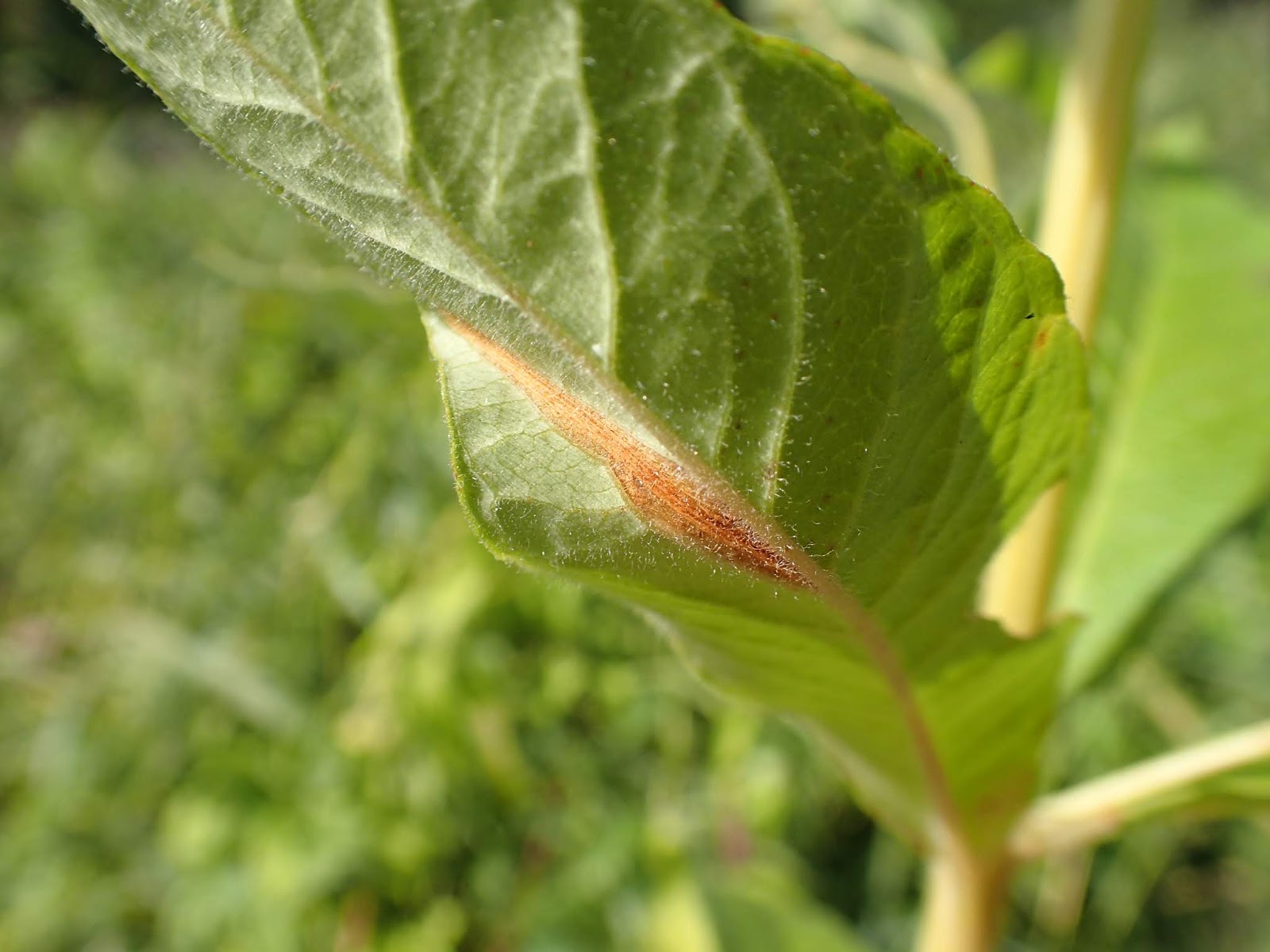
On the Great Broad there wasn't much of note, a single Tufted Duck asleep on the island the most noteworthy. There was a lot of large gulls dropping in though, mostly Lesser Black-backed, and given that I reckon I miss some Yellow-legged Gulls in the younger plumages I photographed a few of the ones in slightly different plumages just in case.


Of the common stuff (combined with Justin's Thorpe Broad count):
Mute Swan:52 (2017: 43)
Egyptian Goose: 29  (2017: 16)
Mallard: 136 (2017: 137)
Coot: 12 (2017: 17)

So numbers similar to the previous year. The Egyptian Goose count is almost double the 2017 figure, but in July this year was only 8. In July last year it was 33, so basically there has been a yearly peak of around 30, but this year it's just a month later.

I added a few bits to my all-species patch list. An odd addition was Ploughman's Spikenard beside one of the main paths. I must have been walking past this for years without noticing it - I can only assume it's because the flowers look a bit like dying Ragwort. A couple of species were completely new to me, a nice red beetle called Platycis minutus and the hoverfly Dasysyrphus albiostratus. I also added a couple of leaf mines, which on this occasion I won't bore you with.


BROADLAND: Burgh Common fungi & leaf mines

11th August 2018

The August after one of the hottest and driest summers in recent memory didn't seem like a promising time for a fungus foray, but having missed the last couple and this being a site I'd not visited before, I was hopeful that there would be a bit about. As Burgh Common has no formal parking, we met nearby before cramming into two cars (and Neil on his motorbike) and heading down a windy track to the start of the reserve.

Some areas usually covered by water had dried up, enabling some searching of reedy areas, but much of the stuff we did find was in the patches of woodland. Some of these did turn out to be new to me, including Nitrous Pinkgill (Entoloma politum), Goblet Parachute (Marasmiellus vaillantii) and Orbilia luteorubella. Unfortunately the most showy species, some nice reddish Boletes couldn't be identified to species. Out in the meadows some cow dung finally provided some moisture, with Coprinopsis stercorea taking advantage.

 Coprinopsis stercorea
 Bolete sp.

The weather seemed more suitable for insects, and the presence of Stewart ensured that we saw lots of leaf mines. There was an almost full set of Alder species, and quite a few from Birch and Hawthorn. The scarcest species were Enchanters Cosmet (Mompha terminella) in Enchanter's Nightshade, Bittersweet Smudge (Acrolepia autumnitella) in Woody Nightshade, and Little Bent-wing (Leucoptera lotella) in Bird's-foot Trefoil.

 Mompha terminella
 Acrolepia autumnitella
 Leucoptera lotella

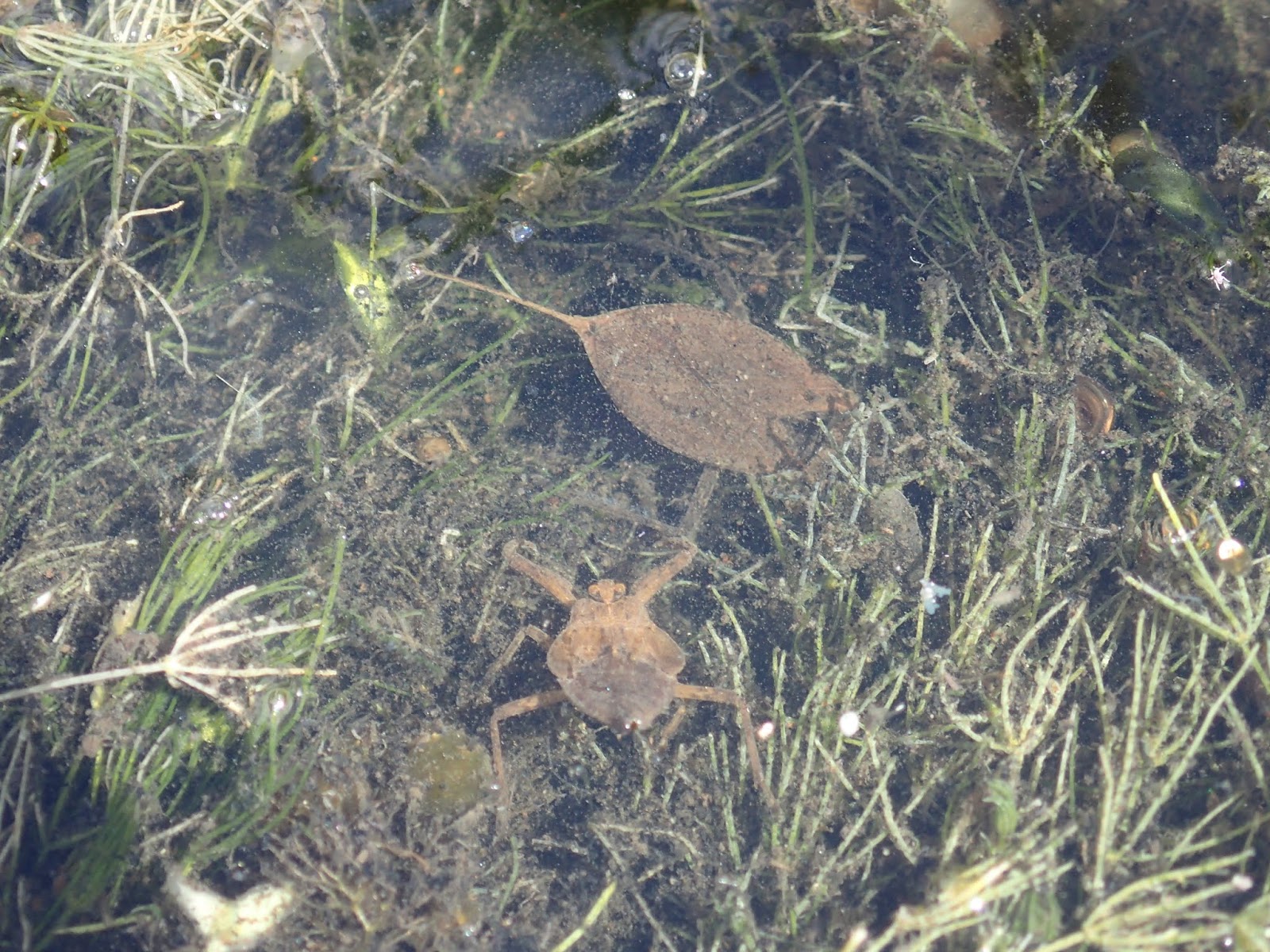
Other highlights of the visit included a Skullcap Sawfly larva, two Water Scorpions and some Bladderwort, whilst a Marsh Harrier did a close flypast.


BROADLAND: A rare fungus on Monkey Puzzle trees

11th August 2018

I am aware that some of my interests are somewhat niche, even within wildlife circles, but it isn't just me. I was reminded of this before a fungus study group meeting in mid-August. We were going to Burgh Common, an out of the way site managed by the NWT, so had met in a car park nearby. Stewart Wright had arrived early to check out a local churchyard, where he had looked for fallen Monkey Puzzle scales (I don't think they are classed as leaves on this species) and had found some with a micro fungus growing on. The species, Phomopsis araucariae, was new for Norfolk and one of only a handful of UK records. I presume that like the species I found on Ginkgo last year this will turn out to be present on most Monkey Puzzle Trees.


NORTH NORFOLK: Natural Surroundings new hoverfly & moth

10th August 2018

We went on a family visit to Natural Surroundings for lunch and a walk around the grounds. The cafe allowed us to show Rose some birds (and a squirrel) up close, as a large family of Blue Tits, some Great Tits and a Coal Tit took turns on the nearest feeders.

Walking down to the river we stopped beside a large Alder and identified about 10-15 different species just by checking the leaves that were around head height. Walking back I noticed an interesting-looking hoverfly on Common Fleabane. Roger Morris identified it for me as Xanthandrus comtus (there is only one photo of that species in the WildGuide and it was marked differently to my specimen). There was another new species for me back in the herb garden where I found a Pied Smudge moth (Ypsolopha sequella) sheltering from the rain. We went into the cabin to watch the Harvest Mice whilst the rain got heavier, before deciding that it had set in and heading for home.


YARE VALLEY: Wheatfen visit

Early August 2018

I called in at Wheatfen one afternoon, hoping the weather would be better than the equivalent visit last year when I got drenched by a sudden storm what blew in whilst I was out on the furthest part of the marsh. Some Small Balsam was growing along the hedgerow, and near the staithe I noticed several Small Teasels in flower - I've no idea how I managed to miss these in the past. 


I kept an eye out for leaf mines on my way round, seeing the moth mines of Buckthorn Bent-wing (Bucculatrix frangutella) and Buckthorn Pigmy (Stigmella catharticella) early on. There was a good range of other moth and fly species, but I hoped there might be something on the scarcer broadland plants. I did manage one new species, Calybites phasianipennella on Yellow Loosestrife, but two mines on Marsh Sow-thistle turned out to be the common Chromatomyia atricornis agg and Liriomyza sonchi.


There was a nice range of butterflies, including a couple of second-brood Brimstones and a Painted Lady. I also found good numbers of the very rare beetle Galeruca laticollis, currently only found at Wheatfen. After noticing my first one, I soon saw quite a few gravid females (the abdomens swell so much that they don't fit under the wing cases) and also some mating pairs. I managed to get back to the car without getting wet, so success all round.


SUFFOLK: Lepidoptera in the King's Forest

1st August 2018

This spring Sharon Hearle of Butterfly Conservation has been running a series of moth trap openings in the King's Forest in north Suffolk as part of the Shifting Sands Project (itself part of Back from the brink, a heritage lottery backed scheme to help rare species and habitats). These have been held in mid-week so I was only able to attend one. Five traps were put out, but they were small Heath traps, so there was only a modest number of moths to go through. There were four new macros for me - Birch Mocha, Peacock Moth, True Lovers Knot and Bird's Wing. Clouded Buff was a Breckland speciality, albeit one that I had seen before. In addition one attendee had brought another Breckland speciality, Marbled Clover, caught nearby at Lackford.

 Birch Mocha
 Clouded Buff
 Peacock Moth
 Marbled Clover
 Bird's Wing

Afterwards we went for a walk along one of the nearby rides. A Grayling sat obligingly on the path, and we were treated to a sight I've not seen for many years as around 30 Red Admirals flew all around us, attracted by the squashed wild cherries on the path. A Silver-washed Fritillary was also present in the same area, and the leaf mine of Stigmella aceris in Field Maple, a very scarce but spreading species over the border in Norfolk was new for me.


Other than the butterflies and moths, Sharon showed us a colony of Pantaloon Bees, which were being rather skittish. Nearby I found the bug Alydus calcaratus, and a couple of Tortoise Shieldbugs were nice to see.