The Whitlingham Bird Report for 2025 is now available to download from the Bird Reports page or from here

NORTH NORFOLK: Cley NNNS walk

Mid-July 2019

As part of the NNNS 150th anniversary celebrations some joint walks with the NWT had been organised, mainly at Cley Marshes. These were all focused around a wildlife group that wasn't birds, so that if any birders wanted to develop their ID skills by looking at another group then they could. I had booked on one of these walks with Nick Owens, author of the Bees of Norfolk. The walk was intended to be looking at bees, hoverflies and grasshoppers, but with a knowledgeable group we ended up looking at all manner of invertebrates.

We saw a good range of invertebrates, including some quite scarce beetles, but the highlight for me was probably Flecked General, one of the large soldierflies that I'd never seen before. A handful of photos from the day are included below.

 Yellowtail moth caterpillar
 Coremacera marginata - a snail-killing fly
 Cystiphora sonchi galls on Sow-thistle
Flecked General

NORWICH: Cherry Bark Moth

Mid-July 2019

Whilst checking an apple tree for leaf mines after work one day I noticed a micro moth resting on a leaf. Overlooking the small size it was beautifully patterned, and a species I'd not seen to boot. It was a Cherry Bark Moth (Enarmonia formosana).


NORWICH: Some new bees

Mid July 2019

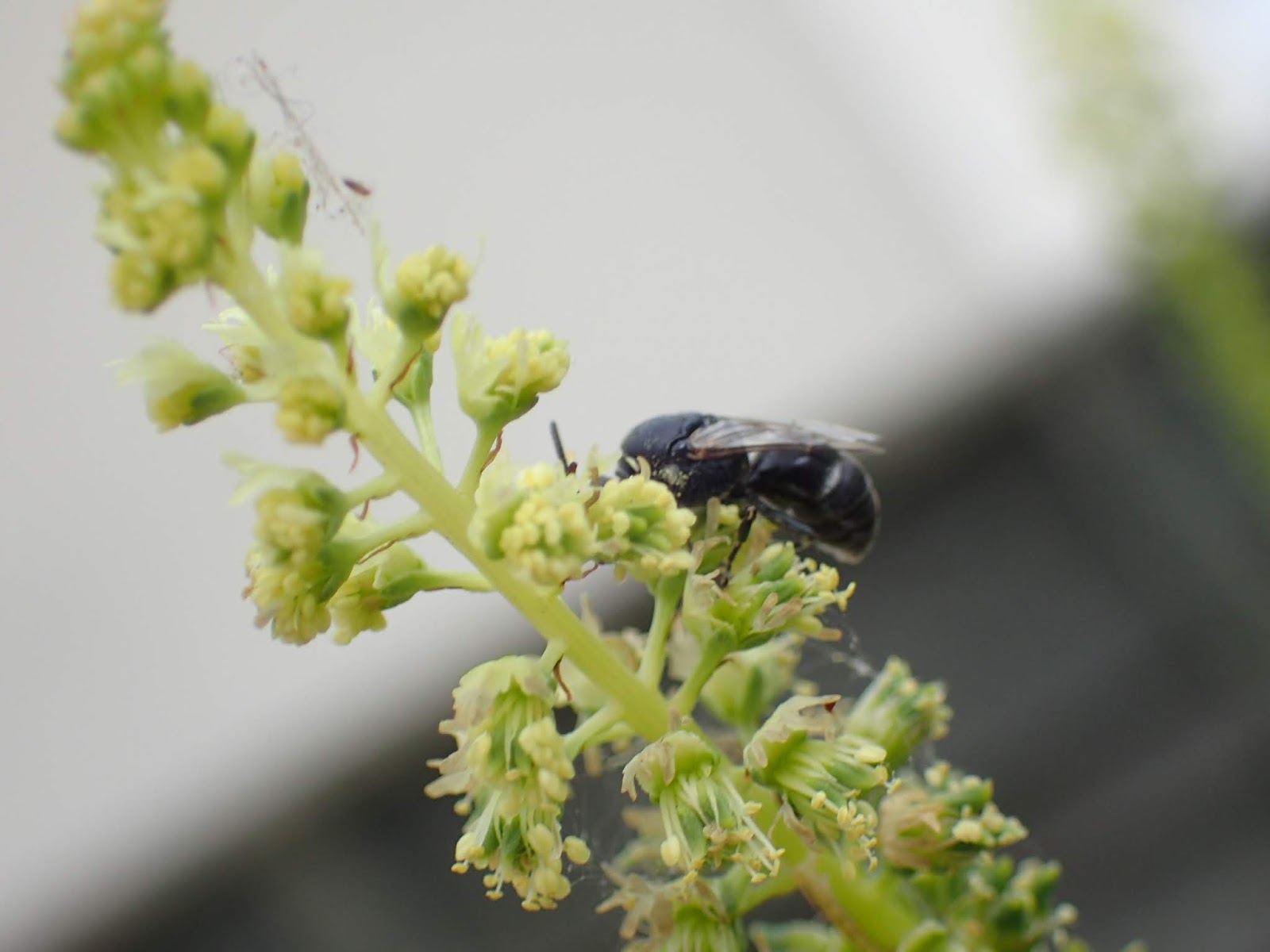
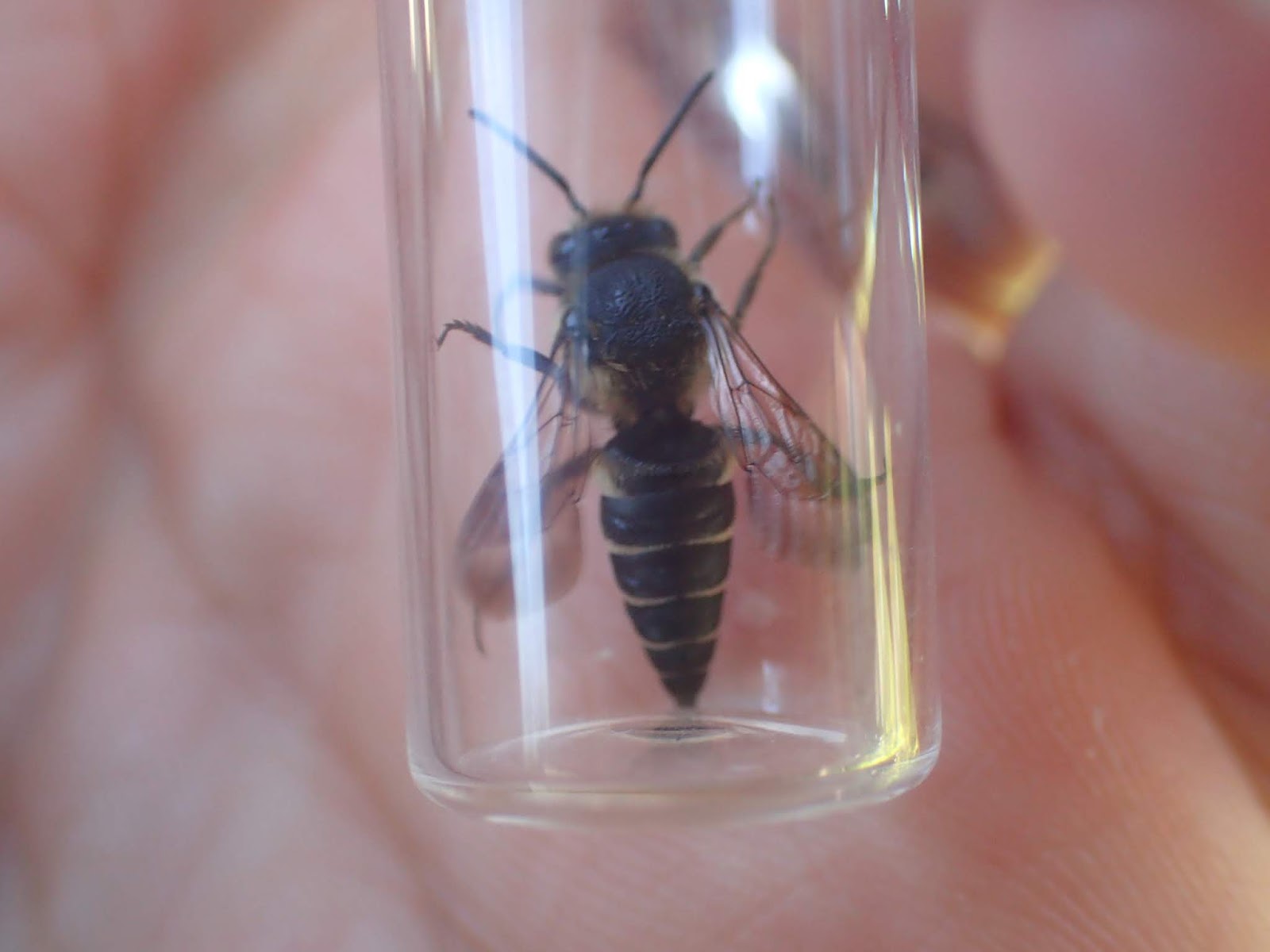
We have some excellent bee habitats in Norfolk, but in terms of number of species one of the best has to be the wildlife garden of Jeremy & Vanna Bartlett in west Norwich. As well as the general planting Jeremy sometimes plants particular plants in the hope of attracting specific bees. One example of this was some Weld, one of the main plants associated with Mignonette Yellow-face (Hylaeus signatus). I'd been checking some Weld on my way to work and not seen any bees on it, but Jeremy and Vanna had up to six attending their plant, so Cathy & I went round to have a look. Despite the overcast conditions a couple were present on our visit, including one male clutching the top of the plant like a miniature King Kong.


We popped round later in the month too, when Vanna had found Nomada zonata, previously a rare new colonist but now spreading across southern England. One of the sharp-tailed bees, Coelioxys inermis, was also new for me.


NORWICH: Local lepidoptera

Early July 2019

An exciting new addition to my butterflies-on-faeces list when a Comma landed on some cat poo on our front lawn. On my way home from work I saw a large dark lepiodpteran flying down the road and hoped that it might be a Camberwell Beauty (a rare migratory butterfly), but when it landed it turned out to be an Old Lady (a silly named moth).


WHITLINGHAM: July counts and a new hoverfly

6th July 2019

The July WeBS count fell early in the month, and I headed to Thorpe Marshes first. There was very little on St Andrew's Broad, but I did see two new species that I was very pleased about, the hoverfly Chrysotoxum verralli and a Lesser Earwig - the first time I've seen any earwig species other than Common Earwig.


Then it was round to Whitlingham, where there was much more wildfowl, but nothing unusual. Selected counts below:
Mute Swan: 108 (2018: 114)
Geylag Goose: 91 (2018: 72)
Canada Goose: 71 (2018: 9)
Egyptian Goose: 31 (2018: 8)
Mallard: 83 (2018: 83)
Tufted Duck: 2 (2018: 2)

Some nice synchronisity about the duck counts compared to last year and the Canada Goose count was of note as there were no 50+ counts in 2018.

Having counted both sides I didn't really have the time to look for insects, but the bug Deraeocoris flavilinea was a new one for me. Walking back through the car park I noticed that a new bike shelter had a 'green roof' and lots of drilled holes in wood to attract bees. This struck me as a nice touch, and hopefully next year there will be some new bee records generated from it.


NORWICH: Dusky Brocade

6th July 2019

My garden moth trapping has been infrequent this year, partly due to the weather and partly due to the need to cherish any extra sleep I can get in the mornings before my daughter wakes up. This time I initially wondered why I'd bothered having only found eight species of moth in the trap. On closer inspection though one of them was a Dusky Brocade, a new species for me let alone the garden.


EARLHAM CEMETERY: Plant walk & random invertebrates

30th June 2019

June's Friends of Earlham Cemetery walk was led by Mike Crewe with a focus on plants. There were a few new grasses for me (unsurprising given my lack of expertise with them) but it was also good to pick up some general ID tips from Mike. One of the first yellow composites we saw was Beaked Hawksbeard, which I'd never recorded before but suspect is probably in my lawn! Nomada fabriciana, a leaf mine of the moth Leucoptera laburnella on Laburnum and Puccinia cnici on a thistle were all new records from the walk.


NORTH NORFOLK: Natural Surroundings anniversary

29th June 2019

Natural Surroundings had a 30th anniversary celebration programme of events, and we attended early to see the small mammal trap opening and the moth trap opening. As it happened only two Field Mice had been caught, although it was still nice for Rose to see her first wild rodent having seen the captive Harvest Mice several times. The moth trapping also was a bit short on numbers - a Nematopogon, probably N. schwarziellus, was the only thing that was new for me, although Small Angle Shades is something I don't see often. We then had lunch and watched the birds on the feeders and noticed a Figwort Sawfly in the polytunnel.


NORWICH: Miscellaneous wildlife seen during June

June 2019

Having got a bit behind, here are a few of the miscellaneous wildlife treats that I've seen around Norwich, mostly either before or after work.

Hornet Moth, recently emerged from the base of a poplar
Cinnabar moth
Rosemary Beetle
Brown-tail moth caterpillar
Common Awl Robberfly
Common Broomrape
Wasp Beetle
Knotted Hedge Parsley
Phytomyza cytisi leaf mine in a Laburnum leaf

NORWICH: Sawfly and moth mines in Acer spp.

June 2019

Earlier in the month at How Hill I found the first Norfolk record of the sawfly Heterarthrus cuneifrons leaf mining Sycamore. During my research in identifying it I found that there were three UK Heterarthrus species that cause mines on Sycamore or Field Maple, so I decided to hunt for the other two. These species have an unusual pupating trick - when the larvae are fully grown they make a circle out of the leaf surface and spin it together to make a disc shaped cocoon. This then falls to the ground, but if it doesn't fall amongst leaf litter then the larva inside can 'jump' within the disc to move it across the ground to a suitable site. As a result one of the species, Heterarthrus aceris, has been given the vernacular name of Jerking Disc Sawfly!

There are plenty of Sycamores and Field Maples around Norwich, and in the next few weeks I found both species to complete my Acer set. Heterarthrus aceris mines Sycamore and the mines are found at the edge of the leaf (unlike H. cuneifrons where they are in the middle of the leaf), whilst H. wuestnii is found at the edge of Field Maple leaves.


 Heterarthrus wuestnii occupied mine in Field Maple
 Vacated Heterarthrus aceris mine in Sycamore
 Occupied Heterarthrus aceris mine in Sycamore
Occupied Heterarthrus aceris mine in Sycamore - finalising the disc cocoon

Whilst checking these trees I also found some moth leaf and samara mines. Moths in the genus Ectoedemia mine the samaras (winged seeds) - there are different species for Sycamore, Field Maple and Norway Maple. These mines are tiny and can be hard to find initially, but once you get your eye in as to what is a mine and what is just ageing or damage then they can be found fairly easily when present.

 Mine of Ectoedemia sericopeza in Norway Maple samara
 Mine of Ectoedemia louisella in Field Maple samara
Stigmella aceris leaf mine in Field Maple
A leaf 'cone' formed by the larva of a Caloptilia sp moth

SOUTH NORFOLK: Tasburgh moth breakfast

16th June 2019

On Sunday morning Cathy, Rose & I headed to Burrfeld Park, a small meadow nature reserve at Tasburgh, where Mike Dawson and Andy Musgrove were running a 'moth breakfast'. This consisted of a going through two moth traps, one set nearby and one in Shotesham, but with bacon butties supplied too. Unfortunately it had been a rather cool night so the number of moths caught was low - the only new one for me was Yellow-spot Tortrix (Pseudoargyrotoza conwagana), which I had previously only recorded as feeding signs in Ash keys. Poplar Hawk Moth and Eyed Hawk Moth were also seen.


After the trap opening some of us had a walk around the meadow, where several day-flying micro moths were recorded including Little Longhorn (Cauchas fibulella) and Orange-spot Piercer (Pammene aurana).


WHITLINGHAM: June WeBS count & insects

15th June 2019

Having plans for Sunday I carried out the WeBS count a day early - at this time of year it tends to not really make much difference. There were few young waterbirds - some might have been out of sight on the island but it doesn't look like it's been a particularly good year for the geese. A pair of Mute Swans with two cygnets were seen though. Numbers of Canada Geese (90) and Mute Swans (85) were quite high - in fact the Canada Goose count was my highest WeBS count since July 2014 when I counted 92. According to my records there has only been one higher count in that time - 107 on 30th June 2017.

I tried to avoid getting too sidetracked by other species - some Macrophya montana sawflies were obvious and the rust Puccinia aegopodii on Ground Elder appears to be a species I've not recorded before.


Justin couldn't do the Thorpe Broad count, so I popped in quickly to make sure that side got done too. Parking up I had a look at a nice patch of Red Valerian which had several Painted Ladies on, and on the stretch of Whitlingham Lane before the bridge I managed to locate the hoverfly Riponnensia splendens, a species I'd not seen before but had been told about here by Susan Weeks. 


Four Tufted Ducks and 11 Lapwings were the only things of note on the broad itself (although later on Gary saw a Gadwall with some ducklings that must have been out of sight during my visit). Other species of note included the hoverfly Dasysyrphus alsostriatus, the sawfly Cephus spinipes and most interestingly of all a pupa of a type of weevil (Hypera sp) that makes a sort of orange cage.