The Whitlingham Bird Report for 2025 is now available to download from the Bird Reports page or from here

Showing posts with label Butterflies. Show all posts

OXFORDSHIRE: Silver-spotted Skippers and some chalk grassland

Mid August 2022

Mid month I joined Carl Chapman for one of his butterfly day trips, this time heading to Oxfordshire to look for Silver-spotted Skippers. Our destination was Aston Rowant, a lovely bit of steep-sided chalk grassland that at some point was unfortunately halved by a large motorway. It was during the spell of particularly hot weather, which wasn't ideal, but there was at least some shade around the car park area for lunch. The trip was a success, with lots of Silver-spotted Skippers seen - almost all of which kept their wings resolutely shut, but they did at least allow lots of closed wing photos.


The other butterfly highlight of the trip were the blue butterflies. We saw a few Adonis Blues, mostly concentrated in a small area near the bottom of the slope, but even more interestingly I noticed one had been taken by a robberfly. This was later identified from the pictures as Downland Robberfly, Machimus rusticus, a nationally scarce species and only the second site record according to the national recording scheme coordinator Martin Harvey. Chalkhill Blues were very common, and Carl found a nice abberation as well.


I had been keeping an eye out for Juniper trees, which are apparently common here. I hadn't seen any and was wondering if I was going mad, but scanning through binoculars spotted quite a few on the opposite side of the road. Other highlights were Pale Toadflax and a couple of galls, Mikola fagi on Beech and Aceria thomasi on Thyme.


NORTH NORWICH: Yellow Bird's-nest

Mid July 2021

I have a list of 'target' species that occur in Norfolk or Suffolk that I'd like to see at some point (admittedly mostly in my head rather than written down), and one of those species was Yellow Bird's-nest, a "myco-heterotrophic" plant, which means that instead of using chlorophyll to get its nutrition it parasitises fungi in the soil (Tricholoma species if I recall). I had previously looked for and not found this species at a couple of locations in north Norfolk, but having heard that some was flowering at our NNNS study site north of Norwich I called in, and with some good directions from Jo I eventually found a couple of flowering spikes. 

As this is a recording priority site I did have a look at the insects whilst I was there, and was particularly pleased to find a couple of new beetles, click beetle Ampedus balteatus and Black-striped Longhorn Beetle. There were also lots of Blushers beginning to fruit, and a Green Hairstreak caterpillar was the first time I'd found the larval stage of this species.


NORTH-EAST NORFOLK: The best of Bacton Woods

Late June 2020

In the third of our family woodland walks, we decided to go to Bacton Woods, one of my old haunts. Having crossed over one of the main paths we crossed onto a ride with a mixture of coniferous and deciduous trees with some nice dappled sunlight. There were some nice areas of bramble, and a Silver-washed Fritillary flew across the path (you didn't get them here when I was growing up). Further along we saw the first of many White Admirals, probably my favourite butterfly although I've not seen Marsh Fritillary yet.


Rose was enjoying herself, with some running backwards and forwards, bark rubbings and splashing. She even handled both losing a welly in some thick mud and a nettle sting with admirable stoicism. I found some nice insects too, including the micro moth Tinea fulvella, the hoverfly Volucella inflata, the spider Diaea dorsata and the longhorn beetle Stictoleptura rubra.


On the way back to the car I noticed some interesting galls on Red Oak, which I think are caused by Taphrina caerulescens. We had lunch in the car, where a Wasp Beetle briefly landed, and whilst eating my food I was watching insects on the bramble nearby. I decided that it looked like an interesting bramble so I took a series of photos, from which Alex Prendergast (the BSBI Rubus referee for this area) was able to identify it as Rubus adamsii, a scarce species in East Anglia but one known from Bacton Woods.


NORWICH: Garden lockdown list day 72 - an egg-laying butterfly

DAY 72 - 1st June 2020

The undoubted highlight of today was watching a Large White butterfly laying eggs on the Rocket plants (ideally it would have been on some of the wild mustard plants rather than our salad, but hey-ho). Having initially seen it from indoors, Rose & I went outside and we were able to watch it flying around and occasionally laying an egg. Afterwards I had a hunt and managed to locate several of them. The hoverfly Helophilus pendulus and 14-spot ladybird were new for the lockdown list.


146. Helophilus pendulus (a hoverfly)

147. 14-spot Ladybird

MID NORFOLK: Foxley Wood - return of the Purple Emperor

Late July 2019

In recent years the Purple Emperor butterfly has been spreading away from core populations in the East Midlands, with new records (or new modern records) at sites in Northamptonshire, Cambridgeshire, Suffolk, and more recently Norfolk. Whilst there had been occasional sightings in the past, records of both male and female Purple Emperors at Sheringham Park, combined with sightings nearby at Beeston Common in the past three years had suggested that they were present in low numbers and probably breeding nearby.

With this background, I was rather surprised when Butterfly Conservation released a press release to announce the official return of the Purple Emperor. Partly it seemed odd wording (either its back or it isn't, the official part seems redundant, rather like most uses of the word literally), but also this was before any sightings had been reported from Norfolk in 2019, so why now? All became clearer about a week later. Photos of Purple Emperors started to be shown on social media - clearly they were now present somewhere else, but there was a seemingly unecessary secrecy about it. This didn't last long - the location was Foxley Wood, the location of the last Norfolk population that died out in the early 1970s. The reason for initially keeping it quiet wasn't revealed. Foxley is a great place and thanks to sympathetic woodland management seems in a good place for the population to rebuild. The NWT wrote about the return here: https://www.norfolkwildlifetrust.org.uk/news-and-articles/news/all-news/2019-07-17-the-emperor-returns

Patrick Barkham also wrote about the Foxley Purple Emperors for the Guardian. One of the interesting bits here is the local who remembers last seeing them in 1971 - pertinent only because one prominent Purple Emperor finder was keen on the theory that they had been present but unreported in woods across East Anglia for the past 50 years, a theory rejected by almost all local naturalists (partly because there was no real evidence for it and partly because it was a bit insulting to suggest that nobody else was seeing them despite these woods being well watched and visited sites) https://www.theguardian.com/environment/2019/jul/30/butterflywatch-the-return-of-the-dazzling-purple-emperor

Anyway, with a few hours free one morning we went on a family visit to Foxley, hoping to see a Purple Emperor. It was during a hot period so not ideal whether for either us or the butterflies, but not long after arriving we did see a Purple Emperor as it flew majestically out of a large Oak, across the ride we were on and off towards an area of sallows. We also saw several Purple Hairstreaks and at least five Silver-washed Fritillaries.

The Hogweed was covered in insects - sadly I can't identifiy many of the flies, but there was also some common hoverfly species too plus Chrysotoxum bisinctum. Elsewhere in the wood I found a leafmine of the sawfly Heterarthrus wuestneii on Field Maple, which might be a new record for the site, and got excited by a large greyish Longhorn Beetle. I assumed it was something I'd never seen before, so was surprised when my database showed a previous record. That was from Tasburgh the previous month and the explanation was simple, this was a Variable Longhorn beetle, and the one I'd found looked nothing like the yellowy-brown seen the previous month. 


WHITLINGHAM: June WeBS count & insects

15th June 2019

Having plans for Sunday I carried out the WeBS count a day early - at this time of year it tends to not really make much difference. There were few young waterbirds - some might have been out of sight on the island but it doesn't look like it's been a particularly good year for the geese. A pair of Mute Swans with two cygnets were seen though. Numbers of Canada Geese (90) and Mute Swans (85) were quite high - in fact the Canada Goose count was my highest WeBS count since July 2014 when I counted 92. According to my records there has only been one higher count in that time - 107 on 30th June 2017.

I tried to avoid getting too sidetracked by other species - some Macrophya montana sawflies were obvious and the rust Puccinia aegopodii on Ground Elder appears to be a species I've not recorded before.


Justin couldn't do the Thorpe Broad count, so I popped in quickly to make sure that side got done too. Parking up I had a look at a nice patch of Red Valerian which had several Painted Ladies on, and on the stretch of Whitlingham Lane before the bridge I managed to locate the hoverfly Riponnensia splendens, a species I'd not seen before but had been told about here by Susan Weeks. 


Four Tufted Ducks and 11 Lapwings were the only things of note on the broad itself (although later on Gary saw a Gadwall with some ducklings that must have been out of sight during my visit). Other species of note included the hoverfly Dasysyrphus alsostriatus, the sawfly Cephus spinipes and most interestingly of all a pupa of a type of weevil (Hypera sp) that makes a sort of orange cage.


CHILTERNS: Small Blue and some nice orchids

25th May 2019

After lunch at Dunstable we headed to another site about half an hour away to look for Small Blues. As we walked from the car park I noticed a weevil, which I recognised as the smaller of the two cramp ball weevils. This one was Platystomos albinus, a new species for me.


Heading across a meadow I saw my first Twayblades of the year along with several butterflies and day-flying moths. We then headed into the woods. I nearly didn't give a cardinal beetle a second glance as they are common this time of year, but fortunately I did pay enough attention to notice that it was actually a Black-headed Cardinal Beetle rather than the common red-headed species. Before emerging into a clearing one of the other tour participants pointed out a White Helleborine, a new orchid and my third new species in 30 minutes following the two beetles.


A scrubby meadow seemed a good place to hunt for the Fly Orchids that are present at this site and would have also been new for me, but we couldn't find any. We did find quite a few Greater Butterfly Orchids which was nice given their scarcity back home in Norfolk. A couple of plant cages held Meadow Clary, which I didn't fully appreciate as I assumed that the cages were there to protect areas that would later hold Chiltern Gentians.


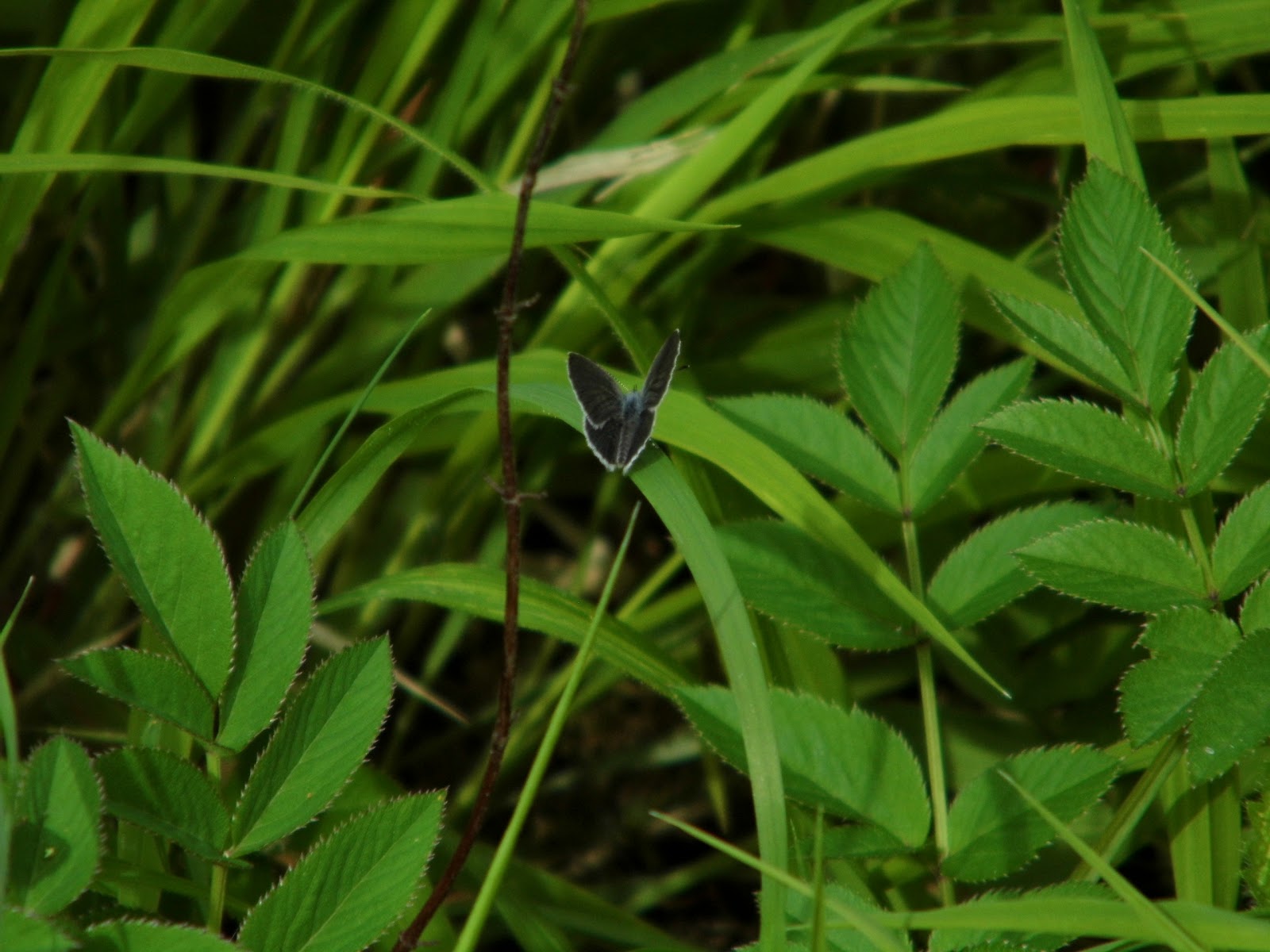
We were ready to give up and head back to the car when a Small Blue was spotted along the edge of a woodland ride, completing a very successful trip.


CHILTERNS: The Duke of Burgundy

25th May 2019

Being keen to see some new butterflies this year I had booked onto Carl Chapman's tour to the Chilterns to look for Duke of Burgundy and Small Blue. The old car park on Bison Hill was closed, so we began at Dunstable Downs, where I saw a new species straightaway as a Slender-footed Robberfly landed on the roof of the car.


We headed down onto the chalky landscape and headed to a sheltered area of Hawthorn. A smal orangey butterfly flew past us without stopping - almost certainly my first Duke but not the sort of views I was hoping for. Luckily it didn't take long for much better ones, as I found one sitting up patiently nearby.


Carrying on around the rest of the site we saw Dingy Skippers and then eventually quite a few more Duke of Burgundies, including a pale one that seems to be the aberration leucodes. A Grizzled Skipper, Grass Rivulet moths, great views of a Red Kite and a metallic green chafer-type beetle (Cryptocephalus sp) completed a successful and pleasant visit.