The Whitlingham Bird Report for 2025 is now available to download from the Bird Reports page or from here

Showing posts with label Crickets. Show all posts

BRECKLAND: Brandon CP - a parasitised cricket and other goodies

Mid-August 2021

One of our favourite Breckland locations is Brandon Country Park, so we headed there over the summer. The cafe was open for outdoor dining, so we had lunch on the tables nearby before heading past the lake and out towards the heath before looping round and back through the woods. Probably one of the most interesting sightings came early on when Cathy noticed an Oak Bush Cricket under a leaf. When I looked closely at it I noticed the eyes seemed un-naturally red and the abdomen seemed to have almost 'melted' onto the leaf. Having posted it on Twitter fortunately Brian Eversham recognised the signs of it having been parasitised by a fungus, Enthophaga grylli. Having flagged this up, several other people also reported seeing similarly parasitised Oak  Bush Crickets in different counties around the same time.

Elsewhere on the track we saw a Large Shaggy Bee (Panurgus banksianus) and the burying beetle Nicrophorus vespillo. Further round I checked some Broom and found the treehopper Gargara genistae, something of a Breckland speciality in East Anglia, whilst Cathy noticed some Buff-tip caterpillars.


Before leaving we had a look around the walled garden and saw galls of  Rhopalomyia tanaceti on Tansy flowers in the flowerbed.


WHITLINGHAM: Family woodland wander

8th November 2020

A family walk at Whitlingham Woods, in part accompanied by a Tree Slug as my daughter insisted that she wanted to show it (named Sluggy) the woods. The fallen Oak tree that has hosted impressive displays of Black Bulgar again was covered in fungi, mostly Stereum spp but also a nice Beefsteak Fungus. Other fungi included Dead Moll's Fingers, a slender relative of Dead Man's Fingers, plus the tiny but interesting-looking Merismodes anomalous.


I made a point of checking lots of tree trunks for resting moths. No luck on that front, but we did see lots of Door Snails, a Pine Ladybird (a fairly common species but one previously missing from my Whitlingham list), Oak Bush Cricket and the spider Drapetisca socialis.


NORWICH: A selection of garden insects

7th & 8th May 2017

You don't have to go very far to see some interesting insects, particularly in sunny weather. On Sunday I was making a cup of tea when I noticed a hoverfly outside, and nipping out for a better look I saw that it was Epistrophe eligans, a common species but one I've only seen once before. Whilst outside I also saw Platycheirus albimanus, which Cathy had seen previously here but was the fourth hoverfly onto the garden list.


On Monday evening I took advantage of a brief sunny spell to have a walk around the garden. Three things were of particular interest, a tiny Speckled Bush-cricket on a dandelion flower, a scale insect sp on a Field Maple sapling and three Polydrusus formosus weevils on the same tree. Not bad for a quick garden wander!


SUFFOLK: Somerleyton Hall

12th August 2015

On Wednesday Cathy & I (along with our mothers) went to Somerleyton Hall, just across the border into Suffolk. On our way we stopped at St Olaves, where we had food and drink at the Bell Inn, apparently the oldest recorded pub in the broads. 


We booked onto a tour of the hall, but before that spent some time exploring the gardens. The highlight was a stretch of flowerbed that was packed with Speckled Bush-crickets and early-instar Common Green Shieldbugs. Cathy found some Rhododendron Leafhoppers, which we thought was rather odd as they were on Chinese Lantern plants. Later on we did find hundreds on Rhododendrons nearby, so it has been suggested that they were simply trying to disperse rather than feeding on an alternate plant. An Oak Bush-cricket was also found on the Rhododendron. As we looked around the outside of the hall I noticed three active House Martin nests. Going inside we had an interesting tour around the hall, before having tea and a big piece of cake in the cafe.

 Somerleyton Hall
 Speckled Bush-cricket
 Rhododendron Leafhopper
Oak Bush-cricket

WHITLINGHAM: Lesser Stag Beetle

26th July 2015

Looking ahead to the weather for my impending time off, I was less than pleased to see that it was basically rain showers for most of the week. With this in mind I decided to get a couple of hours in at Whitlingham on Sunday morning before the rain hit. Wildfowl numbers were similar to the previous week, so the avian highlights were a Kingfisher (perched up on the main island), two Buzzards that flew over and four Swifts, still lingering on in Norwich for a few more days.

In addition to looking for any storm-driven birds, I wanted to check for Willow Emerald damselflies along the south shore of the Great Broad. These damselflies are spreading rapidly now, and were present at Thorpe Marsh, Cow Tower, Cringleford and UEA last year, but not seemingly at Whitlingham. Last Sunday I had seen an Emerald Damselfly sp. (i.e. Common or Willow) fly up into an Alder, but not managed to see it well enough to confirm it was definitely a Willow Emerald. Later that day I checked my emails to find a message from a local birder who had seen a Willow Emerald in pretty much the same spot the day before. I'm being good and not counting it, and there was no sign on this visit, so the wait for my 18th patch odonate goes on.

Another thing I was checking for was for Ladybirds infected with a fungus, but I'll probably do a separate post about that particular quest! I did find a few more new species to add to my patch list, which will hopefully hit 900 in the next few weeks. Of the new species the most pleasing were Short-winged Conehead, Lesser Stag Beetle and the hoverfly Volucella inanis.


NORTH NORFOLK: Moths & Butterflies

30th July 2014

Cathy, Margaret & I began the day at Titchwell to see the opening of the moth traps. Just over 30 species had been caught, most of them fairly common stuff, but there was a new moth for me in the form of Sharp-angled Peacock, along with my second Chinese Character.

After the moth trapping we walked down to Island Hide to look for the Spotted Crake. On the way Cathy noticed the constant buzzing sound of a Roesel's Bush Cricket, which we found at the edge of the path. We waited a little while for the Crake without success, and on our way back we saw two Wall butterflies. My infrequent coastal visits mean that I don't often see Walls anymore (when I was growing up we used to get them in the garden in North Walsham!) so it was a nice butterfly to see.

Blue-tailed Damselfly at Titchwell

After Titchwell we headed along to Cley visitors centre for lunch, noting the flock of Spoonbills on North Scrape. We then carried on to Holt Country Park, where I was hoping to photograph White Admirals and Silver Washed Fritillaries. When I had last came looking for the Fritillaries they had only just begun to establish themselves here and I got a couple of very brief views, so I was delighted to see that around 10 were on Buddleia in the car park. Photographing them proved a bit harder, as they seemed to prefer the higher buddleia flowers and some of them were rather tatty. We watched as one Silver-washed Fritillary flew across the car park being constantly orbited by another (presumably a male around a female?) - very interesting behaviour to watch. I didn't see the brassy variation valezina, although one of the females showed a decent green tinge.

Male Silver-washed Fritillary (deep orange colour)

Whilst watching the Fritillaries a White Admiral flew in. Probably my favourite butterfly, partly because of how exotic it looks despite the monochrome, but also for the stately manner that it flies, gliding sedately over the flapping masses of other butterflies. We saw three in the end, and I did get my photos. Cathy had brought a backpack with butterflies on it, which attracted a Comma in for close views. Walking over to the visitors centre I finally got a good Silver-washed Fritillary picture as one landed in front of me. We also saw some other interesting insects, including a male Wood Horntail. Just before leaving I noticed a Grayling in the car park, the first non-coastal one I've seen in Norfolk for a while.

Spot the real one...
Female Silver-washed Fritillary
Male Wood Horntail (the female is the more familiar yellow-and-black)
White Admiral

WHITLINGHAM: Butterflies galore

7th August 2013

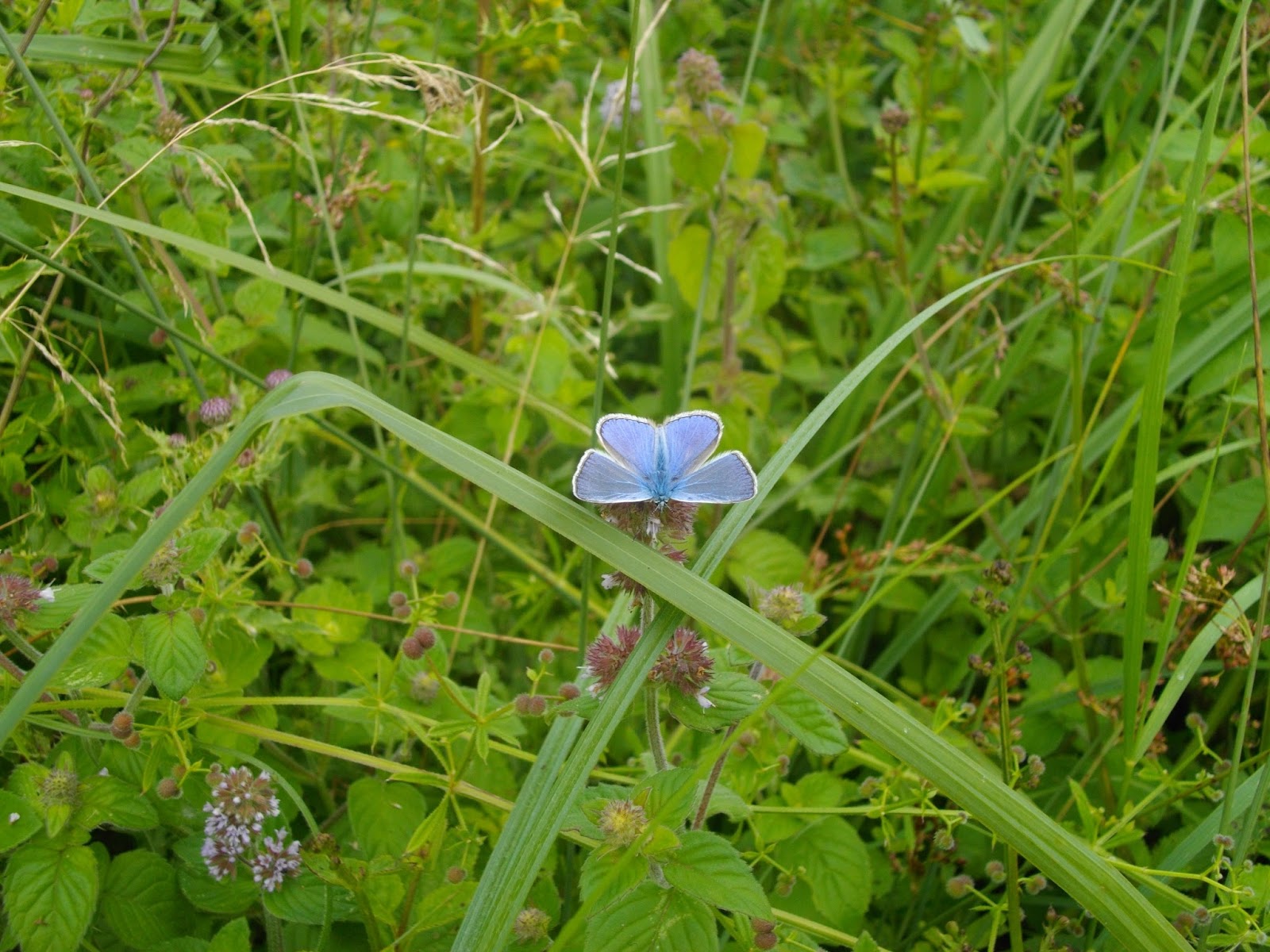
I braved the summer crowds for an afternoon walk at Whitlingham. This year has seen something of an influx of Clouded Yellow butterflies, so I thought I'd have a look for a patch one. I didn't find any, but did manage 14 species, my highest single day count here. This included a Painted Lady and three Common Blues, which I have presumably seen here before and not noted. This became my 20th patch butterfly, with the only likely addition being Purple Hairstreak, of which I still think there must be some nearby. I also found a colony of Roesel's Bush Crickets, lots of Long-winged Coneheads and a Common Blue Damselfly with a non-goblet shaped marking.

On the bird front there are still at least four Common Terns on the Great Broad. Three large Great-crested Grebelings were on the river, still being fed by an adult, whilst across the river at Thorpe Tufted Ducks have bred for the first time in a while - a female and six young were on the shingle spit.


WEST NORFOLK: Black Darter & new Titchwell trails.

2nd September 2012

As summer draws to a close, Dad & I went to Roydon Common in search of Black Darters. It proved to be a good all-round naturalists trip. On the bird front a couple of Buzzards circled overhead, and some Crossbills called as they flew through. A Stoat ran across our path, and a we startled a Chinese Water Deer amongst some rushes. A Small Copper and lots of Speckled Woods were flying around, whilst Roesel's Bush Crickets and Common Green Grasshoppers chirruped away. I noticed an Artichoke Gall on an oak, and whilst looking at that Dad pointed out several Buff-tip caterpillars on nearby leaves. Finally after seeing loads of Common and Ruddy Darters, we located an immature male Black Darter, a species I have wanted to see for some time (thanks to Paul W for his help with directions).


After an excellent roast lunch at the Ffolkes Arms (sic) at Hillington, we headed north to have a look at the new paths at Titchwell. We popped into the Island Mere hide, where several Black-tailed Godwits and Ruff were really close to the hide (if I had been a birder from 200 years ago I reckon I could definitely have bagged them wt ye crossbowe). A Peregrine flew east over the main path. We had a look over the new pool, named Patsy's Pool after Patsy Cline*, a female Red-crested Pochard and four Little Grebes being the pick of the birds. Continuing round we arrived at Titchwell's East Bank, and looked back over the freshmarsh. A single Spoonbill had emerged (the flock of 21 had been spooked off before we arrived apparently). It was all very nice, hopefully I shall be back here to see something rare in the near future!

* This may not be true. 

WHITLINGHAM: Yellow-legged Gull & some crickets

24th August 2012

Another couple of hours spent looking for non-specific bird species. I paid particular attention to a couple of tit flocks that were moving around the site on the off chance that a Pied Flycatcher or Greenish Warbler had tagged along, but found nothing more exciting than three Chiffchaffs. On the broad there were two rafts of large gulls (then one super raft as the solar boat spooked the first lot). The vast majority of the gulls were Lesser Black-backed, but I did pick out an adult Yellow-legged Gull amongst them. The nettles were loud with the stridulations of Dark Bush Crickets, and I went and had a look at the Long-winged Coneheads that I first noticed a couple of years ago. Websites often suggest that people struggle to hear them without a bat detector, but they have always been quite noticeable to me. As I walked back a Swift flew over heading southwards, as did four House Martins a little later.

Female Dark Bush Cricket
Female Long-winged Conehead (camouflaged well!)