The Whitlingham Bird Report for 2025 is now available to download from the Bird Reports page or from here

Showing posts with label Robberflies. Show all posts

OXFORDSHIRE: Silver-spotted Skippers and some chalk grassland

Mid August 2022

Mid month I joined Carl Chapman for one of his butterfly day trips, this time heading to Oxfordshire to look for Silver-spotted Skippers. Our destination was Aston Rowant, a lovely bit of steep-sided chalk grassland that at some point was unfortunately halved by a large motorway. It was during the spell of particularly hot weather, which wasn't ideal, but there was at least some shade around the car park area for lunch. The trip was a success, with lots of Silver-spotted Skippers seen - almost all of which kept their wings resolutely shut, but they did at least allow lots of closed wing photos.


The other butterfly highlight of the trip were the blue butterflies. We saw a few Adonis Blues, mostly concentrated in a small area near the bottom of the slope, but even more interestingly I noticed one had been taken by a robberfly. This was later identified from the pictures as Downland Robberfly, Machimus rusticus, a nationally scarce species and only the second site record according to the national recording scheme coordinator Martin Harvey. Chalkhill Blues were very common, and Carl found a nice abberation as well.


I had been keeping an eye out for Juniper trees, which are apparently common here. I hadn't seen any and was wondering if I was going mad, but scanning through binoculars spotted quite a few on the opposite side of the road. Other highlights were Pale Toadflax and a couple of galls, Mikola fagi on Beech and Aceria thomasi on Thyme.


NORWICH: Robberflies and a lacebug

Mid-August 2020

A couple of additional interesting things seen whilst at my in-laws, firstly a mating pair of Kite-tailed Robberflies landed on the window, and secondly the tiny lacebug Physacheila dumetorum landed on my hand. I haven't seen many lacebugs so assumed it would be a new one for me, although when checking I found that I had seen one before in similar circumstances whilst at the Gunton Arms.


BROADS: Golden-haired Robberfly and the same Deerfly again...

 Early August 2020

Next up on the family walk schedule was Hickling, where the reserve was open for a one-way walk aroudn the reserve. We hadn't got too far when some wild west-style hoof noises started echoing around. We stepped away from the gate we had just come through and turned to look. A Konik Pony soon trotted into view, pausing at the gate to look at us before carrying on and meeting up with two other ponies.


It was a sunny day and quite a few insects were basking, including Golden-haired Robberfly and a Marsh Damselbug. A Twin-lobed Deerfly tried to bite me but fortunately was doing it through a hat. Norfolk has three fairly common Deerflies, but whenever I discover one trying to bite me it is always this species.


In a surprising turn of events we actually saw some birds too. A Kingfisher flew across Hickling Broad from the viewpoint, whilt three Black-tailed Godwits followed a small flock of Lapwing over the reserve. On the way back three Great White Egrets were also seen at the back of one of the scrape areas.

NORTH NORFOLK: Sheringham Park - an insect filled family trip out

Early June 2020

Whilst I had been out locally a few times, we were considering where and when to go out as a family (it can be difficult to make sure a 2 year old socially distances). We settled on Sheringham Park, the recently reopened NT property, partly because we had planned to visit this spring anyway, but also because the National Trust were restricting the numbers of people, so we knew it wouldn't be too busy. 

It was a slightly drizzly day, but we had a good walk through the woods, starting at the bower where a female Blackcap was bathing in the pond and nearby Nuthatch and Firecrest called. It was actually a very productive trip for insects, with a handful of new species for me. Longhorn Beetles are one of my favoured groups, so the pick of them would probably be the Black-clouded Longhorn Beetle (agg) found by Cathy. It has fairly recently been discovered that there are two very similar species, hence the need to record it as an aggregate. Pictures of this, and the other new species are below. We also saw some impressive bracket fungi, Dryad's Saddle and Sulphur Polypore, and even caught a glimpse of the sea from one of the viewpoints.

 Dioctria linearis - a robberfly with pale legs
 Graphopsocus cruciatus - a distinctively patterned barklouse
 Oak Marble (Lobesia reliquana)
 Black-clouded Longhorn Beetle agg.
 Pediacus dermestioides - a flattened beetle usually found underneath bark
 Cottony Camellia Scale (Pulvinaria floccifera)
Tenthredopsis nassata (a sawfly)

WHITLINGHAM: Loads of new invertebrates

Late May 2019

In late May I headed to Whitlingham for a couple of hours after dropping Cathy off. Having given the broad a quick look and noted the lack of birdsong, I decided to focus on the picnic meadow. This paid off nicely with a string of new site records, quite a few of which were also new to me. Below are some of the more photogenic species:

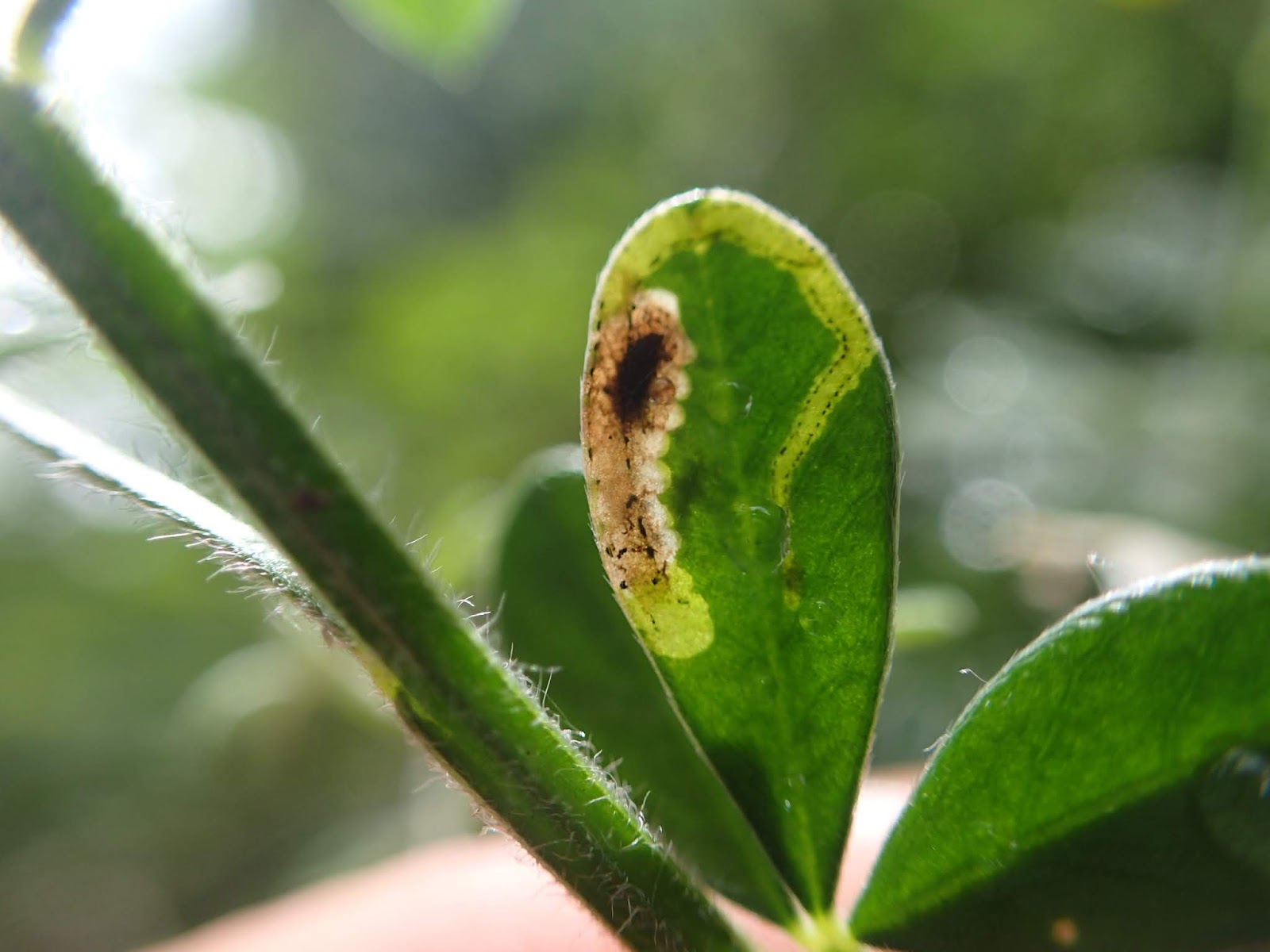
 Agromyza johannae leaf mining Broom (new for me)
 Bee Orchid (present here for many years but only one spike seen today)
 Molanna angustata - a distinctive Caddisfly
 Ciona alauda - one of the weevils associated with Figwort, although seen here on Buddleia
 Eriocrania sangii - leaf mine of this scarce micro moth seen on Birch
 Eristalinus sepulchralis
 Kaliofenusa altenhoferi sawfly leaf mine on Elm
 Orthochaetes setiger weevil mine on Ribwort Plantain
 Common Red-legged Robberfly
Yellow Rattle - a surprise to see this, but almost certainly seeded here.

CHILTERNS: The Duke of Burgundy

25th May 2019

Being keen to see some new butterflies this year I had booked onto Carl Chapman's tour to the Chilterns to look for Duke of Burgundy and Small Blue. The old car park on Bison Hill was closed, so we began at Dunstable Downs, where I saw a new species straightaway as a Slender-footed Robberfly landed on the roof of the car.


We headed down onto the chalky landscape and headed to a sheltered area of Hawthorn. A smal orangey butterfly flew past us without stopping - almost certainly my first Duke but not the sort of views I was hoping for. Luckily it didn't take long for much better ones, as I found one sitting up patiently nearby.


Carrying on around the rest of the site we saw Dingy Skippers and then eventually quite a few more Duke of Burgundies, including a pale one that seems to be the aberration leucodes. A Grizzled Skipper, Grass Rivulet moths, great views of a Red Kite and a metallic green chafer-type beetle (Cryptocephalus sp) completed a successful and pleasant visit.


WHITLINGHAM: Clouded Yellow search

11th September 2016

During the afternoon Ben Lewis had seen a Clouded Yellow butterfly at Whitlingham, so I headed down early evening just in case it was still around. Despite the warmth the shadows were beginning to fall, and there were very few butterflies of any colour. I spent some time watching a Robberfly (a female Kite-tailed Robberfly I think) some Lasioglossum bees on Canadian Goldenrod. 


With the South Yare Wildlife Group fungus foray coming up at the end of the month I also had a quick look for some fungi. The dry conditions meant there wasn't much about, but the Giant Polypore was impressive as ever.


WHITLINGHAM: Late summer insects

1st September 2016

I headed down to Whitlingham for an hour after work on Thursday, but with few birds about I ended up going as far as the island then looping back around the picnic meadow. A Holly Blue was of interest, as like Small Copper I tend to see them less than annually here. I noticed some leaf spots on the lime and went to have a look, and in doing so also found a soldier fly resting on one of them.


Twin-spotted Centurion and Mycosphaerella microsora leaf-spots on lime

Other interesting sightings on the meadow included a Robber fly with prey (not identified to species yet, hopefully I'll sort that out later) and a Common Darter on a dead umbellifer.

 Robber fly sp.

BRECKLAND: Brandon CP Bioblitz

30th July 2016

On Friday and Saturday NBIS ran a Bioblitz at Brandon Country Park, just over the border into Suffolk, as part of the second year of the Breaking New Ground project. Bioblitzes are very popular at the moment, and as a result experienced recorders tend to have to pick and choose which ones they can attend. I had been asked if I was free to attend this one, and as Cathy & I like Brandon we had agreed to help do some recording on the Saturday.

The first event of the day was going through the moth trap, so having said hello we went into the walled garden where Teresa and Tim showed several families the moth catch from the previous night. There were three Pine Hawk Moths and a Poplar Hawk Moth to please the children, along with others including Black Arches, Lesser Swallow Prominent and Scalloped Hook-tip. The most attractive moth in my opinion was a Maiden's Blush showing much more red than the ones I'd seen before.


Next up was a fungus walk led by Tony Leech. Again the participants were families with young children, so Cathy & I headed off into the woods and brought back fungi for them to see, Cathy finding more than I did! One of them was new for me, Entelome hebe. A Brimstone flew past, a Red Longhorn Beetle rested on some nettles and back near the cafe I found some Rosemary Beetles on the lavender.

 Parasola leiocephala
 Rosemary Beetle

After lunch we headed out for a look around the woods and lake area. There were a lot of dragon and damselflies, including Emperor, Brown Hawker, Southern Hawker, Emerald Damselfly, Common Blue Damselfly, Blue-tailed Damselfly and lots of Ruddy Darters. A robber fly has been identified for me as Golden-tabbed Robberfly, a species whose East Anglian distribution is largely restricted to the Brecks. Another highlight was the hoverfly Xanthogramma pedisequum, which had been caught and brought to the table for ID. We stayed until the end when we went round to check the mammal traps, seeing a Bank Vole that somehow escaped out of the back of a trap.

 Ruddy Darter
Golden-tabbed Robberfly