The Whitlingham Bird Report for 2025 is now available to download from the Bird Reports page or from here

Showing posts with label Trowse Meadow. Show all posts

WHITLINGHAM: Trowse Whooper Swans

Early November 2022

There was an unexpected patch tick for me when two Whooper Swans spent the day on the flooded Trowse Meadow, visible from Whitlingham Lane. I'd not seen either wild swan at Whitlingham before, although there was a Bewick's Swan on the river near Bishopgate for a while a few years back and I've seen a couple of flocks over the south of the city too.


WHITLINGHAM: A couple of visits to Trowse

September 2021

A couple of brief visits to Trowse Meadow and the burial ground, a rather negelected bit of my patch of late, turned up a few interesting things. On my first visit I noticed a new patch plant, Balm, whilst some fibrecaps were probably (but not confirmed as) Deadly Fibrecap (Inocybe erubescens). There were a couple of nice galls on some roses too.


On the next visit I looked for and found a couple of species I'd seen elsewhere recently, Dogwood aphid and Spindle scale insect, and photographed some pondskaters that I have frustratingly failed to identify.


TAS VALLEY: Caistor St Edmund, High Ash Farm & Trowse

25th July 2017

After dropping Cathy off in the city I had a few hours to spare before picking her up again. I decided to head to Venta Icenorum, the old Roman Town at Caistor St Edmunds just south of the city. The main attraction here from a wildlife point of view is a large area of dry grassland with the river Tas wending its way through. Plant highlights here included White Mullein, Dark Mullein, Common Calamint and Restharrow.


Much of the grassland around the base of the monument had been recently cut, so I walked around the base of the mound to check out the flowers growing on the banks. The overcast weather meant lower returns than normal, but when I stopped to check out a Hawthorn I found a Hawthorn Beetle, an overdue first for me.


Other highlights on my walk round included my first Clover Melitta bee, several Common Blue butterflies, a Dusky Sallow moth and some unsually obliging Meadow Grasshoppers.


I crossed the road and had a quick look around one of the permissive paths at High Ash Farm, where I found some leaf mines in Himalayan Balsam. There are caused by a fly Phytoliriomyza melampyga. There were no East Anglian records on NBN, so I thought I could have a county first. However when checked with the Agromyzidae recording scheme there are actually several Norfolk records from datasets that aren't on the NBN Atlas. There are a range of reasons why this is the case, but it's not the first time that the NBN maps haven't born any relation to a species range that I have checked, which is a shame.


On my way back to the city I called in at Trowse Meadow and managed one patch addition, a twisted stem gall on Black Poplar caused by aphids.


TROWSE: Some mimicking hoverflies & other patch ticks

24th June 2017

After my successful Currant Clearwing visit, I headed around Norwich to Trowse for a bit of time on patch. Trowse Meadow was pleasant, but in overcast conditions there weren't as many insects about as I'd hoped, with the exception of numerous Banded Demoiselles near the river. A clump of Pencilled Cranesbill growing near the bridge are new to my Whitlingham list as far as I remember, and the click beetle Adrastus pallens was also new.


I then crossed the road and went up into Trowse Woods. I walked fairly quickly through the shady areas because my destination was the clearing at the top of the woods, where two islands of Buddleia attract lots of insects. I was in luck, and after a few minutes there was some bright sunshine. A Common Darter was resting and I got good views of Eristalis intricarius, a bee mimic, and a pair of mating Meadow Browns. The undoubted highlight was a new hoverfly for me, Chrysotoxum festivum, a wasp mimic.


Leaving the woods I looked round past Whitlingham Hall down to the country park, adding another two patch ticks, Oak Bush-cricket (a species that sometimes comes to moth traps but is otherwise quite hard to record, despite being common) and a ground bug, Petritrechus lundii.


WHITLINGHAM: Trowse Meadows

23rd August 2016

As the hot weather continued I headed down to Trowse for an hour, to have a look for insects on the meadows. I found a promising place to sit where I could see the river and several species of flower, and phased out the droning background noise of work going on across the river. Fish shoaled in the shallows, and a Brown Hawker patrolled just above my head. I noticed that the figwort was Green Figwort, which was a patch tick, and a Lasioglossum bee fed on some Water Mint. A Small Copper was of note, considering I don't see them every year here.


After a while I crossed the road and headed for a walk around the church meadow. I hadn't been here for years, and there wasn't much to see, with only a bit of Ragwort and Knapweed in flower. I checked some Lime tree trunks, finding a couple of Noon Flies, before heading back through through the churchyard and home.


WHITLINGHAM: Trowse invertebrates

29th May 2016

In case you hadn't noticed, we are now firmly in the period where inland bird activity has declined and plants and insects come to the fore on the blog. With this in mind I decided that rather than go straight to Whitlingham I would focus my attentions on Trowse Meadow and Trowse Woods before having a quick look over the broad.

Trowse Meadow was covered in buttercups, and looks the sort of place that should really have orchids too, but apparently doesn't. Some cows are grazing on it, but they seem to have a very placid temperament. I focused on some of the vegetation along the river edge, finding a couple of Downlooker Snipe Flies and an interesting dark fly sheltering underneath a poplar leaf. Incidentally there are a couple of trees here that look like Black Poplar, which is quite rare now. Does anyone know if the Poplar trees at Trowse are 'proper' Black Poplar or hybrids? Anyway, I didn't recognise the fly, but Andy Musgrove identified it as another soldier fly, possibly Scarce Orange Legionnaire, which if confirmed would be another new to 10km like Friday's Black Colonel.


Downlooker Snipe Fly
(Scarce?) Orange Legionnaire - note the orange body that gives it its name is hidden under the black wings

I saw two more interesting bugs as I departed the meadows and entered Trowse Woods. Firstly on nettles at the edge of the meadow was the ant-like nymph of Miris striatus (sometimes called the Fine-streaked Bugkin) and secondly was a yellowish soldier beetle, Cantharis decipiens.


On my way up through the woods I stopped to note various plants, harvestmen, weevils, beetles, galls and leaf miners, some of which I photographed to look at closer when the time allows. The clearing at the top of the woods didn't have many flowers out (a patch of Red Campion notwithstanding) so I carried on and exited the woods, heading east towards Whitlingham. Here I spotted a new micro moth, the Sulphur Tubic.


Walking back along the lime tree avenue to Whitlingham there were several more things of particular interest. This fly, apparently bound to the dock with some white silky stuff, has actually been parasitised by a fungus (Entomophthora muscae). The fungus kills the fly, but not before making it walk to a prominent position so that the spores can be dispersed and infect other flies. The Longhorn Beetle (Grammoptera ruficornis) was also a new species for my patch list. After a quick look over the Great Broad I completed my circuit, ending a very productive visit.


TROWSE: A neglected bit of the patch

7th August 2015

The majority of my patch visits up until the last couple of years were carried out on foot, and as it was no further to go I would often cut across Trowse Meadow rather than walk the first part of Whitlingham Lane. In recent years when I got lifts or latterly drove myself, I have headed straight to the main country park. This struck me earlier in the week, so I decided to head down to Trowse on Friday evening, specifically to cover Trowse Meadow and Woods, a rather neglected part of my patch.

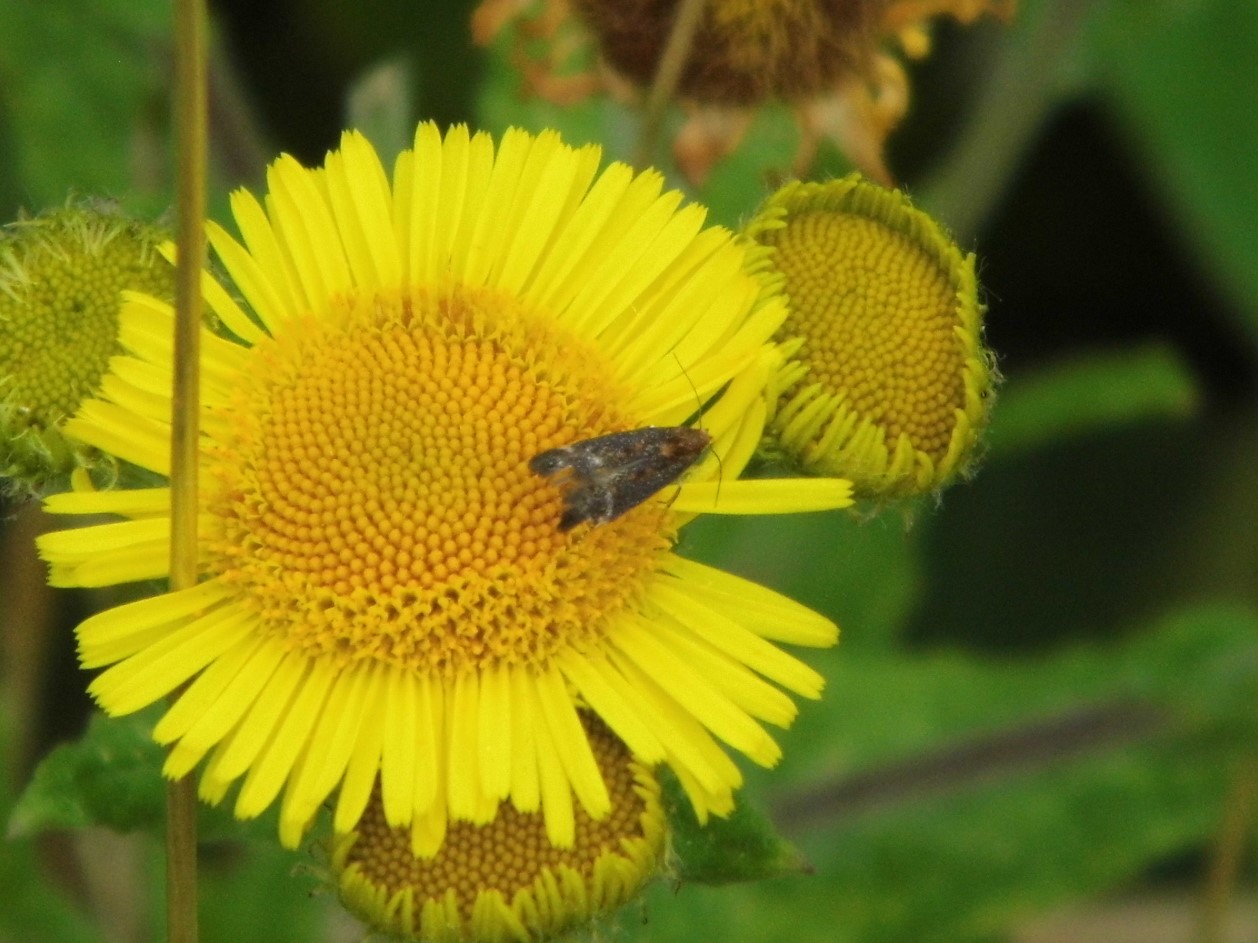
I had a nice stroll around the meadow, without adding too much. I did notice a poplar tree that resembles Black Poplar, which would be new if it isn't a hybrid and is in a natural state. It also appears to have a yellow rust on it, although I think there are two possibilities, so that isn't straight forward either. I found an unfamiliar micro moth on Fleabane, which once home I identified as Dark Fleabane Neb (Apodia bifractella), a rare species in Norfolk and it looks like a new TG20 record.

After this I headed into Trowse Woods, and was only a few feet in when I noticed a 14-spot Ladybird. I had recently looked through my old ladybird records, so I knew that this was a new patch record, my 900th species here. Note that my numbering is based on the order I identify things, not necessarily when I see them. Whilst this may be counter-intuitive, the other option would be to re-do all of my numbering if I were to retrospectively identify something I saw earlier in the year, which does happen. In reality it is the overall number of species that interests me more than the order anyway.

The weather was rather overcast and humid, making the woodland seem rather opressive. I had a look in one of the large 'craters' just in case the Bearded Tooth fungus that used to grow here had returned. It hadn't, but there was a bit of fungi, including some bright Yellow Shield fungi (Pluteus chrysophaeus). This wasn't new, having seen it in a similar place last year with the Fungus Study Group. Whilst stood still, a shrew ran out from under a log. I didn't see it well enough to rule out Pygmy Shrew, although I suspect it was a Common Shrew. It darted out again, but knowing how active they have to be I left it to go about its shrewy business.


I emerged in the glade at the top of the woods to the strong scent of Buddleia. Disappointingly there were few butterflies or hoverflies around, a single Red Admiral soon flew off. I took the path along towards Whitlingham Hall, stopping to photograph some Robins' Pincuchion galls to add to my gall guide. As I reached the Lime tree avenue the smell of a barbeque reached me, coming from the packed Whitlingham camp site, which has been so successful there is currently a planning application to make it permenant and build three lodges into the woodland edge. A couple of Swallows near the Little Broad were the only birds of note.

 900. 14-spot Ladybird
 901. Dark Fleabane Neb (Apodia bifractella)
Possibly two more?! Firstly is this Black Poplar? The rust will probably require microscopy and some specialist literature.