The Whitlingham Bird Report for 2025 is now available to download from the Bird Reports page or from here

Showing posts with label Lifer. Show all posts

WEST NORFOLK: Snettisham C.P. - Great Reed Warbler & interesting inverts

Late May 2022 

I had planned to spend a day in west Norfolk around Whitsun to look for the scarce hoverfly Microdon devius (in turn because I hadn't got round to it last year!), but with showers forecast and having not seen a new bird for several years I decided to change plans and head instead to Snettisham C.P. where a long-staying Great Reed Warbler was in residence. Arriving at the car park I almost instantly heard Turtle Doves calling, which was a nice start to the visit. I cut across an area of scrub, noting some aphids and the psyllid Cacopsylla hippophaes on the Sea Buckthorn. 


After quite a long walk along the embankment I reached the place where the Great Reed Warbler was singing from. There was only one other birder present, and the bird showed brilliantly perched near the top of the reeds as it belted out its song. Cutting back down onto the country park I noticed the aphid Brachycaudus tragopogonis on Goatsbeard.


Next I checked out the edges of some brackish pools, noting Saltmarsh Rush, Sea Club Rush and False Fox Sedge.


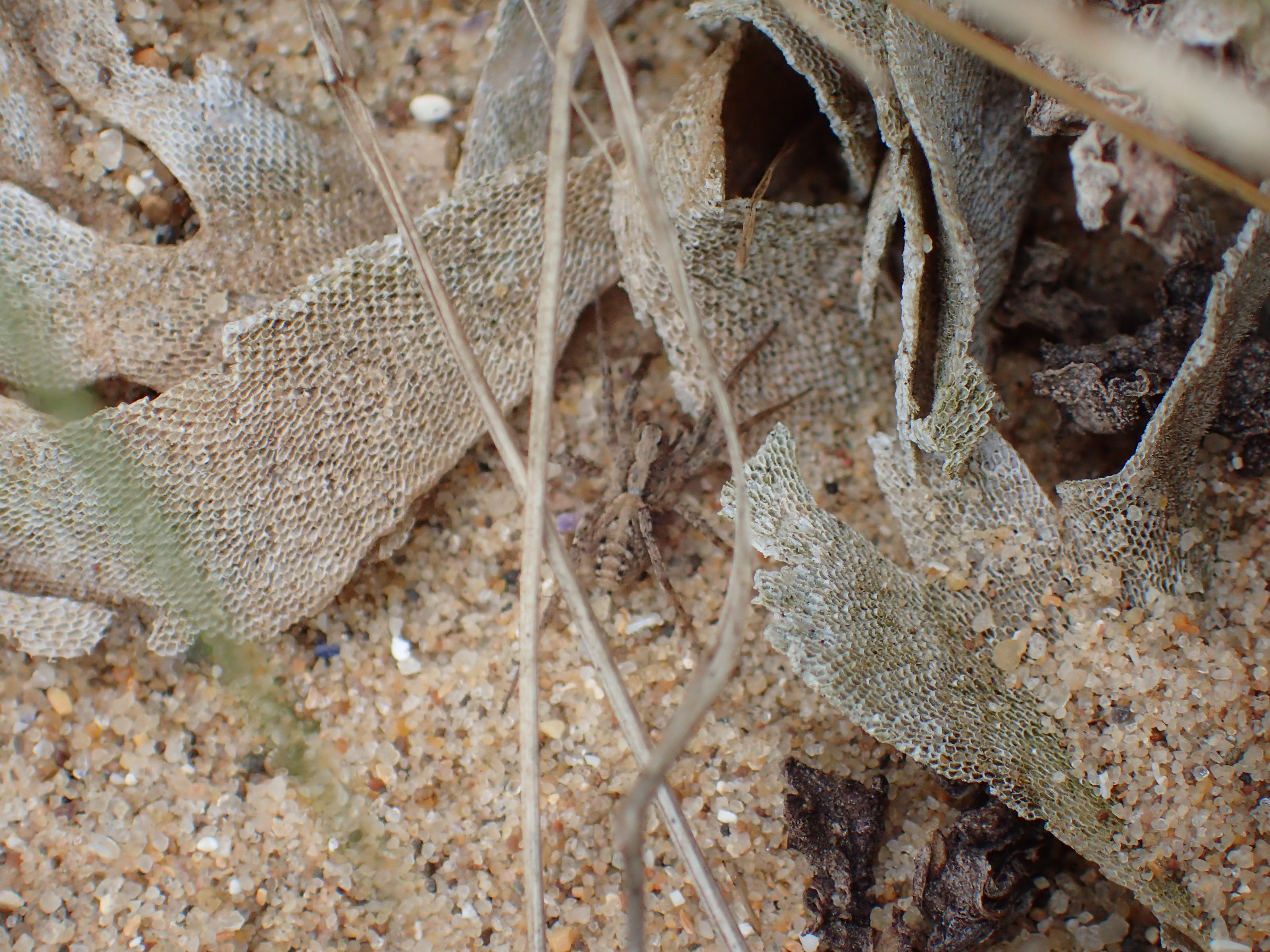
I spent lunchtime along the seaward side of the dunes. I spent some time looking at patches of Marram hoping to find the Marram Pseudoscorpion, and Stork's-bill for another one of my target species, Dalman's Leatherbug. I found neither, but did see plenty of bugs Trapezonotus sp (based on habitat T. arenarius), the beetle Phylan gibbus, spider Xerolycosa miniata and Fallen's Leatherbug.


I finished my visit by checking Viper's Bugloss plants for larvae of a case-bearing moth, but ended up finding an adult of a different species, Bugloss Bent-wing, Tinagma ocnerostomella.


WEST NORFOLK: A nice dung heap

27th December 2019

It was the day after Boxing Day, and I had spent the morning watching Paddington 2 on repeat with my daughter. I temporarily distracted myself by having a look through some of the books I'd got for Christmas, and picked up Dung Heaps of Eastern England volume 2. I was concerned that I wouldn't be able to pick up the story having never read volume 1, but it was quite straightforward. 


Apparently one of the most impressive dung heaps in Norfolk was at Sedgeford, a village near Docking in West Norfolk, so I decided to set out after lunch to have a look. The sky was a uniform grey - in fact it seemed like the sun had risen a few degrees above the horizon and then given up, like some post Christmas apocalypse was imminent. At least it wasn't raining, and I arrived at Sedgeford in exactly the same overcast conditions. Finding the dung heap was simple as a small gathering of fellow manure enthusiasts had already got it under observation.


Whilst there I thought it would be a good idea to make note of any wildlife around, and by happy coincidence what should be accepted as Norfolk's first Eastern Yellow Wagtail (Motacilla tschutschensis) was feeding on the heap. This species has probably occurred in Norfolk previously, but the relatively recent promotion to full species and recent work on ID mean that this is likely to be the first record to go past the records committee, even if others are accepted retrospectively.


You could be forgiven for not having heard of Eastern Yellow Wagtail, indeed it won't be in many field guides. There are currently four subspecies - as a male this one has been identified as the nominate race, Motacilla tschutschensis ssp tschutschensis, which is pronounced in a similar way to having a series of sneezes. Naturally rather than leave it at this people are eager to give it an English name. Blue-headed Eastern Yellow Wagtail has been suggested, but this seems overly long and invites confusion with Blue-headed (Western Yellow) Wagtail. Now it appears most people are going with Alaskan Wagtail, but Alaska is a relatively small part of its range, and on a standard map it would actually be classed as west of the UK not east. In case you were wondering who decided on the name Alaskan Wagtail, it would appear some Dutch birders popularised it, although it isn't clear from the paper if they just made it up or got it from somewhere else. Anyway, nice bird, nice dung heap.


NORTH NORFOLK: Titchwell Semipalmated Sandpiper

21st July 2019

A family trip to Titchwell, my first visit of the year. The weather was nice, and as we walked down the main path I noticed a Bloody-nosed Beetle at the side. We soon saw the Dunlin flock, and after a scan through managed to locate the Semipalmated Sandpiper that had been found a few days before. This was my first new bird of the year (the result of now much birding in spring rather than having a large list it should be pointed out) and it was nice to share it with Cathy & Rose, who was lifted up to view through the telescope and then pointed out at the distant flock to show where she had been looking. A Curlew Sandpiper and Spotted Redshank were also present on the freshmarsh, and we got good views of a Spoonbill that flew overhead. I'd noticed a few clegs landing on us as we stood around, and not wanting her to get bitten we moved on, noting a few more invertebrates as we headed back.


NORTH NORFOLK: A bit of coastal birding

22nd October 2018

Other commitments have meant few days out birding this autumn, so it was a pleasant surprise that on the day before an arranged trip to North Norfolk with Adam that a Brown Shrike had been found at Weybourne Camp and the presumed Stejneger's Stonechat was still present between Salthouse and Kelling. 

Having both seen the long-staying Brown Shrike at Staines a few years ago, both Adam & I were most interested in the Stonechat, so we headed straight to Salthouse and parked up by the duckpond. Whilst there a message came though to say there had been no sign of it, but we walked down to Meadow Lane. It only took a couple of minutes to locate the 'Eastern' Stonechat - perhaps we just got there as it was waking up, or the observers present were looking in the wrong place. Whilst it stayed mostly distant, the gusty wind made it hang in the air, showing off the rump and underwing nicely.


After a while we moved on to Weybourne, where the news was progressively less optimistic. Birders walking back had been present from dawn and not seen the Brown Shrike. The next few told us that access to the camp wasn't possible today because of activities in the compound, and finally we found out that Moss Taylor had conducted a thorough search of the area and it appeared the bird had definitely moved on. We switched our attention to the sea, where there was a good passage of distant auks, Gannets and Red-throated Divers, but not much else.

We had time to visit one area to look for migrants, so decided to spend the time at Gun Hill. The lack of thrushes on our way out to the dunes didn't bode well, and there were very few birds at all in the scrub - a 1st-winter Reed Bunting and a Whinchat were the only things of note. As we headed back eastwards Adam stayed in the dunes whilst I walked along the dune edge, hoping to find Dune Cup fungus. I didn't find any (they had probably been covered by loose sand), but we did see quite a bit of other fungi, including Dune Stinkhorns.

 Agaricus sp.
 Dune Cavalier
Dune Stinkhorn

Spotting a plank of wood I decided to check under it to look for specialist woodlice and beetles. This was half successful, as the woodlice were all the ubiquitous Common Rough Woodlouse and Common Pill Woodlous, but the beetles were beach species, Broscus cephalotus and Aegiala arenaria. We stopped off on the way home at a location that has held Tree Sparrows in the past, but a house renovation and some scrub clearance means that sadly the area is no longer suitable for them.


NORTH NORFOLK: Wells warbler & fungi

17th September 2017

I didn't have any plans for Sunday, so when an Arctic Warbler was found at Wells Woods I decided to head over and have a look. It was raining on the way up, but by the time I got there the sun was out, creating a marked difference between the waterproof wearing birders and the beach going tourists. After a brisk walk to the area of birches that the Arctic Warbler was frequenting I got brief views before it flew further back into the trees. Rather than go round I decided to stay and wait for it to come back, and was rewarded with good 'scope views as it worked its way up through the trees. It was a bit too mobile for my digiscoping so I didn't bother trying, but others were clearly getting some good photos.

After a while (and conscious of the fact I'd only paid for two hours of parking) I wandered back. At the edge of the birches I stopped to look at a Brown Birch Bolete, and closer to the dell I found several more. These latter ones had darker caps, but turned out to be the same species. A Small Copper landed briefly on the path, and two Bitter Waxcaps were growing in the Dell amongst lots of Eyebright. I also noticed some sawfly caterpillars feeding on Birch leaves on my way back. A pleasant trip for my first coastal birding of autumn, and belated my first new bird of the year.


NORTH NORFOLK: Pony poo and geese

21st December 2016 

Having dropped Cathy off in the city, I had a few hours to spare. I decided to head to Holt Lowes, where Andy Musgrove had recently seen Poronia punctata, a scarce nail fungus sp. that grows on pony dung. I had previously looked for this species unsuccessfully at Roydon Common and equally unsuccessfully for the related species Poronia erici on rabbit droppings at Holme Dunes. Whilst there is no shortage of horse dung in Norfolk, the medication given to horses tend to kill off many of the fungi that may otherwise grow, so this species only occurs where the wilder breeds of pony are used for conservation grazing. 

After heading out on to the heathland I had located some pony dung, but no nail fungus. Eventually I found some covered in small toadstools, probably Conocybe sp. Clearly this was a good age for fungal fruiting, and so it proved to be, with my first Poronia fruiting body. It hadn’t got as large as some of the ones that Andy had seen, but there we are. I considered whether to spend more time looking, but at the back of my mind there was a desire to go and look for the Todd’s Canada Goose* near Docking, which Gary had kindly texted me to say had been seen again this morning. In the end the goose won, and I headed back to the car. 


I headed past Holt and Fakenham before turning off to Docking. Out on the road to Brancaster I saw a couple of cars pulled over, so parked nearby and went to join them. There was a large flock of Pink-footed Geese, with many more behind them in fields further over, but upon scanning them I couldn’t see the Todd’s Canada Goose. The birders already present confirmed as much, several White-fronted Geese but nothing else so far. I waited whilst another large flock arrived, bringing with it several Barnacle Geese. A newly arrived birder then told us he had seen the Canada Goose in a field from the next road over, so I decided to head round that way in the hope it was still present. And it was! I was able to pull off the road and ‘scope the flock from the car, picking out the Todd’s Canada Goose without much trouble. Full of festive cheer I drove back to Norwich, arriving just in time to pick Cathy up from the city. 

* Todd’s Canada Goose is the vernacular name for Canada Geese of the subspecies ‘interior’. There are a number of subspecies of Canada Goose, of which the smaller ones now form part of a separate species, Cackling Goose – BirdGuides did a useful article on which subspecies are ascribed to which parent species. Subspecies of both Canada Goose and Cackling Goose occasionally arrive in Norfolk with wild goose flocks, and as such are ‘category A’ birds rather than the resident feral flocks, which are on category C of the British list.

SUFFOLK: Minsmere Cliff Swallow

5th November 2016

On Friday evening news emerged on Twitter of two very rare birds - a Cliff Swallow at Minsmere and an Eyebrowed Thrush in Northumberland. The thrush looked particularly nice, but I had no intention of going that far. The Cliff Swallow on the otherhand was tempting - Minsmere is just as close to get to as Titchwell, and there hadn't been any previous East Anglian records, so there was no imminent sign of one turning up in Norfolk. I hadn't made up my mind when I received a message from Andy Musgrove, who was going and had space in his car. This was the spur I needed to decide to go and have a look.

The Cliff Swallow had been seen going to roost in the reedbed, so we left early in the hope that we would see it shortly after leaving the roost. As it was we arrived and were told that it had flown south with seven Swallows about ten minutes earlier. Undiscouraged we waited, and it wasn't long until a group of hirundines returned. There was a brief period where we could clearly see eight Swallow spp at a distance but not make out which was the Cliff Swallow, but luckily they flew right past us, and the pale rump and distinctive shape stood out.

I had been prepared for flight views only, but the dull weather was probably poor for feeding, and the flock settled in a small tree between the Sand Martin cliff and the north wall. We obtained excellent views, both perched and in flight, although the Cliff Swallow was often facing the opposite direction to the swallows. I took a few record shots, the first one in poor light and the latter with the Cliff Swallow (the bird of the left) looking away from us. Still, there were lots of birders there, so if you want to see a better photo I'm sure you can track one down on one of the other blogs linked on the right hand panel. A flock of five Bewick's Swans flew over whilst we were watching the Swallows.


Nb. These photos are "record shots" - not very sharp or good colour, but if you enlarge or squint you can make out what the bird is, just. Some pseudo-modest photographers insist that their otherwise pin sharp flight shot taken with £5000+ worth of equipment is only a record shot because a bee flew through the bottom corner of the shot. They are mistaken.

After a while we decied to do a lap of the reserve. We saw a couple of Stonechats along the path, and Andy swept an interestingly-shaped spider called Cyclosa conica from the vegetation. There was quite a bit of fungi about in the short grassland, including Hairy Parachute, False Chanterelle and a couple of different yellow spindle types. Near the sluice we had a closer look at the Tamarisk, and I was shown a Tamarsik-specialist bug called Tuponia brevirostris. On the way back round we also saw a Musk Mallow specialist Weevil, Aspidapion soror. A final delight came in the form of a spider with the English name 'Marsh Knobhead'. In the interests of accuracy an ecologist pointed out that a rare confusion species for the spider does also occur at Minsmere, which although usually not overwintering, could do this year because of the warm weather. So technically it is a probable Marsh Knobhead.

 Probably a Marsh Knobhead
 A scarce weevil.

On the way home we were near Hempnall when Mike said that the fields looked good for Golden Plover. Less than a minute later we saw a small flock of Golden Plover. Hopefully these predictive powers can be put to better use with a rarer species at some point. Thanks to Andy for driving, and also to the staff at Minsmere, who have now had to cope with several big twitches this year and have coped admirably.

NORTH NORFOLK: Wheatears and a whale

23rd October 2016

Whilst I'm a big fan of fungi, birds remain my favourite 'group', so I had been acutely aware over Saturday and Sunday morning that whilst I was involved with fungus-related events Norfolk's first twitchable Isabelline Wheatear was present at Burnham Overy Dunes. On Sunday that area of the dunes also held a Pallas's Warbler and a Desert Wheatear, so a good cluster of rare species. After lunch I headed to Burnham Overy, and having checked the tide times parked up in the village car park.

After a brisk walk out to the dunes I arrived at a large group of birders, only to find that they were gathered to watch the Pallas's Warbler rather than the Isabelline Wheatear. As it happened this worked out just fine, as the Isabelline Wheatear came to us, flying in onto the ridge of a dune in front of us, and showing well for a brief period. It moved out of sight and then was accidentally flushed, at least providing flight views. Once it had gone I had a look at the Pallas's Warbler, which was very mobile amongst some Privet and scrub.


I decided to head west, keeping an eye out for the Isabelline Wheatear, which appeared to have gone down into the dunes not too far away. A birder further along beckoned, and upon reaching him we saw that he had located the Desert Wheatear. Earlier on I had a brief chat with Carl Chapman (Norfolk's cetacean recorder), who had told me that the Fin Whale that washed up on the beach recently was still present, so I decided to retrace my steps to the boardwalk, keeping an eye out as I went, before heading over to see the whale. Some people find looking at dead whales ghoulish, but I see little difference between this and looking at museum specimens. The carcass was roped off and people were being respectful - hopefully those seeing the dead whale will be more receptive to environmental issues around our oceans in the future, which would be a fitting epitaph.


I crossed the beach and went up into the dunes to have a look around, but saw very few birds. There was quite a bit of fungi, including lots of puffballs, some Dune Dapperlings and Dune Waxcaps. One of the dune specialties here is Winter Stalkball, and I was able to show how similar the smaller ones are to rabbit droppings! With the light beginning to fade I walked back to the car after a highly productive afternoon.

 Dune Dapperling (Lepiota erminae)
 Dune Waxcap, an old specimen split so it looks like a flower
 One is a rabbit dropping, one is a Winter Stalkball!
Older Stalkballs are easier to identify, although still need some work to find. Luckily they often grow in quite big groups.

SUFFOLK: Minsmere Swamphen

1st August 2016

On Sunday afternoon news broke of a Purple Swamphen at Minsmere. You could be forgiven for not knowing what a Purple Swamphen was, because they used to be called Purple Gallinules, and after a bit of splitting this particular species is now known as Western Swamphen. The RSPB Minsmere account tweeted that the bird was ringed, and therefore probably an escape, so I went shopping and didn't think much more about it. I returned to see that there had been a retraction - it wasn't ringed, and information was emerging that there had been a movement of several other individuals through France this summer, away from their breeding area along the southern French coast.

The seemingly increased chance that this was a wild bird, and therefore a first for Britain, along with the excellent photo of the recent French bird here: http://www.faune-bretagne.org/index.php?m_id=54&mid=23405 made me want to go and have a look for myself. Figuring that Minsmere would be packed that evening, and having work to do during the day on Monday, it was Monday evening before Cathy & I headed down to look for the Swamphen.

Having arrived at Minsmere for the second time in four days (usual visit frquency about once a year) we headed down to south hide, where there was a large crowd of people along the path. The height of the vegetation meant that the favoured pool wasn't completely viewable from anywhere, so we picked a spot with a limited view but of the area where the Swamphen had last been seen. Despite showing well on Sunday and Monday morning, it hadn't been seen for at least 45 minutes before we arrived. An hour and a half later and the novelty of staring at a Little Egret was beginning to wear off.

Fortunately, before we gave up (or got hypnotised by the Egret), a very tall man beside us announced that he'd got the Western Swamphen, walking out of the reeds. A few seconds later and it became visible to us too, walking behind the Little Egret we'd been watching. It was a cracking bird to see - imagine putting a Moorhen on steroids until it grew to twice its size, painting it bluey-purple, stretching its legs and toes and painting them red, then shoving a Puffin's beak on the whole setup. The main group of birders hurried over to us to see it, but many still couldn't see because of the vegetation. Seeing that Cathy had already ducked out to give her place to another birder, I did the same rather than wait to get a rubbish record shot, so no photos I'm afraid. If you haven't seen it (and I'm guessing most readers will have done) then there are some good photos of it on Craig's, Peter's and David's blogs. 

Also of interest was a pale pink flower growing in large clumps along the path to the hides. This is Marsh Mallow, which in ye olden days was eaten and may have been some sort of prototype for todays marshmallows.


NORTH NORFOLK: Great Knot

2nd July 2016

On Saturday afternoon I headed back to Titchwell, hoping to catch up with the Great Knot that has been accompanying the Knot flock for the past few weeks. As I drove between Docking and Brancaster the scene in front of me seemed the very definition of atmospheric. The water on the road was evaporating in the strong sunlight, and as I crossed the brow of the hill a Red Kite drifted over the road. Either side fluffy cumulous clouds hung in the sky, but ahead lines came down from menacing grey clouds, showing that it was raining hard offshore. A flash of lightning lit up the sky, reminding me uneasily that early in its stay the Great Knot had been spooked by a big storm.

It was about 16:30 when I reached Titchwell, and I was surprised to see how few people were around the car park and visitors centre. There were a few people standing on the main path scanning towards the Knot flock, so I set up my telescope and looked out. There were two tightly packed groups, so in the end I conceded and asked if the Great Knot was amongst them. It was, but right at the back and only the head and a bit of the back was visible. Relocating to the Parrinder Hide the Great Knot was more visible, albeit not more active. After a while (and one of those crunchy nature valley bars) I headed back to the main path, seeing a Spotted Redshank and a leg-ringed Avocet before heading home.


NORTH SUFFOLK: Blue-winged Teal

7th June 2016

I seldom twitch birds outside of Norfolk these days, but when a drake Blue-winged Teal was found at Carlton Marshes near Lowestoft on Monday I was tempted. I have a fondness for ducks, and had previously attempted but failed to see a Blue-winged Teal at the Ouse Washes with Jim. In the past ten years there had only been a couple of accepted records in Norfolk, both one-day birds at Cley and Holme. This bird was less than 1km from the county border, so it almost counts. With all this in mind Cathy & I headed off to Carlton Marshes after work on Tuesday.

I'd only visited the reserve once before, and wasn't exactly sure where the bird was. It was being reported on the scrape, but as a relatively recent feature this wasn't marked on the site map. After a tentative walk out towards the eastern path I decided to stick to the main track, and where this track met the raised bank we saw a couple of birders. They were watching the Blue-winged Teal, albeit distantly, and kindly got us on the bird. It was feeding in a rushy corner of the pool, along with several Eurasian Teal. The distance and the propensity of the bird for keeping its head down meant my attempts at digiscoping a record shot failed.

After a while the Blue-winged Teal moved out of sight, so we headed back, taking in the Swifts and hirundines flying low over the path. Small China-mark moths fluttered low over the ditches either side of the path.

WEST NORFOLK: Third time lucky - Pallid Harrier

13th February 2016

I called in briefly at Whitlingham around midday, mainly to check out the gulls. This was largely scuppered as the model yachters were using the slipway again, so the gulls were on the water. I scanned through as many as I could find in the hope that the Mediterranean Gull present on Monday would be amongst them, but I couldn't see it. I headed along the south shore as far as the island, scanning the bay and the reed edges, 6+ Shoveler and c30 being the pick of the birds. On my way back the gulls were beginning to return, but no rings were visible.

After returning home for lunch I then headed to Roydon Common, hoping to see a Pallid Harrier. Twice in December I had looked for this overwintering bird at Flitcham. On the first occasion it wasn't seen all day, and the second time the area was closed for a royal shooting party. I had decided I wouldn't try a third time, but in recent weeks the same bird had been seen coming into the harrier roost at Roydon daily, and this seemed a better bet.

Doing my research I noticed that the Pallid Harrier arrived at Roydon at varying times, anywhere between 15:00-17:00. To be on the safe side, and also because it was an overcast day, I aimed to arrive about three. With no sign of any raptors, I passed ten minutes checking the pony dung for Nail fungi. I didn't find any (again), but I did find some Dung Roundheads. A lichen-covered tree also turned up some bright pink splodges of Illosporiopsis christiansenii, which is probably common everywhere but rather under-recorded.


I decided to head along to a viewpoint overlooking the area that the harriers roost and wait until dusk. It was only about 15:20 when we looked up at a Kestrel flying over. Suddenly another bird of prey appeared below it - a ringtail, and more specifically the Pallid Harrier! It had appeared over the ridge from the south, which we weren't expecting, and soared around close to us, giving exceptional side, underpart and upperpart views as it glided round. It flew into the distance and landed on the ground, barely visible. A bit later on the Pallid Harrier gave prolonged flight views before perching on a post. It really was a beautiful bird, and I was glad that I had made the effort to look for it again. I also saw a ringtail Hen Harrier and a Barn Owl before heading back to Norwich. My photo attempts were rubbish, so I've attached a drawing instead.

EAST NORFOLK: Siberian Stonechat & Puffballs

24th October 2015

Whilst there has been a clearout of birds from the North Norfolk coast, another rare bird had been located mid-week at Caister-on-sea. Siberian Stonechats had until fairly recently been treated as a sub-species, but are now considered a full species in their own right (and indeed may be further split in the future). The Caister bird is a male, and a particularly nice looking bird, so Cathy & I decided to go and have a look.

We parked up near the lifeboat station and walked south through the dunes. A Common Stonechat flew out of some scrub, but we didn't see much more until we had reached a small group of people scanning inland. I set up the 'scope and quickly picked out the Siberian Stonechat perched on some brambles along the edge of the golf course. It remained faithful to this area, frequently flicking up to feed and returning to its favoured perch. It showed off the large, unstreaked rump patch that helps identify this species, and I even got an out-of-focus photo of it.


After having a look at the Stonechat Cathy went over to look out to sea. She had found a seal, but then called me over to check out a large bird she had found. I had a look and found that it was a 1st-year Swan - not the sort of thing you would expect to see offshore, although I had seen a couple of Whooper Swans off Titchwell a few years back. Distance prevented me from identifying this one conclusively (I suspect Whooper), so I would be interested if someone got better views and knows for sure. Cathy had also noticed some large puffballs, which based on the long stipe and 'spikiness' were Pestle Puffballs, although in slightly unusual habitat. We also saw Dusky and Grassland Puffballs on our way back to the car.

 Swan sp.
Pestle Puffball