The Whitlingham Bird Report for 2025 is now available to download from the Bird Reports page or from here

Showing posts with label Caterpillar. Show all posts

NORWICH: April Earlham Cemetery visits

Early April 2023

I visited Earlham Cemetery twice in April, firstly for an event organised by the Friends of Earlham Cemetery to look at mosses, and secondly for a few hours on a sunny day looking for hoverflies. Most of the mosses were species that I had seen before, but a couple pointed out by East Norfolk bryophyte recorder Mary Ghullam that I hadn't seen were Hooded Bristle-moss (Orthotrichum cupulatum) and Streblotrichum convolutum (=Barbula convoluta).


On my second visit I failed to find any Criorhina species, but did find a few new bits and bobs. I typically don't pay much attention to bluebottle and greenbottle type flies because many need close examination for ID, but I had seen pictures of one called Eudasyphora cyanella that has a small area of white at the front of the thorax, and I amanged to find one of those. I also saw the tephritid fly Tephritis formosa, a leafhopper Acericerus heydenii, the bug Stygnocoris fuligineus and a caterpillar of the Tree Lichen Beauty moth.


WHITLINGHAM: September count and lots of Oak associates

11th September 2022

Highlight of the WeBS count was one Wigeon.

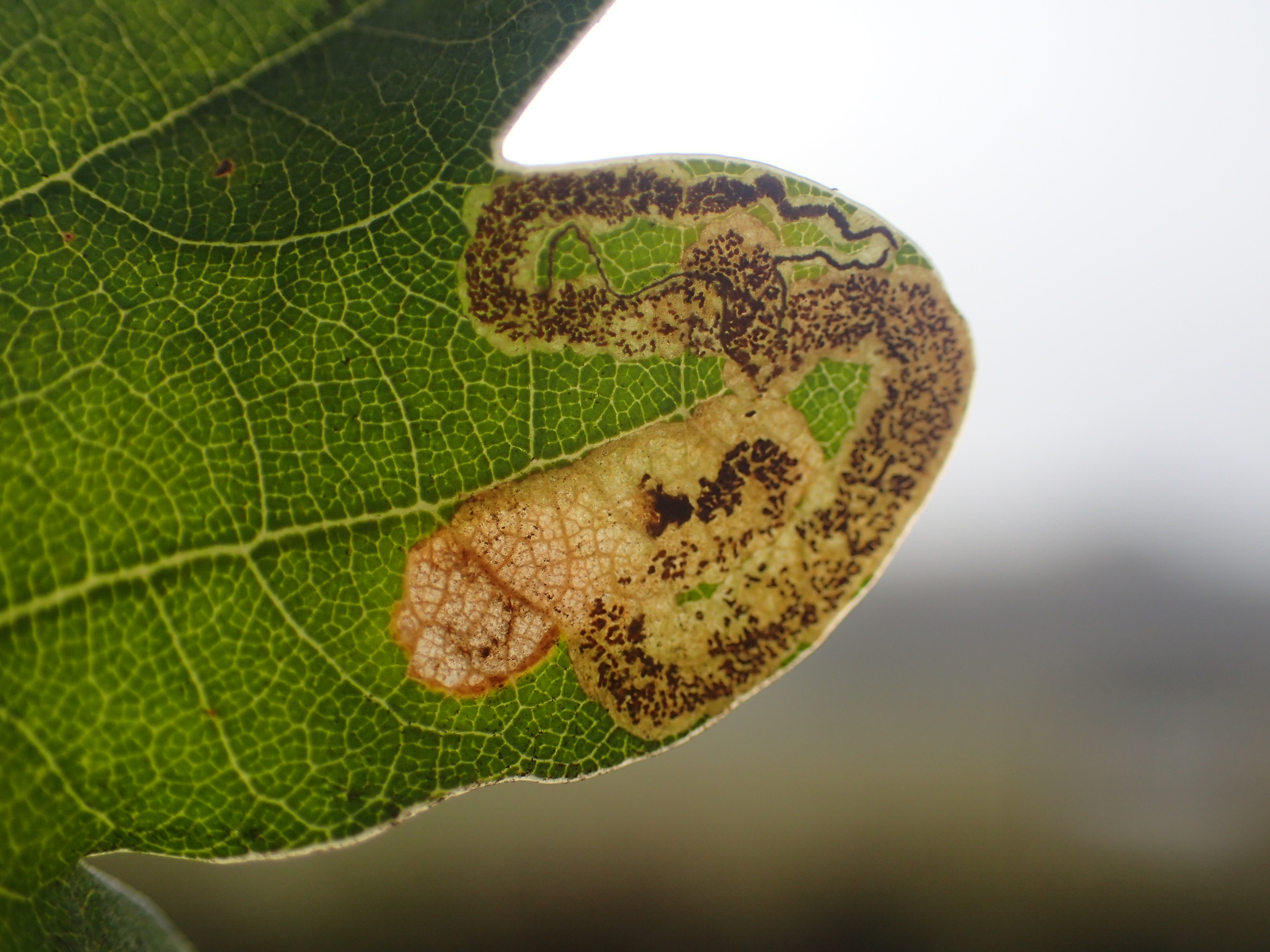
I spent a little while looking at an Oak, and found quite a few galls, leaf mines and caterpillars, most of which are pictured below. I also saw some Variegated Oak Aphids, including an alate (winged adult) which was a first for me, having only seen non-winged ones here previously.

Moth leaf mine - Tisheria ekebladella

Heliozella sericella mine and cut-out

Oak Marble Gall
Variegated Oak Aphid
Trioza remota galls
Stigmella sp. leaf mine
Oak Knopper gall
Artichoke Gall
Neurotus anthracinus gall
Smooth Spangle Gall

Buff-tip caterpillar
Caloptilia sp.

Coleophora 'flutipennella'

I also found a hawk moth caterpillar - Poplar Hawk or Eyed Hawk (it doesn't look quite typical for either unfortunately) being attacked by a wasp


WHITLINGHAM: The arrival of the Box Tree Moth

Early June 2022

A brief pop in to Whitlingham was notable for the finding of a Box Tree Moth caterpillar on Box bushes near the ruined hall. This non-native species gets through a large number of generations throughout the year, stripping garden Box bushes, so it's presence is certainly not a good thing.


WHITLINGHAM: May visit and lepidopterans

Mid May 2022

A clear avian highlight of the May WeBS count was a flock of four Common Sandpipers flying around the far shore of the Great Broad, sadly way out of camera range.

In terms of invertebrates there was a good range, including a case of Forest Case-bearer (Coleophora ibipennella) on Oak, Blood-vein caterpillars on Dock and the aphid Thelaxes dryophila. I also noticed some chrysalises that had emerged from cut willow stumps, but have no idea what species they might relate to.


THORPE MARSH: A rainy spring visit

Early May 2022

My first visit to Thorpe Marshes of the spring was probably most notable for bumping into a handful of people I'd not seen for a while, notably Chris, Susan, Ann and Stuart. I was hoping that some showers would pass through and bring some hirundines, and this did indeed happen, bringing my first Sand Martins of the year. Unfortunately for me the rain then got harder and I got completely soaked. Before I crossed the bridge I noticed a Mottled Umber moth caterpillar and an aphid parasitised by a Praon-type wasp. The damp weather meant not many insects about on the marsh, but Dock leaves with Puccinia phragmitis clustercups on are always nice to see, and I spent a delightful few minutes only a few feet away from a Grey Heron.


NORTH NORFOLK: Pensthorpe invertebrate highlights

Late August 2021

Pensthorpe is known for many things, including the wildlife-friendly farming, reintroduction programmes and of course the large wildfowl collection. It will however perhaps not be much of a shock to regular readers that the wildlife highlights of my visit with the family were actually both found on a small birch tree outside the toilet block before you enter the main reserve. On this particular birch I found three Solitary Birch Aphids (Monaphis antennata), a rare aphid that is unusual because it occurs on the upper side of the leaf rather than underneath, relying on its colour and solitary nature to hide it from predators. On the same tree I noticed a small caterpillar partly suspended on silky threads. This was Birch Ermel (Swammerdamia caesiella), a new species for me. In the wooded area a really nice ichneumon, Opheltes glaucopterus obliged for photos. The ducks were nice too of course.


THORPE MARSH: Toadflax Brocade caterpillars & insect highlights

Mid July 2021

Thorpe Marsh is the more neglected bits of my patch, so I made an effort to visit this month. Before going onto the marsh I walked around some of the local residential streets to check out areas of Purple Toadflax. My target was caterpillars of the recent colonist Toadflax Brocade moth (https://www.norfolkmoths.co.uk/index.php?bf=22230). These larvae were first recorded in Norfolk in 2019, and so far have not turned up in my own garden, but I was pleasantly surprised to find them on the second patch of plants I checked.


 I then spent a couple of hours walking around Thorpe Marshes. Little Egret was the pick of the birds, but I did find an overdue target species, Red Marsh Ladybird (Coccidula rufa). This species has been recorded here before, but I also hope at some point to find the other wetland Coccidula species here. At the Bungalow Lane end I found a new bug for me, Salicarus roseri, and a bit further along there were some Caliroa cinxia larva stripping the underside of an Oak leaf.


NORTH OF NORWICH: Bog Beacons and heather invertebrates

2nd May 2021

After leaving Earlham Marshes I headed to a site north of Norwich that is subject to a long-term NNNS Research Project. The site is currently being surveyed by a team of expert botanists, and a week or so ago they had come across a fungus that I had wanted to see for ages, Bog Beacon (Mitrula paludosa). This small but spectacular species is commoner in the north (where there are more bogs, funnily enough) but there were only a couple of previous Norfolk records. Armed with good directions from Ian I set off and found the area without much trouble, which was handy because the area has some rather deep boggy areas of mud.


Whilst on site I decided to sweep a bit of heather in the hope that I could find either of my long-term heathland target species, Heather Ladybird or Heather Shieldbug. I didn't see either, and actually didn't find too much. There were a few spiders, including Agalenatea redii, plus Small Heather Weevil and a Heath Rustic caterpillar.


NORWICH: Harrison's Wood fungi & Broom moth caterpillar

7th November 2020

For most of November we were in a national lockdown, albeit unlike the first one outdoor activity was permitted for recreation rather than just exercise. We decided to go out for one local walk per week, and this week we chose Harrison's Wood in Sprowston. We had first visited a week ago but only covered about a third of it before it started getting dark, an constant issue over the winter months. This time we took a different route, covering an area with lots of pine trees and conifers. As expected this gave us some different fungi species, including Earthfan, Powderpuff Bracket, Ear Pick fungus, Brown Parasol, Jewelled Amanita, Primrose Brittlegill and Cauliflower Fungus. I was also pleased with the find of a Broom Moth caterpillar, on Bracken rather than its eponymous plant.