The Whitlingham Bird Report for 2025 is now available to download from the Bird Reports page or from here

Showing posts with label Sculthorpe Moor. Show all posts

MID-NORFOLK: Sculthorpe Woodcock & beetles

17th July 2016

One of Cathy's aunts has been staying with her mum this week, and they had asked if we could go out for the day and see some wildlife. Rather than go to the coast, which would probably be packed with sun-worshippers, we went to Sculthorpe Moor. There were relatively few visitors, although the Hawk & Owl Trust were having a party for their volunteers in the visitors centre.

There weren't many birds visible on the first section of the boardwalk, although a couple of Marsh Tits were coming to the feeders at old gits corner. We stopped a while on the bridge over the stream, and further along I noticed some ripples. Suspecting a Water Vole, I moved position so that I could see past some overhanging vegetation to the source of the movement. To my surprise it turned out to be a Woodcock! There was enough distance between it and us that we could all watch as it bathed along the stream edge, stretching and occasionally flapping. A very unexpected but pleasing sight.


Along the river we watched Emperors and Four-spotted Chasers disputing territory, with Large Red, Azure and Blue-tailed Damselflies amongst the vegetation. At the next hide along we watched a family of Collared Doves on the bird table and a Buzzard flew over. Cathy was enjoying watching some small fish spinning side one, showing a silvery gleam, until a Little Grebe came right up to the hide and started eating them.


On the way back Cathy was carefully watching the boardwalk as she had found several small frogs and toads earlier. This time she found something more unsusual, a Sausage Ground Beetle*. As we got back to the car I noticed a pale cream coloured ladybird. It turned out to be a 14-spot Ladybird, which I see quite regularly, but usually with a deeper yellow colour and with some spots joined up.


* so named because the small raised areas between the ridges resemble a string of sausages

NORTH NORFOLK: Sculthorpe Glow-worms

4th July 2015

On Saturday evening Cathy, Margaret & I went to Sculthorpe Moor for one of their organised Glow-worm walks. In the past Glow-worms were fairly widespread, even occurring at Whitlingham in the 1990s, but in recent years they have declined, and having not seen one for several years we decided to go on this walk. Incidentally the decline is a bit tricky to be sure about, as not that many people go out after dark during the summer surveying for Glow-worms.

We arrived just before nine and had a brief talk, before setting off for a walk onto the reserve. As it began to get dusk Woodcock began to fly over and we got brief views of a Barn Owl. We stopped to admire the new elevated boardwalk and hide, which is almost finished and due to open over the summer. We spent a bit of time at the hides at the end of the reserve to wait for it to get dark.


Once the light had gone we headed back in search of our quarry. Along the edges of the path we saw three adult female Glow-worms. It is the females that produce the best 'glow' to attract the males. The larvae also glow, however they can turn it on and off, producing blinking or disappearing lights rather than the steady light of the adult. We saw lots of larve (20+) as we walked back through the wooded areas, and also stopped to admire a bright orangey moon from the Whitley hide. I didn't get any good photos of the Glow-worms (I have included a picture just to show the light) but if you didn't read my blog back in 2009 then have a look at a photo I took then of a mating pair at Taswood fishing lakes: http://jamesbirdsandbeer.blogspot.co.uk/2009/07/taswood-lakes.html

 Glow-worm in the dark
 Pre-harvest moon

NORTH NORFOLK: Sculthorpe finches & Water Shrew

15th February 2015

On Sunday we decided to go on our annual winter visit to Sculthorpe Moor, probably Norfolk's best nature reserve for seeing Bullfinches. On the way we briefly stopped at Three Score so I could scan for the Great White Egret (no sign of it at the time, it did turn up later). Due to some navigational failings on my part we explored rather too much of Bowthorpe and Ringland before eventually getting back to the Fakenham Road and carrying on to Sculthorpe, where we struggled to find space in a packed car park. Handily many of the birders had almost finished their mornings birding, so the reserve itself wasn't too busy.

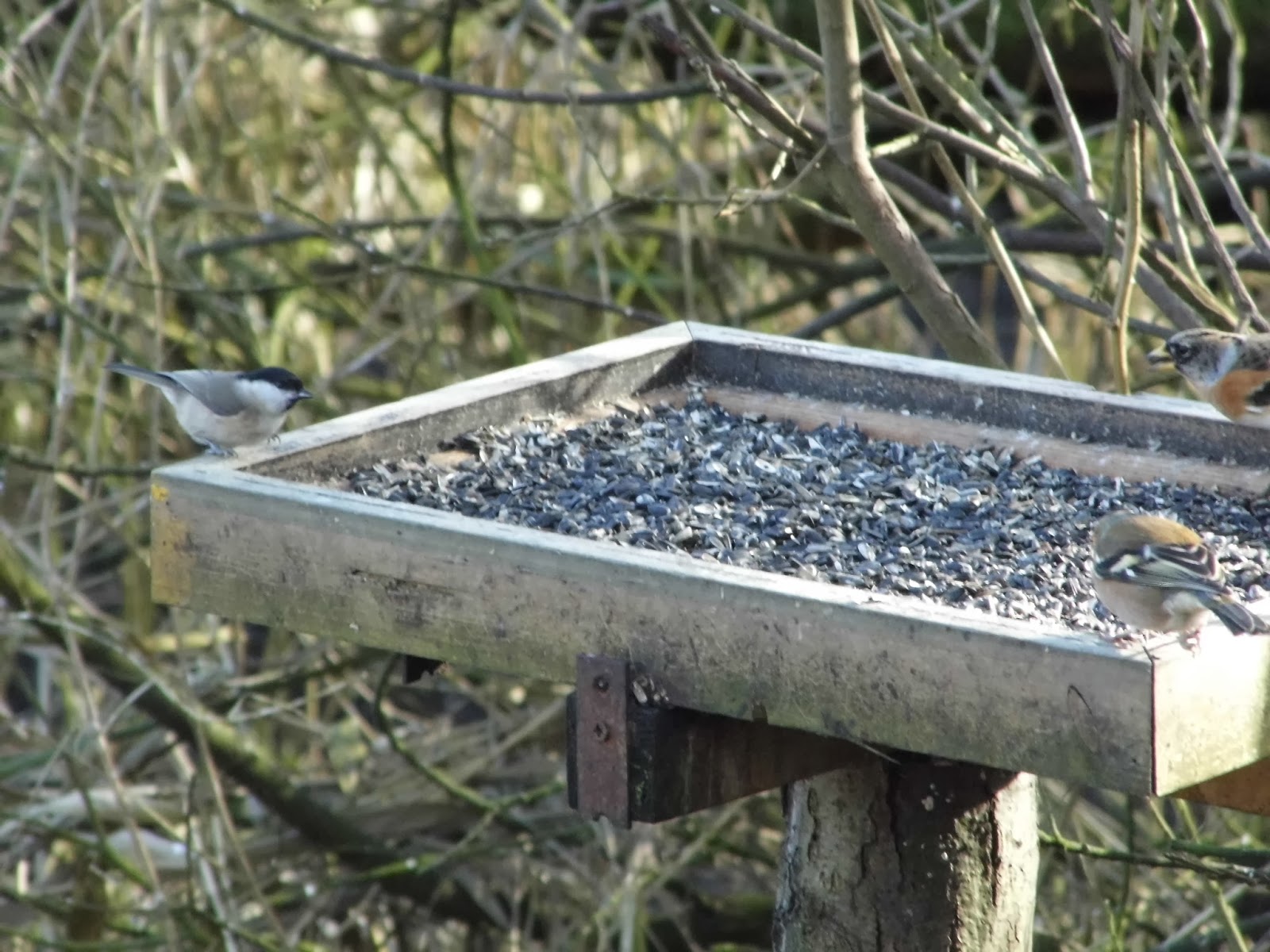
On the first set of feeders we saw pretty much everything we had come to see; a pair of Bullfinches, a Brambling, two Nuthatches, Coal Tits and Marsh Tits, two of the latter being colour ringed. Unfortunately as they were flying in and out I couldn't get the exact codes, but there was definitely a red-and-white and a yellow-and-white in there.


Further around we saw a small flock of Siskins in the Alders. Presumably due to the mild winter I still haven't seen (or indeed heard from anyone else about) any at Whitlingham so far in 2015. We didn't stop at the woodland hide, so carried on along the path, stopping only to look at some Scarlet Elf Cups and scan along the dyke. Further along we saw some more fungi and a very skulking Wren before arriving at the fen hide. The view was much different to our last visit, as some vegetation has been cleared to give an area of open water stretching into the distance.

As usual the bird tables at either side of the hide provided most of the entertainment, and there was a constant stream of birds, particularly Chaffinches, onto them. A flock of Long-tailed Tits were also a pleasure to see. For once we didn't see any Bullfinches here (although I did hear one from the path up to the hide), but three more Brambling, a Nuthatch and some Reed Buntings were all good to see close up.


It turned out that the best sighting of the day came near the end. As we crossed the recently cleared out dyke that runs through the woodland we stopped to scan along the muddy edges. Some ripples were coming from a small section of bank, and after that some bubbles. It looked as though something had swam out from an underwater hole in the bank. For a while we could only see ripples or a bubble trail, but then suddenly a Water Shrew launched itself out of the water and onto the mud at the edge, where it disappeared into presumably another hole. A brief view, but a new mammal for me and an excellent end to our visit.

NORFOLK: Sculthorpe Moor Bullfinches

15th February 2014

Despite the squally weather Cathy, Margaret & I headed out to do a bit of birding. We diverted via Ber Street to check if the Waxwing was still present and it was, although more obscured than yesterday. Handily a birder was already there and pointed it out half hidden amongst some apples.

We then went to Sculthorpe Moor to see some Bullfinches. This had been the plan a fortnight ago until the Whitlingham hibernaculum check - I went to look at the bats instead on the understanding that we would go to Sculthorpe soon and would find Cathy seven Bullfinches (four males, three females).

From the visitors' centre we stopped to shelter from the rain at the first set of feeders and were rewarded with a Coal Tit and a pair of Bullfinches. There wasn't much showing from the Woodland Hide, so we carried on, seeing some Scarlet Elf Cups near the river. Continuing along the boardwalk we were glad the river wasn't an inch higher as it had already flooded much of the area either side of the path. At the Whitley Hide we were treated to close views of loads of Chaffinch, Greenfinch and Brambling, whilst several Reed Buntings favoured the left hand bird table. After a while a pair of Bullfinches arrives, followed by a second pair. Somewhat strangely another male flew in and Cathy's request list was complete - we saw seven Bullfinches in her desired male/female combination. Hopefully these premonition skills will be used again later in the year.


We took a circuitous way home, calling in at Cley Spy for me to get a new tripod head and the heading along the coast road for the first time since the floods, seeing a Little Egret and a Marsh Harrier.

NORFOLK: Sculthorpe Moor

2nd November 2013

It had been a while since we had visited Sculthorpe Moor, so with a free Saturday Cathy, Margaret & I headed there for a look around. We were hoping to get good views of two winter staples here, Bullfinch and Brambling. Whilst both were around somewhere, they steadfastly refused to come to the feeders whilst we were there. The Whitley Hide bird table was dominated by families of Chaffinch and Greenfinch, whilst a Lesser Redpoll also showed well on the ground as it drank from the pond. A large flock of Siskins swirled over, Marsh Tits were numerous and my first Sculthorpe Nuthatch was on the feeders at the start of the boardwalk.

There was a bit of fungi in the woods, including a distinctive looking but as yet unidentified Lepiota sp, and I did manage a new species from the trip, Lady Fern.


NORFOLK: Sculthorpe Moor Dawn Chorus

22nd April 2011

Whilst here last week we had noticed that there was a dawn chorus walk and cooked breakfast on. Cathy doesn't usually look favourably on my suggestions for getting up in the small hours and going birding, but for some reason this walk was deemed acceptable. The highlight of the walk was undoubtedly looking out over the Wensum and watching Marsh Harriers rising out of the mist as the sun rose. Birdwise a Grasshopper Warbler was heard from the Whitley Hide and 2 Cuckoos flew over. On the way back we found the Golden Pheasant on the side of the path, and it posed for a photo before running off through the woods.


NORFOLK: Sculthorpe Phylloscopus opus

16th April 2011

The week before the Easter holidays had got me guessing what my next Norfolk tick would be. The White-tailed Eagle and Black Stork seemed unlikely to stick around, but I had a good feeling about Ring-necked Parakeet (surely one is frequenting gardens in the north-east of the county somewhere?). Anyway, when news came out that a Wood Warbler, the commonest British bird that I was yet to see (having finally got Red Grouse last year) was at Sculthorpe Moor, a favourite reserve of ours, the stage was set for a fourth Phyllosc in three days.

Upon arrival we heard that the Wood Warbler had been seen and heard on a dawn chorus walk earlier that morning, but not heard since. We weren't discouraged, and as we drew near the Frank Jarvis Hide we were met by a birder who had just relocated the bird. We couldn't hear anything, but then the Wood Warbler began calling from woodland across the bridge from Old Gits Corner. It gave good views, flying actively around near the tops of the trees along the boardwalk, calling but not giving full song.

Once the Wood Warbler flew back across the river (and had stopped calling) we carried on to the Whitley Hide, seeing a couple of Orange-tips. Watching the bird table we saw male and female Bullfinches, a pair of Bramblings, male and female Reed Buntings and a Marsh Tit. In the distance my first Cuckoo of the year was calling. On the way back one of the resident plastic Golden Pheasants jumped up into a tree, making a weird squeaky call. A couple of Marsh/Willow Tits on the feeder at Old Gits Corner flew off before I could get a decent look, but we shall undoubtedly be back for another visit soon.