The Whitlingham Bird Report for 2025 is now available to download from the Bird Reports page or from here

Showing posts with label Hybrid. Show all posts

WHITLINGHAM: An overdue boat trip and lots of fungi

Late October 2019

Back in 2012 the Broads Authority transferred the specially-commissioned solar boat Ra from Barton Broad to Whitlingham Great Broad, and since then it has been offering passenger trips around the broad every summer. I had always intended to go on one of these trips "at some point", but the circumstances outlined in my recent blog post (Changes afoot) meant that haste was needed. It was confirmed on one of the broads forums that as the Broads Authority would no longer be managing Whitlingham C.P., they would be re-homing Ra elsewhere on the Broads. Given that boat trips don't run over the winter I had a few weeks to go on one. Fortunately I made the time, and as the only one for that time slot had a very pleasant chauffered tour around the broad.


The birds seen from the boat were the expected species, a few Gadwall and Tufted Duck, Kingfisher and a Great-spotted Woodpecker on the main island. On returning I was looking at the Barnacle Goose when I noticed something resembling a Ruddy Shelduck. It didn't look quite right, and on close inspection I decided it was an Egyptian Goose x Ruddy Shelduck hybrid, which was agreed with by hybrid guru Dave Appleton. I also think this was probably the bird seen at Strumpshaw in September by David Bryant.


I spent a highly productive few hours looking for fungi in the wooded areas. Whilst I didn't see anything new, quite a few of the species were ones I'd not noted at Whitlingham before. These included Birch Knight, Earpick Fungus (a particular favourite of mine - it has a felty cap, spines instead of gills or tubes and grows on pine cones), Crimped Gill and Redlead Roundhead. There were also nice specimens of Freckled Dapperling and the various stages of Haresfoot Inkcap.


A couple of insects were of note, my first patch record of Aulagromyza heringii in Ash leaves (this leaf mining species seems to have had a very good autumn) and a bug I'd not previously recorded, Drymus brunneus, found on a bracket fungus amongst the leaf litter.


WHITLINGHAM: White-cheeked Pintail hybrid

Mid-April 2019

A late afternoon walk at Whitlingham with Cathy & Rose meant that I caught up with the White-cheeked Pintail x Mallard hybrid that has been moving between Whitlingham and Strumpshaw. It has been hanging around the slipway fairly regularly, but I hadn't seen it up until that point. Whilst there I also read the rings of five Mute Swans, which have probably travelled a combined total of zero km, but you never know.


BRECKLAND: Hawfinches and hybrid ducks

Mid-February 2019

Adam & I try to get in a day birding most holidays, and decided to head down to the Brecks for this one. We opted to give Santon Downham a miss, so our first stop was by a roadside overlooking a block of forest. The weather was still overcast so we weren't confident of our chances of seeing Goshawk, but it didn't take too long before one was up. It didn't display, but instead flew back and forth a few times over the trees giving excellent views. As I stood there listening to a Skylark I realised that it was my first of the year, as was a Mistle Thrush that called and then flew off in front of us.

Next up we tried another block of forest where a feeding station has been set up in an area where Willow Tits are still present. The table was attracting a steady stream of the Blue, Great, Coal and Marsh Tits (and Dunnocks), but unfortunately we didn't see or hear any Willow Tits. A Hairy Shieldbug landed on Adam's leg whilst we waited. Eventually we decided to just walk a bit further along the ride, seeing a Muntjac and a Great Spotted Woodpecker, but not a lot else.


Our main target was a Kumlein's Gull that had been appearing sporadically in the gull roost at Lackford Lakes, but with a few hours before the gulls were due to start arriving we decided to go to Lynford first. We checked out Lynford Water in case there were any Goosander, but only saw common species (although the sound of a huge flock of Siskin was impressive). In the arboretum we quickly found some Hawfinch and got great views as they fed under the trees in the paddock. We were rather bemused that some nearby photographers seemed more interested in photographing Great Tits on some rather oddly positioned feeders on the bridge (oddly placed because people had to keep walking past them), but on our way back we found that most of them had just been taking time out from photographing Crossbills drinking from the flooded meadow.


After missing a turning we eventually found Lackford Lakes, a reserve that neither of us had visited before. We had a cup of tea in the visitors centre before heading out for a look around the reserve. The first hide we called into was packed, so we moved round to the next one, which overlooked an area called the Slough. Around 400 Lapwings were roosting, along with some common waterbirds. Whilst looking through the ducks I noticed two of the 'Mallard' accompanying the Pochard had pinkish bills. A closer look revealed that they were hybrids. Recalling my Peter Scott Wildfowl book I suspected these were Rosybill x Mallard, an ID that hybrid bird guru Dave Appleton agreed with.


With our visit already a success thanks to the hybrid ducks, we walked back to the sailing lake to watch the gulls come in. The roost was large, but lots of the birds were Black-headed Gulls rather than their larger relatives. After an hour or so we decided to call it quits - one 1st-winter Caspian Gull had flown in but there was no sign of the Kumlein's Gull. It was a light evening and we knew it might arrive later on, but both of us needed to be back home in reasonable time. Whilst watching the gulls we were also entertained by several Goldeneye, whilst a Kingfisher, Red Kite and Sparrowhawk all flew past during our vigil.

All in all we had a very pleasant day out with some unseasonably warm weather in the afternoon - thanks to Adam for doing the driving.

THORPE MARSH: Leaf miners and ducks

18th November 2017

On Saturday I popped down to Thorpe Marsh to look for some Bearded Tits that had been heard in the small reedbed on the previous day. After crossing the railway I decided to check some Cow Parsley for the leaf mine of Phytomyza chaerophylli, a common but overlooked species which I found in the first patch I checked.


Heading round towards the marsh I stopped near the reeds and listened for a while, but there was no sign of any Bearded Tits. It was rather windy, so I wasn't surprised not to see them. Whilst on my vigil I kept an eye on birds moving along the tall trees near the railway line. A flock of Fieldfares flew west, and a large Goldfinch flock with a scattering of Siskins were feeding in the Alders.

After a while I gave up and moved off, checking the flood and marsh before moving on to the broad. There were loads of ducks, including around 160 Tufted Duck and the returning Pochard x Ferruginous Duck.


On my way back it struck me that I couldn't recall any apple trees at Whitlingham, so I should check the crab apple near the mooring basin. This was a good idea, as I noticed some old mines of Apple Leaf-miner moth, Lyonetia clerkella.


EAST NORFOLK: Duck hybrid, unsuccessful Eagle watch

22nd April 2017

On Friday night a White-tailed Eagle was found in the broads. They are fairly frequent visitors to the county, but can be rather difficult to see as they roam widely. As it was still present on Saturday morning Cathy kindly agreed to temporarily postpone our planned Bluebell walk to look for the eagle. It had last been reported in the Martham area, so I decided to head for Rollesby in the hope that it would show over the broad. Whilst at Rollesby we had a quick look at the widely lauded/derided (delete as applicable) Cinnamon x Blue-winged Teal hybrid that has been present of late, paired up with a female Mandarin. I also realised that the Common Terns flying about were my first of the year.

(there are many better photos of this bird online - see those taken by Dave Appleton, Chris Lansdell, David Norgate etc.)
With no sign of the White-tailed Eagle, and no further news from anywhere, we drove through Marsham and then along the Horsey straight, before parking up for a cup of tea. I heard a Cuckoo calling in the distance (another year first), and saw Marsh Harriers and Buzzards up, but no luck with the eagle. After a few hours we gave up and went to lunch at Waxham Barn. The Eagle was later seen around Fritton, although on Sunday it was seen over Sculthorpe. My only chance now is if it flies over the city centre whilst I'm on a lunch break!


NORWICH AREA: Ringland Ruddy Shelduck hybrid


18th February 2017

During the week I had heard that several Tundra Bean Geese had been seen at Ringland with a flock of Greylag Geese, so having been given directions to the area they had frequented I headed off for a look. I spent a pleasant morning walking footpaths in the area, but didn’t come across the Bean Geese or the large Greylag flock, so it appears that they have moved on. Whilst looking over the floodplain the most interesting bird superficially resembled a Ruddy Shelduck, but on closer inspection appears to be a Ruddy Shelduck x Egyptian Goose hybrid, a conclusion that others online had also reached having seen it earlier in the week. It was calling and displaying to an Egyptian Goose.


Also in the area were at least three Bullfinches, a Little Egret and a Red Kite.

WHITLINGHAM: Pochard x Ferruginous Duck

26th November 2016

A lovely bright morning, so I nipped down to Whitlingham for a quick walk along the southern shore of the Great Broad. Arriving in the middle car park I could immediately hear Siskins, and there was a large flock of them in the willows and Alders between here and the Little Broad. Moving along I heard a Mistle Thrush singing, followed by several others calling. There were a few Black-headed Gulls on the slipway, but no ringed ones whilst I was there.

It was evident that both Coot and Tufted Duck numbers have built up nicely - I didn't have the time to attempt proper counts but at an estimate there was a minimum of 200 of each. There were still eleven Little Grebes, but they had split up, with two on the Little Broad, two near the observation screen and a group of seven in the bay. The Pochard x Ferruginous Duck was still present, accompanying the Pochard just west of the main island. A Brambling called from somewhere behind me. All too soon it was time to head back home.


WHITLINGHAM: A proper look round

3rd January 2015

With rain forecast for the afternoon I headed to Whitlingham in the morning to get a proper lap. Near the slipway there was a welcome return for the Pintail x Mallard hybrid (I didn't see it in the last week of the year). It even did the decent thing and emerged from the area of vegetation that it usually frequents, allowing some unobscurred photos of it. Dunnock and Robin in the scrub nearby were birds I missed on January 1st.


Partway along I met Justin, who was completing his lap. As we chatted three flocks of Siskins flew up and joined together, at least 80 birds. A Kingfisher also flew past over the Great Broad. On the 1st Justin had seen an interesting looking Pochard, a dark female that may well be a hybrid, although we aren't sure what with. I managed to find it, but my digiscoped photos were out of focus and it flew off before I had a chance to look again further onwards. Carol had told us that there had been around 20 Shoveler the previous evening, which is a very good count here. Justin had counted 19 earlier, but I could only muster 17 (still a good count here).

Scanning across to Thorpe Broad I added Snipe, Lapwing and Stock Dove to my year list. 41 Pochard were on the broad, although most of them had previously been on the Great Broad. There was a lot of Tufted Ducks, but I didn't attempt to count them. A yellowy woodlouse looked interesting, but as suspected was just a Common Striped Woodlouse.


Once again the conservation are bay was packed with birds, but the only new bird for the year was a Little Grebe, which I had probably overlooked earlier. Just outside the bay there were two female Goldeneye, with a third one along the north shore of the Great Broad. On the lawn outside the watersports centre there was a clump of fungi including a particularly large one. At the time I wasn't sure what they were, but having thought about it I think they are just large Common Inkcaps. I kept an eye out for plants in flower on the way round, noticing seven, and also leaf-mines in Cow Parsley, Sow-thistle and Ground Ivy.

 Probably Common Inkcap, although I will get a second opinion!
 Leaf mine in sow-thistle. There are two near identical possibilities.

WHITLINGHAM: December wildfowl counts

13th December 2015

Today was the final WeBS date of the year, so it was off to Whitlingham to carry out December's wildfowl count. Carol & Rob had asked to come along so I met them at the start of the path down to the Little Broad. There was still a bit of mist hanging over the trees, and I stopped on the way along to photograph some lichens growing on the curb - still to be identified.


We walked along the edge of the Little Broad, stopping to watch a small flock of Siskins fly over and a Kingfisher zoom past. A Grey Heron squawked as it flew across the broad. Transferring to the Great Broad we stopped near the ruin to get some more photographs of the Pintail x Mallard hybrid, which was still sticking to that small length of broad edge.

 
There were lots of birds on the broad, including the most Coot I've seen here this year (264). Two drake Goosanders were along the far shore but still visible with the naked eye (earlier in the day an extra one had been seen). The most interestingly from the counts was the large number of Grey Herons. We counted seven on the Great Broad, although one was probably the one from the Little Broad. There was another at Thorpe, making eight in total, two more than my previous highest count here. The combined Whitlingham/Thorpe duck counts were 87 Mallard, 106 Gadwall, 198 Tufted Ducks, 48 Pochard and 42 Teal. A Little Grebe, two Lapwing and another Kingfisher were also of note.

WHITLINGHAM: Pintail hybrid and fungi

5th December 2015

Most of the time that I'm at Whitlingham I am on my own, so Saturday was a bit of a change as I was there a walk around the Great Broad for Anne Crotty's birthday, along with about 20 others. Anne is a fellow member of the Norfolk Fungus Study Group, so there were a few other mycologists within the group and I was hoping that despite the time of year we might turn up a couple of interesting species. 

I arrived a bit early so that before meeting up I could have a look for an interesting hybrid duck that Justin had found in the week. The bird in question was a drake Pintail x Mallard, quite an unusual hybrid. I located it with Mallards along the south shore of the Great Broad, but it frustratingly it kept fairly close to the shore, where views are obscurred by the ditchside vegetation. It was also rather nippy when it did swim, meaning I only got one in focus and three out-of-focus shots of it before having to head off. I also had a brief chat with Rich Moores before I headed to the car park.


As many of the group were not particularly interested in fungi we didn't dawdle too much, but we did manage to record a couple of interesting species. I found a Peppery Roundhead (Stropharia pseudocyanea) which is a patch tick for me, and Stephen found a Crepidotus sp that has been taken for checking but looks like it could be Crepidotus luteolus, which would be something like the 5th Norfolk record and a site first. After the walk we headed back to Anne's house for tea and cake, and whilst there she showed us another interesting fungus, Hohenbuehelia astrocaerulea, which had grown on a tree in her garden.

 Crepidotus sp.
Dried out specimens of Hohenbuehelia astrocaerulea

NORTH-EAST NORFOLK: East Ruston

1st April 2015

On Wednesday Cathy & I took our mums to East Ruston Vicarage Gardens for a late Mother's Day trip (it was shut in March). Despite growing up nearby, I had never been before. We had a pleasant afternoon looking through the various different garden areas, followed by a big piece of cake in the tea room. In the summer I can imagine the gardens would be very good for insects, but because of the time of year we were mainly restricted to a few Bumblebees and Honey Bees. Bird-wise the highlight was a small flock of Yellowhammers. Before we left I noticed a couple of unusual ducks on a small pond. They were clearly hybrids of some sort, Dave Appleton has confirmed that they are Wood Duck x White-cheeked Pintail.

Afterwards we stopped at Walcott for ice cream, where we saw 18 Turnstones. I did keep scanning out to see whilst we were parked up, but didn't see anything of note passing through.


WHITLINGHAM: Wigeony hybrid

31st December 2014

I managed an hour or so at Whitlingham this afternoon to see what the cold weather had brought. The Little Broad was more than half frozen, although the unfrozen bit still contained Shoveler, Gadwall and a Little Grebe. There were good numbers of Tufted Ducks on the Great Broad, but the main bird of interest was a hybrid duck that Justin had found during the morning. It appears to be a Eurasian Wigeon x Mallard hybrid [This is an edit - originally I suggested Eurasian x American Wigeon] although I'm open to ideas if anyone thinks differently. It is an escape (rings were visible when it was out of the water) which is a shame, but nevermind. A walk back along the south shore of the Little Broad failed to provide any Water Rails, leaving them as 'heard only' for the patch year list. Best wishes to everyone for the new year.


30 INTERESTING THINGS - 3/30 Hard Shield Fern

23rd February 2014

This week had seen a small influx of early migrant birds to Norfolk, so I headed down to Whitlingham in the hope of breaking my earliest patch record for Willow Warbler or Sand Martin. The weather was overcast with a few showers, but this can be handy for 'dropping' migrants, so I didn't resent the rain. On the Little Broad ten drake Shoveler were still present, along with a dwindling number of Gadwall. There was no sign of last weeks Egyptian goslings, which doesn't bode well for them. The most interesting bird on the Great Broad was a hybrid Canada x Greylag Goose near the main island.


With no migrants other than the now widespread Chiffchaffs, I headed further along into the woods. On my way along a woman stopped to tell me she had just seen a Hedgehog walking across the road ahead, but it had gone by the time I got there (I have only seen a squashed one here). There was plenty of birdsong, including a drumming Great Spotted Woodpecker, two Nuthatches, Song Thrush and lots of Wrens. The woods were carpeted with Dog's Mercury, Moschatel and Early Dog's Violet were also in flower.


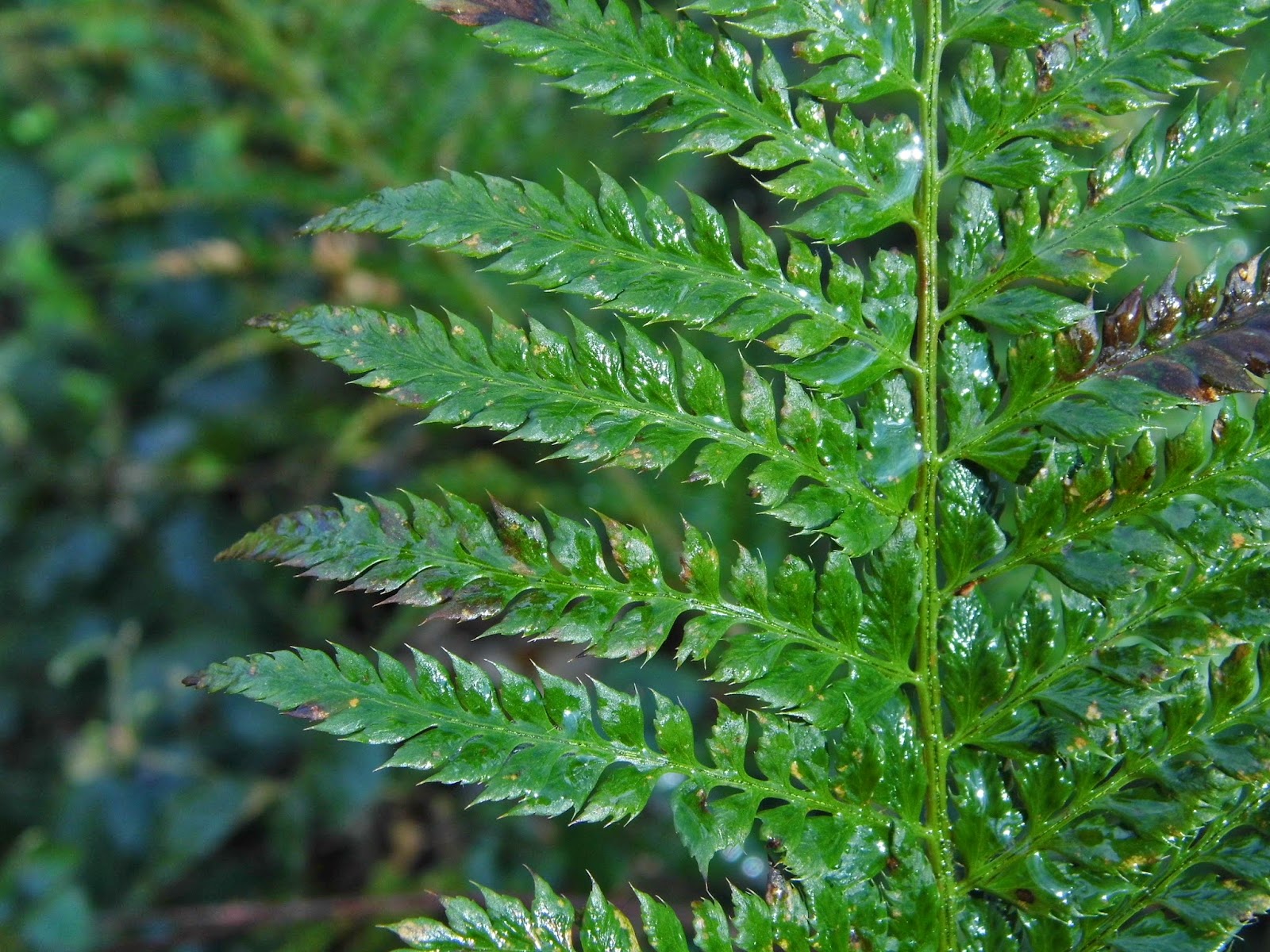
Having asked for sites for Hard Shield Fern, a species I have never (knowingly) seen, I was told of several places, including Whitlingham Wood. Jeremy had kindly told me that there was a record from the woods in 2011, so I paid particular attention to the clumps of ferns, most of which are Male Fern. I had almost completed a circuit of the woods, not hearing any migrants along telegraph pole alley, when I noticed a different fern near the top of the steep steps. A closer look revealed it as my target species, Hard Shield Fern. I know I've looked at that clump of ferns before, but just never realised what it was!


NORTH NORFOLK: Italian/Hybrid Sparrow

28th August 2013

I managed to to get to Northrepps for a quick look at the possible Italian Sparrow that was noticed a couple of weeks ago and is still present in the same garden. There has already been quite a bit of discussion about this bird with no real consensus - opinions are split between aberrant House Sparrow, Spanish Sparrow x House Sparrow or Italian Sparrow. For my part, I think that the largish bill, positioned high so that the forehead runs into it (rather than the visible forehead of House Sparrow) suggests at Spanish Sparrow involvement. Given the lack of streaking on the breast, I had wondered if it could be an F2 hybrid, but I suspect that this would show more grey on the crown, so my guess (and it is nothing more than that!) is that this bird is a Spanish x House Sparrow hybrid. This isn't perhaps as unlikely as it sounds - in 2009 at least ten Spanish Sparrows turned up in the Netherlands for example. Whatever the identity, I enjoyed watching the bird on a quiet and sunny day in the countryside, and as the keenest birders had already been, I had it to myself. As I walked back down Hungry Hill four Buzzards flew over and there were numerous Swallows and House Martins overhead.

Many thanks to Carl and Andy for flagging up this bird and allowing people to come and visit.

You can find visiting instructions and more photos of the sparrow here, and Dave Appleton has evaluated the possible identity of the bird here.