The Whitlingham Bird Report for 2025 is now available to download from the Bird Reports page or from here

Showing posts with label Dragonflies. Show all posts

WHITLINGHAM: May update

11th May 2024

A case of what might have been, with Black Terns present at Colney GPs and both Black and Arctic Terns at Rockland, but not at Whitlingham. A flock of 21 terns did drop in, but after lots of scanning I concluded that they were all Common Terns. I heard Reed Warbler, Garden Warbler, Blackcap, Chiffchaff, Willow Warbler but not Sedge Warbler or Whitethroat. One brood of Grey Herons had fledged, whilst there were more Cormorants on nests than on my April visit. A Muntjac ran across the field south of Whitlingham Lane, and I found a newly emerged Hairy Dragonfly.


THORPE MARSHES: Late spring visit

Late May 2023

A couple of hours spent around a sunny Thorpe Marshes. A good sign that it wasn't too busy was a Grey Heron beside the path out onto the marsh, which reluctantly flew as I approached. Two recently fledged Stonechats could be seen further across the marsh, pleasing to see this species is still hanging on in this urban-ish location. The highlight of the visit was a new bug for me, Pachybrachius fracticollis, but there was plenty else of interest including lots of European Chinchbugs, several Anasimyia lineata hoverflies and great views of a settled Hairy Dragonfly. A smut fungus, Anthracoidea subinclusa, was found on Carex riparia, whilst on Hawthorn were some adult Cacopsylla peregrina psyllids.


NORWICH: Mousehold heath - a June invertebrate selection

There is a rare case-bearing moth, Coleophora saturatella, that feeds on Broom, so now and again I like to check the plants at Mousehold in the hope of finding it there. As expected by now I didn't find it, but there were plenty of other interesting things, some associated with Broom, but others more generalist.

Andrion regensteinense
Ditropis pteridis
Green Tiger Beetle
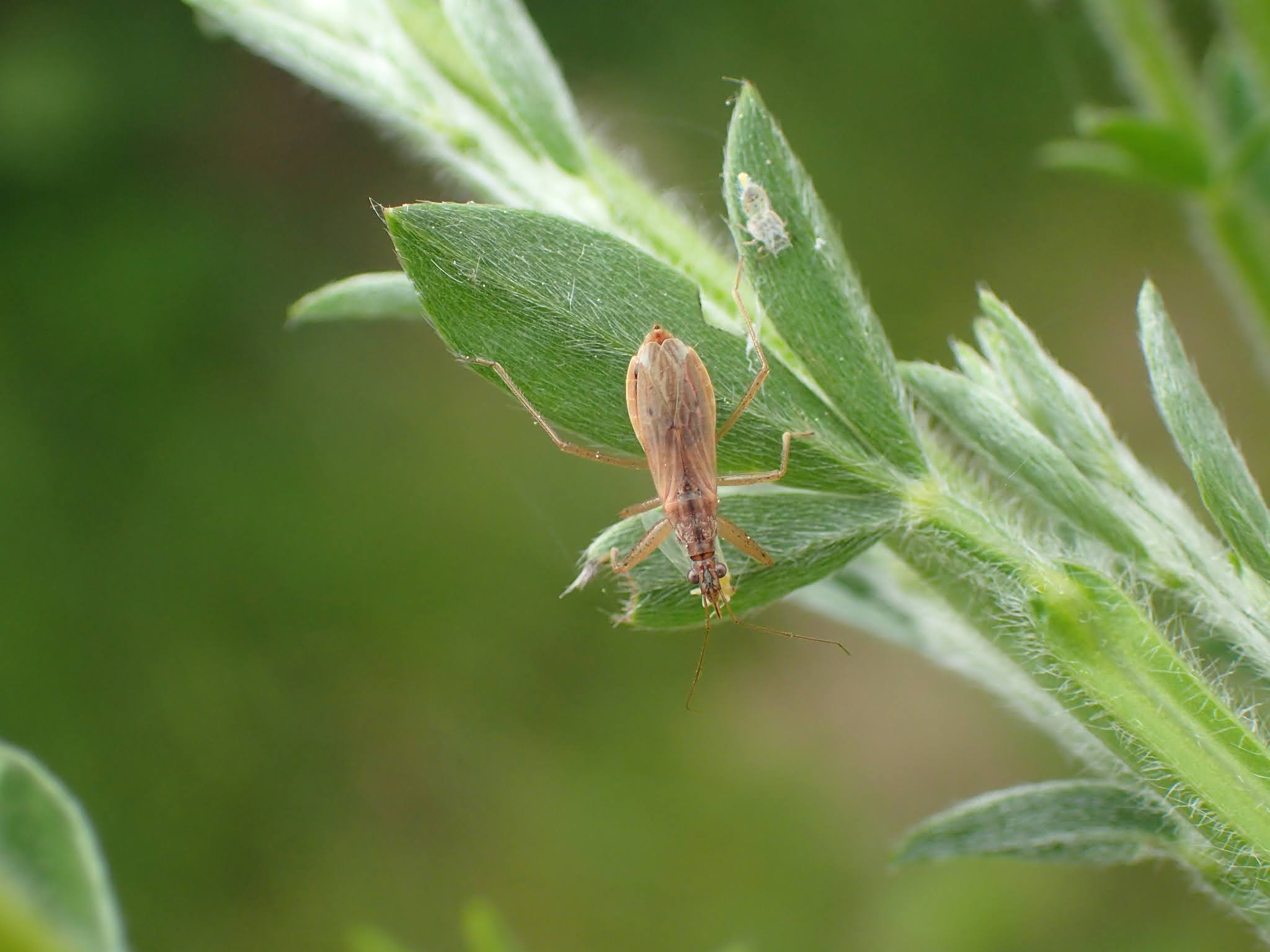
Common Damselbug (Nabis rugosus)
Norfolk Hawker - a common species in the broads but it seemed strange seeing one up on the heath
Prosternon tesselatum, a species of click beetle.

WEST NORFOLK: Southern Migrant Hawker

Early August 2020

For the past few weeks people had been posting pictures of Southern Migrant Hawkers at Thompson Common. This species was formerly a rare migrant to the UK, but in recent years has colonised in the Essex and been appearing with a bit more regularity elsewhere. At Thompson reports had been of at least six males and a mating pair, so perhaps there seemed like a reasonable chance of bumping into one.

We emerged from the woods and turned our attention to a dried out pingo where many of the sightings had been made. A hawker soon flew in and perched up, but it was a 'normal' Migrant Hawker. A couple of other naturalists were also looking - one had seen a Southern Migrant Hawker in flight a few hours earlier but that was it. We spent a while watching the very active dragonflies, hoping they would land, but it appeared that everything we saw was Migrant Hawker or Brown Hawker. Trying around the corner I saw a very blue looking dragonfly, and it briefly perched up on some bur-reed, enabling me to confirm it was our target species, Southern Migrant Hawker! It gave great flight views (down to a few feet) but barely settled. My bridge camera takes a while to focus, so I had to make do with a few not-quite-in-focus record shots. We also saw one of the site specialties, Scarce Emerald damselfly. A few more people turned up, including Vanna, Jeremy & Ian, and they managed good views too.


By now Rose was getting bored, so rather than explore further we headed back to the car. I had seen a water-dropwort species in the first dry pingo so double checked it was Fine-leaved Water Dropwort, a second new species of the day. A sedge generated much comment online, but was eventually decided as Carex otrubae by people much more knowledgeable than me about these things. Platycis minutus (a net winged beetle) was a nice find on the way back to the car.


WEST NORFOLK: Grimston & Roydon

Mid July 2020

Having not seen my dad during lockdown, I arranged to meet up outside so we could go for a walk. Having spent the past few months in east Norfolk I decided to head west to Roydon Common and Grimston Warren. I'd not visited the latter site before, so Lukas from the wardening team had very kindly agreed to meet us to show us some of the more interesting bits. We had an excellent morning, including great views of both male and female Black Darter dragonflies, plus various other odonata.


After lunch we checked out an area for Raft Spiders, a relative of the more commonly mentioned Fen Raft Spider, and after a bit of scanning of pools I managed to find one. The site has lots of Round-leaved Sundew so I kept checking for Sundew Plume moth caterpillars, an unusual species that eats this insectivorous plant. At one point I thought I'd found one, but it turned out to be a hollowed-out husk, which had been parasitised by the ichneumon wasp Campoletis trichoptili. Whilst not the species I was looking for, this ichneumon is understandaly rarer than the moth, with only a handful of UK records and new for Norfolk.


A big thank you to Lukas for his help. Both sites are large and we didn't cover too big an area, so another visit next year might be in order to see things like Bog Asphodel and some of the scarcer bee species.

SOUTH NORFOLK: Redgrave & Lopham Fen

2nd June 2018

On our way back after an out-of-county trip, Jeremy, Vanna, Ian and I stopped at Redgrave and Lopham Fen for lunch and a look for Fen Raft Spiders. This reserve on the county border is mostly in Norfolk but managed by the Suffolk Wildlife Trust. I'd never visited before but will have to return at some point, as it was a large site with loads of wildlife. We took the shortest trail (the spider trail) but still found lots to look at.

One of the standout species was the Four-spotted Chaser, a common dragonfly but one that was present in very large numbers. I noticed that several of them were of a variety called praenubila, where the small black marks are replaced by larger black splodges (compare the middle individual to the bottom one on the second photo). Unfortunately the 'best' one was obscurred by vegetation, but it looked very smart in the field.


Other things that caught our attention were some quivering Aspen trees, several species of beetle including Chrysolina polita, Dead-nettle Leaf Beetle and the large caterpillars of Drinker Moth, Garden Tiger and Emperor moth. A Hobby was seen briefly chasing the dragonflies, and a brood of Shelducks were on one of the pools.


Further round I noticed an Anasimyia contracta hoverfly, my third member of this genus seen this year (I've never seen the two remaining ones). One of my other highlights was a rare spider, Marpissa radiata - one of the NNNS 'Norfolk's Wonderful 150 Species' being profiled for next year's anniversary celebrations. As we headed back towards Norwich I noticed a Little Owl in a roadside tree, and after reversing back we managed to get silhouetted views (we didn't leave the car to see it properly to avoid spooking it).


A quick diversion to Mulbarton failed to yield the Bee Orchid that we had hoped for, but on dropping Jeremy and Vanna off we were shown some Asparagus Beetles, another new species for me.


YARE VALLEY: Roman Wood

24th September 2017

With the winds seemingly not great for migrant birds, and plenty of fungus forays to come, I decided to focus on insects for a bit longer. I was aware of some interesting stuff being recorded at Roman Wood on the edge of Acle recently, including two species I was keen to see (Bishop's Mitre Shieldbug and Rhombic Leatherbug), so I arranged to meet Tim Hodge there to see what we could find.

Roman Wood has a couple of differing compartments, but the area we focused on were recently cut grassland bordered by 20 year old planted trees and bushes. There were plenty of Pestle Puffballs growing around the edges, and the warm sunshine ensured there were quite a few hoverflies around too.


One of the methods of surveying that Tim had been employing at Roman Wood was seiving of the grass piles. I was surprised by the sheer volume of creatures this produced, but many of them were very small. The tiny ladybird Rhyzobia litura was of interest. Nearby a bee bank had been established, and a metallic green Lasioglossum (or possibly Halictus) was inspecting the soil. With no sign of any shieldbugs in the piles we moved on to a bit of sweeping, and this came up trumps with my first Bishop's Mitre Shieldbug.

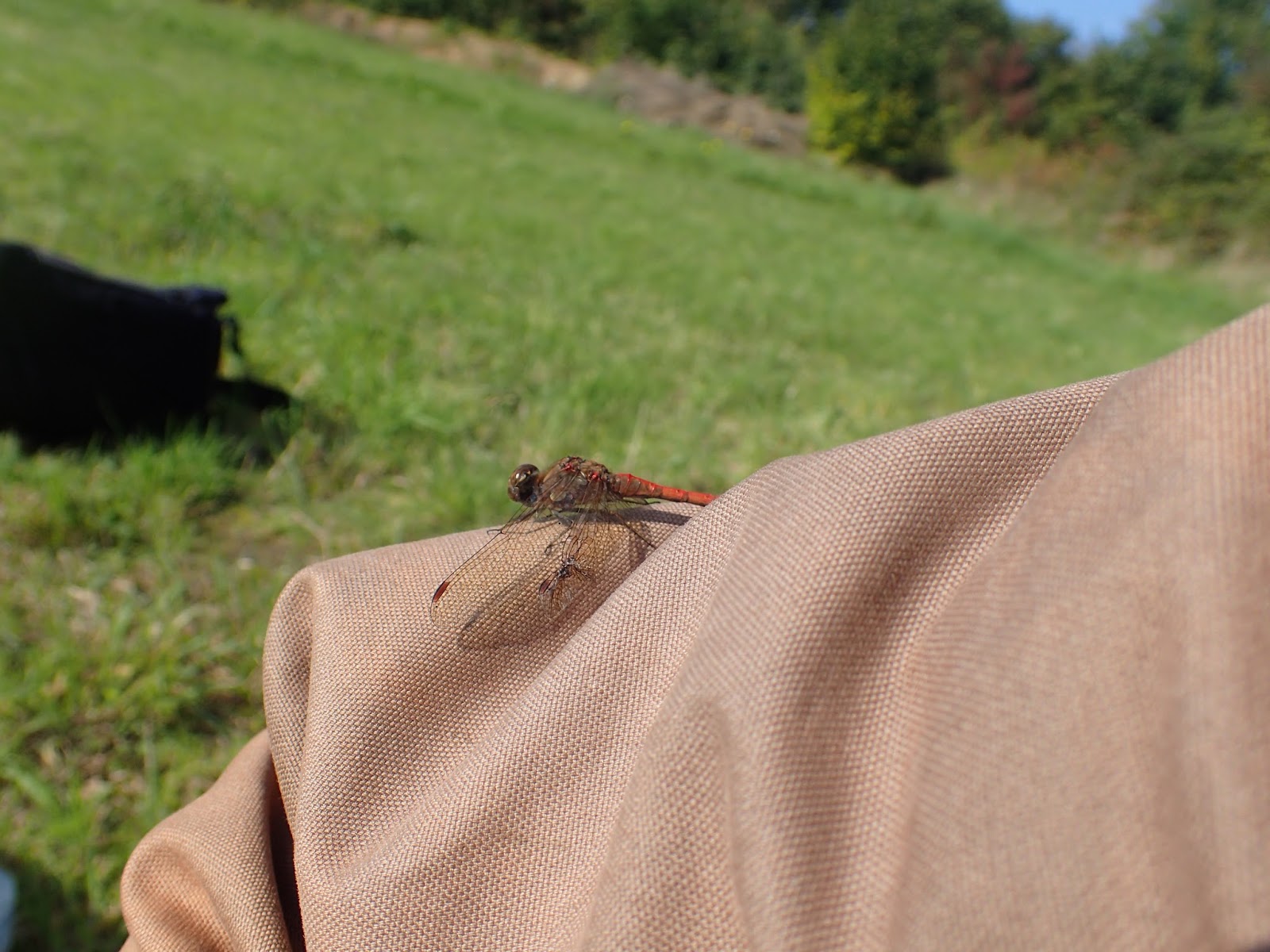
Whilst sitting on the grass a Common Darter landed on me several times, although I had to twist to photograph it. A couple of Agromyzid mines were noted, including a new one for me, Agromyza plantaginis, on Greater Plantain.


At the eastern edge of the site there is a ditch, and as we headed that way Tim pointed out a Willow Emerald. They really are quite widespread now, I've seen them at many sites this year. A rust fungus on Agrimony was a good find and a few other bits were noted, including some mines in Poplar and Alder. Seiving of one final grass pile turned up two Notiophilus palustris beetles, part of a genus of ground beetles that have large eyes and stalk Springtails.


TROWSE: Some mimicking hoverflies & other patch ticks

24th June 2017

After my successful Currant Clearwing visit, I headed around Norwich to Trowse for a bit of time on patch. Trowse Meadow was pleasant, but in overcast conditions there weren't as many insects about as I'd hoped, with the exception of numerous Banded Demoiselles near the river. A clump of Pencilled Cranesbill growing near the bridge are new to my Whitlingham list as far as I remember, and the click beetle Adrastus pallens was also new.


I then crossed the road and went up into Trowse Woods. I walked fairly quickly through the shady areas because my destination was the clearing at the top of the woods, where two islands of Buddleia attract lots of insects. I was in luck, and after a few minutes there was some bright sunshine. A Common Darter was resting and I got good views of Eristalis intricarius, a bee mimic, and a pair of mating Meadow Browns. The undoubted highlight was a new hoverfly for me, Chrysotoxum festivum, a wasp mimic.


Leaving the woods I looked round past Whitlingham Hall down to the country park, adding another two patch ticks, Oak Bush-cricket (a species that sometimes comes to moth traps but is otherwise quite hard to record, despite being common) and a ground bug, Petritrechus lundii.