The Whitlingham Bird Report for 2025 is now available to download from the Bird Reports page or from here

Showing posts with label Plants. Show all posts

NORWICH: Riverside walk

Late July 2022

I opted to walk home from the city via riverside and the riverside footpath, seeing Hawkweed Oxtongue and Royal Midget (Phyllonorycter pastorella) for the first time. The latter is a recent moth colonist, which produces distinctive leaf mines on long-leaved willows. This was the first Norwich-area record.


NORWICH: Some new plants & plant fungi

Mid-March 2022

With it not yet being prime insect season, my daily walk into the city still has a mostly plant and plant fungi based focus. Down a small alleyway near my house I noticed some naturalised spurge plants that I was able to identify as Turkish Wood Spurge, whilst I finally stopped ignoring a brassica I'd seen the week before along Chapelfield and identified it as White Mustard.


I have been regularly checking Pellitory-of-the-wall for a recent colonist leaf-mining moth (so far unsuccessfully) but did find the leaf spots of Ramularia parietariae on one plant. A more intentional search of Herb Robert plants successfully turned up another leaf fungus, Coleroa robertiana.


WHITLINGHAM: Loads of new invertebrates

Late May 2019

In late May I headed to Whitlingham for a couple of hours after dropping Cathy off. Having given the broad a quick look and noted the lack of birdsong, I decided to focus on the picnic meadow. This paid off nicely with a string of new site records, quite a few of which were also new to me. Below are some of the more photogenic species:

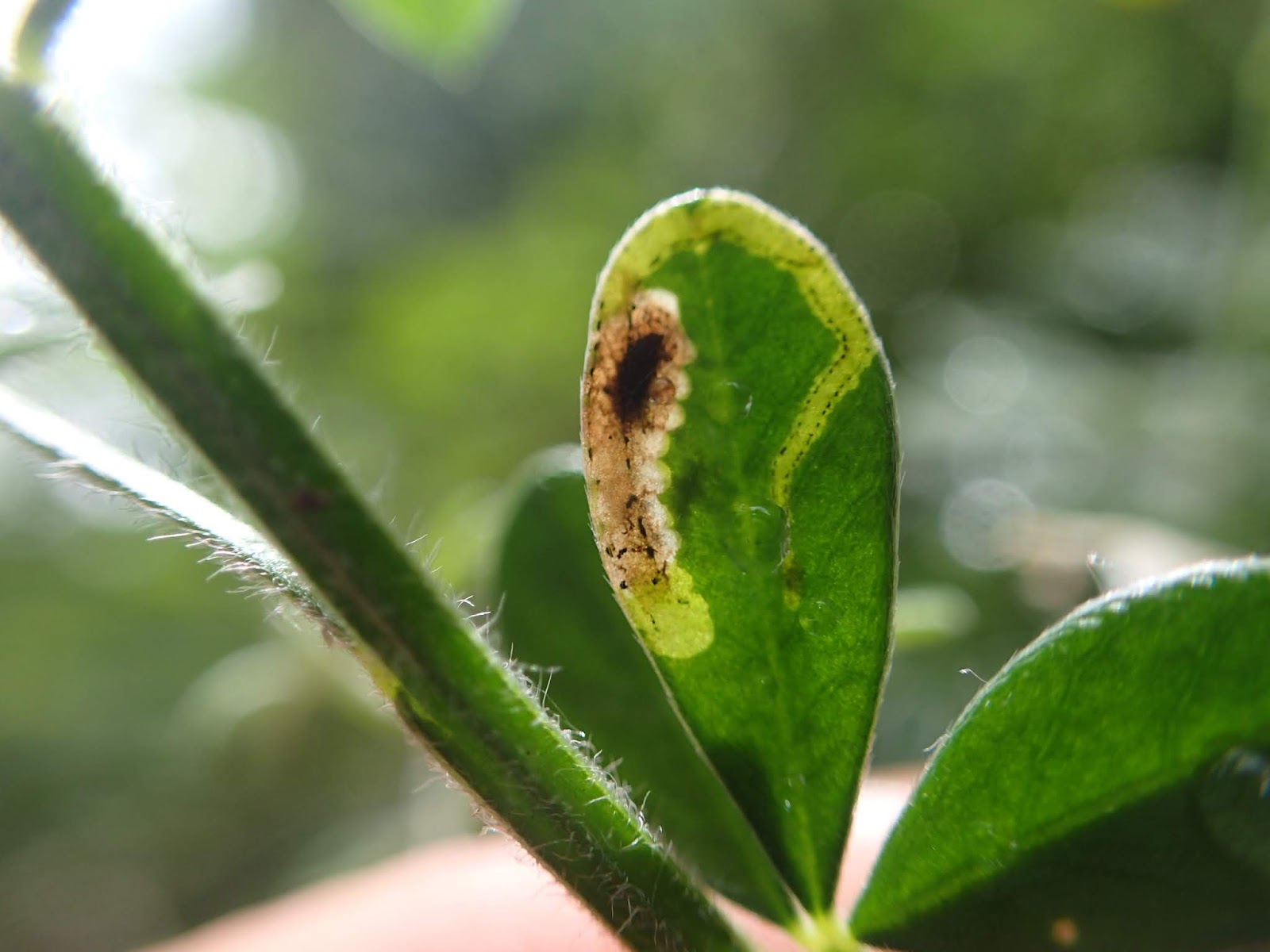
 Agromyza johannae leaf mining Broom (new for me)
 Bee Orchid (present here for many years but only one spike seen today)
 Molanna angustata - a distinctive Caddisfly
 Ciona alauda - one of the weevils associated with Figwort, although seen here on Buddleia
 Eriocrania sangii - leaf mine of this scarce micro moth seen on Birch
 Eristalinus sepulchralis
 Kaliofenusa altenhoferi sawfly leaf mine on Elm
 Orthochaetes setiger weevil mine on Ribwort Plantain
 Common Red-legged Robberfly
Yellow Rattle - a surprise to see this, but almost certainly seeded here.

SUFFOLK: Oxlips and Tachinids

Mid-April 2019

Having contemplated what ancient woodlands fairly near Norwich were buggy friendly, I suggested that we go a bit further afield to Bradfield Woods. This site, managed by Suffolk Wildlife Trust, is a national nature reserve that has apparently been coppiced continuously since 1252 and is rich in wildlife. I'd never visited before, and as a bonus it holds a good population of Oxlips.

We arrived around lunchtime so started with a picnic near the visitors centre, before heading off around the black trail. There was a good range of flora right from the car park, including things like Wood Anemone and Wood Spurge. We hadn't gone very far when Cathy found our first Oxlips (a new species for me), and we ended up seeing loads of them. Further alongs were some Early Purple Orchids, but they were in bud rather than open flower.


It was an overcast day so not great for insects, but I did see a few hoverflies flying around, along with some tachinids. Getting a closer look I assumed that it would be Tachina ursina, however it had some yellowy-orange areas on the side of the tergites which that species doesn't have. In fact it was Tachina lurida, a species that when I checked with the county recorder turned out to be new to Suffolk. Phasia hemiptera, another tachinid, was also seen. Bradfield was a lovely place, and given that we probably only explored about a third of the woods is somewhere we might well return to in the future.


BRECKLAND: Weeting Heath plants

5th August 2017

A very productive day in the Brecks, so much so that a few posts will be needed to cover everything. I started the day at Weeting Heath, where Wild at Weeting, an end of season celebratory event was being held. Normally this wouldn't really be my cup of tea, but I noticed in the event details that two flora walks were being led, and that these would enable visitors to see some of the rare species on the main part of the heath that is normally off-limits. I had wanted to see two of these plants, Spiked Speedwell and Maiden Pink, for some time, so eagerly booked myself on the first walk. Cathy decided not to come, but Ian, Jeremy and Vanna were all keen to come, so I picked them up and headed to Weeting.

Before leaving on the walk we had a look at the few Broad-leaved Helleborine spikes that grow near to the car park.


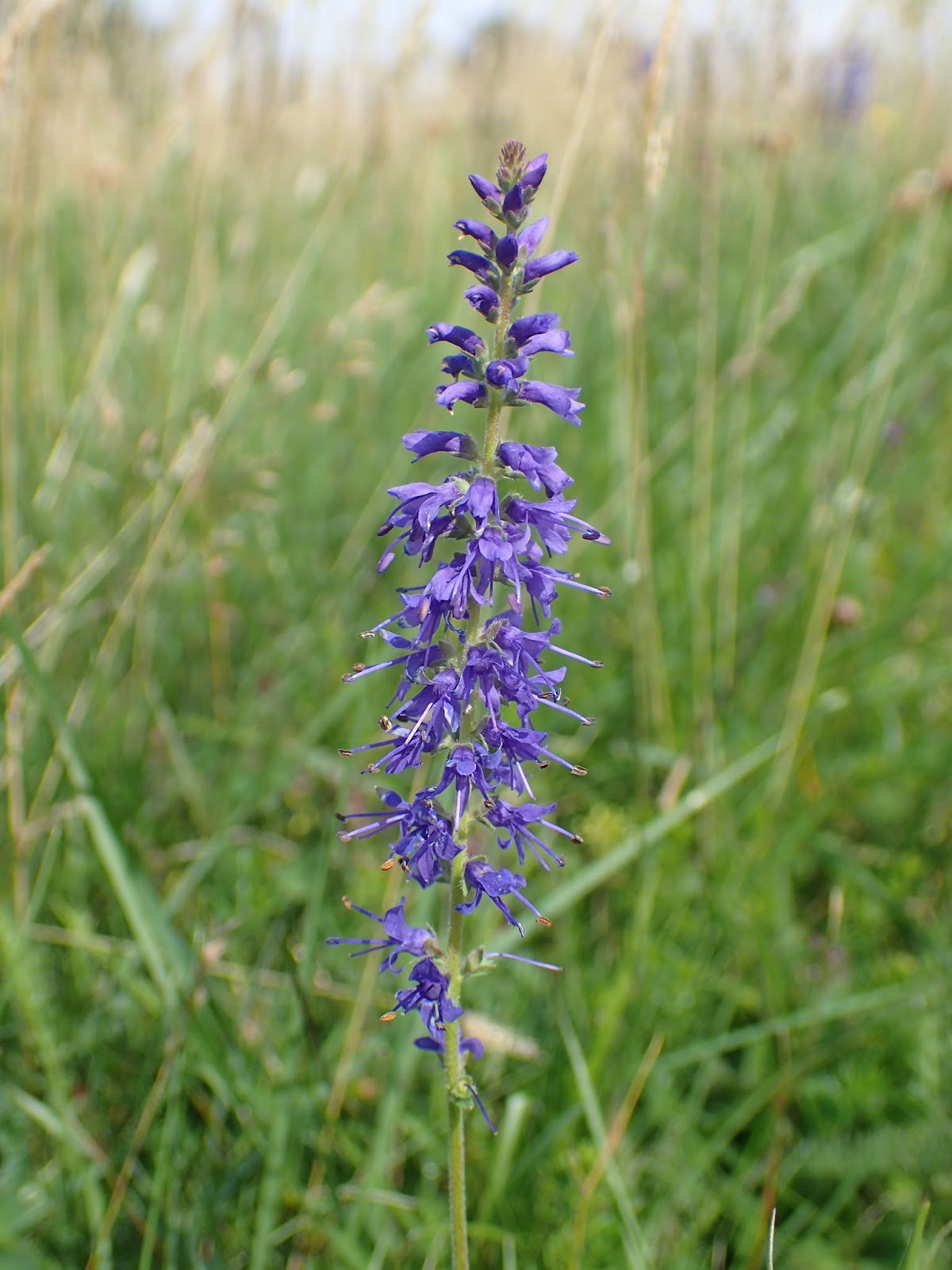
Our first scarce plant was Purple Stemmed Cat's-tail, a rather unremarkable looking grass, followed by the small yellow composite Smooth Cat's Ear. Somewhere along the line botanists obviously liked describing plants in terms of which bit of a cat they thought was most similar. Next up was a clump of Maiden Pink, an attractive plant which might look a bit similar as other pinks are now sold in garden centres. This was a new species for me, and I wasn't disappointed. We then walked across to an enclosure where Spiked Speedwell grows. This was one of my first target species back in 2014, so it was nice to finally see it, and as with the Maiden Pink it was flowering just at the right time for us.


Over the brow of the hill we were taken to see some White Horehound, which was almost over, with only a handful of flowers still. From here we went across to some chalky pits, but some of the earlier spring flora that grows there had gone over. We did see Autumn Gentians, Purple Milk-vetch and Dwarf Thistle which was nice.


On the way back we visited the larger areas of Maiden Pink, before heading to a more recently scraped area where after a search we eventually managed to locate a patch of Sickle Medick (another new plant for me) that the warden had seen the previous day.


We also saw a good range of moths and bugs, which will be the subject of the next blog post. Our thanks go to James the warden for leading the walk and for his knowledge and enthusiasm. We had booked on the right walk too, as by 2pm a thunderstorm hit and we ate our lunch in the car as the rain poured down.

SOUTH NORFOLK: Tas valley plant walk

21st May 2017

My busy period of wildlife events continued on Sunday with a NNNS Wildflowers Revealed walk in the Tas Valley. Part of the idea was to look at some of the boulder clay specialities of this part of the county, although we were warned in the introduction that not many of these had been found during the recce the week before.

We met in the car park at Forncett St Stephen's church, and after a quick talk and one of Jo's cakes we moved off to have a look in the churchyard. As it happened the first plant we stopped to look at was one I haven't recorded before, Cornsalad. It is relatively common, but also has a number of very similar relatives that differ in the shape of the seeds, which might explain why I'd not felt safe recording it previously. Meadow Saxifrage and Hybrid Bluebell were seen, and some ID tips regarding Hairy Tare ID were given.


Along the edge of the churchyard we saw Bur Chervil, Rough Chervil, Barren Brome and Great Brome, and I stopped to photograph a micro moth on the hedge. The only comment I've had on it so far is that it looks like Rhyacionia pinivorana, new to me and the 10km square, but if you disagree then let me know!


We took a footpath down past a field of buttercups and stopped on a bridge over the river, where Mike waded in to get a sample of a Water Crowfoot sp. These are very similar, and require detailed examination to determine which species is involved. Some dried seedheads of Small Teasel were also of note here. I missed a Small Yellow Underwing moth found by Nick, but did see several species of ladybird and an interesting thin-leaved form of Hogweed.


We were now on the Tas Valley Way, which wound its way through a couple of farmyards. As we walked past the first one a few people stopped to look at the horses, an action that made at least one of the inhabitants of the farm surprisingly irate. It was explained to us that they had had lots of rural crime issues here of late, but parties of botanists keeping to the footpath would appear to be rather low on the list of miscreants. After a while we stopped and had lunch, enjoying a nice view across to Forncett St Mary. At this point I decided to leave the rest of the group to it, so after having a chat with Ian and having a look at a 16-spot Ladybird that landed on my leg, I took a different footpath and headed back to the car.


SOUTH NORFOLK: Flordon Common fungi

1st October 2016

The Norfolk Fungus Study Group foray today was at Earsham Hall on the Norfolk/Suffolk border, and I didn't really have time to go there. Handily an alternative was offered, Tony had decided to visit Flordon Common and so a splinter group of Tony, Ian, Tim, Tom and myself headed there for a few hours instead. I had never been to Flordon before, but was aware of it because it had been a NNNS Research Group project, with a detailed write-up in the 2009 volume of Transactions.

We met at a layby near to the entrance to the common , which was marked with a footpath sign but no interpretation board or anything saying 'Flordon Common', so it could easily be missed.


Upon entering the common we headed straight for a small area of short-cropped grassland where Tony had seen an unusual Waxcap the week before. It turned out there were quite a few of the small orangey-red caps. Tony had confirmed that they were Glutinous Waxcaps (Hygrocyube glutinipes), but this species is usually yellow. There is a scarcer red form (var rubra), but given that these were orangey, we don't know where the line is drawn between the two forms! Two Blackening Waxcaps were also present here.


Whilst Tim looked through a cow pat for beetles, Ian had ranged a bit further and located some more fungi. Two of them were species I had only seen once or twice before, Mycena amicta and Fiery Milkcap (Lactarius pyrogalus). The other one was a Parasola sp, which will need further work to identify to species. Further along we were momentarily stumped by some small yellowish fungi growing beneath a bush, until someone mentioned that it was Hawthorn. It turns out that there is a species that grows on old buried Hawthorn berries, and this was it, Tubaria dispersa.


The next species of note (so ignoring some small yellow discs growing on a cow pat) was an attractive Scalycap growing from the base of an Alder. Given the host I guessed at 'Alder Scalycap', but actually it was the closely related Golden Scalycap (Pholiota aurivella). Whilst near the stream bank I noticed some red fibrous-looking things below the water. Being the curious type (and hoping to have discovered a new species of freshwater seaweed) I waded in for a closer look. It turns out they were the end of Alder roots - whether they are this colour in the ground or only in water I don't know. Either way very interesting.


Aware of time restraints we had a quick look around an area of wet vegetation, noting Cramp Balls (Daldinia concentrica) on Alder rather than its usual host, Ash. Back near the road we found a few more fungi near a Willow tree, including Goldleaf Shield (Pluteus romellii). We exited the common and walked along the road before re-entering along a drier edge. Here we saw more Glutinous Waxcaps and several other small fungi, but the main feature of interest was some of the plants, which included Good King Henry, Vervain, Cotton Thistle and Dwarf Mallow. In a wetter area nearby Devil's Bit Scabious and an Eyebright sp, possibly E. pseudokerneri, were still flowering. A nice site, and probably worth a spring visit for insects judging from the number present on an autumn day.


WHITLINGHAM: September WeBS count

18th September 2016

Whilst I had been at Hickling looking at fungi there had been a very good passage of seabirds, so on Sunday morning I got up early and went to the coast hopeing to catch the tail end of it. As is often the case Sunday didn't match up to the previous day, with Arctic Skua, Great Skua and lots of Red-throated Divers the highlights. Eventually I gave up and headed home for lunch, before then heading to Whitlingham to carry out the WeBS count.

Selected counts (2015 totals in brackets) were:
Mute Swan 21(61)
Greylag Goose 10 (163)
Canada Goose 4(3)
Egyptian Goose 10 (4)
Mallard 74(63)
Gadwall 0 (1)
Tufted Duck 7 (3)
Pochard 2 (0)
Coot 97 (45)

There wasn't anything particularly unusual for the time of year, although both Mute Swan and Greylag numbers are well down on last year. Coot numbers jumped from 47 in August (similar to 2015 when 44) to 97. Last years October count was 103, so it will be interesting to see if this is just an early arrival or whether numbers will be higher this winter. Two Buzzards were seen over the thin strip of woodland between the lime tree avenue and the ski slope.

Despite keeping my head down and concentrating on birds I did add three patch species, Marsh Cudweed (which seems to be having a good year, I've seen lots of it elsewhere), the hoverfly Rhingia campestris and a powdery mildew on Water Mint. Parent Bug and 22-spot Ladybirds were also noted. Once again several people thought my telescope was a camera - this happens on every count and I'm becoming very weary - if you don't know the difference between them please google it and pass on the knowledge.

 22-spot ladybirds (they feed on mildew)
 Marsh Cudweed
Parent Bug

BRECKLAND: Weeting Castle & Cranwich Camp

30th July 2016

After leaving Brandon Country Park we headed back into Norfolk. I wanted to look for a couple of scarce breckland plants, but firstly we diverted down a small track at Weeting to visit the remians of Weeting Castle. Like several Norfolk 'castles' this one was actually a stately home with a moat, but nonetheless it made a pleasant diversion.


After looking at the ruins we carried on to Cranwich Camp, an area of dry grassland managed by the NWT. The first (and rarest) plant I wanted to see was Proliferous Pink, and I found one almost straight away near the car parking area. Later on I found some more out on the camp, although it was starting to go over. We walked around one edge to look for the second plant, Spanish Catchfly, but at first couldn't find any. There was a range of other interesting plants, including Wild Thyme and Restharrow. Re-tracing our steps we headed off along the other edge. I had been looking for a rare micro-moth, Powdered Grass Veneer, and having spotted one I then looked round and found that it had led me to an area of Spanish Catchfly

 Proliferous Pink
 Spanish Catchfly

Although the plants were the main objects of my searching, I was also looking for Marbled Clover moths. There were lots of macro moths on the knapweed particularly, but most were 6-spot Burnets and the rest were Ear Moths, the latter a bit odd for diurnal observations. The meadow area looked good for invertebrates too, but my casual glance gave up just the one new species, the bug Calocoris roseomaculatus. I did keep an eye out for Smooth Rupturewort too, but I think that it is actually found at a nearby area called Cranwich Heath rather than Cranwich Camp.