The Whitlingham Bird Report for 2025 is now available to download from the Bird Reports page or from here

Showing posts with label Moths. Show all posts

CENTRAL NORFOLK: Hockering Wood invertebrates

Late May 2024

I had set aside a day at the end of the month to go looking for hoverflies, but unfortunately it was raining so this would have been a waste of time. Instead I decided to go to Hockering Woods, a privately owned SSSI ancient woodland that is opened up by the owners over the summer. It is not the easiest place to visit - entrance is via a single gate and the road is used by lorries based nearby so walking from elsewhere is not really an option. There is parking for a couple of cars nearby, and the last time I visited the site was locked despite being within the published opening days. Anyway this time it was open and I managed to park at the second time of trying.

There was plenty to find alongside the paths by scanning the wet vegetation. In particular I was delighted to find my first Four-spotted Carrion Beetle (Dendroxena quadrimaculata) and I found a fly new to Norfolk, Liriomyza pascuum causing leaf mines on Wood Spurge. There were quite a few moths, including a large number of Small Barred Longhorn Moth (Adela croesella), and I also found a Buff-tip.


SUFFOLK: Minsmere lichenicolous fungi

Mid-February 2023

We went on a family visit to Minsmere, the highlight of which was a new micro-moth for me - Heath Button (Acleris hyemana). Other than that I also noted a few lichenicolous fungi, Erythricium aurantiacum, Laetisaria lichenicola and Xanthoriicola physciae.


FENLAND: Welney swan feed

Mid February 2023

We headed out to the edge of the fens for a family trip to Welney, timed to see the midday swan feed. If you've never been there is a large, heated hide set up to provide views out over the flooded fenland, providing close-up views of Whooper Swans (the shyer Bewick's Swans are often visible in fields on the approach road but seldom come in for the feed) and large numbers of Pochard. Some species new for the year included Pintail, Dunlin, Black-tailed Godwit and Cattle Egret, although the Tree Sparrows weren't on the feeders when we were looking.


After lunch we went for a brief walk along to some of the other hides. We had a look at some Xanthoria/Caloplaca lichens, searched unsuccessfully for Mousetail and saw a few invertebrates. These included Water Ladybird, the larva of Endothenia gentianeana/marginata in an old Teasel seedhead (you have to examine them closely to see if they have a feature called an anal comb - I didn't) and cases of a snail - Bithynia tentaculata I think.


NORTH NORFOLK: A stroll on Bryant's Heath

Late October 2022

Having gone back to North Walsham to visit relatives I decided to take a few hours and walk one of my old haunts, the Weaver's Way down towards Felmingham. I left the footpath at the bridge and continued on to Bryant's Heath, where I did a quick lap and then back the way I had came. There were a few highlights - as I entered the heath I saw a micro moth flying weakly over vegetation. I followed it and managed to get good enough views to confirm it was a November Tubic (Diurnea lipsiella), a new species for me. After checking quite a bit of Aspen I found a couple of mines of Virgin Pigmy moth, Ectoedemia argyropeza, a new 10km square for it. Less pleasant was a ked fly, presumably Deer Ked (Lipoptena cervi) that landed on my trousers. These are rather odd looking blood-sucking flies (see Deer Keds on arthropodafotos.de for more information on them).


The fungal highlight was finding a large patch of Fly Agarics under some birches. Unfortunately they were spread out enough that my pictures don't do justice to what was a very impressive sight.


The last thing of note was several Apionid weevils on Broom. Having researched the pair of similar Broom-feeding species earlier in the week, I was happy these ones were Protopirapion atratulum.

NORWICH: Some early October highlights

Early October 2022

More interesting things seen on my daily commute, including two new aphids, Aphis oenotherae on Evening Primrose and Aphis solanella on Black Nightshade. At Sainsburys on Queens Road there were several moths around one of the security lights, unfortunately nothing new but Large Ranunculus is always nice to see. Walking down towards Lakenham Way I found a Nigma walckenaeri spider hiding under a silk tent. There were also some interesting plants at Wensum Park on a dried-out bit of what is usually a flooded inlet, notably Marsh Yellow-cress, Bullwort and Cockspur Grass.


NORWICH: Royal Midget

Late September 2022

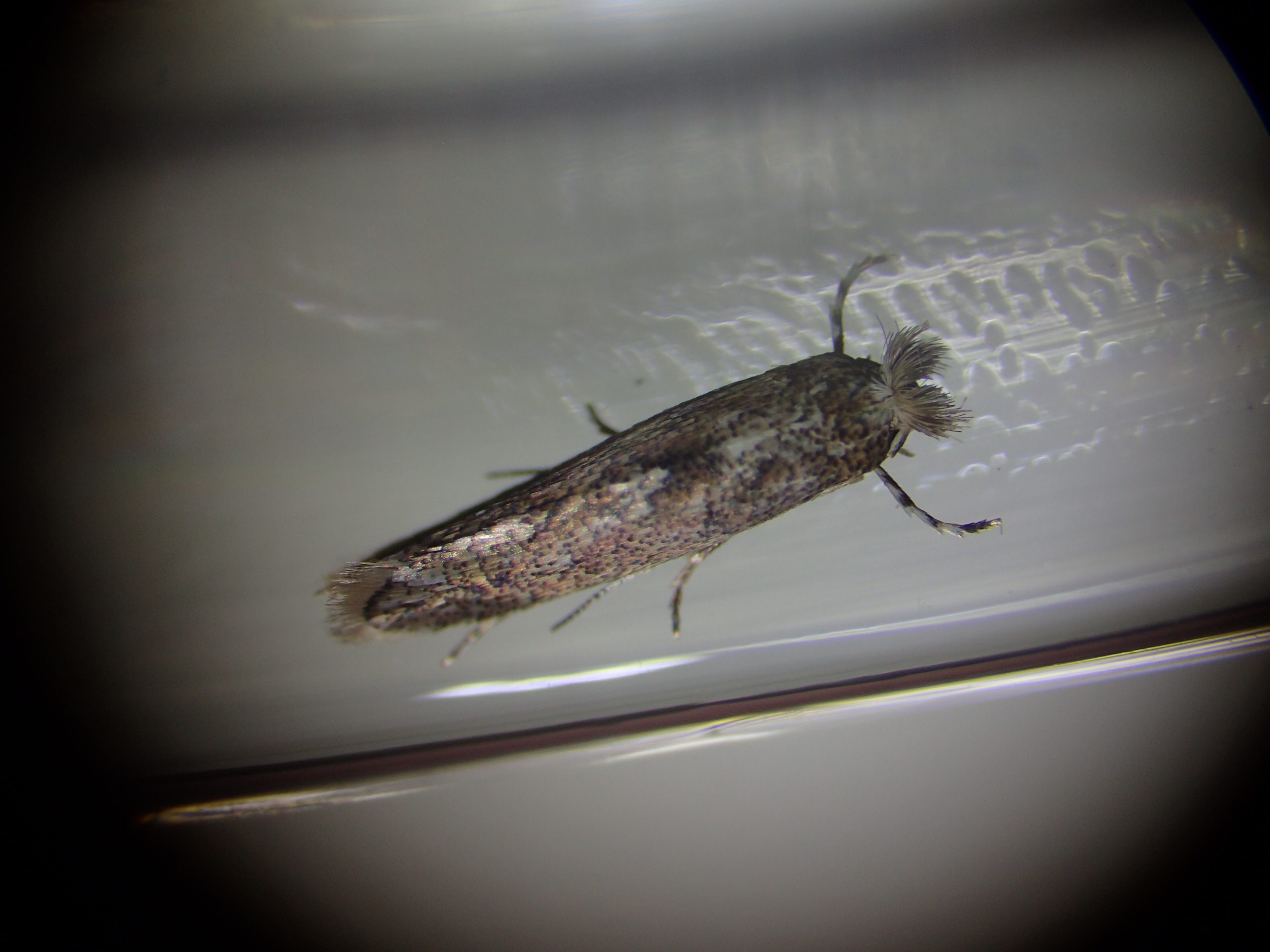
In July I had found Royal Midget (Phyllonorycter pastorella) leaf mines in the Norwich area for the first time. This species was only found in the UK for the first time in 2014, and in Norfolk in 2018. The mines that I found were typical, in being long with a single crease on long-leaved Salix sp. During September I started seeing similar mines in other places around Norwich, notably Whitlingham and Wensum Park. I wasn't completely convinced though, as these mines were a fairly normal Phyllonorycter size rather than the 'typical' extra long ones. I decided to collect an occupied mine from Wensum Park, and a few weeks later an adult emerged. It was indeed Phyllonorycter pastorella, a nice little moth with bushy hairs on the front of the head.


NORWICH: Sweetbriar Marsh invertebrates

Early August 2022

One day after work I called in at Sweetbriar Marshes, where Vanna Bartlett had recently seen Andrena denticulata on the Fleabane. I managed to find a few, along with Red Bartsia Bee and a few other bees. On the reedmace I found Chilacis typhae bugs, some half buried in the seedheads, and an adult Orchestes hortorum weevil as on an Oak leaf. The most interesting find was a small micro moth on Skullcap. Unfortunately there are two rather variable species, both rare, so whilst I think this one is likely to be Small Metal-mark, Prochoreutis myllerana, it would require a specimen to confirm it. There are only 11 Norfolk records since 1900 The only previous record from TG20 is from Charles Barrett, the early moth chronicler back in 1874.


WHITLINGHAM: Egyptian Geese brood and some micro moths

Early August 2022

We met a friend at Whitlingham for a walk around the Great Broad. On the slipway there was a new brood of Egyptian Geese plus locally ringed Greylag Goose, Mute Swans and a returning Black-headed Gull. Whilst walking round I noticed a Notch-wing Button (Acleris emergana) and leaf mines of Antispila petryi on Dogwood.


NORWICH: Riverside walk

Late July 2022

I opted to walk home from the city via riverside and the riverside footpath, seeing Hawkweed Oxtongue and Royal Midget (Phyllonorycter pastorella) for the first time. The latter is a recent moth colonist, which produces distinctive leaf mines on long-leaved willows. This was the first Norwich-area record.


WHITLINGHAM: A few July invertebrates

17th July 2022

The Whitlingham WeBS count for July was one of the quieter ones I've done, with no real species or counts of particular note. In terms of non-avian highlights, Opilio canestrinii is a common harvestman but not one I'd recorded at Whitlingham before, Alder Signal moth (Stathmopoda pedella) is a fairly scarce moth and Uroleucon aeneum aphids on Musk Thistle was a new species for me.


CAMBRIDGESHIRE: Wicken Fen

16th July 2022

Whilst most of the Norfolk Fungus Study Group programme is naturally in Norfolk, the group also has a scattering of members based in Suffolk, Cambridgeshire and Lincolnshire, and this year took up the invitation to hold a meeting at Wicken Fen, a few miles over the border into Cambridgeshire. Wicken and Woodwalton Fens were places I knew of at an early age from nature documentaries, so I was eager to attend to have a look round. Unfortunately from a fungi recording point of view the visit coincided with a spell of hot dry weather, and the number of species seen was low, mostly restricted to plant fungi and a few on wood.


The highlight was undoubtedly a Silver Barred moth, found by Stewart Wright. This species is limited to a small number of fenland sites and was something we had been actively looking for on the trip, only for Stewart to find one as we neared the end. A downy mildew on Wild Mignonette (Peronospora crispula), Parsley Water-dropwort and the Tephritid fly known as Knapweed Ghost (Acanthiophilus helianthi) were also new species for me. Thanks to Chris Preston and Owen Mountford for facilitating our visit.