DAY 47 - 6th May 2020
Most of the white butterflies flying through the garden still refuse to land, but I managed to confirm that at least one of them was a Large White. I also found a nice multi-coloured rove beetle, that with help from Tim and Calum I managed to confirm was Paederus riparius. Rose found a small spider, but I've not identified it and doubt it will be identifiable from this.
106. Large White
107. Paederus riparius (a rove beetle)
DAY 48 - 7th MAY 2020
108. Small Purple-and-gold (Pyrausta aurata) - a small attractive moth, also known as the mint moth, seen in the garden.
DAY 49 - 8th MAY 2020
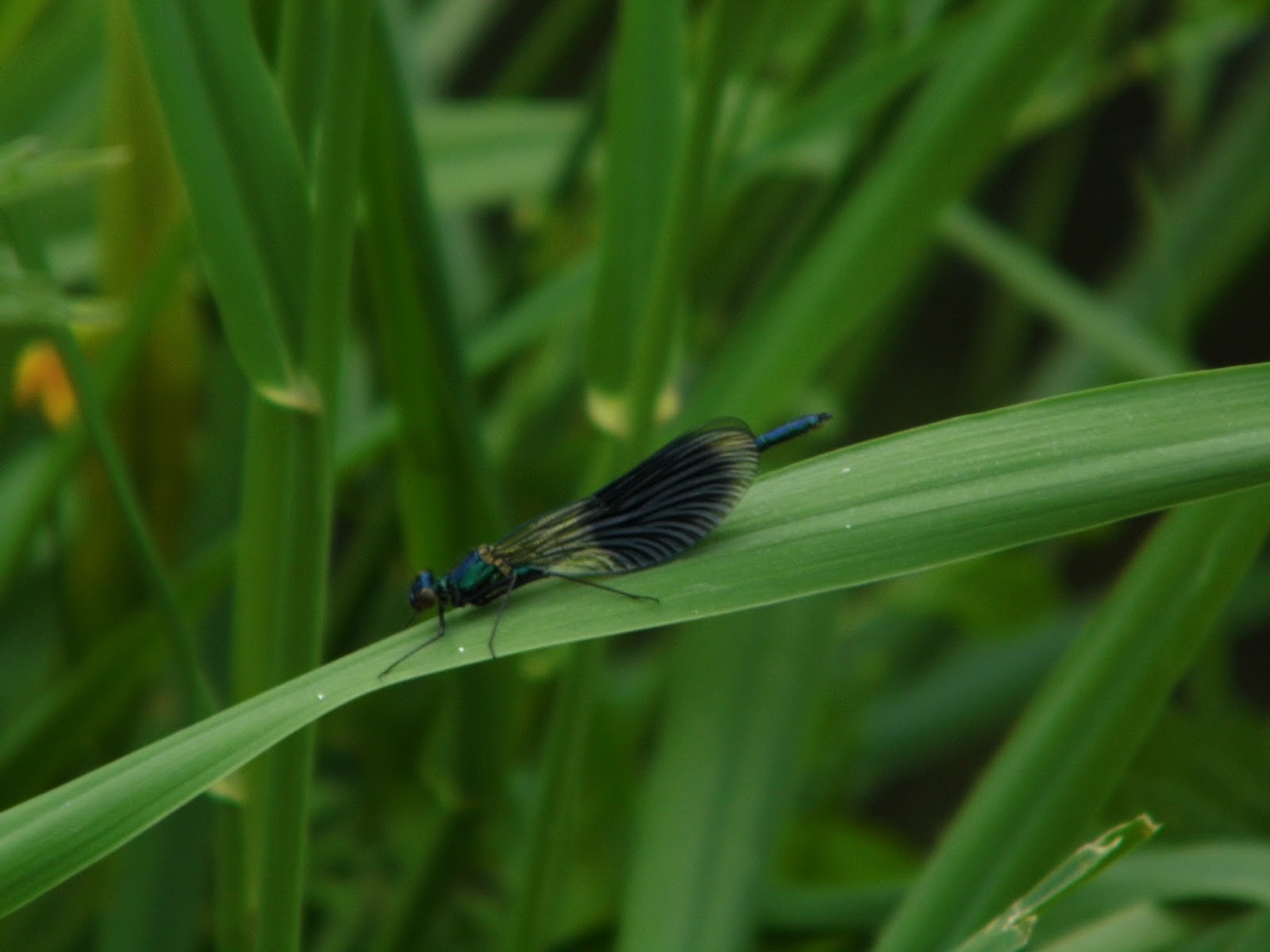
109. Large Red Damselfly - Cathy noticed this flying up the window and I managed to get a silhouetted photo as it flew onto the roof of the adjacent garages. This species is the only regular odonate here, although there is no sign of them breeding in the pond yet.
DAY 50 - 9th MAY 2020
Nothing new added.
The Whitlingham Bird Report for 2025 is now available to download from the Bird Reports page or from here
Showing posts with label Damselflies. Show all posts
EAST NORFOLK: Looking for migrants and damselflies
Late August 2019
Near the end of the month Adam & I had set a day aside for birding. There had been an arrival of Wrynecks and Whinchats along the east coast a few days previously and also several sightings of Scarce Blue-tailed Damselfly on the pools at Winterton, a species I've never seen, so we decided to head to Horsey and then walk to Winterton and back.
We arrived in light drizzle, which was eventually replaced with bright sunshine by the time we left. Despite the seemingly favourable weather conditions there were not many migrants about. Several local Stonechat families were seen, as was a big mixed Linnet/Goldfinch flock, two Whinchats and a few warblers. Surprise sighting of the day went to a Green Sandpiper that flew up off one of the pools, and a Pied Flycatcher was heard but not seen within some willows.
Unfortunately there wasn't much better luck with the Damselflies. There were lots of Emerald Damselflies, but the only other damsel found was a female Blue-tailed, which proved a bit of an ID challenge because it looked particularly small and dowdy. I assumed it was teneral, but actually some old females look like that. Some Donacia beetles were also noted on the pools, although I'm never completely convinced I've keyed them out correctly so I still need to double check the ID.
The highlight of the visit therefore was the leaf mine of the Nationally Scarce B micro moth, Phyllonorcyter quinquegutella on Creeping Willow. Back at Horsey Mill car park we stopped for a drink and had a walk around the garden, seeing several Rhingia campestris hoverflies.
NORWICH - a week of wildlife
8th-11th May 2018
The sustained spell of sunshine meant many plants were flowering and lots of insects were on the wing around Norwich. Accordingly I varied my route to and from work to take in as many patches of flowers as possible, and recorded a range of species.
My week actually began with a fungus twitch. At the start of the bank holiday Dave Andrews had tweeted photos of a phallic-looking fungus growing in a Norwich curchyard. He had naturally assumed it was a Stinkhorn, Phallus impudicus. The time of year would be unusual for that species however, and when I looked at it I realised it was actually a Semi-free Morel, Mitrophora semilibera. I'd not seen this species before, so luckily it was still standing (in fact I saw six fruiting bodies), although the fruiting bodies had started to deteriorate in the heat. On the way home I noticed some galls on Rowan, caused by Eriophyes sorbi.
On the next day I was pleased to find a Nomada sp sunning itself on some riverside trees. The size and uninterrupted bands made me think it was Nomada goodeniana, but the tegulae etc should be yellow, so perhaps I need to reconsider that. My first Large Red Damselfly was seen nearby, as were several Syrphus ribesii hoverflies.
At work I noticed a small deceased insect on a windowsill, which Tony Irwin kindly identified for me as the barklouse Loensia variegata. Finally on my way home I saw a yellow flower that I didn't recognise, which turned out to be Woad. This plant is well known as the source of the blue dye used for body painting in the past (a good excuse to rewatch the Horrible Histories 'warrior boast battle' here: https://www.youtube.com/watch?v=-SUeX-5QTAM)
Thursday morning was damp, but fortunately the evening was warmer, so I diverted through Waterloo Park. My target was a sawfly, Blennocampa phyllocolpa, that causes the leaves of roses to roll in at the sides. Andy Musgrove assured me that it was probably on every area of roses in Norfolk, but I hadn't seen it on the random plants checked on my route over the past few days. I managed to find the leaf rolls on a bush near the pavilion steps, and did see an adult, although it didn't stay for a photo.
Whilst waiting in vain for the sawfly to return, a nice Sulphur Tubic, Esperia sulphurella, landed on me, whilst a Holly Blue and a mating pair of Parent Bugs were also noted. Whilst photographing the Parent Bugs several Birch Catkin Bugs fell on me - if you haven't ever seen one then standing under a birch tree for 30 seconds will probably remedy that (they are very common).
On Friday I stopped near a patch of sunny leaves to see what was basking. There were loads of Syrphus hoverflies, but once again all that I checked were S. ribesii. There are two similar, and apparently common, other Syrphus species, S. torvus and S. vitripennis, but as yet I've recorded neither. The bug Dryophilocoris flavoquadrimaculatus was found, more Large Red Damselflies had emerged, and a distinctive-looking fly was almost certainly Anthomyia procellaris.
Less obvious species noted were Horse Chestnut Scale Insect on Sycamore and Elder Aphid, Aphis sambuci, on Elder. There were also aphids on the Sycamore, but I've not identified them yet, perhaps better to wait until they have grown a bit.
Elder aphid
Aphid sp on Sycamore
I had received a text from Adam to say that he had heard a Cetti's Warbler near Cow Tower on his way into work. That would be a good 'inner ring road' Norwich bird, so I took a rather large detour there on my way home in the hope that it would still be around. Unfortunately it was either quiet or had gone. The breeze had got up, limiting the potential for insects, but I did find the leaf mine of Lynonetia clerkella on Hawthorn, the caddisfly Limnophilus rhombicus, the hoverfly Dasysyrphus venustus and a bee, probably Andrena scotica. A brood of Egyptian Geese capped off my week of wildlife commutes.
NORWICH: Cow tower Willow Emeralds
25th August 2017
Another brief Norwich excursion, when after work on Friday I detoured through the cathedral grounds and round the river. The main purpose of the walk was to check for Willow Emerald damselflies at the pond near Cow Tower, and I was pleased to find four, including a mating pair. There were also several male darters, although I didn't see them well enough to determine if they were Common or Ruddy. A red shieldbug was also seen near the pond, which as suspected was a mid-instar Hawthorn Shieldbug.
WHITLINGHAM: Bat workshop & woundwort shieldbugs
17th May 2017
On Wednesday evening I attended a 'using your ears' bat workshop at Whitlingham. This session, organised by Norwich Bat Group and delivered by Lisa Worledge of the Bat Conservation Trust was aimed at helping people using heterodyne bat detectors to identify bat calls, not just based on the call frequency, but also on things like rhythm and repetition. This proved to be a very useful session, using a mixture of bat calls recorded from magenta detectors, along with simulated calls made up of clicks and artificial notes. Afterwards we did go for a quick walk, but it was raining steadily so we gave up after a short while. I have been on quite a few bat walks before, but I found the session very useful, particularly as one of the species we looked at was Serotine, which I am yet to see.
Before the session started I had a quick look over the broad and in the vegetation nearby, seeing a Common Blue Damselfly and several mating pairs of Woundwort Shieldbugs.
TRING: Nautral history museum & treehopper
30th April 2017
After our walk at Bison Hill, Cathy & I headed to Tring to visit the Natural History Museum. We arrived a couple of hours before opening, and spent some of it in the memorial garden. As you would expect it was a scenic, peaceful place, and we particularly enjoyed seeing some recently emerged Large Red Damselflies taking their first flight, helicoptering uncertainly up into the nearby vegetation.
After lunch we went to the museum, and were suprised to see there was a queue outside waiting to be let in. Whilst this did mean that the galleries were rather full as we walked round, it was good to see so many people are interested in natural history. There appeared to be some sort of activity packs that encouraged children to go around and draw their favourite animals, which again has to be a positive thing.
The bird galleries were of particular interest, in particular a case of British birds with pigment deficiencies. A temporary exhibit contained a composite skeleton of a Dodo, one of only a handful left in museums. There were more interesting galleries upstairs, and also a feature on the man who begun the collection, Walter Rothschild, and eccentric (he had a carriage pulled by Zebras!) who contributed much to the study of insects in particular.
Upon leaving the museum, seeing a Holly Blue beside the steps, Cathy suggested having a look at the park nearby. This proved to be a good idea, as I found a hopper with distinct flanges on the top of its head. My first thought was Eared Leahopper, but it was the wrong shape. Back at home I was able to find it on the ever-useful British Bugs website - it was a treehopper, Centrotus cornutus, a new species for me and a very interesting-looking one.
Bottom photo taken by Cathy Emerson
LINCOLNSHIRE: Burghley House
10th August 2016
To celebrate our wedding anniversary Cathy & I went to Burghley House, a stately home in south Lincolnshire. We had a nice look around the house and a meal at the orangery restaurant, but for the purposes of the blog I will mention a few of the insects that we saw within the grounds. As we walked across to the entrance Cathy spotted a pair of Common Blue Damselflies at the side of the road:
In the afternoon we walked through the sculpture garden, taking in a large lake. A Red-eyed Damselfly was seen in vegetation along the edge, and a Figwort Sawfly was on its foodplant close by. The most interesting sighting for me was a Common Furrow-bee (Lasioglossum calceatum) feeding on Water Mint.
There were also a couple of plant sightings of interest, but neither likely to be 'wild'. Firstly I was looking at some ferns in the water garden. I didn't recognise one of them, and as it was growing with Maidenhair Spleenwort I thought it might be native to the area, however as there were lots of planted ferns a bit further on it probably wasn't. The second plant was a Corncockle. These attractive pink flowers used to occur as arable weeds, but are now very rare. The reason you are likely to have heard the name if you are not a botanist is because there was a ridiculous scare story about them in the papers a few years back. They are poisonous, likely many plants, but only if you eat them. As a result, the Telegraph were outraged that seed packets contained Corncockle Seeds. You can still read Patrick Barkham's response in the Guardian here: https://www.theguardian.com/lifeandstyle/shortcuts/2014/aug/26/corncockle-countryfile-bbc-packets-seeds-poisonous
Unknown and dubiously wild fern sp.
Corncockle. Don't look at it too long or it might get you.
WHITLINGHAM: Damselflies and 100 birds for the year
12th June 2016
After work I headed down to Trowse Meadow and Whitlingham. Light rain was falling, which had grounded damselflies along the riverbank. I saw at least seven Banded Demoiselles and a Large Red Damselfy, plus a similar range of insects to my last visit.
Carrying along down Whitlingham Lane I saw a metallic black beetle on an umbellifer. At home I was able to identify it as Chrysolina oricalcia. This is a fairly under-recorded species in Norfolk - county recorder Martin Collier says that there have been around ten modern records in Norfolk. As is often the case there are now about 12 - the day after mine it was also found in Earlham Cemetery.
Arriving at Whitlingham I scanned over the broad and saw a Marsh Harrier circling above, belatedly my 100th patch bird of the year. It disappeared behind a tree and I was surprised to see it reappear much closer, only to find there were in fact two individuals, my first record of multiple birds over the C.P. With little of note on the broad I headed off into the picnic meadow. I had been told a few years ago that there are a few Bee Orchids here, but I've never found them. I did however find a Southern Marsh Orchid, a patch tick and a rather unusual species given the relatively dry meadow.
Whilst walking around I found another patch first, a Mother Shipton moth, and a new gall on Lime. 26 Woundwort Shieldbugs were also of note. Altogether a very productive evening visit.
Subscribe to:
Comments (Atom)