The Whitlingham Bird Report for 2025 is now available to download from the Bird Reports page or from here

Showing posts with label Mammals. Show all posts

NORWICH: A park rat and a rabbit

Late January/early February 2022

Various things colluded to restrict my wanderings, but I did increase my Norwich walk-to-work mammal list for the year to three, following on from Grey Squirrel (just about everywhere) with Brown Rats in Wensum Park and a Rabbit in Chapelfield (seemingly a bizarre location for one, but it appeared to be wild type rather than a pet and I have seen a couple nearby once before). A darkish mantled gull at Wensum Park didn't look quite right for Yellow-legged, and it appears the local consensus is that it's a Lesser Black-backed x Herring Gull.


I've not yet got into the swing of much invertebrate hunting, but a check of a small Pine tree on my way home from work (hoping for Striped Ladybird) turned up a couple of rather elongated aphids, which I think were Eulachnus rileyi.

YARE VALLEY: Wheatfen mammals & fungi

19th September 2015

On Saturday morning Cathy, Margaret & I visited Wheatfen for an event focussing on small mammals. Dan Hoare had set a series of live mammal traps (e.g. Longworth traps) in a range of habitats around the reserve the previous night, and we went round to see them checked and emptied. The main attraction for me was the presence of Yellow-necked Mice, with Wheatfen being one of very few Norfolk sites for this species. I was in luck, as the second trap we checked contained a male Yellow-necked Mouse, a new species for me. It was to be the only one caught, there were quite a few mice caught, but the others were all Wood Mice.


As we walked around the reserve I found myself getting repeatedly destracted by the large amounts of fungi. Some of the highlights included my first Fly Agarics of the year, along with a Parrot Waxcap and some Pointed Clubs. There was a range of Russulas and Milkcaps that deserved more attention had they been the focus of my visit.


Other species of interest included a Chiffchaff amongst a flock of Long-tailed Tits, an Elephant Hawk Moth caterpillar and a fern gall. Having collected all of the traps we went to the education centre for a cup of tea and to examine some skulls and droppings of mammals found on the reserve. Many thanks to Dan for putting out the traps and leading the walk.

BRECKLAND: A Yare Valley outing

8th April 2015

On Wednesday a select bunch of Yare Valley birders embarked on a birding day out to the Brecks. Whilst I can't compete with Jim's erudite trip report (http://jimsbirdingblog.blogspot.co.uk/2015/04/the-end-of-beginning.html) or Ben's excellent Firecrest photos (http://bensbirding.blogspot.co.uk/2015/04/brecks-and-strumpshaw-update.html), this is my brief summary of the day.

Ricky & I left Norwich just after six and travelled to a forest ride deep in the Brecks where we met Jim & Ben. We were hoping to locate some Golden Pheasants at a site that Jim had seen several in the past. We couldn't hear any calling, which we took as a bad sign, but nonetheless set off patrolling the rides and looking down the gaps between conifers. With no sign of any Goldies we eventually gave up, although good views of a Woodlark were of some consolation.

Jim previously lived in Suffolk, and his local knowledge allowed him to smuggle us across the border into Suffolk without alerting the border patrols. The omens were bad when I got out of Ricky's van to find that he had parked on an already-decaying dead squirrel. At this site too there was no sign of any Golden Pheasants. The highlight for me was Brittle Cinder fungus (Kretzschmaria deusta), whilst for the others probably a Nuthatch. With the smell of disappointment (or was it that squirrel?) in the air, we headed back into Norfolk.

We were running out of accessible Golden Pheasant sites, so we decided to switch focus to some other Breckland species. Santon Downham wasn't heaving with birders, but neither was it heaving with birds either. We saw some Mandarins, including one high up in a tree, plus Brambling, Lesser Redpoll and three drumming Woodpeckers, all Great-spotted. As we were preparing to leave Ben picked up a distant Goshawk over some nearby woodland.


As the day brightened up we headed to another Breckland site where we got some excellent views of a displaying Goshawk, which we all enjoyed very much. Afterwards we headed to East Wretham, having a good chat with the warden before saying goodbye to Ricky, who had to go to work. The remaining three of us headed off to Lynford Arboretum. We did spend a bit of time around the gate, seeing Brambling, Siskin and Nuthatch, but no Hawfinches. Having heard several Firecrests we finally got great views of one as it foraged amongst the Bluebell leaves, behaviour I'd never seen before from this species.

Leaving Lynford we did a bit of minor-road birding. Three Red Kites tussling over a field would have been a nice sight in itself, but they continued towards us and passed low over the car to give cracking Gigrin-eque views. A little way away we saw three Stone Curlews in a field. We all remarked that it was nice to see what they looked like without them being wobbled by heat haze.

Our final stop of the day was an area of forest where we hoped to see Willow Tit. We walked down the main path full of expectation. As it was we managed to save ourselves the trouble of writing out a pesky description for the rarities committee by not seeing any. We did see a Roe Deer. It stared back at us for quite some time, but as it turned away first we claimed victory over this denizen of the woods.


Despite missing out on the Golden Pheasants and Willow Tits we all had a good day out, thanks to Jim for composing our itinery, and to Jim & Ricky for sharing driving duties.

NORTH NORFOLK: Sculthorpe finches & Water Shrew

15th February 2015

On Sunday we decided to go on our annual winter visit to Sculthorpe Moor, probably Norfolk's best nature reserve for seeing Bullfinches. On the way we briefly stopped at Three Score so I could scan for the Great White Egret (no sign of it at the time, it did turn up later). Due to some navigational failings on my part we explored rather too much of Bowthorpe and Ringland before eventually getting back to the Fakenham Road and carrying on to Sculthorpe, where we struggled to find space in a packed car park. Handily many of the birders had almost finished their mornings birding, so the reserve itself wasn't too busy.

On the first set of feeders we saw pretty much everything we had come to see; a pair of Bullfinches, a Brambling, two Nuthatches, Coal Tits and Marsh Tits, two of the latter being colour ringed. Unfortunately as they were flying in and out I couldn't get the exact codes, but there was definitely a red-and-white and a yellow-and-white in there.


Further around we saw a small flock of Siskins in the Alders. Presumably due to the mild winter I still haven't seen (or indeed heard from anyone else about) any at Whitlingham so far in 2015. We didn't stop at the woodland hide, so carried on along the path, stopping only to look at some Scarlet Elf Cups and scan along the dyke. Further along we saw some more fungi and a very skulking Wren before arriving at the fen hide. The view was much different to our last visit, as some vegetation has been cleared to give an area of open water stretching into the distance.

As usual the bird tables at either side of the hide provided most of the entertainment, and there was a constant stream of birds, particularly Chaffinches, onto them. A flock of Long-tailed Tits were also a pleasure to see. For once we didn't see any Bullfinches here (although I did hear one from the path up to the hide), but three more Brambling, a Nuthatch and some Reed Buntings were all good to see close up.


It turned out that the best sighting of the day came near the end. As we crossed the recently cleared out dyke that runs through the woodland we stopped to scan along the muddy edges. Some ripples were coming from a small section of bank, and after that some bubbles. It looked as though something had swam out from an underwater hole in the bank. For a while we could only see ripples or a bubble trail, but then suddenly a Water Shrew launched itself out of the water and onto the mud at the edge, where it disappeared into presumably another hole. A brief view, but a new mammal for me and an excellent end to our visit.

WHITLINGHAM: Bug hunt & bioblitz

5th July 2014

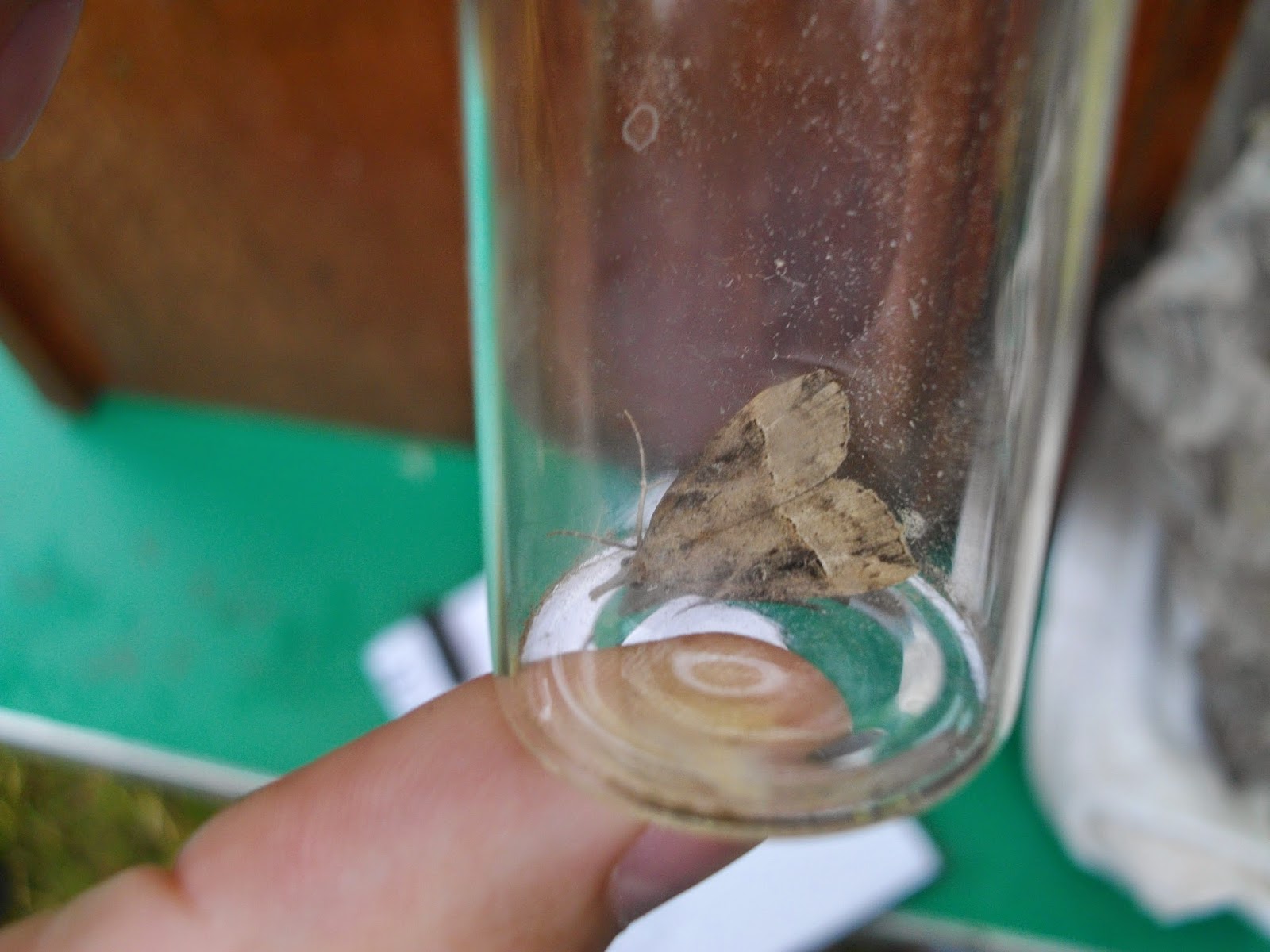
Saturday saw the much anticipated (by me at least!) mini-bioblitz at Whitlingham. It also saw a change in the weather, with the warmest week of the year ending with persistent rain. Cathy & I made up half of the non Broads Authority/NBIS staff who braved the weather for the opening of the moth traps. Two traps had been left out, and between them around 60 species had been caught. Two of them were completely new for me, Buttoned Snout and Wainscot Veneer, whilst many more were species that I hadn't seen at Whitlingham before - I shall update the Butterflies and Moths page accordingly in the next few days. Particular thanks to Phil Heath for setting up the traps and going through the catch in the morning.

Buttoned Snout
Drinker Moth
Rosy Footman

The next event was labelled as Mammal Mayhem, a title that was looking a bit sensationalist when the first eight traps we checked were all empty. The highlight of this first half was seeing a tail-less dinosaur in the area of woodland with the traps - if anyone knows where it came from or why its there then please let me know! 

The Whitlingham dinosaur

There was a bit of fungi in the woods, which Tony later identified as Spring Cavalier and Willow Shield. We then moved on to the picnic meadow to the other eight traps. These proved much more productive, with two Wood Mice and a Field Vole. The sun was out and Six-spot Burnet Moths were emerging in good numbers.

Field Vole. Photo: Catherine Emerson
Wood Mouse
Six-spot Burnet Moths

After dropping Cathy off at home I returned for a bit more recording. The weather had affected the programme a bit, so instead of a guided walk I spent some time in the area around the visitors centre, seeing another couple of new fungi species and recording some plants. After this I went to the pond-dipping area with Nick to see what had been caught there, before having a look at the NBIS desk on the meadow, where the highlight was a colourful Rove Beetle sp.


Despite the weather this event enabled me to see a number of new species on my patch, so thanks to everyone involved in organising it.

WEST NORFOLK: Black Darter & new Titchwell trails.

2nd September 2012

As summer draws to a close, Dad & I went to Roydon Common in search of Black Darters. It proved to be a good all-round naturalists trip. On the bird front a couple of Buzzards circled overhead, and some Crossbills called as they flew through. A Stoat ran across our path, and a we startled a Chinese Water Deer amongst some rushes. A Small Copper and lots of Speckled Woods were flying around, whilst Roesel's Bush Crickets and Common Green Grasshoppers chirruped away. I noticed an Artichoke Gall on an oak, and whilst looking at that Dad pointed out several Buff-tip caterpillars on nearby leaves. Finally after seeing loads of Common and Ruddy Darters, we located an immature male Black Darter, a species I have wanted to see for some time (thanks to Paul W for his help with directions).


After an excellent roast lunch at the Ffolkes Arms (sic) at Hillington, we headed north to have a look at the new paths at Titchwell. We popped into the Island Mere hide, where several Black-tailed Godwits and Ruff were really close to the hide (if I had been a birder from 200 years ago I reckon I could definitely have bagged them wt ye crossbowe). A Peregrine flew east over the main path. We had a look over the new pool, named Patsy's Pool after Patsy Cline*, a female Red-crested Pochard and four Little Grebes being the pick of the birds. Continuing round we arrived at Titchwell's East Bank, and looked back over the freshmarsh. A single Spoonbill had emerged (the flock of 21 had been spooked off before we arrived apparently). It was all very nice, hopefully I shall be back here to see something rare in the near future!

* This may not be true. 

THORPE MARSH: Common Sandpipers

20th August 2012

Another scorchingly hot day, but as there have been a few birds on the move recently I gave Thorpe Marsh another look. The scrape had dried up, but scanning east I picked up a large raptor soaring in the distance. It had more than a little bit of a Honey Buzzard look about it, but unfortunately for me it few off north-east (with slow, effortless wingbeats!) and was added to the wastebin of unidentified raptor sightings.

Shortly afterwards Dan arrived and we scanned for a bit, but didn't see any other raptors. Swallows and House Martins were hawking insects past Bungalow Lane, but the local Swifts have cleared out.  Walking round to the broad we found three Common Sandpipers on the shingle, two of which went for  a fly across the broad and river before returning and landing out of sight. Several butterflies included Peacock, Small Tortoiseshell and Red Admiral, whilst a dead and rather smelly Common Shrew was delighting a host of Greenbottle flies.

WEST NORFOLK: Grizzled Skippers

12th May 2012

With the good weather continuing, we decided to go to Foulden Common to catch up on some butterflies.  On the way we got close up views of a Muntjac standing just off the road, and numerous Orange-tips were flying.  On first glance the common seemed rather devoid of butterflies, with just a couple of Brimstones.  A look at the gorse that had held Green Hairstreak last year paid off with a Holly Blue, and we also saw a couple of bright Small Coppers.  Another butterflier had located a Grizzled Skipper, which quickly flew off, but Cathy located another, and as the sun came out we found another three.  We didn't see any Dingy Skippers, but it was suggested that both species were late emerging this year (it turns out that one was seen on Saturday - but its quite a large site to track down one small brown butterfly!)

Grizzled Skipper.  
Better than last years effort, but nothing I could do about the grass in front of it.

WHITLINGHAM: Dawn visit

6th April 2012

I decided to head down to Whitlingham early, to catch some of the dawn chorus and have a look round before the site got busy.  This paid off straight away, with views of my first patch Otter from the bridge at Trowse.  I walked along the misty meadows to try to locate it further along the river towards Whitlingham, but it wasn't visible looking back along the river.  Usually there are lots of canoeists around, even just after dawn, but today I had the place to myself.  On the Thorpe side of the river a young Fox came down to the river to drink.


Further along I looked back across the broad to the visitors centre, noticing the new platform that has been put in to allow boat trips on the Solar boat Ra which is being moved here.  I can't say I welcome the added disturbance, but it will at least allow a ducks-eye view of the broad, which will help me when anticipating where certain species might occur.


A singing Willow Warbler was the highlight in the conservation area.  No Garganey, but a lone Teal and two drake Shovelers were in the bay.  I headed up into the woods on the off chance that Adams Firecrests were still around, but there was still no sight or sound from them.  A female Bullfinch had joined Tuesdays male, lots of singing Blackcaps and Chiffchaffs and a pair of Goldcrests were calling.  

I headed further down the lane, seeing two Oystercatchers at the sewage works.  On the fields between Whitlingham and Bramerton several Meadow Pipits and Reed Buntings were feeding, wilst the song of Skylarks filled the air.  A Red-legged Partridge ran across a field nearby, both of the latter birds would be patch ticks if it wasn't for the fact that I don't count birds this side of the sewage works.  Back at Whitlingham there was a brood of seven Egyptian Goslings, in addition to seven of last weeks (one has perished so far).  Eight Mallard ducklings were also recently hatched.


NORFOLK: Marlingford & Sculthorpe

3rd March 2012

A visit to Marlingford Mill produced a good range of species late morning.  When we arrived the American Wigeon was out of sight in the river, but eventually it did work its way back up the bank, to start with just as a head visible above the grass, then finally the whole bird in front of the alders.  Whilst waiting I found a Kingfisher along the river, a pair of Grey Wagtails hopped about on shingle in the channel and a Nuthatch flew onto a nearby tree.  Earlier a Little Egret had been sat at the top of a tree, and a small group of Egyptian Geese were feeding on the marshes.

We proceeded onto Sculthorpe Moor, where we spent a very pleasant couple of hours.  Marsh Tits were calling from several areas of the wet woodland, and a Treecreeper worked its way up a tree near the path.  Walking along the river Cathy found a Toad, which was making a squeaking noise, something that I can't remember ever hearing before.  Further along we found many more that were also making this noise.  From the Whitley Hide we admired a pair of Bullfinches and saw a Field Vole beneath one of the bird tables.  A period of sunshine brought four Buzzards soaring up over the far hide.  On our way back we saw more Toads, another vole and lots of Scarlet Elf Cup fungus.


NORWICH AREA: Grey Wagtails

25th February 2012

An evening drive south of Norwich was owl-less, but we were rewarded with excellent views of a pair of Grey Wagtails.  Upon our arrival at a ford we had found last year there was no sign of activity, until Cathy spotted one of the wagtails right next to the car!  It flew across the road but soon returned, and perched up on a post just feet away.  Unfortunately the poor light meant that most of my photographs were out of focus.  Whilst I was attempting to take some in-focus shots, Cathy located the other bird, and the pair flew onto a piece of rubbish at the edge of the ford.  We also saw lots of Red-legged Partridges, fighting Pheasants and a Rat.

Close, but facing the wrong way
Facing the right way, but not enough light for a good photo

WHITLINGHAM: A probable hybrid and a nice woodland walk

15th January 2012

So far its been quite slow going at Whitlingham. I noticed an odd-looking female Pochard, which had a uniformly dark head, clearly marked white patches alongside the base of the bill (like some female Tufted Ducks) and a seemingly thicker or differently shaped bill. It could well be a female Pochard x Tufted Duck hybrid, hopefully I can get some better pictures to help confirm this. Well hopefully I can find a Smew or something interesting, but you know what I mean, a hybrid is better than nothing.


With the wildfowl looking similar to the past couple of weeks I decided to head into the woods for a change. This paid immediate dividends when I found a Stoat rummaging around in the leaf litter. Further round I had to move off the path to allow a pack of Nordic walkers* through. Most of them were grateful, although one of the last ones muttered something about there being a murder in the woods, a reference to the bird-themed episode of Midsomer Murders broadcast last week, were two twitchers were killed in a wood**. Despite their ski-poles, it appeared they hadn't been up the steep steps as there was plenty of wildlife about. A while spent watching a mixed tit flock paid off with close views of a Nuthatch, whilst further round a Fox ran off through the undergrowth and I got neck-ache checking through a flock of Goldcrests.

* Nordic walkers are people that walk around with two ski poles.  I think the original idea was that it was practice for skiing, but now it seems to be a fitness activity in its own right.
** As you'd expect this was straight out of the annals of birding stereotypes, and centred around the stringing of a Blue-crested Hoopoe (sic).

WHITLINGHAM: Week 20 - Some Damselflies

15th May 2011

A drizzly day and it was more in hope than expectation that I went to Whitlingham. The bird "highlight" was probably a Song Thrush, whilst the mammalian highlight was undoubtedly this dead Mole. My first Blue-tailed Damselflies of the year were amongst the Common Blues, whilst the spur-mark on the side of the thorax on this damselfly may make it an immature male Large Red-eyed Damselfly, which if memory serves would be my first CP record. If not then its an infuscans form female Blue-tailed, and I need to find some birds instead of deliberating over this nonsense.


Immature Red eyed damselfly