The Whitlingham Bird Report for 2025 is now available to download from the Bird Reports page or from here

Showing posts with label Winterton. Show all posts

EAST NORFOLK: Looking for migrants and damselflies

Late August 2019

Near the end of the month Adam & I had set a day aside for birding. There had been an arrival of Wrynecks and Whinchats along the east coast a few days previously and also several sightings of Scarce Blue-tailed Damselfly on the pools at Winterton, a species I've never seen, so we decided to head to Horsey and then walk to Winterton and back.

We arrived in light drizzle, which was eventually replaced with bright sunshine by the time we left. Despite the seemingly favourable weather conditions there were not many migrants about. Several local Stonechat families were seen, as was a big mixed Linnet/Goldfinch flock, two Whinchats and a few warblers. Surprise sighting of the day went to a Green Sandpiper that flew up off one of the pools, and a Pied Flycatcher was heard but not seen within some willows.

Unfortunately there wasn't much better luck with the Damselflies. There were lots of Emerald Damselflies, but the only other damsel found was a female Blue-tailed, which proved a bit of an ID challenge because it looked particularly small and dowdy. I assumed it was teneral, but actually some old females look like that. Some Donacia beetles were also noted on the pools, although I'm never completely convinced I've keyed them out correctly so I still need to double check the ID.


The highlight of the visit therefore was the leaf mine of the Nationally Scarce B micro moth, Phyllonorcyter quinquegutella on Creeping Willow. Back at Horsey Mill car park we stopped for a drink and had a walk around the garden, seeing several Rhingia campestris hoverflies.


EAST NORFOLK: Roe Deer & Hoopoe

Mid-April 2019

Adam & I met up in North Walsham for a look around a few sites in East Norfolk. We started by heading for a lake that sometimes attracts Ospreys on passage - no luck this time but we did see a pair of Marsh Harriers. The winds had been stifling the arrival of migrants, and a walk along the dune scub at Waxham turned up nothing better than a Blackcap, although we did see the two Ring Ouzels that had been present in that area for a while. Good views of a Roe Deer were the highlight of the visit.


Neither of us had seen a Hoopoe for several years, so we decided to head to Winterton, stopping briefly on the Horsey straight to see the Tundra Bean Goose and Great White Egret. At Winterton we walked quite a way down the south dunes, seeing only a pair of Stonechat and some Skylarks, before hearing that the Hoopoe had last been seen near the toilet block. Deciding to check the north dunes we were on the verge of giving up when someone gave us a thumbs up and pointed in the direction they had come from. A few more minutes searching and we located the Hoopoe, which showed well until accidentally flushed by some walkers.


On the way back we called in at a site that used to hold Lesser-spotted Woodpeckers on the off-chance, but there was no sign of any, albeit by then it was mid afternoon so this wasn't a surprise.

EAST NORFOLK: Winterton sharp-tailed bee

12th July 2018

During a work trip to Winterton Dunes I noticed a few species of interest, notably Large Sharp-tailed Bee (Coelioxys conoidea), the beetle Sermylassa halensis and Long-legged Tabby moth (Synaphe punctalis). Three Brent Geese flew south over the sea and terns called in the distance.


EAST NORFOLK: Winterton lichens

3rd June 2017

Earlier in the year I had attended a walk at Sparham looking at lichens with the county recorder, Peter Lambley. Afterwards Peter had agreed to hold several other walks later in the spring for anyone who wanted to learn a bit more about lichens in different habitats. I had been unable to attend the first of these at Salle church, but met Peter on Saturday at Winterton dunes to have a look at some dune Cladonia species. I had previously been on a lichen workshop in the Brecks, so this gave me the opportunity to compare some inland heath and coastal heath species.

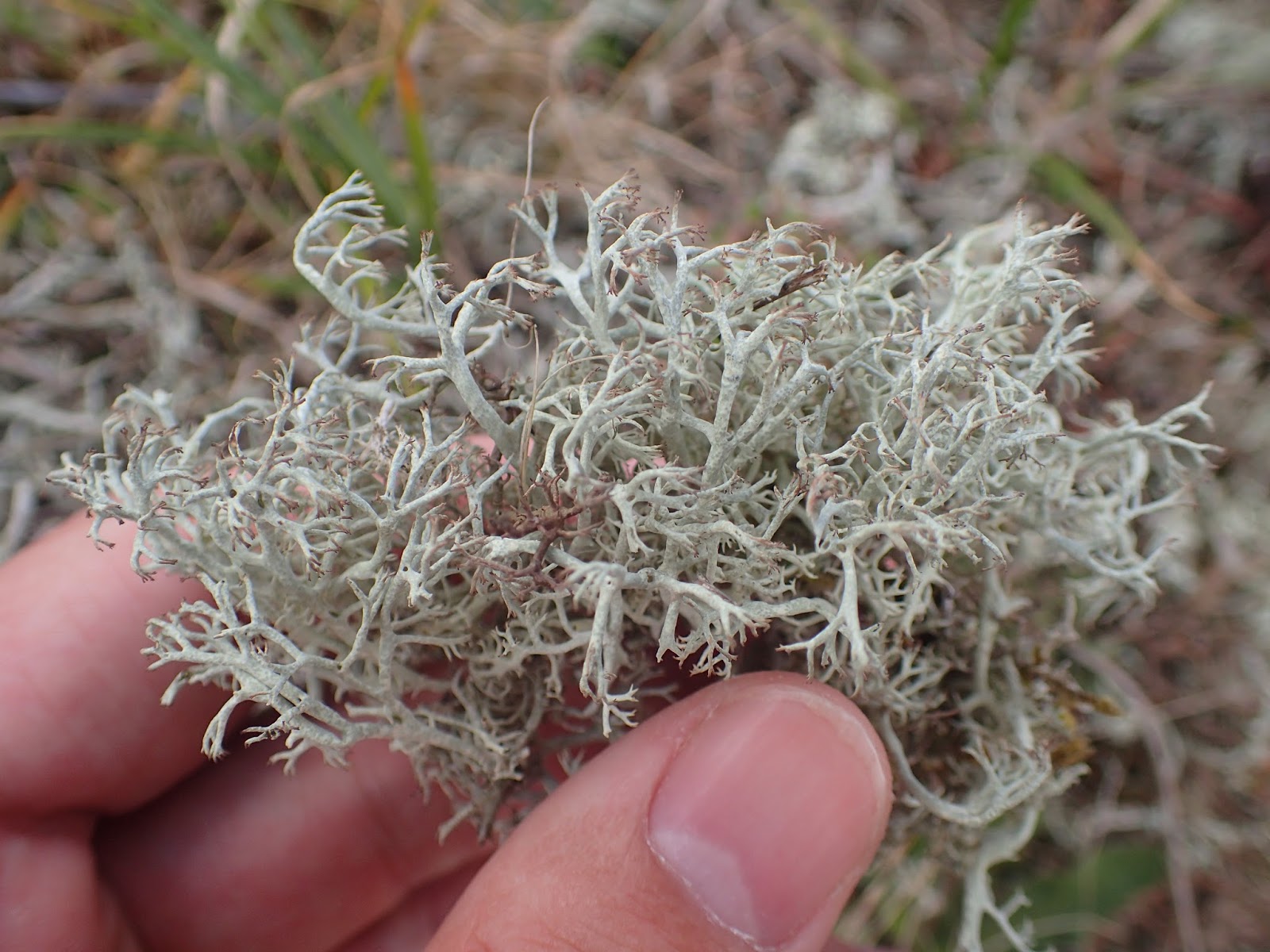
Whilst the dunes didn't hold as many different species as woodland, churchyards etc, the species present occurred in good numbers. We had a look at Cladonia arbuscula, which had long bent-over tips with 3 or 4 branches near the end and swept in the same direction, and compared it with the abundant Cladonia portentosa which had the tips swept in different directions.

 Cladonia arbuscula
 Cladonia portentosa

One of the highlights for me was seeing lots of red-tipped lichens. I must have seen these before but don't remember it, and despite their small size they look spectacular. Most were Cladonia diversa, with red blobs around the edge of the 'cups', but there was also Cladonia floerkeana, which has the blobs on thin stalks.


Most of the lichens we looked at were growing on the ground or on the stunted trees, but we did also see four species growing on a concrete telecoms block, and an unassuming new species for me, Lecanora conizaeoides, was found on the totem pole. In addition to the lichens we saw a good stand of Royal Fern, two Red-veined Darters (the first of which was more obliging than the one I saw at Beeston earlier in the week), a gall on Aspen, Marram Weevil and around 30 Bee Orchids.

 Lecanora conizaeoides


My thanks to Peter Lambley for giving up his time to show me the lichen flora of this area.

EAST NORFOLK: Winterton visit

21st August 2015

On Friday Cathy & I went for a late afternoon visit to Winterton. We had a nice walk, but there were very few birds and not much else other than Grayling butterflies. We did see one Dark Green Fritillary and a Rush Veneer moth. I had a look around some of the pools in the hope that we might see a Natterjack toadlet, but there was no sign of any. Dragonfly wise Southern Hawker and Ruddy Darter were the only two odonates seen.


EAST NORFOLK: Winterton Dunes

29th October 2012

Cathy & I went to Winterton in the afternoon for a walk around the south dunes, hoping to catch up with any migrant stragglers. We walked around in the drizzle barely seeing a bird, although we did find three Fox Moth caterpillars. I set up on the edge of the dunes for a bit of a sea-watch, seeing one Little Auk south and a Shag and Red-throated Diver on the sea, but after 15 minutes gave up as the rain started to come down harder.