The Whitlingham Bird Report for 2025 is now available to download from the Bird Reports page or from here

Showing posts with label Fungi. Show all posts

BROADS: A trip to Trinity Broads looking for fungi

Mid June 2023

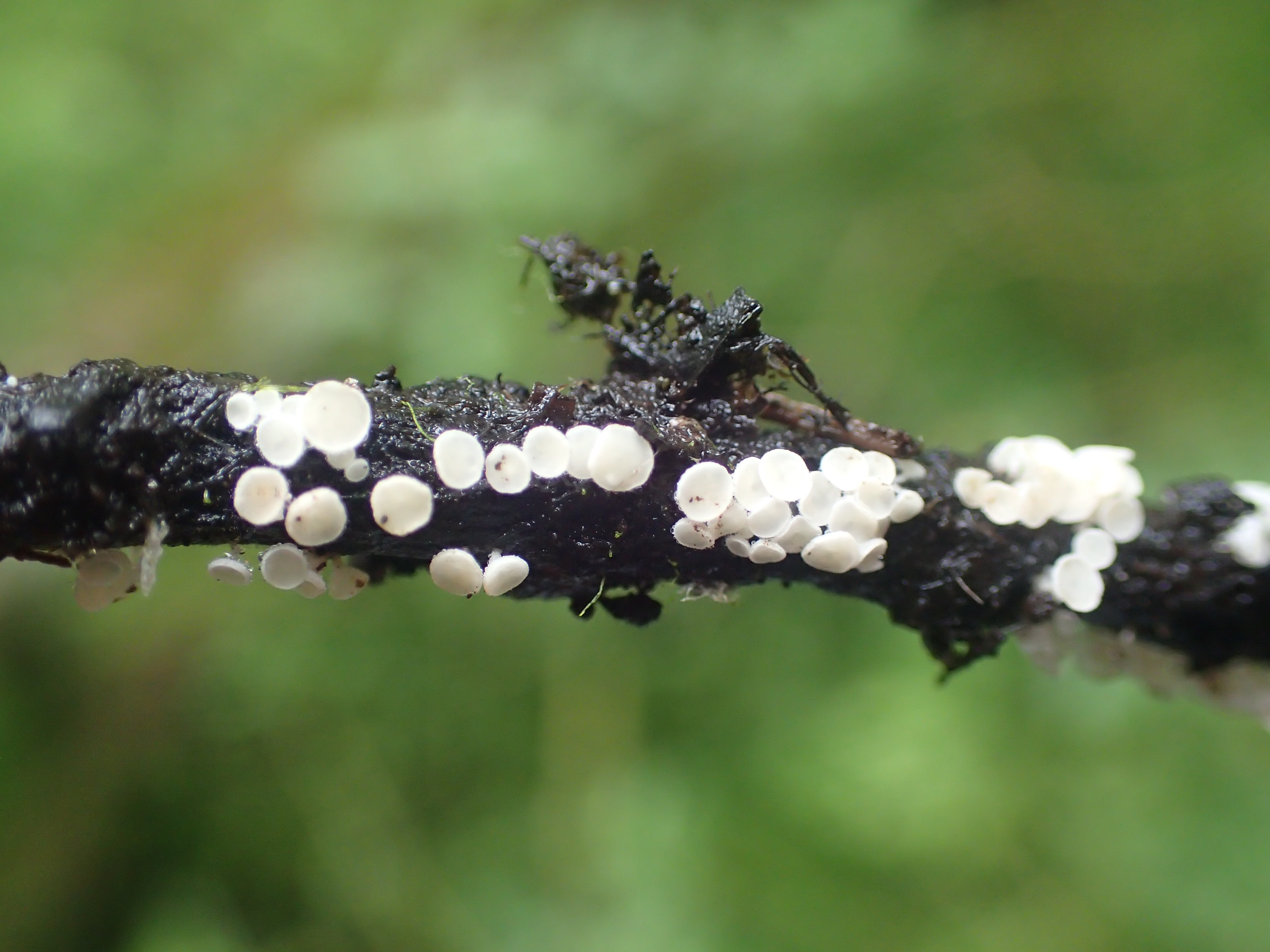
In June the Norfolk Fungus Study Group visited Trinity Broads, specifically an area of woodland near Rollesby. The dry weather meant that there wasn't much in the way of 'cap and stem' fungi, but we did find quite a few interesting things in a relatively small patch of wet woodland, as well as enjoying some nice views over the broad. Some of the new species for me included Podosphaera mors-uvae (American Gooseberry Mildew), Hymenoscyphus salicellus, Vibrissea filisporia and Pandora dipterigena (the latter a fungus on mosquitoes).




Afterwards we had a quick walk around the boat club woods, where we also had permission to record. Here I saw the bug Cyllecoris histrionus for the first time. The visit was also quite good for psyllids - the total of seven species is the most I've recorded in a single day. All were fairly common species - Baeopelma foersteri and Cacopsylla fulguralis were the most notable ones.


NORWICH AREA: Broadland CP fungus foray & woodland invertebrates

20th May 2023

As part of the ongoing wildlife recording at Broadland Country Park, the Norfolk Fungus Study Group visited in May to look for spring fungi. The dry conditions meant that there was not too much found, however there was a nice display of Bog Beacons, a scarce species in East Anglia, and the highlight was a tiny fungus called Polycephalomyces tomentosus found growing on a slime mould.


There were some rather interesting invertebrates including a hopper on heather called Ulopa reticulata, a woodland cranefly Ctenophora pectinicornis, the weevil Attelabus nitens, Black-headed Cardinal Beetle and the beetle Elaphrus riparius.


YARE VALLEY: Buckenham Carr March fungus foray

18th March 2023

My first Norfolk Fungus Study Group foray of the year saw the group return to Buckenham Carrs, a recent NNNS research project site. Whilst walking around the site multiple Chiffchaffs were singing, a Barn Owl flew silently over Buckenham Broad and in the distance Cranes were calling. I saw quite a few new species of fungi, but annoyingly I only got a poor record shot of the most pleasing one, Ruby Elf Cup (Sarcoscypha coccinea). In Norfolk we have two species of red elf cup, both almost identical to the eye but separable with care under the microscope. All of the ones I have checked, and most in the county in general are Sarcoscypha austriaca, so when we saw some I assumed that is what they would be. Fortunately Steve took one away to check and discovered that it was S. coccinea. Other highlights included Poplar Bell (Schizophyllum amplum), the second Norfolk record of Moss Ear (Chromocyphella muscicola), Thyronectria sinoptica on Ivy and Mollisia amenticola on Alder cones.


Ruby Elf Cup
Moss Ear
Mollisia amenticola
Poplar Bell

Thyronectria synoptica

WHITLINGHAM: Harvestmen and fungi

Late November 2022

Earlier in the month Vanna Bartlett had found some interesting harvestmen at Whitlingham, and she kindly offered to help me look for them. It was raining steadily as I picked her and Jeremy up, but by the end of our visit the rain had almost stopped. Despite the damp conditions we did see fout species of harvestman, including two that were new for me - Oligolophus tridens and Lophopilio palpinalis. We saw a nice selection of fungi too, including Goldleaf Shield and Olive Salver (Catinella olivacea). Striped Millipede was another new one for me.

Oligolophus tridens 
Lophopilio palpinalis
Striped Millipede
Pluteus romelii
Catinella olivacea
Wrinkled Peach

EAST NORFOLK: Great Yarmouth dune fungi

19th November 2022

The penultimate Norfolk Fungus Study Group foray was at Great Yarmouth North Denes, and upon arrival I soon regretted not bringing my gloves as there was a biting cold wind. Our initial searches found quite a bit of fungi but mostly of a handful of species, but as we spread out there were quite a few interesting things. My highlight was all set to be Dune Cup, a scarce cup fungus usually only found in early winter along the seaward side of young Marram dunes, and previously the only Norfolk records were the stretch of coast between Holme and Wells. That was usurped somewhat by Andy Beaumont's excellent find of Feather Stalkball growing on decomposing Razorbill feathers. I had never heard of it before, but was aware of its close relative the Horn Stalkball, which grows on the horns of old sheep skulls in the north. Close views of Red-throated Diver and Med Gull were also appreciated given the lack of time I spend at the coast.

Deconica pratensis
Octospora rutlians
Bryoscyphus dicrani
Sphaerobolus stellatus
Dune Cup
Horn Stalkball
Field Bird's-nest
Rutstroemia maritima

NORWICH: Hospital fungi and misc observations

Early November 2022

The silver lining to several hospital visits at the start of the month was noticing quite a bit of fungi between the wards and the car parks, and also Henbit Dead-nettle, which was apparently a new species for me. The most frustrating of the fungi were some cracked Paxillus species associated with Oak and Hornbeam. By rights these should not be Paxillus involutus, which is apparently found in woodland, usually with birch, but I was unable to get these to fit any of the alternative species.

Bearded Milkcap
Shaggy Inkcap


Ectoedemia occultella on birch
Henbit Dead-nettle

Paxillus sp.

NORTH NORFOLK: A stroll on Bryant's Heath

Late October 2022

Having gone back to North Walsham to visit relatives I decided to take a few hours and walk one of my old haunts, the Weaver's Way down towards Felmingham. I left the footpath at the bridge and continued on to Bryant's Heath, where I did a quick lap and then back the way I had came. There were a few highlights - as I entered the heath I saw a micro moth flying weakly over vegetation. I followed it and managed to get good enough views to confirm it was a November Tubic (Diurnea lipsiella), a new species for me. After checking quite a bit of Aspen I found a couple of mines of Virgin Pigmy moth, Ectoedemia argyropeza, a new 10km square for it. Less pleasant was a ked fly, presumably Deer Ked (Lipoptena cervi) that landed on my trousers. These are rather odd looking blood-sucking flies (see Deer Keds on arthropodafotos.de for more information on them).


The fungal highlight was finding a large patch of Fly Agarics under some birches. Unfortunately they were spread out enough that my pictures don't do justice to what was a very impressive sight.


The last thing of note was several Apionid weevils on Broom. Having researched the pair of similar Broom-feeding species earlier in the week, I was happy these ones were Protopirapion atratulum.

CENTRAL NORFOLK: Selection of fungi

Late October 2022

I took an autumn wander around Buxton Heath looking for fungi, before  stopping off briefly at Broadland Country Park on the way back.


Fly Agaric
Bay Bolete
Nail Fungus on pony dung
Nut Disco on an acorn
Earthfan
Slime mould sp
Virgin Pygmy leaf mine in Aspen
False Deathcap
Splitgill

Smoky Bracket