The Whitlingham Bird Report for 2025 is now available to download from the Bird Reports page or from here

Showing posts with label Millipede. Show all posts

SOUTH NORFOLK: Shotesham lichen meeting

30th March 2024

Norfolk lichen recorder Rob Yaxley had organised a few informal meet-ups to survey churchyard lichens, and I managed to attend one at Shotesham, a village a few miles south of Norwich. We looked at three churches (two 'proper' ones and a ruin) and as expected racked up a good lichen list. The presence of quite a few experienced naturalists meant that we also turned up various other species across a wide range of groups. The pictures below are a small selection of highlights, but things that spring to mind include a lichenicolous fungus that appears to be new to Norfolk (Spiloma auratum), my long-awaited first Bristly Millipedes, the inconspicuous ladybird Rhyzobius litura, Ashy Mining Bee and smut fungi on aconite and sweet violet and the pseudoscorpion Chthonius isochneles.


WHITLINGHAM: Harvestmen and fungi

Late November 2022

Earlier in the month Vanna Bartlett had found some interesting harvestmen at Whitlingham, and she kindly offered to help me look for them. It was raining steadily as I picked her and Jeremy up, but by the end of our visit the rain had almost stopped. Despite the damp conditions we did see fout species of harvestman, including two that were new for me - Oligolophus tridens and Lophopilio palpinalis. We saw a nice selection of fungi too, including Goldleaf Shield and Olive Salver (Catinella olivacea). Striped Millipede was another new one for me.

Oligolophus tridens 
Lophopilio palpinalis
Striped Millipede
Pluteus romelii
Catinella olivacea
Wrinkled Peach

MID NORFOLK: New fungi and much more at Foxley Wood

15th January 2022

The fungus study group don't usually hold a field meeting during January but were convinced to do so this year. This proved to be both a popular and productive decision, with around 30 members meeting up and recording around 120 species. As you would expect for the time of year much of these were either growing on wood or were microfungi on plants, but there were interesting examples of each. It looks like at least two of my finds turned out to be new for Norfolk - a young specimen of an oysterling with brown hair tufts on the cap was Scaly Oysterling (Crepidotus calolepis) and some small clear wart-like growths on Exidia plana were the mycoparasitic fungus Heteromycophaga glandulosae, whilst some small cocoa-bean like growths on an Ash branch were Hysterographium fraxini were also of note.


At a foray last year Stewart Wright had introduced us to the tiny black 'sundial' like projections under Alder leaves caused by Ophiognomonia alni-viridis. After he found the related species Gnomonia gnomon on Hazel leaves I asked if there were any others we should be looking for, and we managed another two - Ophiognomonia setacea on Oak and O. intermedia on Silver Birch. There is also a rare/under-recorded one on dead Rose leaves for me to look for elsewhere.


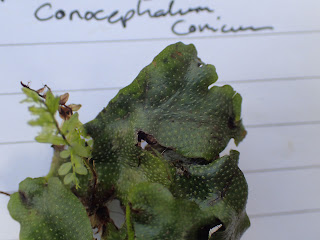
Foxley is an excellent reserve for many groups of species, and Rob Yaxley kindly pointed out some bryophytes as we went round, including the liverwort Conocephalum conicum and Big Shaggy-moss Rhytidiadelphus triquestris. Rob also identified a millipede that I'd spotted underneath a fallen branch as Brachydesmus superus.


New macro moths are always a bonus, and having seen a rather tatty specimen on the ground I was pleased when someone found a fresher looking Spring Usher. There was a new micro moth species too, when Stewart found an occupied leaf mine in Greater Stitchwort containing the larva of Three-colour Groundling, Caryocolum tricolorella. The light was beginning to fade as we walked back to the cars, allowing several group members to use their UV torches to illustrate the luminescence of Sulphur Tuft.


NORWICH: Earlham Cemetery galls walk

23rd September 2018

On Sunday I was due to lead a walk for the Friends of Earlham Cemetery looking at leaf miners and plant galls. Heavy rain was forecast and we thought would put everyone off, but in the end a core of hardy participants braved the weather and gathered at the cemetery gates. Vanna had been looking at galls here recently and so was able to direct us to several interesting finds, whilst we also found a good range of leaf mines.

Gall highlights included:
 Eupontania pedunculi
 Artichoke Gall (Andricus foecundatrix)
 Andricus gemmeus
Neuroterus anthracinus

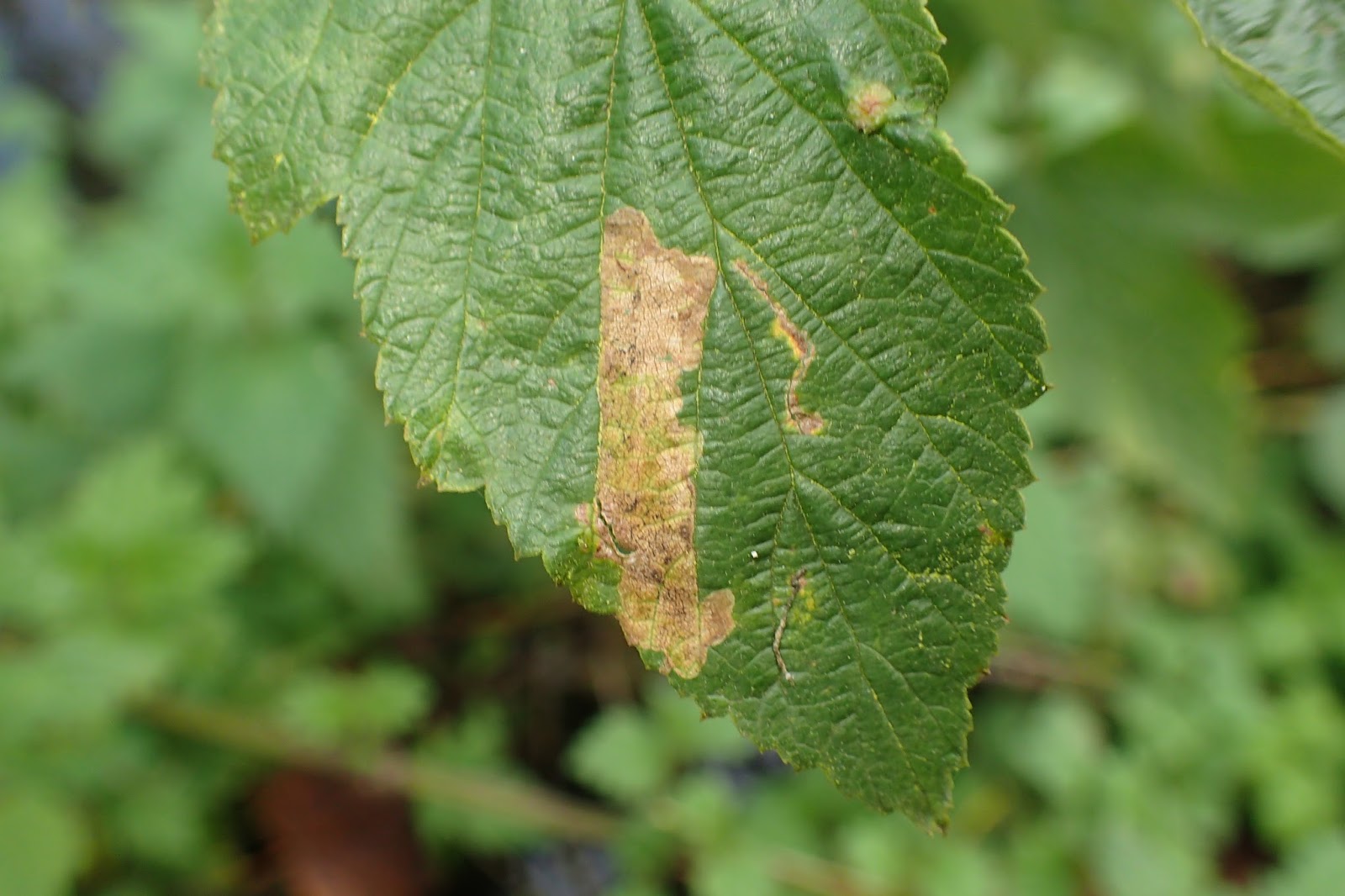
Of the leaf mines, Nemorimyza posticata was a good one, and Phyllonorcyter schreberella appears to be new for me.


As well as the leaf mines and galls we also saw a Juniper Shieldbug, late instar Megacoelum infusum, lots of Ant Woodlice and a Spotted Snake Millipede. Thanks to everyone that did make it and found enough to keep us interested despite the rain.


NORTH NORFOLK: Bayfield fungus foray

5th November 2017

On Sunday the Norfolk Fungus Study Group met up at Natural Surroundings for a foray on the nearby Bayfield estate. Much of the route was on a permissive path, but we had also got permission to go into a nearby wood. I doubted that we would get anywhere near the numbers of species seen at Felbrigg, but once again was proven wrong as the final list again passed the 130 mark. There was a good turnout of mycologists, and Stewart was present so a few leaf mines got recorded too.

At the entrance to the woods Tim D found Rooting Shank, which was a good start as it showed that there were still large gilled species about. A few smaller brackets and jelly fungi followed, including Fenugreek Stalkballs, until we emerged into a clearing with a good range of species including Funeral Bell (a new one for me), Blueleg Brownies, Inky Mushroom and the cup fungus Peziza petersii.

Blueleg Brownies
 Rooting Shank
 Funeral Bell
 Fenugreek Stalkball
 Peziza petersii

We passed into the lakeside meadow, and split into several groups that ranged from slow moving to statuesque. According to the species list the latter must have recorded some Waxcaps, but the rest of us down near the lake managed a Stubble Rosegill, Milky Conecap and Bolbitius lacteus. A tiny but numerous yellow fungus on goose droppings drew interest - it was later identified as a mould, Pilaira moreaui.

 Pilaira moreaui on goose poo. I suspect it is under-recorded.

 Bolbitius lacteus, the best of the few things that I found.

We left the meadow, pausing to see some Walnut Orb Web Spiders found in the roadside wall by Tim H. Further along we entered another area of woodland where we stopped for lunch. This new area was mostly Beech and Oak, and we found a good range of Mycena and species on wood. There were a few beetles too, including Silpha atrata and Pterostichus niger.


Retracing our steps we walked back along a stretch of the main drive, checking the rotting Gunnera leaves. Two different clubs were found, one couldn't be identified by the other one was Redleg Club. Common Eyelash and Orange Bonnet were also see here.


In addition to all of the fungi, we also saw the millipede Blaniulus guttulatus, Agromyza idaeiana mines in Meadowsweet and the larvae of a scarce moth on Hartstongue Fern, Psychoides verhuella


TARGET SPECIES: Yellow Star-of-Bethlehem

19th March 2017

On Sunday afternoon Cathy & I visited Wayland Wood for the first time, hoping to see the first of this year's target species, Yellow Star-of-Bethlehem. I had heard that it could be tricky to find and the flowers only open on sunny days, but fortunately for me several people had seen them flowering earlier in the week and Dave Holman had kindly given me directions to them.

After arriving at the woods we set off, stopping to admire the violets by the edge of the path. I stopped again a bit further on to search for the Anemone cup fungus  had heard about yesterday amongst the Wood Anemone (no luck), whilst Cathy carried on ahead to locate the flowers we had come to see. A call from further along the path told me that she had found them, and fortunately the day had been sunny enough that the flowers were open. There were quite a few Yellow Star-of-Bethlehem plants on both sides of the path, so we got a good look at this rare plant. We did search the leaves for some even rarer fungi that grow on it, but they were disappointingly healthy!


As we hadn't gone too far into the woods to see the Yellow Star-of-Bethlehem, we carried on a did a circuit of the woods. We were a bit early for many of the woodland flowers that will emerge shortly, but we did find a few invertebrates. Whilst I looked for Cramp Ball Weevils, Cathy found two White-legged Snake Millipedes, one stretched out and one curled up. Close by I found an empty moth cocoon and a Kidney-spot Ladybird.