The Whitlingham Bird Report for 2025 is now available to download from the Bird Reports page or from here

BEER: Royal Wedding Beer

29th April 2011

Apparently there was some kind of wedding on. Many breweries had a special ale, but most of them were only given to pubs or available in casks. The only bottle I maaged to get my hands on was this one...


On the bird front I went to Thorpe, saw 2 LRPs, c10 House Martins and a Sparrowhawk.

WHITLINGHAM: Now with bonus hirundines

27th April 2011

As the previous days visit had been rather hit-and-run, I came back after work to have a good poke round. On the whole I needn't have bothered. Gosling update is that there is now a brood of 3 Canada Geese, the lone Egyptian Goose family is down to 1 gosling and the black-and-white Mallard is down to 3 ducklings. The Wigeon x Gadwall hybrid was back in the conservation area and looks to be showing a bit more white between the belly and the tail. The main focus for attention was the large (50+) flock of hirundines skimming across the water. Mostly Sand Martins, with a liberal smattering of House Martins and a few Swallows. Sadly my first Red-rumped Swallow will have to wait a bit longer. I went into the woods and looked down onto Thorpe Marshes, but couldn't see any waders. Looking over the meadows on the way back there was again no Little Owl.

WHITLINGHAM: Owl-less

26th April 2011


Cathy & I had a brief look along Whitlingham Lane this evening, searching for Little Owl, a near mythical species for me here. Adam had kindly texted me to say that he had seen one in the dead tree opposite the Canoe Club, but there was no sign whilst we were there. In fact I have never seen one at Whitlingham, which given that they would presumably be resident and are known for perching out in the open is quite odd. So keep your eyes peeled Whit-watchers, and please let me know if you see one! The evening wasn't a complete waste, whilst watching the meadows a Woodcock flew over at a rate of knots, heading towards Trowse.

NORTH NORFOLK: Wagtail hunt

25th April 2011


More in desparation than hope I spent Monday morning looking for the previous days Citrine Wagtail. Starting at Cromer there was just an apologetic looking Wheatear in the wagtail field. Further along the fields of West Runton held Linnet and Skylark, whilst the Eye Field had more Wheatears. In fact, the only wagtail we saw all day was a Pied at Northrepps. The one positive I took is that if memory serves this is the 4th straight year that Citrine Wagtail has occurred in Norfolk, so hopefully there'll be another one next year!

CAMBS: Ouse Washes

24th April 2011

Jim kindly offered me a lift to the Ouse Washes to look for the long-staying Blue-winged Teal. Unfortunately the birding Gods didn't take kindly to me leaving Norfolk, firstly hiding said Teal, and then dropping a spring male Citrine Wagtail in North Norfolk. We spent a quite a while in Welches Dam Hide looking for the Dam(n) Teal, but it was not to be. We had a brief look from another hide before returning to Welches, and did see Greenshank, LRP and Yellow Wagtail and heard a Gropper, but it was clearly not to be.

NORWICH: Mousehold Heath Green Hairstreaks

23rd April 2011

A target species for me this spring was Green Hairstreak butterfly, a species that I haven't seen for years. I went to Mousehold Heath and after searching most of the open areas I managed to locate three hairstreaks. One promptly disappeared into the Ether, but I tracked the other two as they led me a merry dance around the gorse. In over an hour they never once settled on a flower, instead taking regular breaks above head height on a Silver Birch. I had almost given up getting a decent photo when one of them (obviously feeling guilty) indulged me by settling at eyeline long enough to get a few pictures. On my way back I saw a number of Green Tiger Beetles, another species from my Adder-watching youth.


WHITLINGHAM: Week 17 - Its gosling time

22nd April 2011

Whitlingham was jam packed with people, the predictable result of a hot Bank Holiday. This could easily be overlooked thanks to the recent hatching of goslings and ducklings. The second brood of Egyptian Geese (5), first brood of Greylag Geese (5) and a black-and white domestic Mallard brood (5) were all overshadowed by a whopping 12 ducklings accompanying a pair of Mallard on the Little Broad.


I watched in despair as a group of idiots on Thorpe Marshes who had ignored the big gate and "please don't disturb the breeding birds sign" decided to row a small boat around the edges of the broad. Luckily they soon got bored and went to lay on the shingle. After a while the birds returned, with what was probably a Snipe flying into the vegetation near the spit. Three Common Terns circled over the broad before thinking better of it and departing eastwards. There was no sign of yesterdays Cuckoo.

NORFOLK: Sculthorpe Moor Dawn Chorus

22nd April 2011

Whilst here last week we had noticed that there was a dawn chorus walk and cooked breakfast on. Cathy doesn't usually look favourably on my suggestions for getting up in the small hours and going birding, but for some reason this walk was deemed acceptable. The highlight of the walk was undoubtedly looking out over the Wensum and watching Marsh Harriers rising out of the mist as the sun rose. Birdwise a Grasshopper Warbler was heard from the Whitley Hide and 2 Cuckoos flew over. On the way back we found the Golden Pheasant on the side of the path, and it posed for a photo before running off through the woods.


WHITLINGHAM: Thorpe Marshes Gropper

21st April 2011

Another visit to Thorpe Marshes, and finally a result, my best ever views of a Grasshopper Warbler. It was audible as I was crossing the railway bridge, but it took a while to pin down (don't they always?!). Part of the reason I had trouble pinpointing it soon became apparent - it was actually moving around a lot. Positioning myself at a decent vantage point on the path I was able to watch it reeling from a number of different areas, spending no more than a couple of minutes at each but never going too far in either direction. Many thanks to Paul and Adam for their messages regarding Grasshopper Warblers at this site. A lap around the broad was uneventful, but it was interrupted by a Cuckoo, calling from across the river in the trees at the east end of Whitlingham great broad.

NORFOLK: Snakes at Crostwight Heath

20th April 2011


I spent the day around various villages near North Walsham. After lunch at the Butcher's Arms in East Ruston we then went to Swafield Church, had a walk around Bradfield, had a look along the seafront at Walcott, bought some jam at Ridlington, walked around Crostwight Heath before ending up at Edingthorpe. The birding highlight of the day was a Red Kite hunting over fields between Honing and Briggate, whilst a Yellowhammer at Bradfield is probably (and sadly) of note these days.

I had hoped to find some Green Hairstreaks at Crostwight, but it was immediately apparent that the site was just too gorse-covered. We did however discover an Adder and six Grass Snakes, one of which had been runover. When looking at the Grass Snake picture (click to open it in a new window) notice the head to the left of the main body. It had raised it into the air and was "tasting" the air by tongue flicking until it got bored of us and slid off.


WHITLINGHAM: Another quick visit

19th April 2011


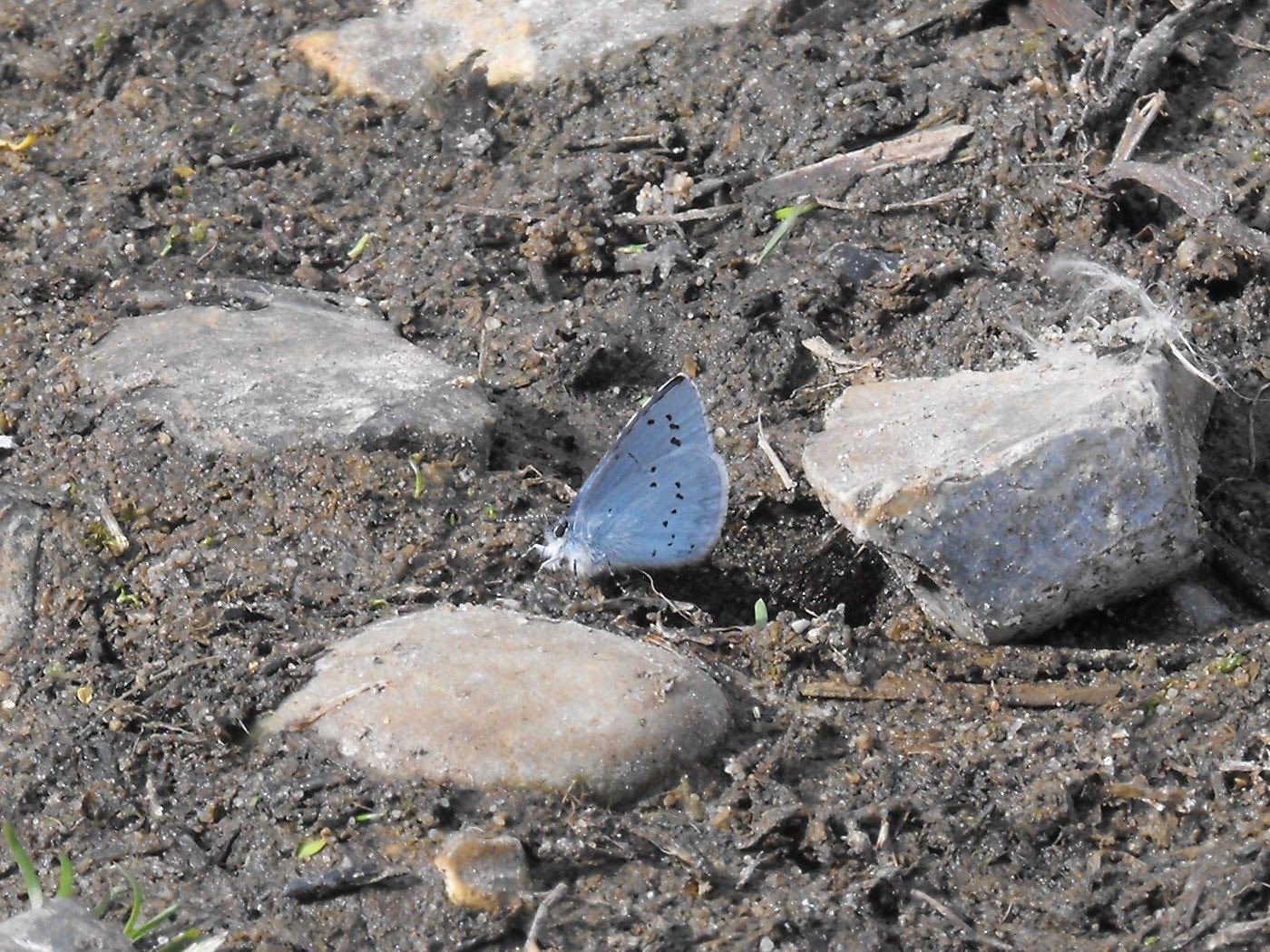
I have this annoying feeling that if I don't go to Whitlingham for a couple of days I'm going to miss something good, so ended up going for a quick walk around in the sun. There was nothing new from last time, and no sign of the Little Gull either. I did see my first Speckled Wood butterflies of the year, and this Holly Blue was having fun in the mud.


NORFOLK: Rockland Broad

18th April 2011

Rockland Broad has a decent track record of attracting Black Terns and Ospreys without the visitor numbers of some of the larger nature reserves, so me & Cathy decided to have a look round on the off chance. We didn't have much luck (although I wasn't too far off, as there was a mini Black Tern influx around Norfolk the next day), but did come up with some insect highlights, including first Red Admiral and Large Red Damselflies of the year. Despite walking along the channel to the river there was no sound of any Bearded Tits. On the adjacent marshes we saw a couple of Chinese Water Deer and a Weasel.


The reedbed west of Rockland channel

WHITLINGHAM: Week 16 - Dawn(ish) chorus

17th April 2011


It was a struggle, but I managed to get up at 5:30 so that I could beat the weekend crowds to Whitlingham. Walking along the Little Broad I could hear my first Reed Warbler of the year singing, but I was spared the walk by another one between the two broads, sharing the small area of reeds with a Sedge Warbler. I gave up counting the warblers in the end, but over the C.P. and Whitlingham Marsh there was a minimum of 15 Sedge, 10+ Chiffchaffs and good numbers of Blackcaps and Cetti's Warblers, including a confiding one at the east end of the broad. Several Chiffchaffs were giving interesting calls, one in the woods was giving a constant "tik tak tuk tuk" call whilst flapping its wings, whilst one at the east end of the Great Broad seemed to be imitating a bit of Willow Warbler song.


My main target was a Grasshopper Warbler that had been heard on the WeBS survey on Saturday, but once again I couldn't find it. I have considered the possibility that I can't hear them, but as I have had no problem in previous years I think they are just being annoying. The conservation area bay held 7 Pochard, a female Goldeneye and best of all my first Shelduck of the year, probably my first on the Great Broad as the last couple have been on the Thorpe side.

As it was still early I went for a walk around Whitlingham Marsh (one Swallow over), looked over the sewage works (Oystercatcher and Rooks) and then came back via the woods. I then walked back around the broad in case the Grasshopper Warbler had started up, with similarly negative results. I did see a pair of Marsh Tits, which brought me to a respectable 52 species for the morning.

NORFOLK: Sculthorpe Phylloscopus opus

16th April 2011

The week before the Easter holidays had got me guessing what my next Norfolk tick would be. The White-tailed Eagle and Black Stork seemed unlikely to stick around, but I had a good feeling about Ring-necked Parakeet (surely one is frequenting gardens in the north-east of the county somewhere?). Anyway, when news came out that a Wood Warbler, the commonest British bird that I was yet to see (having finally got Red Grouse last year) was at Sculthorpe Moor, a favourite reserve of ours, the stage was set for a fourth Phyllosc in three days.

Upon arrival we heard that the Wood Warbler had been seen and heard on a dawn chorus walk earlier that morning, but not heard since. We weren't discouraged, and as we drew near the Frank Jarvis Hide we were met by a birder who had just relocated the bird. We couldn't hear anything, but then the Wood Warbler began calling from woodland across the bridge from Old Gits Corner. It gave good views, flying actively around near the tops of the trees along the boardwalk, calling but not giving full song.

Once the Wood Warbler flew back across the river (and had stopped calling) we carried on to the Whitley Hide, seeing a couple of Orange-tips. Watching the bird table we saw male and female Bullfinches, a pair of Bramblings, male and female Reed Buntings and a Marsh Tit. In the distance my first Cuckoo of the year was calling. On the way back one of the resident plastic Golden Pheasants jumped up into a tree, making a weird squeaky call. A couple of Marsh/Willow Tits on the feeder at Old Gits Corner flew off before I could get a decent look, but we shall undoubtedly be back for another visit soon.


WHITLINGHAM: Thorpe Marshes again

15th April 2011

Realistically I knew that the Wheatear would be gone, but as birds don't find themselves I figured I'd give Thorpe another look. The first half of the visit was the same as the first, although watching three Little Ringed Plovers is never dull. A careful scan of the spit from the bird screen (or is it now a hide now it has three sides?) turned up my first Common Sandpiper of the year, whilst a Whitethroat sang from the riverside trees behind me. I let one of the Thorpe Marsh regulars use the 'scope to look at the Common Sand, and he told me that he is seeing a Red Kite most weeks over his house in Thorpe, so fingers crossed for a much-anticipated patch tick sometime soon.