The Whitlingham Bird Report for 2025 is now available to download from the Bird Reports page or from here

NORFOLK: Late July round-up and patch 100

Late July 2013

With my wedding fast approaching (along with a house move and new job) updates may be sporadic over the summer, for which I apologise.

Last week Cathy & I headed down to Lynford Arboretum, where we were lucky enough to get brief views of one of the juvenile Two-barred Crossbills that has been present for the last week or so. Also in the flock was a 'wing-barred' Common Crossbill, the first time I can remember seeing one although apparently it isn't that unusual.

At the weekend I had a walk around Mousehold. Given its relative height and areas of coniferous trees it is probably the best bet of finding a Crossbill on the outskirts of Norwich, but there was no sign of any today. After the weeks of wall-to-wall sunshine it was overcast, so it wasn't great for butterflies either, mostly just Large Whites and Gatekeepers.

Today I headed down to Thorpe Marsh via Carey's Meadow, where the Roesel's Bush Crickets were calling loudly. At Thorpe the scrape was completely dry, so no chance of a decent wader. Scanning the vegetation at the edge of the ditches I found a green Elephant Hawk Moth caterpillar. This confused me a bit, as the ones I've seen before have been brown, but apparently they start green and then turn brown for their final instar. The walk ended on a high note, as I reached the river I saw a Little Egret standing on the far bank. This was only the second Little Egret I have seen here, the first on the deck and more importantly my 100th patch bird of the year! Almost two months since my 99th bird on 29th May. Hopefully I don't have to wait another two months for the 101st one.


Patch Egret. A boat flushed it 30 seconds later, completing the Whitlingham experience.

WHITLINGHAM: July counts and Essex Skippers

21st July 2013

I tend to avoid Whitlingham at weekends when it gets hot, but there was no avoiding it today as I had the WeBS count to do. Whitlingham Lane and the car parks were all packed because there was Dragon-boat racing on, but as they were doing a couple of boats at a time it didn't seem to have had much of an effect on the already rather habituated wildfowl. On the slipway were several juvenile Black-headed Gulls. Not a plumage we get here that much, and I see that one further down the Yare has already been mistaken for a Red-necked Phalarope!


Wildfowl was pretty much as expected, 105 Mute Swan, 63 each of Greylag and Canada Geese (that being a reduction in Greylags from last month), 49 Egyptian Geese, 91 Mallard and 4 Tufted Ducks being the bulk of the count. Four Common Terns were also still present. Looking across to Thorpe a couple of Oystercatchers and four Lapwings were on the spit, that was about it.

On the insect front there was little dragon or damselfly activity, but a couple of Essex Skippers were a site tick, and there were also Meadow Brown, Gatekeeper, Ringlet and Small Tortoiseshells around.


BROADS: Can you identify this Carpet moth?

Earlier this week I got to examine a trap of moths caught in a garden in Barton Turf. Most of them were straightforward (and included a Ghost Moth, plus my first Miller and Small Angle Shades), but there was a carpet that I am unsure of and would welcome any opinions on.

Unknown carpet sp.
Female Ghost Moth
Peppered moth showing camouflage on a printed background


MID-NORFOLK: Crested Cow-wheat at last

7th July 2013

Last year we made three attempts to see this particular plant. The first two occasions we failed to find the only place in Norfolk that it grows. On the third attempt we found the location, but it had finished flowering. So it was rather pleasing to finally see Crested Cow-wheat for the first time. With the sun beating down, I took a few photos and then we headed back to Norwich to watch the Wimbledon final and have a BBQ. 


WHITLINGHAM: Summer is here

30th June 2013

A rather typical mid-summer visit to Whitlingham, hot, lots of people and not that many birds. In fact the most interesting thing was probably an emergence of butterflies, notably Small Tortoiseshells and Speckled Woods. A Norfolk Hawker near the bird screen and an Emperor along the south shore were the best of the dragonflies. Four Common Terns were fishing on the Great Broad, but that was it for avian highlights. On the way back I walked through the picnic meadow, seeing Orange Hawkweed and Meadow Cranesbill.


THORPE: Carey's Meadow & Thorpe Marsh

29th June 2013

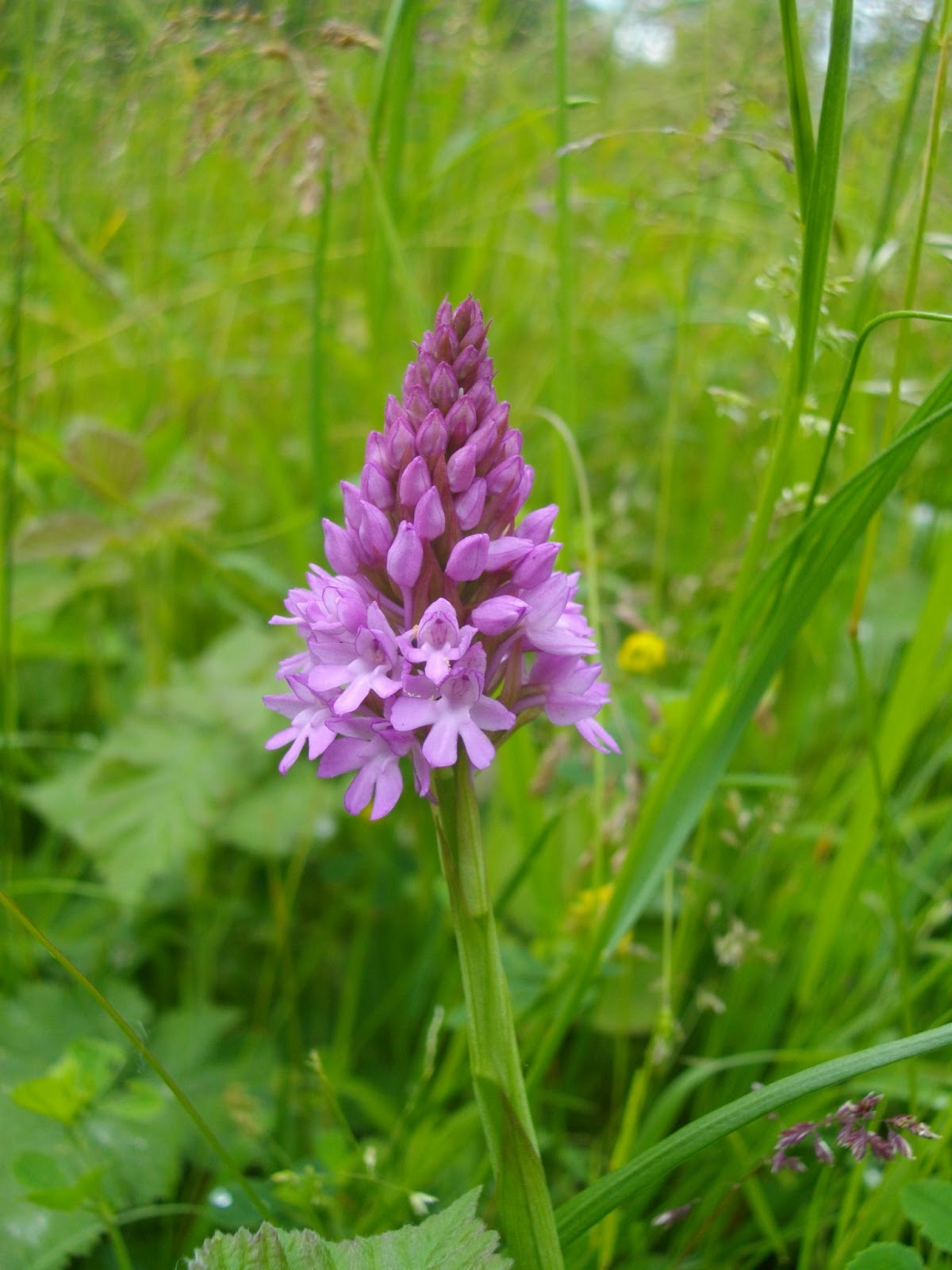
I have rather neglected the Thorpe side of my patch this spring, so I decided to have a walk down to Thorpe Marsh today. On the way I stopped in at Carey's Meadow to look for orchids. I found around 30 flowering spikes of Pyramidal Orchid, a few Common Spotted Orchids and a few Southern Marsh (no Bee Orchids though).


Arriving at Thorpe I completed a clockwise lap, stopping to scan the dry scrape. Several dragonflies whizzed past, and a Small China-mark moth was flying amongst the dyke-side vegetation. The willows have grown up so much that it is now impossible to scan the broad from the bird screen, making it rather redundant. The only birds of note were a Common Tern and a Garden Warbler, but it was still a nie walk in the sunshine. 

BROADLAND: Hickling Swallowtails

27th June 2013

A day off, nominally to go to the Norfolk show, saw Cathy & I instead head off to Hickling. We were mainly looking for Swallowtails, but we also saw a range of dragon and damselflies (Norfolk Hawker, Four-spot Chaser, Black-tailed Skimmer, Large Red Damselfly, Azure Damselfly and Blue-tailed Damselfly. We located at least six Swallowtails, although they were too flitty to get decent photos. A Large Skipper and a Speckled Wood were also new for the year for me.


In terms of birds a Treecreeper was probably the most interesting as I don't remember seeing one at Hickling before. A couple of Little Egrets, Marsh Harrier, Willow Warbler, Sedge Warbler and Common Tern were the best of the rest. We also saw a Drinker moth caterpillar, and a convincing bee-mimic Hoverfly (Volucella bombylans).


WHITLINGHAM: June counts and some micro moths

22nd June 2013

An overcast mid-summers day did not is not usually a great day for a Whitlingham visit, but it was WeBS weekend and Sunday had a 'fun run' scheduled (paying £10 to run around the broad doesn't sound that fun to me), so Saturday it was. A mostly white Greylag was on the slipway with the main Greylag flock. It looks quite distinctive, I would be interested to hear from anyone who has seen this bird elsewhere, to help work out how far away geese come from in summer to moult here.


The Greylag count hit 165 (plus a few goslings), and there were finally two broods of Mute Swans. A brood of young Egyptian Geese may well be a second attempt of the year, and there were also young Coot and Moorhens. A Cuckoo called in the distance, and Common Terns screeched over Whitlingham and Thorpe broads. Insect wise there had been an emergence of micro moths, with 55+ Nemophora degeerella and quite a few Nettle Tap moths.

Nemophora degeerella - note the length of the antennae!
Nettle Tap moth

NORTH NORFOLK: Holt Roller

18th June 2013

A Roller found near Holt on Sunday afternoon was a bird that I particularly wanted to see, but it wasn't until Tuesday evening that I had time to go for a look. I managed to borrow the car from Margaret after work, and Cathy & I headed to Edgefield. The bird had been commuting between the woods to the west of the main road and the Lowes to the east, so our first job was to ascertain where the bird was. A birder at the car park told us that the bird was on the lowes, so we set off east. 1.5 miles later we arrived to find a small group of birders. I'm pretty sure that it would have been quicker to walk from Holt C.P. car park, but I guess if the bird had been at Edgefield it would have been much further so worth hedging our bets.

Anyway, we were there, and a birder kindly allowed us a view of the Roller through his 'scope. It was perched up in a deciduous tree and we were able to watch it fly from tree to tree. At one point it flew down to a manure heap (I'm not convinces it actually was a manure heap, where would all the manure come from? But it did look like one), seized an item of prey and then went back to eat it. Views were good although distant, nicely complemented the Upper Hollesley bird, which had shown well but not flown around much.

We took a different route back to the car, seeing a Woodlark and Wood Horsetail at its only Norfolk site. This was my second Norfolk tick of the year, following on from the Thetford Dipper.

Wood Horsetail

WHITLINGHAM: Summer hail

15th June 2013

Sometimes you get the idea that a trip isn't going to go well. I arrived at Whitlingham to find my normal car park closed, so I headed on to the main one. Here the parking meter was broken, with a note saying "use the one in the overflow car park". As I got out I heard a peel of thunder overhead, and by the time I had returned to the car I had to take shelter from a heavy mid-summer hailstorm. After ten minutes or so it subsided and I got out. I hadn't gone far before my walking boots began sucking up all the nearby water by capillary action, completing their transformation from 'looking a bit rough' to 'no longer fit for purpose'.

Just another summer's day

And so it was, that I began my walk round with soggy feet and the feeling that today probably wasn't the day I got my 100th patch year bird. I began with a look around the ruins and Lime tree avenue for my best bet, Spotted Flycatchers. For the second year running I didn't see any, although I haven't completely given up hope yet. My second best bet was a flyover raptor (Marsh Harrier, Red Kite, Osprey all realistic shouts), so I kept scanning the skies in between the cloudbursts. On the broad itself there was nothing unexpected, most off the birds were Greylag as a result of a good breeding year and regular early summer gathering - I counted around 145 adults with several goslings - including two that appear to have been adopted by a pair of Canada Geese.

Just past the bird screen I got a cryptic message from Neil ("are you on your way to the Swift?"). A quick phone call back ascertained that he did indeed mean a Pacific Swift, but that it was in south Suffolk. A shame that it wasn't in Norfolk, but as I was going out in the afternoon it was probably for the best. Continuing around the broad the common warblers were all still singing, but only one or two of each. A couple of Common Terns were on one of the plastic platforms, and a brood of Coot were in the conservation area. There was still no sign of any cygnets - have all of the swan nests failed this year? With the lack of birds I searched through the undergrowth for anything interesting. Hundreds of Common Blue Damselflies flew about the nettles, with a few Blue-tailed Damselflies scattered in. The most interesting thing I found was a gall growing on Ground Ivy.


BROADLAND: Catfield Fen

9th June 2013

Today was the open day at Catfield Fen. This broadland reserve, owned by Butterfly Conservation, is usually closed to the public due to the unsafe boggy ground and only visible from a path along the western boundary called the Rond. I had wanted to visit for several years now, so despite the overcast conditions Cathy & I set off early to get there in time for the opening of some moth traps that had been left out overnight.

Arriving around nine we gathered in a cut grass area being used as a makeshift car park for the open day. In keeping with the year in general the moth catch wasn't very large, but habitat meant that several of the moths caught were new for me. The most numerous species was May Highflyer, whilst the pick of the rest were Oblique Carpet, Silky Wainscot and Flame Wainscot. We didn't see a single butterfly, but Andy Brazil did show us a female Azure Damselfly that he had found.

Oblique Carpet

Later in the morning we went on a guided walk into the fen. This was mostly centred on an area of carr woodland, and although it was interesting to look around the area, there wasn't much in the way of insect life or flowers due to the conditions. We did see some Water Violets and Royal Ferns, whilst a Great-spotted Woodpecker called in the background.

Water Violet
Royal Fern

WHITLINGHAM: Hobby & an unusual Swift

30th May 2013

An overcast day, once again bringing the Swifts and hirundines low over the Great Broad. There had been a change in the ratio since my last visit, with a rise in House Martin and Swallow numbers and a decrease in Swifts. I left the south shore and went through the woods to look for a 'green man' carved stump that is somewhere in the woods. I didn't find that, but did find some interesting fungi on a log by the riverside. Shortly after a Hobby flew over towards Thorpe Marsh, my 99th patch bird of the year.

Possible Pluteus petasatus and a Peziza sp.

Back at the broad I was scanning the conservation area when I heard the mew of a Buzzard. Looking up there were actually three Buzzards, two of which continued to circle whilst a third bird (presumably an interloper) continued northwards. Birdsong was muted, but I did turn up a couple of interesting insects, notable Red-and-black Leafhopper and Red-headed Cardinal Beetle. As I neared the Watersports Centre a/the Hobby flew through the Swifts. I stopped at a suitable vantage point to try to re-find it, and in doing so noticed a Swift with a lot of white on it. The white wasn't constrained to the rump, and it was the same size as a nearby normal plumaged Common Swift, so it was fairly straight-forwardly an aberrant plumaged Common Swift. It continued to swoop backwards and forwards along the north shore of the broad, and eventually I managed to get several photos of it, none of them particularly sharp.


Incidentally if anyone does know where the 'Green Man' stump pictured here is, I would appreciate directions.

WHITLINGHAM: More Swifts and some interesting insects

25th May 2013

Still plugging away at Whitlingham, I arrived to find another huge Swift invasion under way. There were literally hundreds (at least 600+), and I was able to stand at the edge of the Great Broad and let them fly either side and over the top of me, sometimes so close I could hear the wings as they changed direction. A couple of Common Terns were calling, one in flight and one on a raft, and a Common Sandpiper was perched on one of the fishing platforms. I saw my first couple of hoverflies of the year too, including this Helophilus pendulus.


I saw my first damselflies of the year, with several teneral Common Blues on emergent vegetation. Other interesting stuff included a Slender Groundhopper and a smart Orange-tip. There were also a few more plants in flower, and an interesting green jelly like thing. It looked like a type of fungus, but having got home and checked, it is actually a mass of a type of Cyanobacteria.


WHITLINGHAM: Swifts, Cuckoo and May Shoveler

18th May 2013

An appointment in the city meant that I didn't get down to Whitlingham until lunchtime, but the overcast weather meant that it still wasn't unduly busy. Large groups of Swifts were still wheeling around in the sky like pointy-winged bats on acid. A scattering of Swallows and House Martins were still present but vastly outnumbered. The bird screen came up trumps (there isn't often much to see from here in summer), with a Common Sandpiper on the edge of the island and a pair of Shoveler. This is my latest patch record by quite some way, although I am aware of two later records for the site, both from the end of May. I finally heard my first Cuckoo (98) of the year, and after trying to pinpoint the sound it helped me out by flying into the trees on the island.


A bit further down the path I met another local birder, and we stopped for a chat. He had seen an aberrant Swift with a white patch, possibly the same bird that has been seen at Strumpshaw before. He had also noticed a leg ring on one of the Lesser Black-backs, although it was presumably one of the ones loafing on the broad as we couldn't find it on the posts to read the ring. One other interesting sighting from April was of an adult Med Gull he had seen amongst a flock of Common Gulls, a species that still eludes me here.

On the way back along the south shore I there were three broods of Canada Geese - judging from the size one of the original broods that was missing last week has died, but there are two new broods. Three small Greylag goslings must be a new brood as well, adding to the impressive year for this species here. Whilst searching for a singing Garden Warbler I noticed an unobtrusive green-flowered plant called Crosswort, which turns out to be new for me.

Crosswort

WHITLINGHAM: Red-rumped Swallow (no, I didn't see it)

13th May 2013

There is probably no more frustrating time to hear that a rare bird has been seen on your local patch than Monday morning. I had been at work for around an hour when Neil came in, asking if I had checked BirdGuides recently. It turned out a Red-rumped Swallow had been seen at Whitlingham at 08:12, a site first and a bird I've never seen. It could have been a nervy day waiting to see whether it was still there when I finished work, but as it turned out a text from Justin told me that it hadn't been seen since 08:25. I had checked through the hirundines on the previous day to no avail, which combined with the large arrival of Swifts on Monday (estimate of 1000, up from c300 on Sunday) suggests that the Red-rumped Swallow had just arrived. Interestingly one was seen early morning on 14th May 2012 at Colney GPs, so hopefully we are starting a trend of mid-May Norwich area records; although hopefully the next one will stick around!

I'm not sure that there are any, but if any photographs were taken I would be very interested in seeing them.