The Whitlingham Bird Report for 2025 is now available to download from the Bird Reports page or from here

WHITLINGHAM: Green Man and some more fungi

15th September 2013

Another local visit, this time to Whitlingham. It was raining on and off but I wasn't too bothered, as rain showers can drop unusual birds onto lakes during the autumn. Of course they didn't on this occasion, and I made do by watching a mixed flock of Swallows and House Martins skimming low over the Great Broad, feeding up before they migrate.

There didn't seem much point doing a full circuit of the broad, so instead I headed up into Whitlingham Woods. I had heard that some Dog Stinkhorns had been seen recently, so I went in search of them. Considering the relatively dry weather (up until the last week!) there was quite a bit of fungi around. I didn't find any Dog Stinkhorns, but I did find a Common Stinkhorn and some Stag's Horn, neither of which I have recorded here (despite them being common). There was also a lot of Giant Polypore and Dryad's Saddle (both bracket fungi). My find of the day was the Green Man carving that I have been looking for here for ages. The reason that I hadn't found it became obvious - it was in that most pagan of places, the adventure playground.

The Green Man - one of several wood carvings at Whitlingham

Stag's Horn (Calocera viscosa)

Stinkhorn (Phallus impudicus)

Giant Polypore (Meripilus giganteus)

NORWICH AREA: UEA wildlife bonanza

8th September 2013

Having moved house the previous week, I took a couple of hours out to go to UEA to look for Norwich's most recent damselfly addition, Willow Emerald. Willow Emeralds are a recent colonist to Norfolk and had been largely restricted to Strumpshaw Fen for the past few years, however earlier this summer they had been seen on a stretch of the Yare near Cringleford and near UEA, and more recently the stretch in between. On my way I cut through the woods at the bottom of Eaton Park, seeing this Common Cow-wheat (pictured below). Although commoner than Crested Cow-wheat, which I went and saw earlier in the year, this is still a scarce plant in Norfolk.


I spent some time near the little pond just along the boardwalk from UEA Broad looking for easily photographable Willow Emeralds, but couldn't see any there. I set off along the path, and eventually found four, including a mating pair. Unfortunately I didn't manage to get any photos to improve on last years digi-binned effort, but I was at least able to enjoy good views of them along the far bank of the river. As well as an egg-laying Southern Hawker and four Migrant Hawkers, I also saw quite a bit of other wildlife. I'm still trying to identify this velvety white bracket fungus, but there were several more identifiable species present too.


Polyporus durus or badius, I need to double-check

I also spotted this interesting bug, which I think is Corizus hyoscyami. Bird-wise I saw a couple of Kingfishers and heard Cetti's Warbler and Chiffchaff.


On my way back I spotted this caterpillar on a fruit tree. It is particularly interesting because it is a Grey Dagger caterpillar. When the moth emerges it is identical to the Dark Dagger unless you kill it and dissect its bits, so the caterpillars represent a non-lethal way of securing a positive ID.


YARE VALLEY: Strumpshaw Wryneck

29th August 2013

A quick afternoon visit to Strumpshaw with Cathy, and the Wryneck was still showing well along the riverside path. A good inland record following a large number at the coast last weekend.


NORTH NORFOLK: Italian/Hybrid Sparrow

28th August 2013

I managed to to get to Northrepps for a quick look at the possible Italian Sparrow that was noticed a couple of weeks ago and is still present in the same garden. There has already been quite a bit of discussion about this bird with no real consensus - opinions are split between aberrant House Sparrow, Spanish Sparrow x House Sparrow or Italian Sparrow. For my part, I think that the largish bill, positioned high so that the forehead runs into it (rather than the visible forehead of House Sparrow) suggests at Spanish Sparrow involvement. Given the lack of streaking on the breast, I had wondered if it could be an F2 hybrid, but I suspect that this would show more grey on the crown, so my guess (and it is nothing more than that!) is that this bird is a Spanish x House Sparrow hybrid. This isn't perhaps as unlikely as it sounds - in 2009 at least ten Spanish Sparrows turned up in the Netherlands for example. Whatever the identity, I enjoyed watching the bird on a quiet and sunny day in the countryside, and as the keenest birders had already been, I had it to myself. As I walked back down Hungry Hill four Buzzards flew over and there were numerous Swallows and House Martins overhead.

Many thanks to Carl and Andy for flagging up this bird and allowing people to come and visit.

You can find visiting instructions and more photos of the sparrow here, and Dave Appleton has evaluated the possible identity of the bird here.


NORWICH: Lakenham mothing

24th/25th August 2013

Whilst staying at the in-laws we put the moth trap out (until a torrential shower!). We caught large numbers of Willow Beauty and Scalloped Oak, but the best moth by a distance was my first Lesser-spotted Pinion.

Willow Beauty
Scalloped Oak
Lesser-spotted Pinion


WHITLINGHAM: August counts

24th August 2013

As the East Coast Truckers were assembling along the ring road on Sunday, I went down to Whitlingham on Saturday morning to get the WeBS count done. In drizzly conditions I counted 101 Mute Swans, 31 Egyptian Geese, 140 Mallards, 7 Great-crested Grebes and 6 Grey Herons, along with smaller numbers of the other common wildfowl. Across the river at Thorpe 28 Lapwing and one Common Sandpiper were on the shingle spit.

I took a quick detour into Whitlingham Woods to look at a bracket fungus that I had been told about, and on the way back saw these Suillus sp. ('Slippery Jacks').


THORPE MARSH: Odonata and a Clouded Yellow dip

21st August 2013

Having been too busy to go Clouded Yellow hunting earlier in the month I was particularly keen to get to Thorpe Marsh where Ricky had just seen one on the marsh. Cathy & Margaret dropped me off and I joined Ricky trying to locate it, unfortunately with no joy. Small Tortoiseshells were everywhere, along with a number of dragonfly species (Ruddy Darter, Migrant Hawker, Southern Hawker, Brown Hawker) and Emerald Damselflies. A Swift briefly hawked insects over the marsh, and Lapwing numbers peaked at 26. I'm still hopeful of catching up with Clouded Yellow before the summer is out - I would appreciate details of any you may see in the Norwich area!

Emerald Damselfly
Ruddy Darter

CUMBRIA: Scotch Argus

Mid August 2013

I'm now back from the Lake District - if you are interested you can see some of the wildlife highlights over at Birds and Beer Extra, but in the meantime here is the highlight, a Scotch Argus butterfly seen at Arnside Knott.


WHITLINGHAM: Butterflies galore

7th August 2013

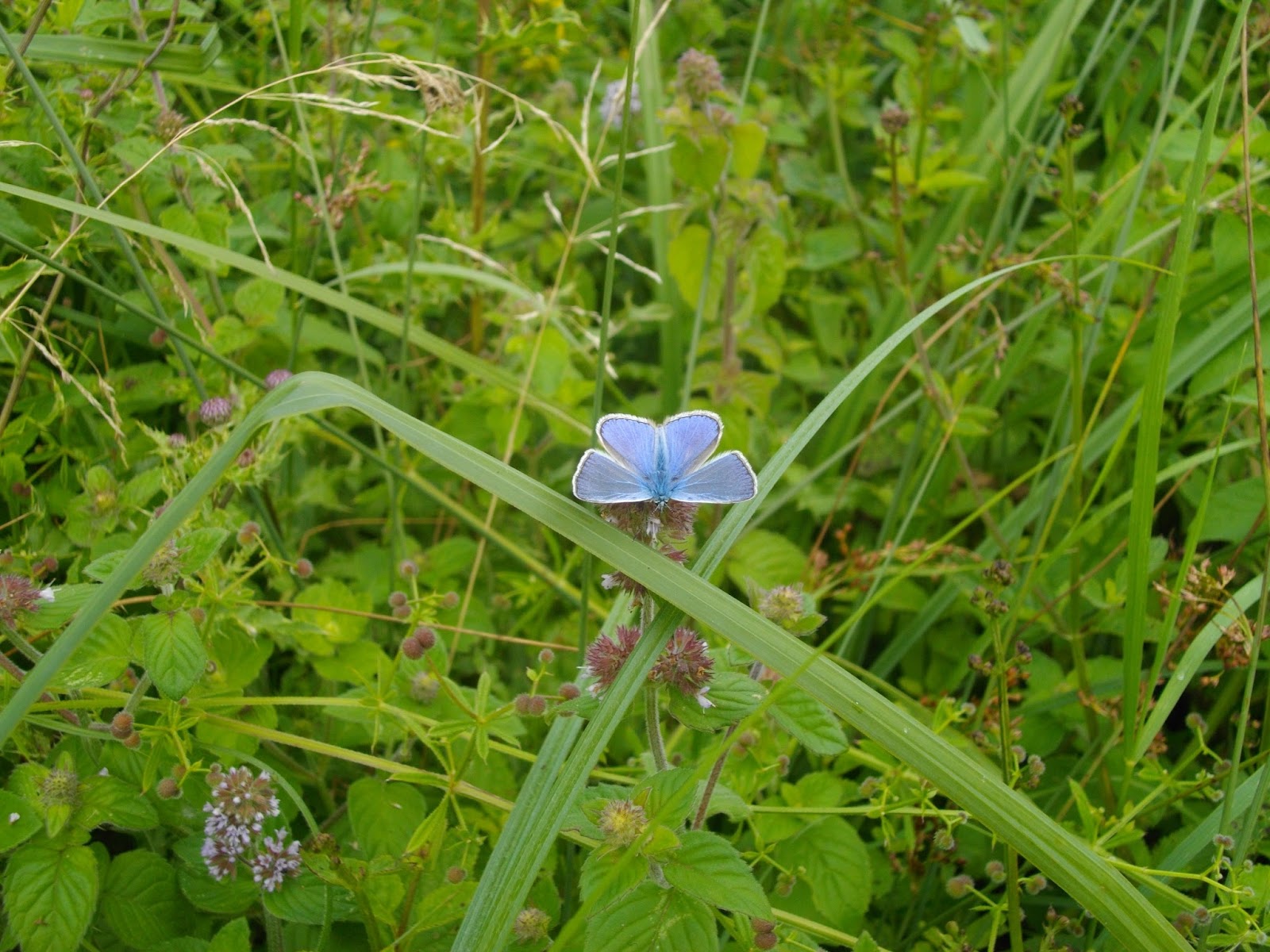
I braved the summer crowds for an afternoon walk at Whitlingham. This year has seen something of an influx of Clouded Yellow butterflies, so I thought I'd have a look for a patch one. I didn't find any, but did manage 14 species, my highest single day count here. This included a Painted Lady and three Common Blues, which I have presumably seen here before and not noted. This became my 20th patch butterfly, with the only likely addition being Purple Hairstreak, of which I still think there must be some nearby. I also found a colony of Roesel's Bush Crickets, lots of Long-winged Coneheads and a Common Blue Damselfly with a non-goblet shaped marking.

On the bird front there are still at least four Common Terns on the Great Broad. Three large Great-crested Grebelings were on the river, still being fed by an adult, whilst across the river at Thorpe Tufted Ducks have bred for the first time in a while - a female and six young were on the shingle spit.


NORTH NORFOLK: Warham blues

4th August 2013

Time for our annual visit to Warham Camp, where despite the blustery conditions thousands of Chalkhill Blues were on the wing. Amongst the other butterflies were a few moths too, including a couple of Dusky Sallows.


NORFOLK: Late July round-up and patch 100

Late July 2013

With my wedding fast approaching (along with a house move and new job) updates may be sporadic over the summer, for which I apologise.

Last week Cathy & I headed down to Lynford Arboretum, where we were lucky enough to get brief views of one of the juvenile Two-barred Crossbills that has been present for the last week or so. Also in the flock was a 'wing-barred' Common Crossbill, the first time I can remember seeing one although apparently it isn't that unusual.

At the weekend I had a walk around Mousehold. Given its relative height and areas of coniferous trees it is probably the best bet of finding a Crossbill on the outskirts of Norwich, but there was no sign of any today. After the weeks of wall-to-wall sunshine it was overcast, so it wasn't great for butterflies either, mostly just Large Whites and Gatekeepers.

Today I headed down to Thorpe Marsh via Carey's Meadow, where the Roesel's Bush Crickets were calling loudly. At Thorpe the scrape was completely dry, so no chance of a decent wader. Scanning the vegetation at the edge of the ditches I found a green Elephant Hawk Moth caterpillar. This confused me a bit, as the ones I've seen before have been brown, but apparently they start green and then turn brown for their final instar. The walk ended on a high note, as I reached the river I saw a Little Egret standing on the far bank. This was only the second Little Egret I have seen here, the first on the deck and more importantly my 100th patch bird of the year! Almost two months since my 99th bird on 29th May. Hopefully I don't have to wait another two months for the 101st one.


Patch Egret. A boat flushed it 30 seconds later, completing the Whitlingham experience.

WHITLINGHAM: July counts and Essex Skippers

21st July 2013

I tend to avoid Whitlingham at weekends when it gets hot, but there was no avoiding it today as I had the WeBS count to do. Whitlingham Lane and the car parks were all packed because there was Dragon-boat racing on, but as they were doing a couple of boats at a time it didn't seem to have had much of an effect on the already rather habituated wildfowl. On the slipway were several juvenile Black-headed Gulls. Not a plumage we get here that much, and I see that one further down the Yare has already been mistaken for a Red-necked Phalarope!


Wildfowl was pretty much as expected, 105 Mute Swan, 63 each of Greylag and Canada Geese (that being a reduction in Greylags from last month), 49 Egyptian Geese, 91 Mallard and 4 Tufted Ducks being the bulk of the count. Four Common Terns were also still present. Looking across to Thorpe a couple of Oystercatchers and four Lapwings were on the spit, that was about it.

On the insect front there was little dragon or damselfly activity, but a couple of Essex Skippers were a site tick, and there were also Meadow Brown, Gatekeeper, Ringlet and Small Tortoiseshells around.


BROADS: Can you identify this Carpet moth?

Earlier this week I got to examine a trap of moths caught in a garden in Barton Turf. Most of them were straightforward (and included a Ghost Moth, plus my first Miller and Small Angle Shades), but there was a carpet that I am unsure of and would welcome any opinions on.

Unknown carpet sp.
Female Ghost Moth
Peppered moth showing camouflage on a printed background


MID-NORFOLK: Crested Cow-wheat at last

7th July 2013

Last year we made three attempts to see this particular plant. The first two occasions we failed to find the only place in Norfolk that it grows. On the third attempt we found the location, but it had finished flowering. So it was rather pleasing to finally see Crested Cow-wheat for the first time. With the sun beating down, I took a few photos and then we headed back to Norwich to watch the Wimbledon final and have a BBQ. 


WHITLINGHAM: Summer is here

30th June 2013

A rather typical mid-summer visit to Whitlingham, hot, lots of people and not that many birds. In fact the most interesting thing was probably an emergence of butterflies, notably Small Tortoiseshells and Speckled Woods. A Norfolk Hawker near the bird screen and an Emperor along the south shore were the best of the dragonflies. Four Common Terns were fishing on the Great Broad, but that was it for avian highlights. On the way back I walked through the picnic meadow, seeing Orange Hawkweed and Meadow Cranesbill.