The Whitlingham Bird Report for 2025 is now available to download from the Bird Reports page or from here

WHITLINGHAM: January counts and Yellow Brain fungus

19th January 2014

A bit of a late post as my laptop cable broke last weekend.

It was the first WeBS count day of 2014 so I headed down to Whitlingham without much hope of seeing any more wildfowl. On the Little Broad a Little Grebe and four Shoveler were amongst c180 Gadwall. Reasonable amounts of Coot and Tufted Duck dominated the Great Broad, along with around 20 Pochard and hundreds of Black-headed Gulls. Part way along the south shore I another local birder stopped to tell me he had seen a Bittern in the reeds along the edge of the conservation area. That particular area is tricky to see, so after a chat (during which point a Kingfisher came and perched nearby) I headed back to the footbridge to scan across, without success. This sighting is interesting because previously I had presumed that Bitterns only came to Whitlingham as a result of freezing conditions, but as we are having a mild winter perhaps this one has arrived simply by choice.

Having scanned for 20 minutes or so I had to continue my count, so I continued along the south shore and then onto the bank to scan across to Thorpe. There were reasonable amounts of ducks on the broad, but the main spectacle was along the reed edges, where a minimum of 50 Snipe were crammed in, probably with many more out of sight. As I carried on towards the conservation area I was stopped by a walker who told me that someone with a telescope was watching a Bittern from near the track to the bird screen. I hurried along, but by the time I got there the birder had gone and once again there was no sign of the Bittern in the time I waited. I finished my count and then walked back, on my noticing a bright orangey-yellow fungus growing on some branches. This turned out to be Yellow Brain (Tremella mesenterica), a fungus which parisitises other fungi (Peniophora sp).

Yellow Brain fungus


30 INTERESTING THINGS - 1/30 Winter Stalkball

18th January 2014

Cathy, Margaret & I went to the North Norfolk coast today, and after a pleasant walk around Titchwell (seeing Water Rail, lots of Pintail and a selection of commoner waders) we headed on to Holme to look for the first of my '30 interesting things'.

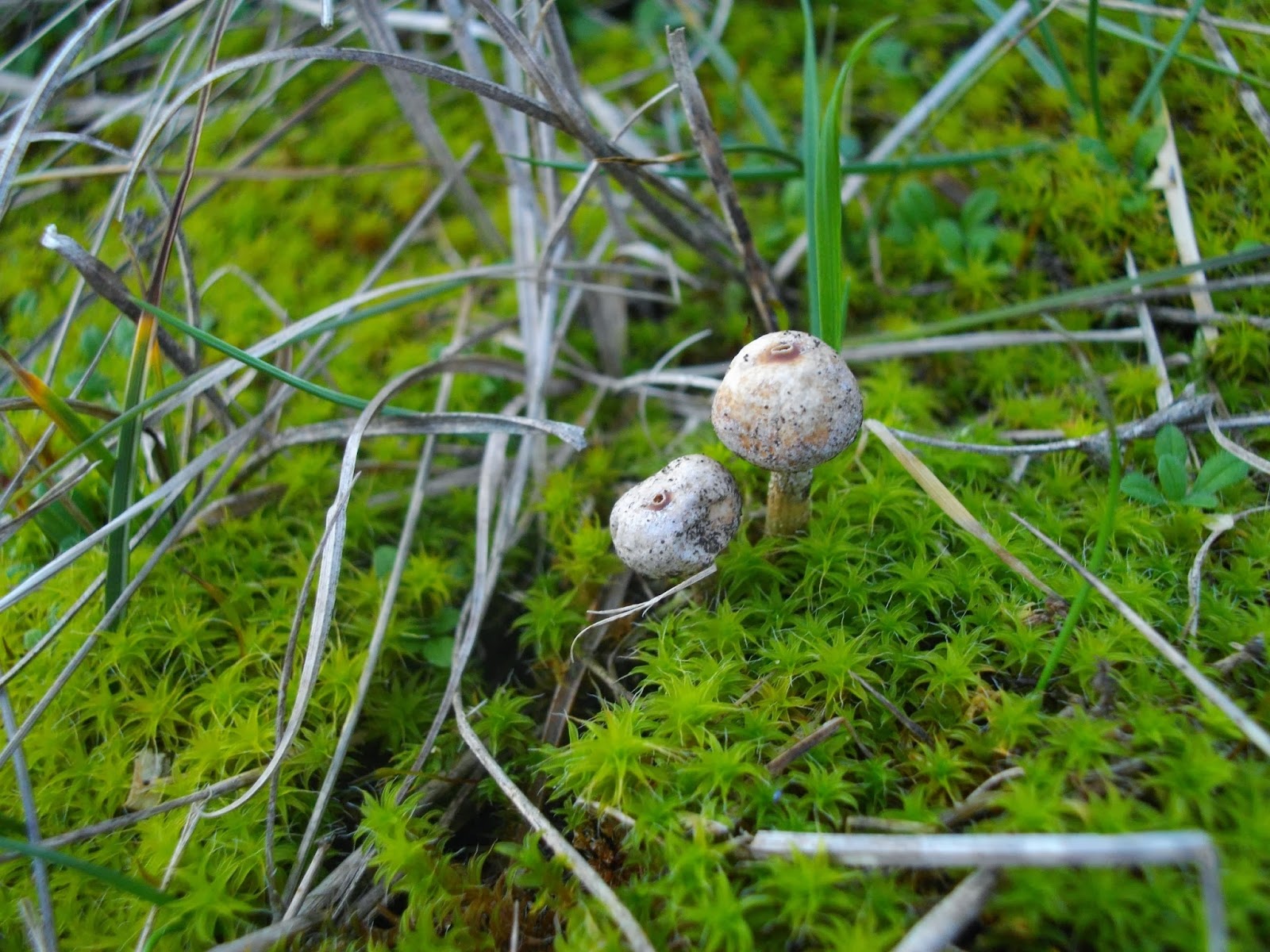
The target was Winter Stalkball. Unless you are particularly interested in fungi you are unlikely to have heard of the stalkballs, but you may well have heard of their commoner relatives, the puffballs. Puffballs are mostly spherical, and when their spores mature they are puffed out and spread by the wind when the puffball is fully mature or is disturbed (for example by an animal or heavy rain). Puffing spores into the air is a good strategy, but clearly the higher the puffball, the further the spores can go. Some puffballs have a thick stipe* to help raise them higher, such as this Common Puffball, seen at Whitlingham this autumn.


There is a small group of species that have gone one better and developed a long stipe relative to the main 'ball'. The best known of these is the Sandy Stiltball, which despite being rare and indeed protected by law, is known from several sites in the county, including one on the edge of Norwich. I have previously blogged about it here. The Sandy Stiltball can grow up to around 40cm tall, but the Winter Stalkball that we were looking for only grows up to 5cm tall. In fact, the top of one looks rather similar to a sun-bleached rabbit dropping! In Norfolk Winter Stalkballs are only found at a few coastal dune systems, and are easily overlooked, so I was grateful to Rob for his help, allowing me to connect with this interesting species.


Winter Stalkballs

* 'Stipe' is the usual mycologist's** term for a stalk
** A mycologist is someone who studies fungi.

30 Interesting things for 2014

Later this month is my 30th birthday, and I had been wondering what sort of wildlife-related activity would be an appropriate celebration. January isn't a great month for going out, with the short hours of daylight and lack of plant and insect life, so I decided to indulge in a year-long search for 30 interesting species.

Picking the species was trickier than I thought. I wanted it to be a mixture of all of the different groups that I'm interested in, but I had to take into account time constraints amongst other things. Anyway, my provisional list is below. Some species I should be able to see without any problems, some will take a bit of research, whilst others may require local knowledge or specialist group help. Will I see all 30? Probably not, but hopefully it will be fun trying!

Birds
1. Colour-headed Yellow Wagtails - I haven't seen any of the scarcer ones, and even the hybrids are interesting birds. Hopefully there should be some in late April in the Eye field or east coast paddocks.
2. White-winged Black Tern - I'm yet to see one in Norfolk yet, and a possible Whitlingham bird too, either in May or August.
3. Long-tailed Skua - Some sea-watching time will be needed for this one...
4. Pallas' Warbler - I still haven't seen one of these yet.

Mammals
5. Natterer's Bat - I had a probable at Whitlingham a couple of years ago, it would be nice to confirm it though - Seen, Trowse Hibernaculum with Norwich Bat Group
6. Barbastelle Bat - A species I haven't seen yet but present in NE Norfolk. Dipped
7. Bottle-nosed Dolphin - I haven't seen any dolphins before, we have a trip to see them in Wales booked for the spring - Seen, New Quay, Wales with Carl Chapman
8. Yellow-necked Mouse - A scarce species in Norfolk, but one of the sites with them usually has a small-mammal trapping day each year.

Amphibians
-- I would like to see Natterjack, but I don't really fancy wandering about the dunes at night. I am also interested in trying to see Marsh Frog in Norfolk - I know there used to be several colonies including one in the Tas Valley, but the most up-to-date information I can find on these is from the 1980s. Does anyone know of any Marsh Frog sites in Norfolk with public access?

Dragonflies
Having seen all of the usual Norfolk dragonflies the closest lifer for me would be White-legged Damselfly. However I would like to get some decent photos of Willow Emerald.
9. Willow Emerald - Get some decent photos. Photographed at Strumpshaw 24/08/14.

Butterflies
Like Dragonflies I have seen the regular Norfolk ones - the closest lifer for me is Marbled White, which should be a reasonable trip.
10. Marbled White - Devil's Dyke.
11. White Admiral - One of my favourite butterflies but one I've never managed to get a photograph of. Fingers crossed this should be simple at Holt C.P. Photographed at Holt CP.

Moths
12. Hornet Moth - I haven't seen any of the Hornet or Clearwing moths - I hope to see one of these at the North Norfolk coast.
13. Scorched Wing Moth - There are loads of fairly common moths I haven't seen, but this seems a reasonable one to look for.
14. Merveille de Jour - I've wanted to see one of these for ages. We don't seem to get them near the garden I trap in, but Justin has kindly offered to let me know when he catches one this autumn.

Orthoptera
15. Great Green Bush Cricket - I have looked for these before and although we heard them, we didn't see any. Seen at Reedham, 24/08/14.

Orchids
16. Frog Orchid - I meant to look for these last year at their known Suffolk site.
17. Lizard Orchid - Hopefully I can see these whilst looking for Marbled Whites.
18. Pale or white form of another Orchid - There are lots, the alba form of Green-winged Orchid would be nice to see.
19. Common Fragrant Orchid - this has fairly recently been promoted to full species, and the NNNS orchid guide says that it occurs in Norfolk, but I haven't been able to find any sites yet. Updated advise is that this species may have occurred in Norfolk previously, but no current sites.

Flowering plants
There are loads of flowering plants in Norfolk that I'd like to see, including the Bladderworts and Yellow Bird's-nest, however I settled on:
20. Spiked Speedwell - or any of the specialist Breckland Speedwells, it's a place I haven't seen many plants.
21. Purple Broomrape - Common in several places along the North Norfolk coast - I failed to find it at Overstrand a few years ago.
22. Chaffweed - Only found at one site in Norfolk. The good news is that it is near Norwich, but the bad news is that the site is threatened with development. You can out more here: http://friendsofthorpewoodlands.blogspot.co.uk/. Unfortunately Chaffweed is a small green plant, so finding it in a large woods may be tricky.
23. Small-flowered Catchfly - A rare Red Campion-like plant that grows in several places around the county. Seen, Strumpshaw area.
24. Maiden Pink - Another Breckland species I'd like to see.

Ferns
25. Hard Shield Fern - scarce in Norfolk so I need to find some good places to look. Seen, Whitlingham Woods (thanks to Jeremy Halls)
26. Narrow Buckler Fern - fairly common but a fern lifer, so provided I can identify it then it could be something to pick whilst hunting for the other species.

Fungi
27. Scaly or Winter Stalkball - Scarce stalked puffball species. Either would be great, but as they often occur at the same sites I may even luck in on both. Winter Stalkball seen at Holme (thanks to Rob Smith)
28. A scarce bracket fungus. There are quite a few possibles here, I haven't seen Hoof Fungus, Phellinus hippophaeicola (grows on Sea Buckthorn) or Ganoderma resinaceum for starters... Gloeophyllum abeitinum (a 1st for Norfolk) seen at Whitlingham (thanks to Tony Leech).
29. Any Earthstar except G. triplex - Again lots to choose from. Beaked Earthstar is the best bet as it sometimes grows in Earlham Cemetery, although there weren't any fruiting bodies in 2013.
30. Parrot Waxcap - A fairly common Waxcap, present at Earlham Cemetery although I spectacularly failed to find it on multiple occasions in 2013.

So there we have it, my 30 to look for. Hopefully looking for these will provide some interesting blog entries, and if you can recommend any sites for some of the trickier species then please get in touch.

WHITLINGHAM: A few more additions

11th January 2014

Despite the continuing mild weather I went down to Whitlingham in the hope of some new wildfowl (there was a Black-throated Diver at Barton the previous day, plus a few Goosander around the county). Once again there was no sign of any Water Rails along the Little Broad shore, but I did get excellent views of a Sparrowhawk that skimmed low along the ditch before perching up half way along. On the broad itself the large flock of Gadwall were still spread out, and a couple of Shovelers were along the far shore.

On the Great Broad the ducks were mostly Tufted Ducks, with around 25 Pochard and a scattering of Teal in the conservation area. Four Little Grebes were bobbing around in the favoured area in the north-east of the broad, and a couple of Great-crested Grebes were also present, along with a half-submerged Grey Heron. On my way back I walked along the Little Broad and heard a Treecreeper calling nearby. I noticed it on a tree a couple of feet away, and got excellent views as it systematically crept up the nearby trees, never getting more than half way up before flying down to the bottom of the next one.

Sparrowhawk, Little Grebe and Treecreeper were new for my patch list for the year (40) and took my foot it list to 43 (having seen Collared Dove, Jay and Redwing elsewhere in the city).

Out of focus because of all of the branches, but gives the impression of the view

WHITLINGHAM: Goldeneye & 'foot it'

3rd January 2014

The weather on New Year's Day had been quite poor, so I decided to go back today and have a better look round. I walked down in order to ensure that anything I did see would count on my 'Foot It' list (January's birding competition to see how many species you can record on foot from your home). This seemed like a mistake as it began to hail, followed by fairly constant rain.

Along the Little Broad shore I kept an eye out for Water Rails, but didn't find any. Scanning the broad I counted 214 Gadwall and a lone Shoveler. Around 150 Tufted Ducks and 30 Pochard were on the Great Broad, along with a single Goldeneye. Teal were tricky to count as they were up on the island, but there were at least 20. I scanned across to Thorpe and the shingle spit was thick with Snipe, a minimum of 16 were visible along the broad edge. A Green Woodpecker and five flyover Lesser Redpoll completed the avian interest for the trip before I returned home to dry off.

Grey Heron
Goldeneye & Tufted Duck

WHITLINGHAM: First visit of the year

1st January 2014

Happy New Year. As a Red-necked Grebe had been reported from Whitlingham the previous evening we went down there late morning to have a look for it. A flock of grey geese with a white one in the middle would be promising if seen at the coast (Pink-feet with Snow/Ross' Goose), but on the meadows south of the country park it was predictably 76 Greylags with a white Greylag. Scanning the Little Broad we saw a flock of c200 Gadwall, but no sign of last weeks Shovelers. Pochard and Tufted Ducks were showing well on the Great Broad, but there was no sign of yesterdays Grebe. On the slipway we saw a white-ringed Black-headed Gull, which turned out to be the same Oslo-ringed bird we saw here in November.


Before heading off we went into the visitors centre, where John was discussing my blog. We had a good chat, during which it turned out that someone had reported a Red-breasted Merganser to one of the staff today. There has been a couple previously but they remain a rare bird inland, so we went back an had another scan of the Great Broad, but without success. If anyone does have details of this bird (or the Red-necked Grebe) then I would be interested to hear about them.

Inside Whitlingham Barn - this end has been emptied out until a new cafe is put in.

By the time we left it was starting to rain. Deciding that Breydon Water wouldn't be a good idea, we had a quick look at Rollesby and Ormesby Broads, seeing a couple of Shoveler and a Teal at the latter, before doing a loop to Horsey and then home via North Walsham.

WHITLINGHAM: Last visit of the year

28th December 2013

Unless something particularly unusual turns up today was my last patch visit of the year, and I decided to head down to Whitlingham before sunrise in the hope of a last minute addition like a Barn Owl or some flyover wild swans. As I walked along the river at Trowse Meadow Redwings were passing overhead, and six Cormorants flew west. A Great-spotted Woodpecker called, and another one was in a tree near the old Whitlingham lane route. A Nuthatch was also calling from near the car park, and I was surrounded by a flock of Long-tailed Tits.


There was still a large concentration of Gadwall on the Little Broad (c240) and six Shoveler. By the time I had reached the Great Broad the sun was up and creating a two-tone effect of golden reeds and sunshine along the north shore and shadowy frost along the south shore. A flock of 17 Pochard were mixed in with the Coot and Tufted Duck, and a pair of Wigeon were the first I've seen here since January. Three Little Grebes were the only other birds of note from the south shore. I stopped briefly to check out a fallen tree where several types of fungi were growing, before carrying on to the conservation area. Here I noticed an adult Herring Gull with a red ring on its left leg, but unfortunately the combination of distance and bright sunlight meant that I couldn't read it.


Coprinellus sp

So there we go, I end the year having seen a round 100 species of bird at Whitlingham in 2013, lower than the past few years but at least scraping into three figures for the fifth successive year.

MERRY CHRISTMAS!

So as 2013 draws to a close it remains for me to wish all of the readers of my blog and fellow Norfolk wildlife enthusiasts a very Merry Christmas and best wishes for 2014!


NORWICH: An unusual find...

19th December 2013

On the way to work today I saw a family staring at something in the road. I looked over and saw this dead Woodcock. I considered picking it up, then the logical part of my brain asked me what my colleagues would think of me walking in with a dead Woodcock under my arm, and more importantly what I'd do with it afterwards, so I checked for rings (it was unringed) and then left it. I happened to mention it to Pete (a fellow birder and bird artist) who said he would have liked to have had it to draw, but by the time he popped back it had gone.


WHITLINGHAM: December counts

14th December 2013

Middle of the month usually means WeBS counts, and so today I went down to Whitlingham to see if there had been any further increase in wildowl. The main change was in Teal numbers, now up to 55. On the downside there was no sign of the Shoveler. There was also 215 Gadwall, 124 Tufted Ducks and 168 Coot, along with the usual swans and geese.

Sighting of the day was a couple of Peregrines over the Thorpe Broad. Initially I thought that they were heading of down the valley, but then they flew round. The smaller bird continued over the marsh, where earlier a flock of 25 Snipe had been put up, but the larger bird showed well, giving several fly-pasts. It concentrated on a large raft of Black-headed Gulls, as if trying to spook one into the air, but it never seemed to be in fully focused hunting mode - maybe it just doesn't like gulls. Once both birds had gone from view I continued my counts from the bird screen, where I discussed the birds and the purpose of the counts with an interested walker.

WHITLINGHAM: A bit of winter wildfowl

8th December 2013

Luckily the flood waters had little effect as far as Norwich (Thorpe Marsh suffered a bit of flooding but that was about it). I headed down to Whitlingham to see if any birds had arrived from the coast. This time last year was my most successful day at Whitlingham, finding Ring-necked Duck and Common Scoter, but there was nothing so exciting this time. The scarcest duck of the day was Shoveler, six of them on the Little Broad, and there was around 200 Gadwall, up on the last couple of years. Two Little Grebes were near the main island, and there were also a couple of Great Black-backed Gulls around.

I decided to spend a while at the slipway looking for more colour-ringed Black-headed Gulls. Despite some controlled wildfowl attracting with seed (and some uncontrolled attracting by families with spare loaves of bread) none of the gulls seen were ringed. Many of the Mute Swans and one of the Canada Geese were, but only with metal rings, which require much closer inspection! I did get a decent look at one though, as it was eyeing me up as a potential food source.


WHITLINGHAM: Sightings for 2013 Bird Report

December 2013

Regular readers of the blog will probably remember that last year I collated my Whitlingham records along with sightings from fellow local birders into a Whitlingham 2012 Bird Report (still available here if you didn't see it at the time). This was generally well received, and I have been working on a report for 2013. The main part of the report is the systematic list, complete with details like high counts, earliest and latest sighting dates etc. There will also be brief articles on January's Bittern invasion and the origins of colour-ringed Black-headed Gulls seen at Whitlingham. In terms of species, 2013 has seen fewer species reported than 2012, but these have included Whitlinghams first Red-rumped Swallow (recently accepted by the Norfolk Birds Rarities Committee - see the latest work-in-progress file on their website).

I would be grateful for any sightings from the Whitlingham area (including Thorpe Marsh) this year. Records of scarce birds, flyovers and ringed birds would be of particular interest.

In particular I would welcome any sightings of the following species as I suspect the following may have been seen in 2013 but I haven't heard about them:

Whooper Swan (usually an annual flyover)
Goosander (near annual)
Smew (near annual)
Common Scoter (several in recent years)
Osprey (Regular at Strumpshaw, occasional sorties upriver)
Most waders
Any Owls (Barn & Tawny presumably resident but not actually seen this year)
Crossbills (Presumably fly over from time to time)
Brambling (as above)

Sightings can be left in the comments on this blog, emailed to whitlinghambirds 'at' yahoo.co.uk or via BirdForum, and everyone who sends in sightings will be acknowledged at the end of the report.

Many thanks.


NORWICH: Yet more Earlham Cemetery fungi

1st December 2013

As the frosts have held off I nipped back to Earlham Cemetery to look for a rare cup fungus. It had been found by the Norfolk Fungus Study Group a few weeks ago when they had a foray there (unfortunately mid-week so I couldn't attend). I managed to find it, but it was rather far gone. So take this photo as a record shot, but have a look in a book or on google if you want to see what it normally looks like!

Sowerbyella radiculata

Whilst there I had another look at the Waxcaps and other bits and bobs. I still couldn't find the area with Blackening Waxcaps and Slimy Waxcaps in, so if you have come across either of those at Earlham this year then I'd appreciate directions for next year. I was told they were somewhere in section 6 if you look at a graveyard map. Whilst I was wandering around I saw a Coal Tit, and there were also lots of Redwings around.

NORTH NORFOLK: Holt Parrot Crossbills

23rd November 2013

Happily for me the flock of Parrot Crossbills that has taken up residence at Holt C.P. was still present today, so Cathy & I went to have a look. If the Crossbills had chosen to spread themselves out over the country park then this would have been tricky, but as it happened they seemed quite content in trees close to the car park. For most of the time we were there some of the Parrot Crossbills (up to eight by the time we left) in a Larch, showing well albeit in bad light. We were able to watch them feeding and showing off the power of their impressive bills.


As it started to rain we headed back to the car, stopping off near the park giant to look at some fungi. There was a purple bracket (Trichaptum abietinum), Jelly Spot (Dacrymyces stillatus) and a Calocera sp. It looks like Calocera cornea, but as that species usually occurs on deciduous wood it may well be a related species.


NORWICH: A few more interesting fungi...

16th November 2013

With frosts (and maybe snow!) forecast this week, I popped back to Earlham Cemetery once more to try to see a few more species. My main target was a coral fungus called Ramaria flaccida. I had failed to find it last week, but Ian had given me some good directions and eventually I did manage to find some. It was starting to die off and blended in with the pine needles and leaf litter.


Next on the list was a white spindle fungus called Clavaria acuta, which can be hard to see growing in mossy ground.


Finally I went looking for some Earthtongues. These are difficult to assign to species, and it is complicated by more than one species growing together. That appears to be the case at Earlham, as a specimen that Ian took last week appears to be Trichoglossum hirsutum, but one of the ones I examined seems to be a Geoglossum sp based on the shape.


The cemetery has been excellent for fungi this autumn, and I still didn't catch up with Parrot Waxcap and Beaked Earthstar, so I'll certainly be back next autumn to look for those.