In between shopping and visiting the in-laws I found out about a Black Redstart that had been reported on a roof on Corton Road. As I live nearby I nipped out to have a look. On my first look there was no sign of it, but on my way back I noticed it peering Robin-like over the top of the roof. I waited nearby and it hopped along the top of the roof. An excellent bird to see locally, so thanks to whoever found it initially.
The Whitlingham Bird Report for 2025 is now available to download from the Bird Reports page or from here
NORWICH: Local Black Redstart
30th March 2014
In between shopping and visiting the in-laws I found out about a Black Redstart that had been reported on a roof on Corton Road. As I live nearby I nipped out to have a look. On my first look there was no sign of it, but on my way back I noticed it peering Robin-like over the top of the roof. I waited nearby and it hopped along the top of the roof. An excellent bird to see locally, so thanks to whoever found it initially.
BRECKS: Lynford Two-barred Crossbills
29th March 2014
On Saturday I went to Lynford Arboretum with Jim and Connor to have a look for the Two-barred Crossbills which have shot back to prominence in the last week or so. On our way there I saw my first Brimstone butterflies of the year, and there were loads of them at the Arboretum, along with a couple of Commas. Upon our arrival a Common Crossbill was in trees near the car park.
Crossing the road and and walking up the main track we heard a probable Two-barred Crossbill contact call, but couldn't find the bird itself. Walking further in we heard at least four singing Firecrests, all deep in cover, but with no sign of any more Crossbills we returned to some puddles near the entrance in the hope of seeing one coming to drink. After a short while a birder stood with us saw a Crossbill fly into a small tree nearby. It was mostly obscured by branches, but Connor noticed it had two clear wingbars. It turned side on and flew down to drink, showing the first wingbar to be large, but the second slightly less so. It looked like a 1st-winter bird, but was it a Two-barred Crossbill, or the debated look-a-like? We thought it was probably OK, but hoped it wouldn't be our only sighting.
The Crossbill soon flew off, but we waited for a while near the gate hoping for it to return. Nearby Nuthatches and Siskin called constantly, and we were treated to a excellent display by a Goldcrest, raising its crown and singing at an interloping bird. Whilst Jim & I were watching the puddles Connor had gone looking for Firecrest. A phone call informed us that instead he had found a Hawfinch, so we hurried along to have a look. When we got there it was still visible near the top of a tall tree, but when it flew out we saw there were actually two!
We looped round through the Arboretum, before deciding to give the puddles one last look. It was whilst standing here that Connor & I both heard a Two-barred Crossbill call, and we picked it up in one of the larches. We called Jim and a small group of birders over, and managed excellent views of a male Two-barred Crossbill. With all eyes focussed on the tree, a female was found on a branch on the other side of the trunk, and finally another male. Just before we left they all moved onto the same branch, with all three in the same 'scope view. An excellent afternoons birding, thanks to Jim & Connor for the lift and company.
30 INTERESTING THINGS - 3/30 Hard Shield Fern
23rd February 2014
This week had seen a small influx of early migrant birds to Norfolk, so I headed down to Whitlingham in the hope of breaking my earliest patch record for Willow Warbler or Sand Martin. The weather was overcast with a few showers, but this can be handy for 'dropping' migrants, so I didn't resent the rain. On the Little Broad ten drake Shoveler were still present, along with a dwindling number of Gadwall. There was no sign of last weeks Egyptian goslings, which doesn't bode well for them. The most interesting bird on the Great Broad was a hybrid Canada x Greylag Goose near the main island.
With no migrants other than the now widespread Chiffchaffs, I headed further along into the woods. On my way along a woman stopped to tell me she had just seen a Hedgehog walking across the road ahead, but it had gone by the time I got there (I have only seen a squashed one here). There was plenty of birdsong, including a drumming Great Spotted Woodpecker, two Nuthatches, Song Thrush and lots of Wrens. The woods were carpeted with Dog's Mercury, Moschatel and Early Dog's Violet were also in flower.
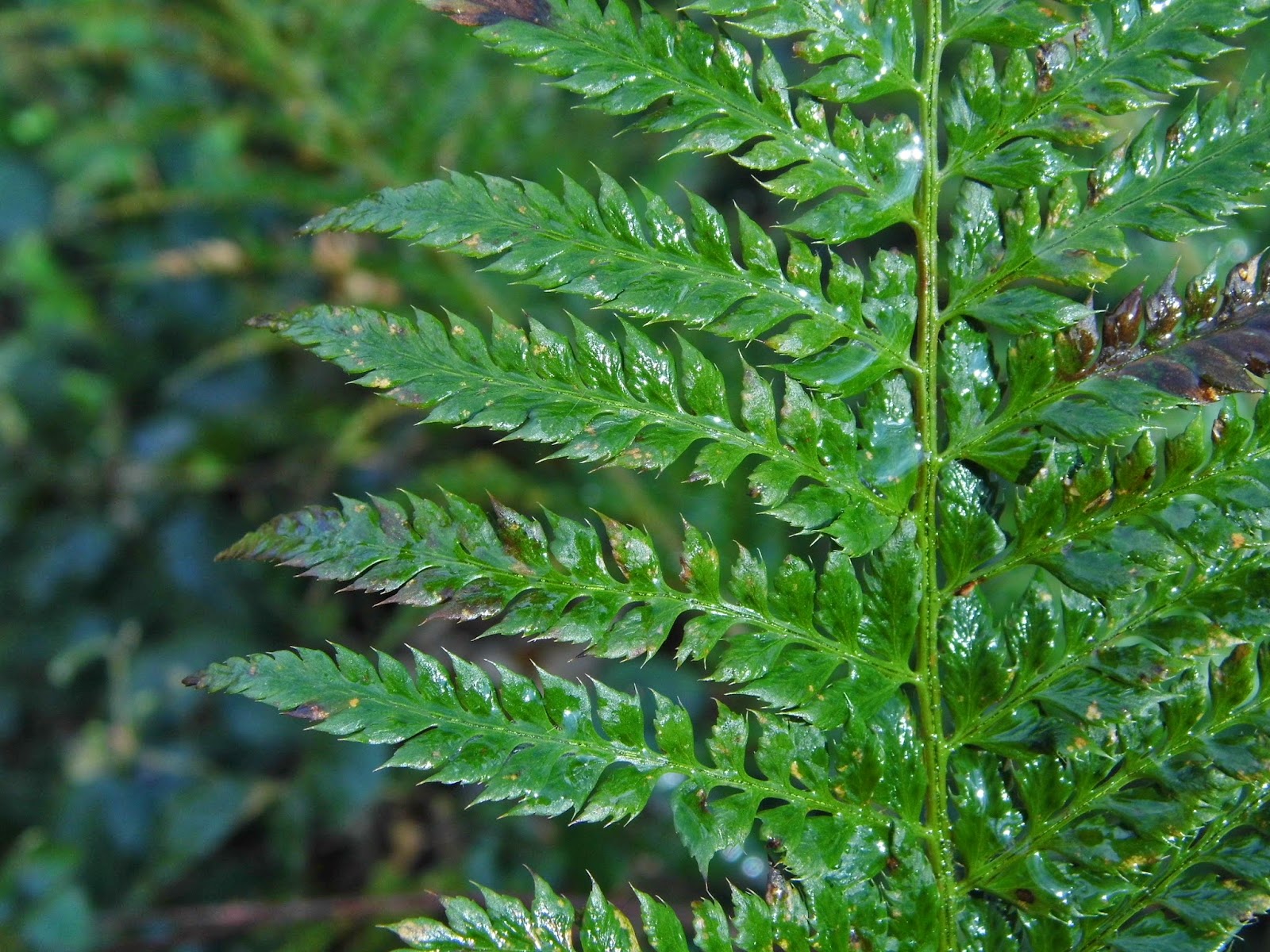
Having asked for sites for Hard Shield Fern, a species I have never (knowingly) seen, I was told of several places, including Whitlingham Wood. Jeremy had kindly told me that there was a record from the woods in 2011, so I paid particular attention to the clumps of ferns, most of which are Male Fern. I had almost completed a circuit of the woods, not hearing any migrants along telegraph pole alley, when I noticed a different fern near the top of the steep steps. A closer look revealed it as my target species, Hard Shield Fern. I know I've looked at that clump of ferns before, but just never realised what it was!
WHITLINGHAM: March counts & Orange Underwing
16th March 2013
A bright sunny morning for today's WeBS count, with the attendant increase in visitors. The Little Broad held three Little Grebes, 11 Shoveler (a good count for March) and 45 Gadwall. A Chiffchaff called intermittently, the first of four around the site. Coltsfoot and Lesser Celandines were flowering in several places, whilst several Small Tortoiseshells and Peacocks were seen flying in search of more flowers.
Little Grebes & Gadwall
Egyptian Geese
Along the shore of the Great Broad two small Egyptian goslings accompanied their parents along the slipway. Overhead some Redwings called unseen. A day-flying moth flew past me, and I managed to track it down a path, where I confirmed that it was an Orange Underwing, my first here. I also managed to find a couple of interesting fungi, Winter Polypore (Polyporus brumalis) and what may be Wrinkled Fieldcap (Agrocybe rivulosa).
Orange Underwing
Winter Polypore
Possible Wrinkled Fieldcap
FENLAND: Whooper Swans
8th March 2014
Earlier in the year my mum and Cathy's mum had both expressed an interest in seeing a Swan feed at Welney WWT reserve. The mild winter has meant that fewer swans than usual were present, but we decided to go anyway and have a meal at the cafe before heading to the main hide as an early Mother's Day present.
Much of the site was still flooded, including the paths, so only the main hide was open. From here we watched as around 60 Whooper Swans and loads of Pochard came right up to the hide to be fed. One of the swans had a yellow ring on its leg, but I couldn't read the digits on it. Only a thin strip of land was visible, and this was covered in Black-tailed Godwits, with 12 Avocet, 1 Oystercatcher and 2 Redshanks. Behind them was a flock of Wigeon, including a drake with a clear green streak, similar to the birds pictured on Dave Appleton's blog.
Despite not seeing any Bewick's Swans we all enjoyed the day out, with sunny weather and excellent views. The swan feeds are finishing today (Sunday 9th) until the autumn.
THORPE MARSH: Little Egret
1st March 2014
Since moving house in the autumn Thorpe Marsh is further to walk, so it had been a while since I last visited. I had heard that a couple of Jack Snipe had been seen there in the week, so I headed down more in hope than expectation. As I crossed the railway line a Song Thrush was singing, an embarrassing patch year tick. Further along the path a couple of Reed Buntings were also singing, another year tick. As I reached the cattle pound I noticed a Little Egret amongst the rushes. I took some photos (this was the first time I've seen one here for any length of time, and only my third patch record). I eventually turned my attention to the scrape, scanning from different angles but not seeing any Jack Snipe.
As I went to move off the Little Egret flew into the middle of the flooded scrape, showing even better than it had before. Eventually it flew off, but only to relocate to the flooded path across the marsh. Walking slowly round I spotted a Stock Dove flying over the woods (no sign of any on the marsh itself though), and a Meadow Pipit also flew over. I stopped to look at some fungi and heard an Oystercatcher calling as it flew in to land on the spit. I scanned through the gulls hoping that Ben's Iceland Gull would relocate from Cantley, but despite a flock of gulls flying in from the direction of the sewage works I failed to see anything other than the commonest four species. Hopefully next time I'm here the Little Ringed Plovers will be back, along with the first warblers and hirundines.
NORTH NORFOLK: A glimpse of the aurora
27th February 2014
I happened to glance at Twitter before putting my laptop away, and noticed some excellent photos of the aurora borealis (Northern lights). Reading down the page it appeared it was showing well as far south as Blickling. Cathy jokingly said we should go and have a look, and I not-jokingly said we should go and have a look. We called Margaret, who had gone to bed for an early night but quickly got up and came over to pick us up. We headed north away from the city lights, heading to Cromer, along to Cley and home via Holt. The main activity had died down, but we still managed to see a green band of light along the horizon, which was excellent. We also saw a couple of small deer and a fox on our way round.
WHITLINGHAM: Siskin & a Suffolk Gull
23rd February 2014
I arrived at Whitlingham to the welcome sound of Siskins. They have been scarce locally this winter, presumably because of the mild temperatures, but around twenty were spread across the tops of the Alders. I scanned the Little Broad, counting nine Shoveler and 95 Gadwall. There wasn't much of note on the Great Broad, although I did stop to watch a Sparrowhawk soaring over the broad. Having gone round the broad I scanned the gulls from the bird screen and noticed a colour-ringed Herring Gull on the posts. I have reported it to the ringer, but as it turns out this bird was present last winter so I know it was ringed as a pullus at Havergate Island in Suffolk.
On my way back I glanced at a pile of wood-chips, and noticed a large group of cup fungi (Peziza sp). These can be tricky to identify, but I'll have a look in the next few days.
NORTH NORFOLK: Walsingham Abbey Snowdrops
17th February 2014
Today was Cathy's birthday, so we went for a walk at Walsingham Abbey to see the Snowdrops. The whole area was very tranquil, both along the flooded River Stiffkey and in the nearby woods. The ground was carpeted with Snowdrops and Winter Aconites, whilst Cathy found Harlequin Ladybirds, Garden Snails and a Plume moth on some old tree trunks.
WHITLINGHAM: February wildfowl counts
16th February 2014
Some bright sunshine today for a change, and as I left the car park a Skylark flew over calling. Starting as always with the Little Broad there had been a decrease in Gadwall numbers to 127, but on the up side the 12 Shoveler was my highest count here since 2010.Single Little and Great-crested Grebes were also present, along with 32 Tufted Ducks.
Nothing except Black-headed Gulls broke the hundred barrier on the Great Broad, with 91 Coot and 89 Tufted Ducks coming closest. 20 Pochard, 9 Teal and 36 Mallard completed the duck interest. I finished the main part of the count just in time, as one of the inflatable motor boats then proceeded to do flat out manoeuvres and turns along the length of the broad. Incidentally the south-east corner of the broad is still very muddy, wellies would be recommended if you intend on walking here.
Thorpe was relatively quiet, with no sign of the masses of Snipe present last month (although I presume they are still present just on the marsh rather than the broad). I did count 58 Tufted Ducks, 8 Pochard and 30 Gadwall, along with a Great-crested Grebe and Common, Herring and Black-headed Gulls.
NORFOLK: Sculthorpe Moor Bullfinches
15th February 2014
Despite the squally weather Cathy, Margaret & I headed out to do a bit of birding. We diverted via Ber Street to check if the Waxwing was still present and it was, although more obscured than yesterday. Handily a birder was already there and pointed it out half hidden amongst some apples.
We then went to Sculthorpe Moor to see some Bullfinches. This had been the plan a fortnight ago until the Whitlingham hibernaculum check - I went to look at the bats instead on the understanding that we would go to Sculthorpe soon and would find Cathy seven Bullfinches (four males, three females).
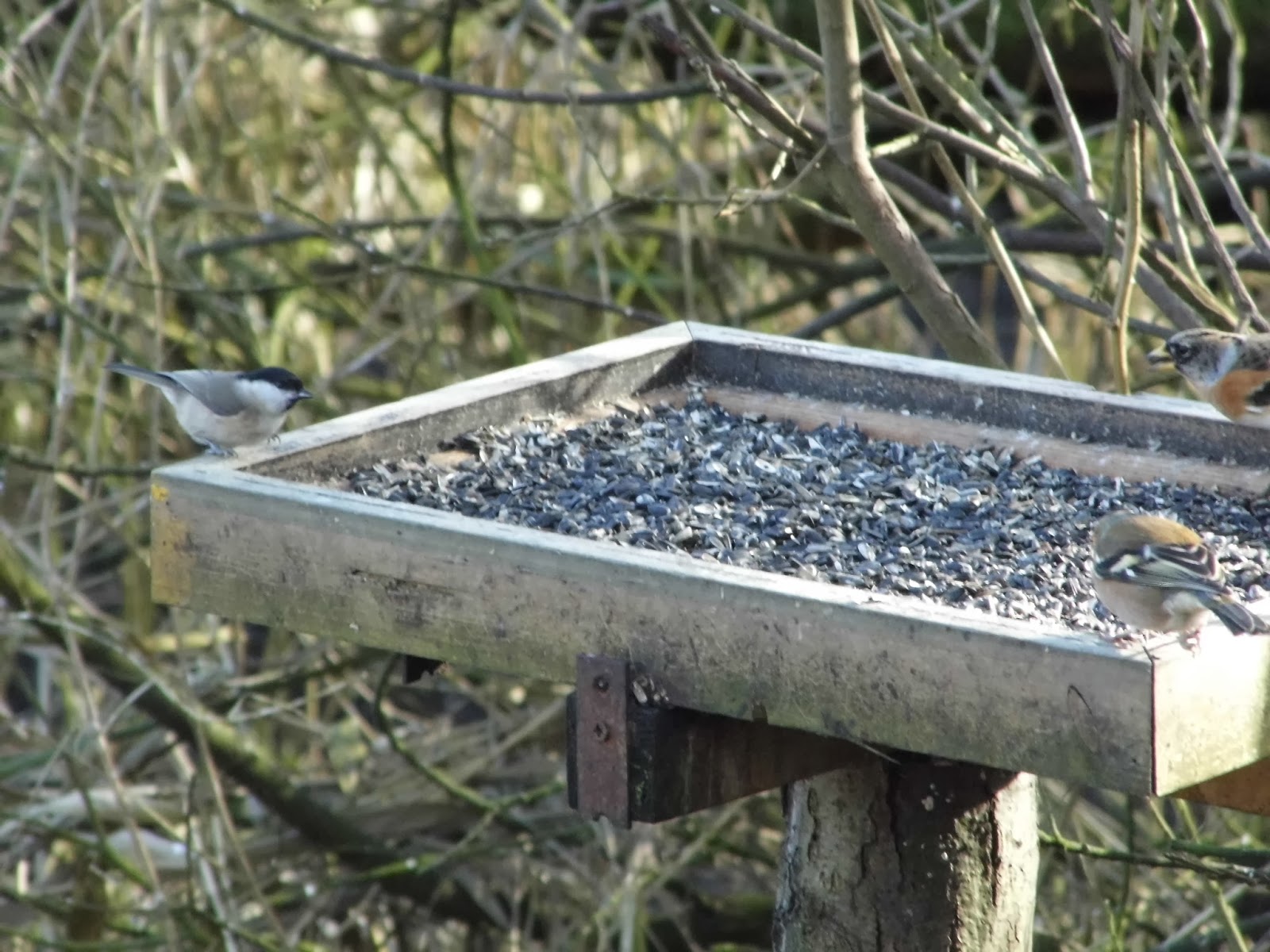
From the visitors' centre we stopped to shelter from the rain at the first set of feeders and were rewarded with a Coal Tit and a pair of Bullfinches. There wasn't much showing from the Woodland Hide, so we carried on, seeing some Scarlet Elf Cups near the river. Continuing along the boardwalk we were glad the river wasn't an inch higher as it had already flooded much of the area either side of the path. At the Whitley Hide we were treated to close views of loads of Chaffinch, Greenfinch and Brambling, whilst several Reed Buntings favoured the left hand bird table. After a while a pair of Bullfinches arrives, followed by a second pair. Somewhat strangely another male flew in and Cathy's request list was complete - we saw seven Bullfinches in her desired male/female combination. Hopefully these premonition skills will be used again later in the year.
We took a circuitous way home, calling in at Cley Spy for me to get a new tripod head and the heading along the coast road for the first time since the floods, seeing a Little Egret and a Marsh Harrier.
NORWICH: City centre Waxwing
14th February 2014
My walk to work this morning was brightened up when I spotted a Waxwing feeding on an apple tree on Ber Street. It was about time quite frankly, I have checked this tree most weekdays over the winter expecting to see some winter thrushes feasting, but instead most of the apples have just fallen to the ground and started to rot. On my way home it was still in almost the same place, but had stopped feeding and instead was just perching in the rain, quite unperturbed by the pedestrians several yards away. I got a record shot with my point-and-shoot camera, but I recommend you check out David Bryant's website for some excellent pictures of the same bird: http://birdsoftheheath.blogspot.co.uk/2014/02/bohemian-like-you.html
30 INTERESTING THINGS - 2/30 Natterer's Bat
1st February 2014
My latest target species from my 30 Interesting Things list was Natterer's Bat, a fairly common bat that I hadn't seen before. Whilst I may have been able to find one by roaming around in the evenings with a bat detector, I had joined the Norwich Bat Group and knew that they sometimes allowed members to come on Hibernaculum visits. As it happened the old Lime Kiln at Whitlingham often has Natterer's Bats over the winter, so that seemed a good bet.
Earlier in the week Jim (who is a committee member of the Norwich Bat Group) had let me know that there was going to be visit on Saturday. I had planned to go out with Cathy, but she very supportively said that I should go and look for bats instead. As a result of this, I met Richard Moores and four other members of the bat group at Whitlingham, and we headed to the Lime Kiln in Whitlingham Woods.
I had been told that Natterer's Bat should be certain here, but things don't always go to plan, and the keys we had been given to unlock the kiln wouldn't work. Whilst we waited for another set to be brought we kept an eye out for birds moving through, and these included a Nuthatch and Marsh Tit. When a member of the Broads Authority turned up with another set, these didn't work either, with the suspicion that someone had tampered with the lock, making it unusable. Leaving him to inspect the lock, we headed back along Whitlingham Lane to Trowse Meadow, where there is a second bat hibernaculum in an old tunnel.
I was now less confident of seeing Natterer's - on the last check this tunnel only held a single Brown Long-eared Bat. With the padlock working first time we squeezed through the narrow entrance and into the tunnel. Several hibernating Peacock butterflies and Herald moths were on the ceiling as we moved further in. I spotted some bat bricks and found our first bat of the day. It was a Myotis sp, and having not seen any of them close up I guessed at the commonest one, Daubenton's. Everyone had a look, and opinion was split, but the majority thought it could well be a Natterer's. Close by in another bat brick was a Brown Long-eared Bat, and then at the end of the tunnel was a definite Daubenton's Bat. With this to compare with we looked again at the debated Myotis, and everyone agreed that it was indeed a Natterer's Bat. Success! Not wanting to disturb the bats I didn't take any photos, so you'll have to make do with this "artist's" impression.
Many thanks to Richard and to the Norwich Bat Group for allowing me to come on the hibernaculum check. It is important to note that all British bats are protected by law and roost sites shouldn't be visited without a licensed bat surveyor . For more information about the Norwich Bat Group and their projects, check out their website: http://norwichbatgroup.org.uk/index.html
WHITLINGHAM: January counts and Yellow Brain fungus
19th January 2014
A bit of a late post as my laptop cable broke last weekend.
It was the first WeBS count day of 2014 so I headed down to Whitlingham without much hope of seeing any more wildfowl. On the Little Broad a Little Grebe and four Shoveler were amongst c180 Gadwall. Reasonable amounts of Coot and Tufted Duck dominated the Great Broad, along with around 20 Pochard and hundreds of Black-headed Gulls. Part way along the south shore I another local birder stopped to tell me he had seen a Bittern in the reeds along the edge of the conservation area. That particular area is tricky to see, so after a chat (during which point a Kingfisher came and perched nearby) I headed back to the footbridge to scan across, without success. This sighting is interesting because previously I had presumed that Bitterns only came to Whitlingham as a result of freezing conditions, but as we are having a mild winter perhaps this one has arrived simply by choice.
Having scanned for 20 minutes or so I had to continue my count, so I continued along the south shore and then onto the bank to scan across to Thorpe. There were reasonable amounts of ducks on the broad, but the main spectacle was along the reed edges, where a minimum of 50 Snipe were crammed in, probably with many more out of sight. As I carried on towards the conservation area I was stopped by a walker who told me that someone with a telescope was watching a Bittern from near the track to the bird screen. I hurried along, but by the time I got there the birder had gone and once again there was no sign of the Bittern in the time I waited. I finished my count and then walked back, on my noticing a bright orangey-yellow fungus growing on some branches. This turned out to be Yellow Brain (Tremella mesenterica), a fungus which parisitises other fungi (Peniophora sp).
Yellow Brain fungus
30 INTERESTING THINGS - 1/30 Winter Stalkball
18th January 2014
Cathy, Margaret & I went to the North Norfolk coast today, and after a pleasant walk around Titchwell (seeing Water Rail, lots of Pintail and a selection of commoner waders) we headed on to Holme to look for the first of my '30 interesting things'.
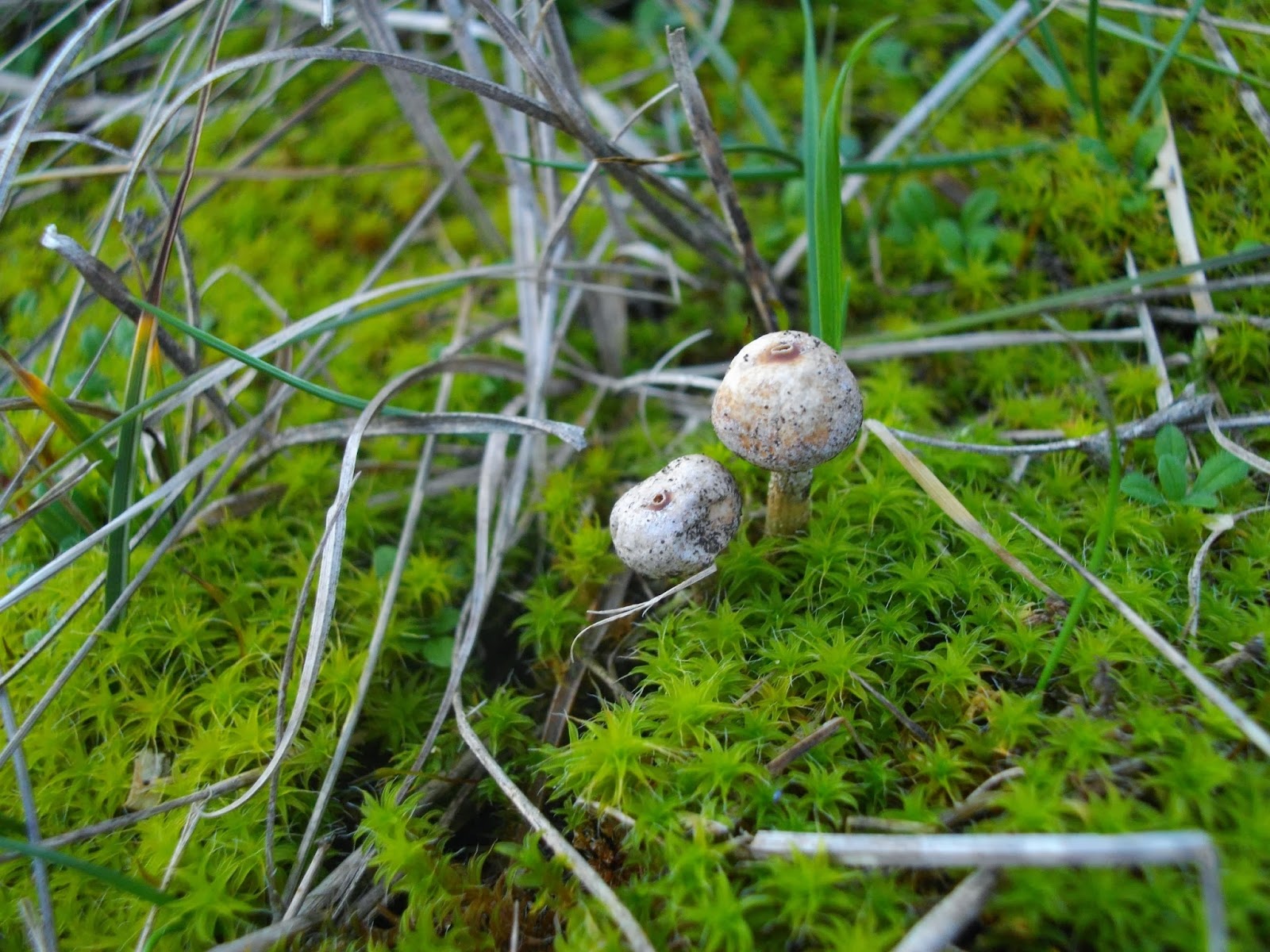
The target was Winter Stalkball. Unless you are particularly interested in fungi you are unlikely to have heard of the stalkballs, but you may well have heard of their commoner relatives, the puffballs. Puffballs are mostly spherical, and when their spores mature they are puffed out and spread by the wind when the puffball is fully mature or is disturbed (for example by an animal or heavy rain). Puffing spores into the air is a good strategy, but clearly the higher the puffball, the further the spores can go. Some puffballs have a thick stipe* to help raise them higher, such as this Common Puffball, seen at Whitlingham this autumn.
There is a small group of species that have gone one better and developed a long stipe relative to the main 'ball'. The best known of these is the Sandy Stiltball, which despite being rare and indeed protected by law, is known from several sites in the county, including one on the edge of Norwich. I have previously blogged about it here. The Sandy Stiltball can grow up to around 40cm tall, but the Winter Stalkball that we were looking for only grows up to 5cm tall. In fact, the top of one looks rather similar to a sun-bleached rabbit dropping! In Norfolk Winter Stalkballs are only found at a few coastal dune systems, and are easily overlooked, so I was grateful to Rob for his help, allowing me to connect with this interesting species.
Winter Stalkballs
** A mycologist is someone who studies fungi.
Subscribe to:
Comments (Atom)