The Whitlingham Bird Report for 2025 is now available to download from the Bird Reports page or from here

YARE VALLEY: Rockland Whiskered Tern

24th April 2014

On my way home from work I found out that a Whiskered Tern had been reported from Rockland Broad. Checking that it was still present, we decided to go and have a look. Understandably there was a bit of a Yare Valley birders convention going on, with Paul W. in the car park and Justin and Ben already on their way back. On the way along the path we heard our first Cuckoo of the year calling in the distance. Upon arrival at the hide we soon saw the Whiskered Tern twisting and turning along the far shore of the broad. We got good but distant views, leaving before we were overwhelmed by the smell of urine in the hide. On the way back we tried to avoid inhaling midges from the small clouds floating at regular intervals along the path.

[Edit] We were nearly back to the car when mild confusion hit, as I overhead two birders saying "Osprey". Following their looks I could only see a Woodpigeon flying over, and must have given them a funny look as one of them explained to me they were actually looking at an Osprey plane, a weird American aeroplane with propellers pointing upwards to allow vertical take-off. So now I know!

Later on the tern flew off north-west, so it remains to be seen whether it will be relocated closer to Norwich. Incidentally in the past few days Common Sandpiper, Cuckoo, Reed Warbler and Garden Warbler have all been seen/heard at Whitlingham, but we are still awaiting Grasshopper Warbler, Lesser Whitethroat and Nightingale.

SOUTH NORFOLK: Ashwellthorpe Bluebells

21st April 2014

With the bank holiday weekend almost over there was just time to go for a walk at Ashwellthorpe Lower Wood to look at the Bluebells. Our walk was sped up when we found out that the car park gets locked at 5pm, giving us just over an hour to get round. We headed for the far corner of the wood where the biggest concentration of Bluebells grow, and were rewarded with a lovely carpet of flowers. In addition to the Bluebells we also saw a number of Early Purple Orchids, Yellow Archangel, Wood Anemone, Wild Garlic and Sanicle.

Bluebells (photo: Cathy Emerson)
 Yellow Archangel
 Early Purple Orchid
Wild Garlic

WHITLINGHAM: Goosander & Red Kite still present

21st April 2014

With a free hour-and-a-half I braved the bank holiday crowds at Whitlingham in the hope of catching up with an Arctic Tern. There had been a reasonable passage of Arctic Terns throughout the country, although few from Norfolk (perhaps migrating straight over?). Either way, I didn't see any terns. The Goosander was still present, showing better than on Friday and also extending my latest record date by another three days. There were no new arrivals, and the only Sedge Warbler heard was across the river at Thorpe. On my way back along Whitlingham Lane the Red Kite flew up above the trees being mobbed by corvids. This was my third sighting of this bird, all along Whitlingham Lane, and it's still exciting to be able to see a kite so close to Norwich.


SUFFOLK: Fritillary meadow

19th April 2014

Today was the only day of the year with public access to Fox Fritillary Meadow, a Suffolk Wildlife Trust reserve with the largest concentration of Snake's-head Fritillaries in East Anglia. In fact it was only open for three hours, so Cathy & I headed down promptly for the start of the open day at 14:30. A short walk from the makeshift car park we were into the meadow, resplendent with the nodding chequered heads of Fritillaries. Amongst the standard form there was a smattering of the white form, and several double-headed plants. As we walked round a Skylark sung above and Cathy spotted a Buzzard soaring amongst the clouds. Many thanks to Suffolk Wildlife Trust for allowing access to this site.


WHITLINGHAM: Goosander & a mummified caterpillar

18th April 2014

This weekend is WeBS weekend, and as on Sunday Whitlingham is hosting a road race and then Norwich play Liverpool at mid-day it seemed prudent to get the count done early. Cathy volunteered to come along and scribe for me, so despite the occasional showers we headed to Whitlingham early afternoon. We had only just left the car park when the local Red Kite flew up over the meadows, showing briefly before vanishing behind the tree-line. The Little Broad held little wildfowl, the pick of the bunch being 5 Gadwall and a Mute Swan on a nest.

Walking along the south shore of the Great Broad we caught up with a large flock (c150) of hirundines. Most of the birds were Swallows, with a smattering of House Martins and a couple of Sand Martins. On the broad a female Pochard and a Kingfisher were along the north shore, and I was counting the Tufted Ducks (30) when I found a drake Goosander! Particularly satisfying given that it's mid-April and I haven't seen one here for a couple of years. It was distant, initially along the north shore east of the island before relocating to the bay when the electric boat went past. Further along we found a single Whitethroat along with several Willow Warblers and Blackcaps. Broods of six Egyptian Geese and 12 Greylag Geese were on the broad, and we also saw a Great-crested Grebe on a nest nearby.

Goosander

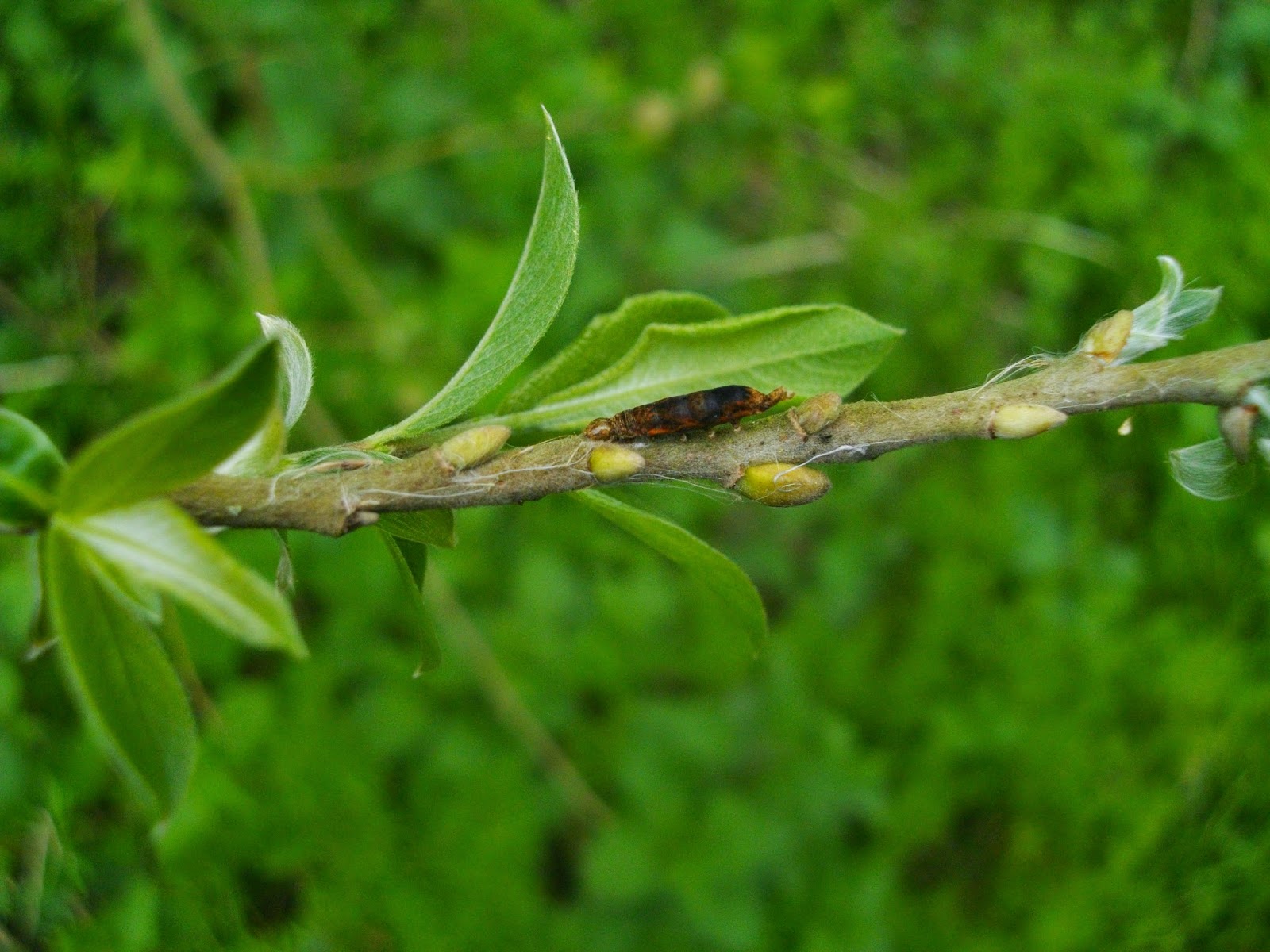
Thorpe was rather quiet except for a Grey Heron and three Great-crested Grebes. On our way back there was no sign of the Goosander in the conservation area bay. I did notice what I initially thought was a micro moth resting on a willow branch. A closer look suggested maybe some sort of chrysalis. In fact I am indebted to Tony Irwin and David Notton for telling me what it actually is. Rather gruesomely it is a caterpillar that has been mummified by a parisitoid Braconid wasp. David believes it is probably from the genus Aleiodes


THORPE MARSH: More hirundines arrive

14th April 2014

Another after work jaunt, this time to Thorpe in search of passage waders. This particular search was in vain, with no sign of any of the hoped for species (Common Sandpiper, Green Sandpiper, LRP). I did see my first patch Buzzard of the year, as one soared over the woods. Walking along the path towards the cattle pound two Sedge Warblers were singing, and two Kingfishers flew over the path. A summer-plumage Little Grebe was on the broad, and small groups of Swallows flew over. Bird of the day was a House Martin mixed in with one of the Swallow flocks, my earliest patch record by three days.


BRECKLAND: Speedwell search & Stone Curlews

12th April 2014

Chronologically the next species on my list of 30 Interesting Things was one or more of the rare Speedwells that can be found in the Brecks. Cathy & I went to a site near Thetford, where we searched along the edges of a path for the tiny blue flowers. We did find two speedwells, but neither were rare - most of the plants were Ivy-leaved Speedwell, whilst the other turned out to be Common Field Speedwell. We did see a Goldcrest and heard a Blackcap in the nearby pines.

Before going back we moved on to Weeting Heath, where we got good views of two Stone Curlews from west hide and had a chat with one of the wardens. I didn't have my 'scope with me to take any photos, but I notice that Craig Shaw also visited Weeting yesterday and he has got a good photo of the Stone Curlews on his blog here: http://craigshawsbirdingblog.blogspot.co.uk/2014/04/brecks.html

NORTH NORFOLK: (Bats and) Chips

9th April 2014

On Tuesday evening we went to NE Norfolk to look for Barbastelle Bats. Before arriving at the roost site we headed to Walcott to get some chips to eat whilst we waited for the bats to wake up. Unfortunately we found out that the inhabitants of Walcott don't eat chips in the evening (at least this appears to be the case as every day except Friday the chip shop shuts at 3). We turned round and tried Bacton, where we just managed to get some chips before that shop shut too. With our precious potato-based meal we headed along the coast and parked up to await the emergence of some bats. Sundown came and went, and there was no sign of any bats. I got out and tried the bat detector at a range of frequencies, but not even a Pipistrelle. At least by trying early in the year there is plenty of time to try again later.

WHITLINGHAM: First Swallows and Red Kite

8th April 2014

April can be the best month of the year for birds at Whitlingham, so after work I decided on a quick visit to look for migrants. Birdsong was muted and I didn't see anything of note along the south shore, but walking back three Swallows flew over the Great Broad, stalling and gliding in the wind. A single Shoveler and six Gadwall were visible on the Little Broad before I headed round to Whitlingham Lane. 

I scanned the meadows for Wheatear, but the only species present was Jackdaw (96 of them!). Before leaving I scanned the dead tree on the off chance that a Little Owl had taken up residence, only to have a Red Kite fly through my field of view! I tracked it along the trees before it emerged and soared over Whitlingham Lane. This was only my second sighting here, and much better views than the first one which had been much higher up. This bird has been seen regularly at Whitlingham and Trowse over the past couple of weeks, so hopefully one of the Norwich-based bird photographers will get some good photographs of it in the near future. Whilst scanning the skies for it to re-appear I was rewarded further with a Peregrine flying over towards the city.


WHITLINGHAM: Spring migrants begin to arrive

6th April 2014

An overcast day with sporadic showers meant I was unlikely to catch up with the soaring raptors seen yesterday (Red Kite, Buzzard, Marsh Harrier), but did seem like good weather for hirundines. There had been a wholesale clearout of ducks from the Little Broad, with no Shoveler and only five Gadwall present. I went and checked the sightings board, but it still read that I should look out for autumn fungi and berries. Heading along the south shore of the broad I heard my first Blackcap about half way along, singing from the edge of the picnic meadow. In all I heard four, along with my first two Willow Warblers of the year just past the old pump house.


On the broad itself there were still 100+ Tufted Ducks and a pair of Pochard. There was no sign of Green Sandpiper or Little Ringed Plover on the shingle at Thorpe, although both have been seen during the week. I scanned the edges of the conservation area bay for Garganey, my patch nemesis, and in doing so almost missed a Little Egret, which was sat in one of the willow trees on the east end of the island. After another shower passed over I scanned again and picked up a single Sand Martin. It flew through and along the river, showing no interest in the broad. On my way back I spoke to one of the park rangers, who confirmed that a Red Kite was being seen regularly over the campsite and Whitlingham Hall area.

In non-avian news there are even more Wrinkled Fieldcaps out on one of the woodchip piles, and I saw a species of Thick-headed Fly.

Wrinkled Fieldcap (Agrocybe rivulosa)
Thick-headed Fly (Myopis sp)

BROADS: Fairhaven Gardens

5th April 2014

Today Cathy & I visited Fairhaven Gardens, an area of wet woodland near South Walsham. The sun was out and we enjoyed our walk along the ditches. As well as the usual early spring flowers there are a number of planted species here, including the potential invasive alien species Skunk Cabbage.


Skunk Cabbage

The sunshine ensured lots of butterflies around, including my first Orange-tip of the year and lots of Brimstones and Peacocks. Cathy hadn't brought her binoculars but still managed to pick out a number of species at distance, including a Treecreeper and fruiting bodies of the slime mould Entiridium lycoperdon high up on a tree trunk. A couple of Blackcaps were singing, along with lots of Chiffchaffs. The bird hide was closed for a workshop, so we went a little bit further on to look out over South Walsham Broad, but there wasn't much on it. On our way back I heard a singing Nuthatch, and again Cathy found it first. As we watched it became clear there was a pair, with one going into a presumed nest hole. We ended our visit with a cream tea in the cafe.


NORWICH: Local Black Redstart

30th March 2014

In between shopping and visiting the in-laws I found out about a Black Redstart that had been reported on a roof on Corton Road. As I live nearby I nipped out to have a look. On my first look there was no sign of it, but on my way back I noticed it peering Robin-like over the top of the roof. I waited nearby and it hopped along the top of the roof. An excellent bird to see locally, so thanks to whoever found it initially.


BRECKS: Lynford Two-barred Crossbills

29th March 2014

On Saturday I went to Lynford Arboretum with Jim and Connor to have a look for the Two-barred Crossbills which have shot back to prominence in the last week or so. On our way there I saw my first Brimstone butterflies of the year, and there were loads of them at the Arboretum, along with a couple of Commas. Upon our arrival a Common Crossbill was in trees near the car park.

Crossing the road and and walking up the main track we heard a probable Two-barred Crossbill contact call, but couldn't find the bird itself. Walking further in we heard at least four singing Firecrests, all deep in cover, but with no sign of any more Crossbills we returned to some puddles near the entrance in the hope of seeing one coming to drink. After a short while a birder stood with us saw a Crossbill fly into a small tree nearby. It was mostly obscured by branches, but Connor noticed it had two clear wingbars. It turned side on and flew down to drink, showing the first wingbar to be large, but the second slightly less so. It looked like a 1st-winter bird, but was it a Two-barred Crossbill, or the debated look-a-like? We thought it was probably OK, but hoped it wouldn't be our only sighting.


The Crossbill soon flew off, but we waited for a while near the gate hoping for it to return. Nearby Nuthatches and Siskin called constantly, and we were treated to a excellent display by a Goldcrest, raising its crown and singing at an interloping bird. Whilst Jim & I were watching the puddles Connor had gone looking for Firecrest. A phone call informed us that instead he had found a Hawfinch, so we hurried along to have a look. When we got there it was still visible near the top of a tall tree, but when it flew out we saw there were actually two!

We looped round through the Arboretum, before deciding to give the puddles one last look. It was whilst standing here that Connor & I both heard a Two-barred Crossbill call, and we picked it up in one of the larches. We called Jim and a small group of birders over, and managed excellent views of a male Two-barred Crossbill. With all eyes focussed on the tree, a female was found on a branch on the other side of the trunk, and finally another male. Just before we left they all moved onto the same branch, with all three in the same 'scope view. An excellent afternoons birding, thanks to Jim & Connor for the lift and company.


30 INTERESTING THINGS - 3/30 Hard Shield Fern

23rd February 2014

This week had seen a small influx of early migrant birds to Norfolk, so I headed down to Whitlingham in the hope of breaking my earliest patch record for Willow Warbler or Sand Martin. The weather was overcast with a few showers, but this can be handy for 'dropping' migrants, so I didn't resent the rain. On the Little Broad ten drake Shoveler were still present, along with a dwindling number of Gadwall. There was no sign of last weeks Egyptian goslings, which doesn't bode well for them. The most interesting bird on the Great Broad was a hybrid Canada x Greylag Goose near the main island.


With no migrants other than the now widespread Chiffchaffs, I headed further along into the woods. On my way along a woman stopped to tell me she had just seen a Hedgehog walking across the road ahead, but it had gone by the time I got there (I have only seen a squashed one here). There was plenty of birdsong, including a drumming Great Spotted Woodpecker, two Nuthatches, Song Thrush and lots of Wrens. The woods were carpeted with Dog's Mercury, Moschatel and Early Dog's Violet were also in flower.


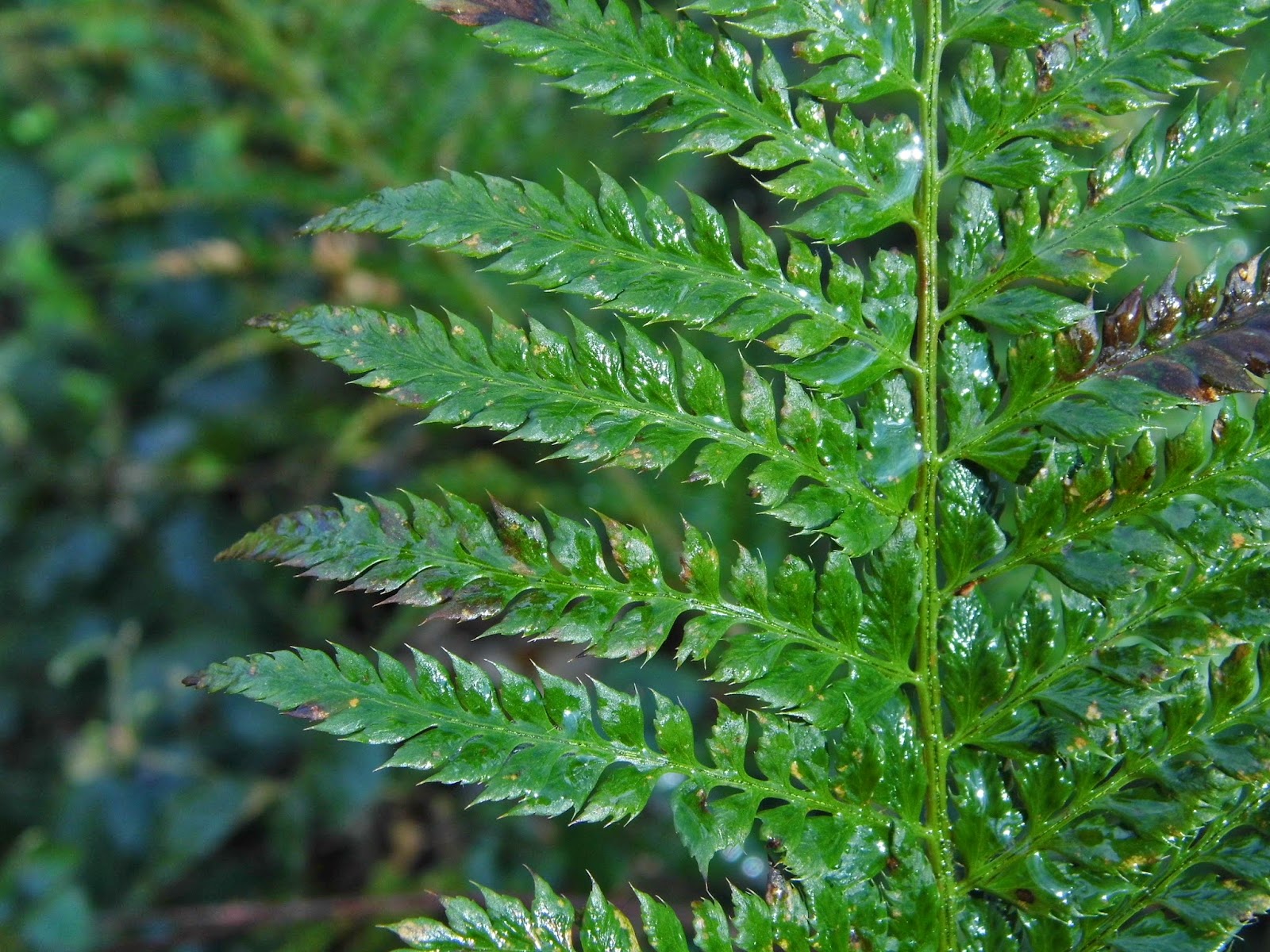
Having asked for sites for Hard Shield Fern, a species I have never (knowingly) seen, I was told of several places, including Whitlingham Wood. Jeremy had kindly told me that there was a record from the woods in 2011, so I paid particular attention to the clumps of ferns, most of which are Male Fern. I had almost completed a circuit of the woods, not hearing any migrants along telegraph pole alley, when I noticed a different fern near the top of the steep steps. A closer look revealed it as my target species, Hard Shield Fern. I know I've looked at that clump of ferns before, but just never realised what it was!


WHITLINGHAM: March counts & Orange Underwing

16th March 2013

A bright sunny morning for today's WeBS count, with the attendant increase in visitors. The Little Broad held three Little Grebes, 11 Shoveler (a good count for March) and 45 Gadwall. A Chiffchaff called intermittently, the first of four around the site. Coltsfoot and Lesser Celandines were flowering in several places, whilst several Small Tortoiseshells and Peacocks were seen flying in search of more flowers.

Little Grebes & Gadwall
Egyptian Geese
Along the shore of the Great Broad two small Egyptian goslings accompanied their parents along the slipway. Overhead some Redwings called unseen. A day-flying moth flew past me, and I managed to track it down a path, where I confirmed that it was an Orange Underwing, my first here. I also managed to find a couple of interesting fungi, Winter Polypore (Polyporus brumalis) and what may be Wrinkled Fieldcap (Agrocybe rivulosa).

Orange Underwing
Winter Polypore 
Possible Wrinkled Fieldcap