The Whitlingham Bird Report for 2025 is now available to download from the Bird Reports page or from here

MID-NORFOLK: Alderford Common area

29th June 2014

On Sunday I went to Attlebridge for the latest part of 'Wildflowers revealed' - an ongoing series of walks with Norfolk Flora Group and NNNS to help beginner botanists. On my way I the rain got steadily harder and I wondered whether anyone would turn up. I need not have worried, with around 15 people braving the rain for the walk. The showers were a feature of the morning, but after lunch the sun came out and it was actually very pleasant.

The first part of our walk took us east along part of Marriott's Way. We had a brief look at some of the commoner plants along the first stretch such as Rough Chervil and Herb Robert, but the first interlude of real interest was when there was a gap in the hedge allowing us to see the edge of an arable field. A number of plants were growing here, but the highlight was my first Night-flowering Catchfly. As a result of the overcast weather the flowers were open during the day too.


A bit further along Marriott's Way we took another footpath off to Upgate Common. As we reached the Reepham Road we saw two 'salt alien' species (coastal plants that have spread inland as a result of the salting of roads in winter) one of which was Reflexed Saltmarsh Grass. A burst of sunshine saw a large number of Ringlet butterflies emerge, and I saw another two new plants in the form of Venus' Looking Glass and Parsley Piert. We stopped for lunch at Upgate Common, where the highlight was a Hobby that flew through the hirundines.

After lunch we set off along another footpath across the fields towards Alderford Common. Here we saw more Night-flowered Catchfly, compared Redshank and Pale Persicaria and saw some Flixweed. Reaching Alderford Common we went into a wooded part to look at an area of Small Balsam, before re-tracing our steps and entering the common further along.

Just onto the common we walked past a nice Bee Orchid, one of several on the common. Common Twayblade, Common Spotted orchids and Souther Marsh orchids were also present. We concentrated on an area of former marl pits, the best chalk grassland in east Norfolk apparently. Lots of Eyebright was scattered around, along with Greater Wild Thyme and Wild Basil. A pond held a Stonewort sp (a sample was taken for determination) and some Great Crested Newt tadpoles. On top of all this I saw some grasses and sedges that are probably very common but I just hadn't been able to identify before. All in all a very worthwhile trip in terms of learning about plants and seeing an unfamiliar area.


WHITLINGHAM: Forthcoming bioblitz

In case anyone hasn't seen the poster, on 5th July Whitlingham are hosting a 'Great Bug Hunt'. Whilst seemingly family orientated, the event is being run in co-ordination with NBIS and has a mini-bioblitz element, i.e. trying to record as many species as possible between 9-4. Some stuff needs booking, so get in fast.


BROADS: Filby dragonfly dip

22nd June 2014

After a busy Saturday I noticed that two Lesser Emperor dragonflies were still being seen at Filby Broad (as well as at several other sites around the county). Having done the shopping I had a couple of hours free, so I headed to Filby for a look. Upon arrival Carl warned that they were being elusive, with one brief sighting in the last hour or so. I waited around 45 minutes, seeing Norfolk Hawkers, a Brown Hawker, Black-tailed Skimmers and Red-eyed Damsleflies, but no Lesser Emperor. The sun had got out and I was slowly cooking, so I gave up and headed back to the car park. Before leaving I did have a quick look along the ditch running north alongside Ormesby Little Broad, again with no success. Hopefully this influx will either continue or result in an emergence next year so that I can catch up with this species at another time.

View from Filby Broad boardwalk
Red-eyed Damselfly resting on a Water Crowfoot sp.

WHITLINGHAM: Loads of geese & some nice inverts

14th June 2014

Mid-June can be rather dull when looking for wildfowl, but a number of migrant insect sightings in the county ensured that I was looking forward to my bird count this weekend. Top of the target list was Lesser Emperor dragonfly, at least five of which had been seen in Norfolk in the past few days, whilst Hummingbird Hawkmoths and Clouded Yellow butterflies are also arriving. After a sunny week the temperatures had dropped and the cloud cover increased, which wasn't ideal, but I gave it a good look anyway.

In terms of wildfowl numbers were very similar to 2013. Most of the goslings were grown up enough to be counted (WeBS methodology is that goslings count once they are over 2/3rds grown). This in itself wouldn't account for the large number of Greylags (158), so presumably some are post-breeding birds that gather here to moult. 54 Canada Geese and 6 Egyptian rounded off the geese. The best bird was probably a Common Tern fishing on the Great Broad. Across at Thorpe the water was deserted, but the pair of Shelduck that arrived a while ago were still present on the shingle. Birdsong was somewhat muted, but all of the common warblers were still singing. I later noticed on Twitter that a visiting birder had seen a Reed Warbler feeding a young Cuckoo, which must have been interesting to see first-hand.

Despite the lack of birds the insects enlivened the visit. A large Mullein Moth caterpillar drew me to some Figwort, on which I then noticed my first Figwort Weevil. After checking plants of Hedge Woundwort on my last few visits I found another target species, the Woundwort Shieldbug. There had clearly been an emergence of one of the Longhorn Beetles (Agapanthia villosoviridescens), with several on the vegetation at the edge of the broad. A couple of pristine Red Admirals were joined by around 20 Small Tortoiseshells, and I found my first Ruby-tailed Wasp sp. On my way round I also met blog-reader and occasional correspondent Brian Robertson - nice to put a face to a name! No new birds for the year or rare dragonflies, but a productive visit nonetheless.


WALES: Day 2 - Day of the dolphins

8th June 2014

Day 2 of our Welsh break, and we were up early to go for a walk before breakfast. Nuthatch, Treecreeper and a Redstart were all in the hotel car park before we had even set off. We walked down to the River Wye and followed the riverside path for a bit. The river level was quite high, which probably accounted for the lack of Dippers, but Cathy did find a Grey Wagtail. A Bullfinch was the pick of the rest of the birds.

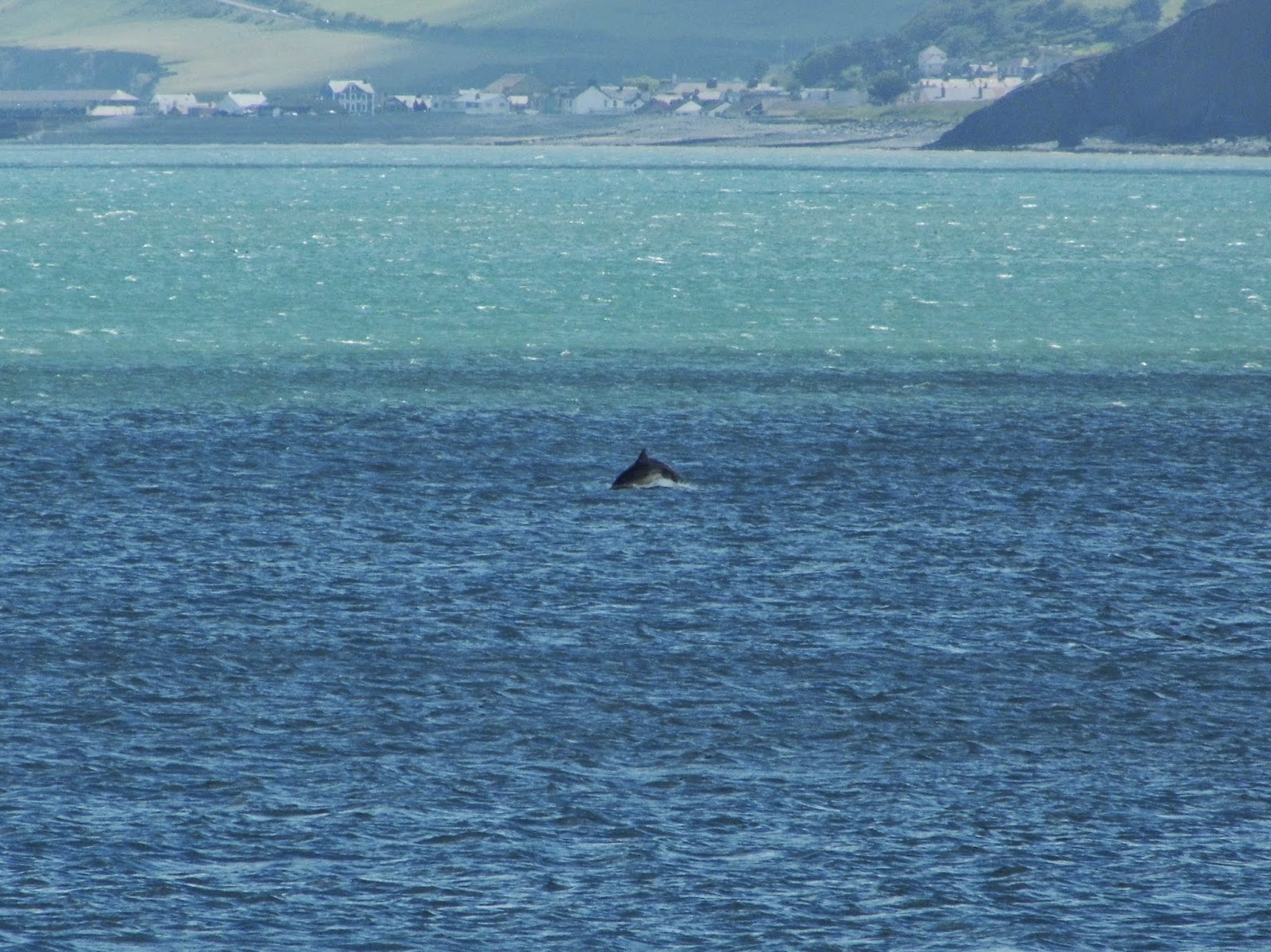
After breakfast we headed to the coast to look for the days main target species, Bottle-nosed Dolphin. We arrived at New Quay (not to be confused with Newquay) and as we parked up a parking enforcement officer asked what we were looking for. When I replied 'Dolphins' he there were lots out there. I laughed politely but he said something along the lines of "no, seriously", and proceeded to point out a pod of Dolphins in the distance! We headed down to the quay, and over the next hour or so we got excellent views, both close inshore and breaching offshore. A Rock Pipit also showed well on the sea defences.


After lunch we then took a steep path up to the cliff top. On our way up two we could see two Peregrines patrolling the cliff, and later on we saw one with prey fly past our vantage point. The path was lined with Wall Pennywort and other flowers growing in the grassland at the top included Kidney Vetch and Sheep's Bit. Sitting down on a headland we saw the final target species of the trip, two Choughs, a species that Cathy was particularly keen to see. Guillemots and Razorbills were floating on the sea, whilst a Stonechat was on gorse behind us. Whilst sitting down Cathy found a Gorse Shieldbug wandering through the grass.


On our way back to the hotel to pick up our bags we made a final stop at Bwlch Nant Y Arian forest visitors centre. The Kite feed had recently finished, but we had excellent views as some of the Kites flew low over our heads as they dispersed. There were some excellent wood carvings, including a giant feeder with Long-tailed Tits on, but the stars of the show were some Siskin feeding only a few feet away. Finally we had a hot drink before heading back to Norfolk.


All in all we had an excellent break, seeing all of the expected species including my first Bottle-nosed Dolphins (one of my 30 Things to see). Not only that, we also got very good views of many of the species too. Many thanks to Carl for a very enjoyable tour.

WALES: Day 1 - Kite feed & woodland specialists

7th June 2014

This time last year Cathy & I were busy with wedding plans, so we had decided that this spring we would go away for a short break. As we were looking at weekends I didn't really fancy a lot of driving, so we decided to book onto Carl Chapman's weekend tour to Wales. The tour takes in the Red Kite feed at Gigrin and Dolphin watching at New Quay, with the rest of the time looking for other birds found nearby.

We set off just after seven, and reached the Elan Valley in time for lunch. Whilst eating we saw a Dipper and a Goosander fly downriver, whilst a Grey Wagtail was also present. A short woodland walk was very productive, with at least five Spotted Flycatchers and good views of singing Redstarts and Wood Warblers.


Next stop was Gigrin farm for the Kite feeds. We had a hide booked, and the Kites were soon circling overhead. As the feed started 150+ Red Kites were flying in, along with a few Buzzards and Ravens. Back in the car park Cathy found a male Redstart in the hedge nearby.


Once the Kites had begun to disperse we headed back to the Elan Valley, but further along this time. The reservoirs were pretty devoid of birds (presumably because of their depth), but the woodland nearby was productive, with more Redstarts, two Pied Flycatchers, Redpoll, Bullfinch and a Cuckoo calling from across the other side of a reservoir.

NORTH NORFOLK: Spectacled Warbler

5th June 2014

Late spring has seen a flurry of birds in Norfolk, including Britain's 8th Spectacled Warbler at Burnham Overy. It was found on Monday, but trips to North Norfolk after work make for a long day, so I decided to leave it. A few days later and the bird was still present and my resolve softened, so after work on Thursday Cathy, Margaret and I headed off for a look. On our way a Barn Owl flew across the road near South Creake. We parked at Burnham Overy and set off along the coastal footpath. On our way to the dunes we saw a Spoonbill and a couple of Grey Partridges, as well as this tortoise beetle (a different species to the one I saw at Thorpe).

Cassida vittata

Eventually we reached the dunes and a small group of birders focused on some Suaeda. We heard a brief bit of song and after a while up popped the Spectacled Warbler. It was constantly on the go, foraging around the suaeda and occasionally flying up to a bush in the dunes. We saw it a number of times, but never long enough to try to take any photos of it. By now we were starting to get hungry, so we headed back, getting excellent views of a Little Tern next to the path, and brief views of a Bearded Tit. The sun was still shining and Burnham Overy looked idyllic as we got back to the car.


THORPE MARSH: Marsh Harrier & Azure Damselfly

31st May 2014

Since moving house last summer I have been closer to Whitlingham than Thorpe, and accordingly haven't visited Thorpe Marsh as often as I used to. I set out to remedy this today, having a slow walk around the marshes. The best bird of the day came right at the start, a male Marsh Harrier flying over and heading off eastwards. A Cetti's Warbler called from very close to the path, but I still haven't actually seen one this year on the patch. A pair of Gadwall were on the scrape, a Shelduck on the broad and a Kingfisher on the river were the other avian highlights, along with a brood of five cygnets.

Another one of my objectives was to find an Azure Damselfly. All of the blue damselflies I've seen at Whitlingham have been Common Blue, and the majority at Thorpe are also this species. Chris Durdin had told me which ditch held the Azures, but as it happened I found one along the permissive path to the marsh anyway. It was a good day for odonata, with Norfolk Hawker, Hairy Dragonfly, Azure Damselfly, Common Blue Damselfly, Large Red Damselfly, Red-eyed Damselfly and Banded Demoiselle. I also saw a number of other interesting invertebrates, including some Emperor Moth caterpillars on Meadowsweet, a Green Tortoise Beetle and a Common Amber Snail.

Patch tick! Azure Damselfly
Emperor Moth caterpillars on Meadowsweet
Red-eyed Damselfly (my second patch record)
Easily overlooked, the Green Tortoise Beetle
Common Amber Snail

NORTH NORFOLK: Black-headed Bunting

29th May 2014

Monday's Black-headed Bunting had been untwitchable, but it was followed two days later by a more accessible one in West Runton. As luck would have it the bird was still present on Thursday, so after I finished work Cathy & I went to have a look. There was no sign of the bunting when we arrived, or for quite a while after. Chris pointed out that it was shaping up to be a dull blog entry if we didn't see it, but luckily for us (and you dear reader) eventually the Black-headed Bunting did appear, and sat in full view albeit distantly. As an added bonus it didn't rain whilst we were there either. Whilst waiting for it the only other birds in the brambles were a Whitethroat and a Linnet, whilst some Gannets were passing out to sea.


NORTH WALSHAM AREA: Pigney's Wood

28th May 2014

The final day of my short holiday, and we were visiting friends in North Walsham. Whilst there I went for a walk to Pigney's Wood, a local nature reserve. I started by following a footpath down to Little London, and then on past Mike Thurston's watersports centre. Here I found that where the path crosses the river the high water levels had washed away part of the path. I could have jumped it, but given the mud looked slippery I chose instead to walk along to the road. This proved to be the safer option, but did mean that my legs got absolutely soaked, to the point where the water began to pool in my walking boots. Having reached the road and proceeded along the correct side of the river I found that the path was flooded. Not knowing how badly I retraced my steps and tried again, this time walking along the road to the main car park.


All of this wet footpath-walking hadn't been completely devoid of wildlife, I had seen Sedge Warbler, Reed Warbler, Reed Bunting, Whitethroat and Sparrowhawk by this point. An Azure damselfly and a Diamond-back Moth were also of note. As I walked along Hall Road a Yellowhammer sat on the wires and the mist rolled across the fields.


After checking the sightings board I took one of the paths towards the old barn. From here I walked to the pools, disturbing a Kingfisher from the pond-dipping platform. A Cuckoo was calling from across the river, and I managed to see it near the top of a willow. Despite looking around some of the hedgerows and mature woods I didn't see much else of note, and headed back via the old railway line, hearing another Cuckoo and getting close views of a Kestrel near the canal.

Drinker moth caterpillar

NORTH NORFOLK: Some new moths

27th May 2014

As I had a few days off I had planned to take the opportunity to go to Natural Surroundings on Tuesday morning to see their moth club open the moth traps. The forecast for Monday night and Tuesday morning was rain, but we decided to go anyway. This proved to be a good decision, as we saw around 65 species, some of which were new for me, including Lobster Moth, Seraphim, Green Arches and Alder Moth. Thanks to Greg and the rest of the group for sorting through the traps.

Lobster Moth
Green Arches
Privet Hawk Moth

After the traps were empty we had a hot drink and piece of cake in the cafe, before heading to Cley. Here we had lunch whilst the rain bucketed down outside. The previous day a Black-headed Bunting had been seen in a Cromer garden and access had been arranged for after 1 should it be found, so we headed home via Cromer just in case, but as it happened there was no sign of the bunting.


NORWICH: Skywatching

26th May 2014

After a busy few months I was relaxing at home when I noticed a couple of twitter messages from the Peregrine watchpoint at the cathedral, where the volunteers had seen a Booted Eagle fly over heading north. The highest point around Norwich to look out for raptors would probably be St James' Hill at Mousehold, but it would have already been past there so I decided to go into the back garden and just watch the skies for a while. This actually proved quite successful, as I saw two Buzzards and a Peregrine, both garden ticks. By the time I came in for lunch there had been several other sightings, including one from the A47 level with Whitlingham. More sightings were reported later in the afternoon too, although so far no photos have emerged.

NORTH NORFOLK: Titchwell in May

25th May 2014

Having not been birding for a while, Cathy fancied a trip out, so we headed to Titchwell. Despite the nice weather it wasn't particularly busy, and quite a few of the people we did see seemed to be more interested in the beach than birds. Avian highlights were a brood of Red-crested Pochard ducklings, two Little Gulls and an offshore Red-throated Diver, but we also enjoyed close views of Common Terns and Avocets, along with a very tame Robin in the picnic area.

As well as the birdlife we also saw Hairy Dragonfly, Four-spotted Chaser, Azure damselflies, Blue-tailed damselflies, Red Admirals and a Large Skipper. Cathy found some Green Dock Beetles, and a Garden Tiger Moth caterpillar was on the edge of the path. On the meadow trail lots of Southern Marsh Orchids were in flower, and a white-flowered Ragged Robin stuck out from the usual pink ones.


WHITLINGHAM: Shelduck and Mayflies

17th May 2014

The hottest day of the year so far can generally be taken as a bad time to visit Whitlingham, but as I had the WeBS counts to do this weekend I went anyway. Wildfowl numbers were generally low, but there appeared to be ten broods of Greylags spread out along the shore. It is difficult to be sure, as some families sort of 'creche' the young, but when I allowed for this (and also taking into account size difference and groups that I have seen on previous visits) ten is still an awful lot of geese. Other than the goslings a Kingfisher was the avian highlight at Whitlingham, however across the river at Thorpe two Shelduck on the broad were a welcome sight. They were my first record here for three years - the last being a flock of 6 that flew over Thorpe on 11th May 2011.


Orange-tip and Small Tortoiseshell butterflies were numerous, and there were also a couple of Brimstones. As I walked further around the broad I stopped on several occasions to watch the dancing Mayflies. On one of these occasions I noticed one in a clump of rushes. I gently parted a few rushes to get a better view of it when the Mayfly put one of its legs onto my finger. I let it crawl on and took one photo before it launched off and into the air to join its contemporaries.

The Mayfly (Ephemera vulgata)

Along the north shore I spotted a dragonfly that had landed on a dried umbellifer stem. It was my first Hairy Dragonfly of the year, and as I approached it flew up and landed high up on a bank of brambles, in view but at an almost un-photographable angle. Further along I had no such problems with an obliging male Banded Demoiselle, which was content to sit close to the path. My final sighting of the day was of a hoverfly, thankfully one that can be identified by sight rather than dissection. It was Leucozona lucorum, a bumblebee mimic.


WHITLINGHAM: More migrants & lots of invertebrates

14th May 2014

Having been busy at the weekend I headed down to Whitlingham this evening to make the most of the sunshine. I popped into Trowse Woods on the way to double-check the small patch of Wild Garlic for Ramsons Hoverflies. This species is the NBIS species of the month, and the added attention has meant new records from several locations around the county. Wild Garlic isn't particularly common around Norwich, and there were no hoverflies around this particular few plants.


Whitlingham was busy, with some sort of swimming competition going on. The constant splashing of the swimmers created a sound rather similar to walking along a swiftly-flowing river. Once the swimming had stopped, peace descended and in fact most of the birds I saw were picked up by song or call. This started with three Common Terns chasing each other over the broad, followed by some Swifts overhead. Next up was a pair of Garden Warblers, showing well amongst some willows.

Further along I was checking the riverside scrub when I heard a Lesser Whitethroat singing from a Hawthorn bush. Although annual, I seldom see more than one a year so this was a good sighting. Well in theory it was a good sighting - in reality it was a rubbish sighting as it stayed steadfastly in the middle of the bush, only showing occasionally. There wasn't much in the conservation area or across the river, but a Bullfinch called from the east end of the broad. Walking back along the south shore I passed at least six broods of Greylag Geese, plus two broods of Canada Geese and one of Egyptian Geese.

In addition to the aforementioned birdlife, the nettle beds were awash with invertebrates. Lots of moths were flying, mostly a Carpet sp (looked like Garden Carpet but I never saw one settled) and Common Marbled Moth. 2-spot, 7-spot and Harlequin Ladybirds were common, along with some powdery-green Weevils (there are several similar species). Other species included Soldier Beetles, Common Blue Damselflies and a Red-and-black Froghopper.