The Whitlingham Bird Report for 2025 is now available to download from the Bird Reports page or from here

NORTH NORFOLK: Moths & Butterflies

30th July 2014

Cathy, Margaret & I began the day at Titchwell to see the opening of the moth traps. Just over 30 species had been caught, most of them fairly common stuff, but there was a new moth for me in the form of Sharp-angled Peacock, along with my second Chinese Character.

After the moth trapping we walked down to Island Hide to look for the Spotted Crake. On the way Cathy noticed the constant buzzing sound of a Roesel's Bush Cricket, which we found at the edge of the path. We waited a little while for the Crake without success, and on our way back we saw two Wall butterflies. My infrequent coastal visits mean that I don't often see Walls anymore (when I was growing up we used to get them in the garden in North Walsham!) so it was a nice butterfly to see.

Blue-tailed Damselfly at Titchwell

After Titchwell we headed along to Cley visitors centre for lunch, noting the flock of Spoonbills on North Scrape. We then carried on to Holt Country Park, where I was hoping to photograph White Admirals and Silver Washed Fritillaries. When I had last came looking for the Fritillaries they had only just begun to establish themselves here and I got a couple of very brief views, so I was delighted to see that around 10 were on Buddleia in the car park. Photographing them proved a bit harder, as they seemed to prefer the higher buddleia flowers and some of them were rather tatty. We watched as one Silver-washed Fritillary flew across the car park being constantly orbited by another (presumably a male around a female?) - very interesting behaviour to watch. I didn't see the brassy variation valezina, although one of the females showed a decent green tinge.

Male Silver-washed Fritillary (deep orange colour)

Whilst watching the Fritillaries a White Admiral flew in. Probably my favourite butterfly, partly because of how exotic it looks despite the monochrome, but also for the stately manner that it flies, gliding sedately over the flapping masses of other butterflies. We saw three in the end, and I did get my photos. Cathy had brought a backpack with butterflies on it, which attracted a Comma in for close views. Walking over to the visitors centre I finally got a good Silver-washed Fritillary picture as one landed in front of me. We also saw some other interesting insects, including a male Wood Horntail. Just before leaving I noticed a Grayling in the car park, the first non-coastal one I've seen in Norfolk for a while.

Spot the real one...
Female Silver-washed Fritillary
Male Wood Horntail (the female is the more familiar yellow-and-black)
White Admiral

NORTHUMBERLAND: Lindisfarne trip

26th July 2014

Today Cathy & I took an early wedding-anniversary trip to Lindisfarne & Northumberland. The tide times dictated that we didn't have much time on the island, but we had an excellent day and vowed to return at some point down the line...

Lindisfarne Castle
White Stonecrop
Bird artwork using (Pheasant?) feathers
Bamburgh Castle

SOUTH NORFOLK: Sharp-leaved Fluellen

In addition to the plants on my '30 things to see' list, there are quite a few other interesting ones that I want to see at some point. These include things like the parasitic Yellow Bird's Nest, the carnivorous Greater Bladderwort, unusual Moonwort fern, the scarcer poppies and arable weeds the fluellens. Last week I saw that Rob Yaxley had found some Sharp-leaved Fluellen on a footpath south of Norwich, and resolved to try and have a look.

After a very hot walk taking in part of the Boudicca Way and some sun-baked fields I arrived at the section of footpath. I searched amongst the larger plants but still couldn't see the Fluellen. I texted Andy, who had also seen the plant, and he offered the useful observation that it was smaller than he had expected. Re-tracing my steps and searching the bare ground carefully I finally saw the Sharp-leaved Fluellen. The leaves were flattened against the ground, and the purple-and-yellow flowers were tiny. Close by were another couple of new plants for me, Stone Parsley and Pepper-saxifrage. My thanks to Rob and Andy, without whom I wouldn't have seen the plant. There is another rarer Fluellen in Norfolk (Round-leaved Fluellen) - now I know the scale I'm working at maybe I'll find that one day!


NORWICH: Sweetbriar trip

After work I walked along Marriott's Way out of the city to Sweetbriar Marsh to look for plants. I didn't see much of interest in the end, but did add naturalised Broad-leaved Everlasting Pea to my Norwich list, and found a new bug in amongst the nettles, Liocoris tripustulatus.


I also noted a very large bramble. I was concerned that it might be the invasive Great Bramble that is now being reported, but having had a look it doesn't appear to be that.


WHITLINGHAM: Butterflies & plants

We are still very much in a lull as far as birds go, but the hot weather has meant large numbers of butterflies out, particularly around the Buddleia, Water Mint and Ragwort. The latter two plants in particular are attracting Small and Essex Skippers, giving good opportunities to compare these very similar species. On the Buddleia Peacocks dominate, along with Small Tortoiseshells, Red Admirals and Commas. Meadow Browns, Ringlets and Gatekeepers can be seen in grassy places, along with the three Whites.

Comma
Meadow Brown

In terms of new Whitlingham species I did find my first 22-spot Ladybird, a small yellow-and-black Ladybird (this record has been passed on to the UK ladybird recording scheme). Another new species was the stable hybrid plant Druce's Cranesbill.


NORFOLK: Rare butterfly alert

Mid-July 2014

In recent days a number of migrant insects have arrived in Britain, including a rare butterfly, the Scarce Tortoiseshell (also known as the Yellow-legged Tortoiseshell). So far they have been seen at Queen's Hills, Burgh Castle and a private site near Wells, but it is expected that more may arrive (or already be here!). So if you see a Tortoiseshell butterfly that doesn't look like the common Small Tortoiseshells then it is well worth a second look! To get the record accepted you will probably need a photo showing the legs in order to rule out Large Tortoiseshell (itself a rarity). The county butterfly recorder would be very interested in any sightings (as would I, as I'm yet to see one!).

If you want to see what they look like then just type 'Scarce Tortoiseshell' into google, or look here:

WHITLINGHAM: July counts & insects

14th July 2014

This weekend was a count weekend, but with a triathlon taking place and storms forecast, I decided to go after work on Monday. As it turned out this ruled out going to see the Great Knot, but I was loathe to go and walk miles along the south bank anyway - hopefully it will stick around for a while yet.

It was a sunny evening, which made for a pleasant walk. Three Common Terns and a few Tufted Ducks were the only birds of note on the broad, whilst Mute Swans, Greylags and Canada Geese numbers were all around 90. 155 Mallard was also a large increase on last months figures.


There was a pleasant surprise along the south shore when I heard a noise coming from the rushes. I found a Norfolk Hawker apparently stuck in the vegetation. I parted the rushes and it remained still long enough for me to take a few photos before flying off. The Ragwort in particular was covered in Soldier Beetles and Skipper butterflies - I managed to get pictures of both Small and Essex Skippers further round. Along the north shore the nettles were covered in thousands of Small Tortoiseshell caterpillars, with a few Peacock caterpillars also mixed in.

Norfolk Hawker
Male Small Skipper (orange/brown antennae tips and curved 'sex brand' - the mark on the wing)
Male Essex Skipper (black antennae tips and small, straight sex brand)
Small Tortoiseshell caterpillars

YARE VALLEY: Strumpshaw Moths & S-f Catchfly

12th July 2014

This morning Cathy, Margaret & I went to Strumpshaw Fen for a moth morning. We had been to one here previously in August, so I was hoping that the difference in date would result in some new moths. Ben had put two traps out, one in the woodland and one in the fen to ensure a bit of variety. In all we recorded just over 60 species, including ever popular species like Poplar Hawk, Elephant Hawk and Garden Tiger. A Pine Hawk Moth was a bit of a surprise. We did see some new species too: Dark Umber, Dark Sword-grass, Small Wainscot, Fen Wainscot and Bordered Beauty. Thanks to Ben & Strumpshaw for putting on this event.

Pine Hawk Moth
Elephant Hawk Moth
Dark Umber
Dark Sword-grass
Small Wainscot

Before going home we made a diversion to inspect some poplars in case there were any emerging Hornet Moths. I didn't see any, or any sign of exit holes on the trees I examined. I know of a couple of sites near the coast that are good for Hornet Moths but if anyone knows of a site near Norwich then please get in touch! We then went onto a nearby site for another one of my target species for this year, Small-flowered Catchfly. I found a number of plants, mostly over, but a few still showing the delivate white-and-pink flowers.

Small-flowered Catchfly

WHITLINGHAM: Another rare fungus

5th July 2014

A quick follow up from Saturday at Whitlingham - whilst looking around the meadow near the barn county fungus recorder Tony Leech noticed an interesting bracket fungus on the end of one of the logs. It was a Gloeophyllum sp, and we presumed that it was one of the two species that have been seen at Whitlingham previously (G. trabeum or G. sepiarum). This would have been good in itself, but when Tony checked it at home he identified it as Gloeophyllum abietinum, a new species for Norfolk!


WHITLINGHAM: Bug hunt & bioblitz

5th July 2014

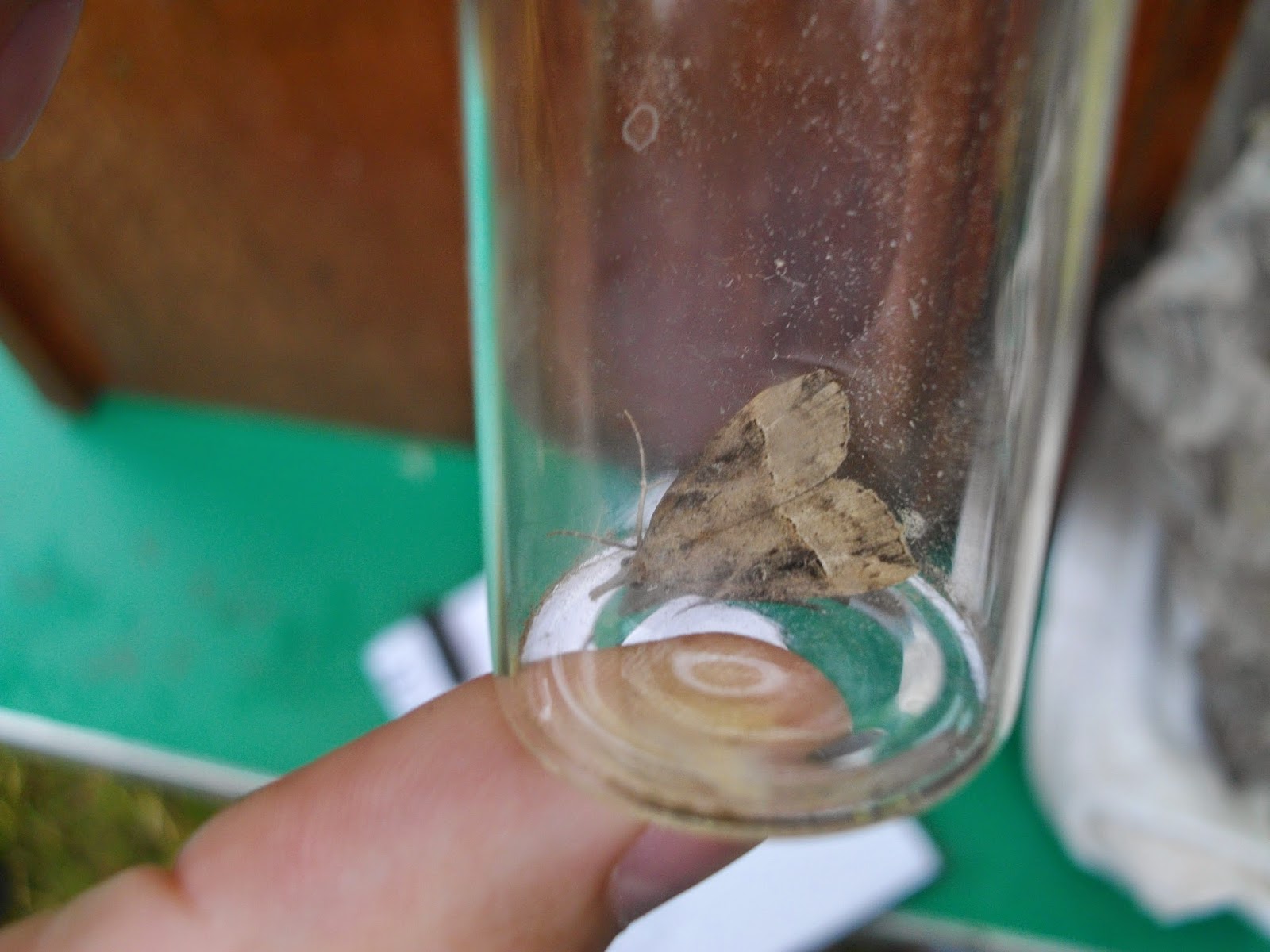
Saturday saw the much anticipated (by me at least!) mini-bioblitz at Whitlingham. It also saw a change in the weather, with the warmest week of the year ending with persistent rain. Cathy & I made up half of the non Broads Authority/NBIS staff who braved the weather for the opening of the moth traps. Two traps had been left out, and between them around 60 species had been caught. Two of them were completely new for me, Buttoned Snout and Wainscot Veneer, whilst many more were species that I hadn't seen at Whitlingham before - I shall update the Butterflies and Moths page accordingly in the next few days. Particular thanks to Phil Heath for setting up the traps and going through the catch in the morning.

Buttoned Snout
Drinker Moth
Rosy Footman

The next event was labelled as Mammal Mayhem, a title that was looking a bit sensationalist when the first eight traps we checked were all empty. The highlight of this first half was seeing a tail-less dinosaur in the area of woodland with the traps - if anyone knows where it came from or why its there then please let me know! 

The Whitlingham dinosaur

There was a bit of fungi in the woods, which Tony later identified as Spring Cavalier and Willow Shield. We then moved on to the picnic meadow to the other eight traps. These proved much more productive, with two Wood Mice and a Field Vole. The sun was out and Six-spot Burnet Moths were emerging in good numbers.

Field Vole. Photo: Catherine Emerson
Wood Mouse
Six-spot Burnet Moths

After dropping Cathy off at home I returned for a bit more recording. The weather had affected the programme a bit, so instead of a guided walk I spent some time in the area around the visitors centre, seeing another couple of new fungi species and recording some plants. After this I went to the pond-dipping area with Nick to see what had been caught there, before having a look at the NBIS desk on the meadow, where the highlight was a colourful Rove Beetle sp.


Despite the weather this event enabled me to see a number of new species on my patch, so thanks to everyone involved in organising it.

MID-NORFOLK: Alderford Common area

29th June 2014

On Sunday I went to Attlebridge for the latest part of 'Wildflowers revealed' - an ongoing series of walks with Norfolk Flora Group and NNNS to help beginner botanists. On my way I the rain got steadily harder and I wondered whether anyone would turn up. I need not have worried, with around 15 people braving the rain for the walk. The showers were a feature of the morning, but after lunch the sun came out and it was actually very pleasant.

The first part of our walk took us east along part of Marriott's Way. We had a brief look at some of the commoner plants along the first stretch such as Rough Chervil and Herb Robert, but the first interlude of real interest was when there was a gap in the hedge allowing us to see the edge of an arable field. A number of plants were growing here, but the highlight was my first Night-flowering Catchfly. As a result of the overcast weather the flowers were open during the day too.


A bit further along Marriott's Way we took another footpath off to Upgate Common. As we reached the Reepham Road we saw two 'salt alien' species (coastal plants that have spread inland as a result of the salting of roads in winter) one of which was Reflexed Saltmarsh Grass. A burst of sunshine saw a large number of Ringlet butterflies emerge, and I saw another two new plants in the form of Venus' Looking Glass and Parsley Piert. We stopped for lunch at Upgate Common, where the highlight was a Hobby that flew through the hirundines.

After lunch we set off along another footpath across the fields towards Alderford Common. Here we saw more Night-flowered Catchfly, compared Redshank and Pale Persicaria and saw some Flixweed. Reaching Alderford Common we went into a wooded part to look at an area of Small Balsam, before re-tracing our steps and entering the common further along.

Just onto the common we walked past a nice Bee Orchid, one of several on the common. Common Twayblade, Common Spotted orchids and Souther Marsh orchids were also present. We concentrated on an area of former marl pits, the best chalk grassland in east Norfolk apparently. Lots of Eyebright was scattered around, along with Greater Wild Thyme and Wild Basil. A pond held a Stonewort sp (a sample was taken for determination) and some Great Crested Newt tadpoles. On top of all this I saw some grasses and sedges that are probably very common but I just hadn't been able to identify before. All in all a very worthwhile trip in terms of learning about plants and seeing an unfamiliar area.


WHITLINGHAM: Forthcoming bioblitz

In case anyone hasn't seen the poster, on 5th July Whitlingham are hosting a 'Great Bug Hunt'. Whilst seemingly family orientated, the event is being run in co-ordination with NBIS and has a mini-bioblitz element, i.e. trying to record as many species as possible between 9-4. Some stuff needs booking, so get in fast.


BROADS: Filby dragonfly dip

22nd June 2014

After a busy Saturday I noticed that two Lesser Emperor dragonflies were still being seen at Filby Broad (as well as at several other sites around the county). Having done the shopping I had a couple of hours free, so I headed to Filby for a look. Upon arrival Carl warned that they were being elusive, with one brief sighting in the last hour or so. I waited around 45 minutes, seeing Norfolk Hawkers, a Brown Hawker, Black-tailed Skimmers and Red-eyed Damsleflies, but no Lesser Emperor. The sun had got out and I was slowly cooking, so I gave up and headed back to the car park. Before leaving I did have a quick look along the ditch running north alongside Ormesby Little Broad, again with no success. Hopefully this influx will either continue or result in an emergence next year so that I can catch up with this species at another time.

View from Filby Broad boardwalk
Red-eyed Damselfly resting on a Water Crowfoot sp.