The Whitlingham Bird Report for 2025 is now available to download from the Bird Reports page or from here

NORTH NORFOLK: Alpaca trek

10th August 2015

On Monday Cathy & I headed to Wells. We had chosen a rather novel activity for our wedding anniversary, Alpaca trekking along the coast footpath. We arrived just before 11 and met our guide, Ian, who gave us a bit of information about his Alpacas, before heading out. We probably looked rather odd walking them through the outskirts of Wells, although I'm sure the locals are used to it by now. We soon emerged onto the coast footpath, and had a very pleasant couple of hours walking towards Warham. The fields and saltmarsh were awash with colour, and it was a lovely sunny day to be out. The Alpacas were generally well behaved, and when we got back we fed the them some chopped up apples, which went down very well. Arriving back at the car a few Swifts headed over the town.


[Edit] Also a reminder to anyone interested in celestial phenomena that the Perseid meteor shower peaks tomorrow evening (Wed 12th). It is usually one of the best annual displays of meteors, along with the Geminids in December.

BROADS: Hickling Wainscot course

9th August 2015

Earlier in the year I had noticed that Dave Grundy was running a workshop at Hickling Broad, focusing on identification of Wainscots and other reedbed specialist moths. I also noticed that it was the weekend closest to my wedding anniversary, but although Cathy had no interest in going she paid for me to attend as an anniversary present, which was very nice of her.

During the morning we had a presentation from Dave about moth trapping in different habitats, followed by one from Jon Clifton about identifying some of the wetland species. After lunch we went to some traps that had been placed overnight on the reserve and came back to the classroom with some species to identify. The benefits of this approach were not only the help from two experienced moth-ers, but also the chance to use a wide range of different books to see which we found most helpful, and being able to directly compare specimens of different speces against each other.

Temperatures had apparently dipped overnight, and we missed out on two species that I had hoped to see, Reed Leopard and Small Dotted Footman. We did however see a number of rare or range-restricted species, including Reed Dagger, Webb's Wainscot, Fenn's Wainscot and Dotted Footman. A few species had also been brought from Wicken Fen to show us, including a Mere Wainscot. One of the spectacles of the day was the shear amount of Garden Tiger moths, with over 30 in one trap alone. At the end of the course I went to help empty the remaining moths from the trap, and saw my first Sallow Kitten plus an Antler Moth, the latter being a Norfolk tick.

 Fenn's Wainscot
 Garden Tiger Moths
Garden Tiger showing underwing

WHITLINGHAM: Just in case...

7th August 2015

Having got back from Trowse and had some food, I received a message about a possible Purple Heron at Whitlingham, seen in the afternoon. It seemed unlikely, not just because of the rarity and location, but also as I knew a birder had been at Whitlingham earlier in the day and hadn't seen anything unsual. That said, I'd have been pretty annoyed if there was a Purple Heron present and I hadn't looked, so I went to check. I seemed to be the only one looking, which surprised me a bit, but ultimately there was no sign. I stayed until dusk, but the highlights were limited to 2 Grey Herons, 2 Kingfishers and 4 Swifts screeching overhead. Upon my return I saw that the Purple Heron had originally been mentioned on Twitter, but with no photo or details other than that it had been on the far end of the island in the afternoon. Graham has checked this morning (Sat 8th) and there was also no sign then either.

TROWSE: A neglected bit of the patch

7th August 2015

The majority of my patch visits up until the last couple of years were carried out on foot, and as it was no further to go I would often cut across Trowse Meadow rather than walk the first part of Whitlingham Lane. In recent years when I got lifts or latterly drove myself, I have headed straight to the main country park. This struck me earlier in the week, so I decided to head down to Trowse on Friday evening, specifically to cover Trowse Meadow and Woods, a rather neglected part of my patch.

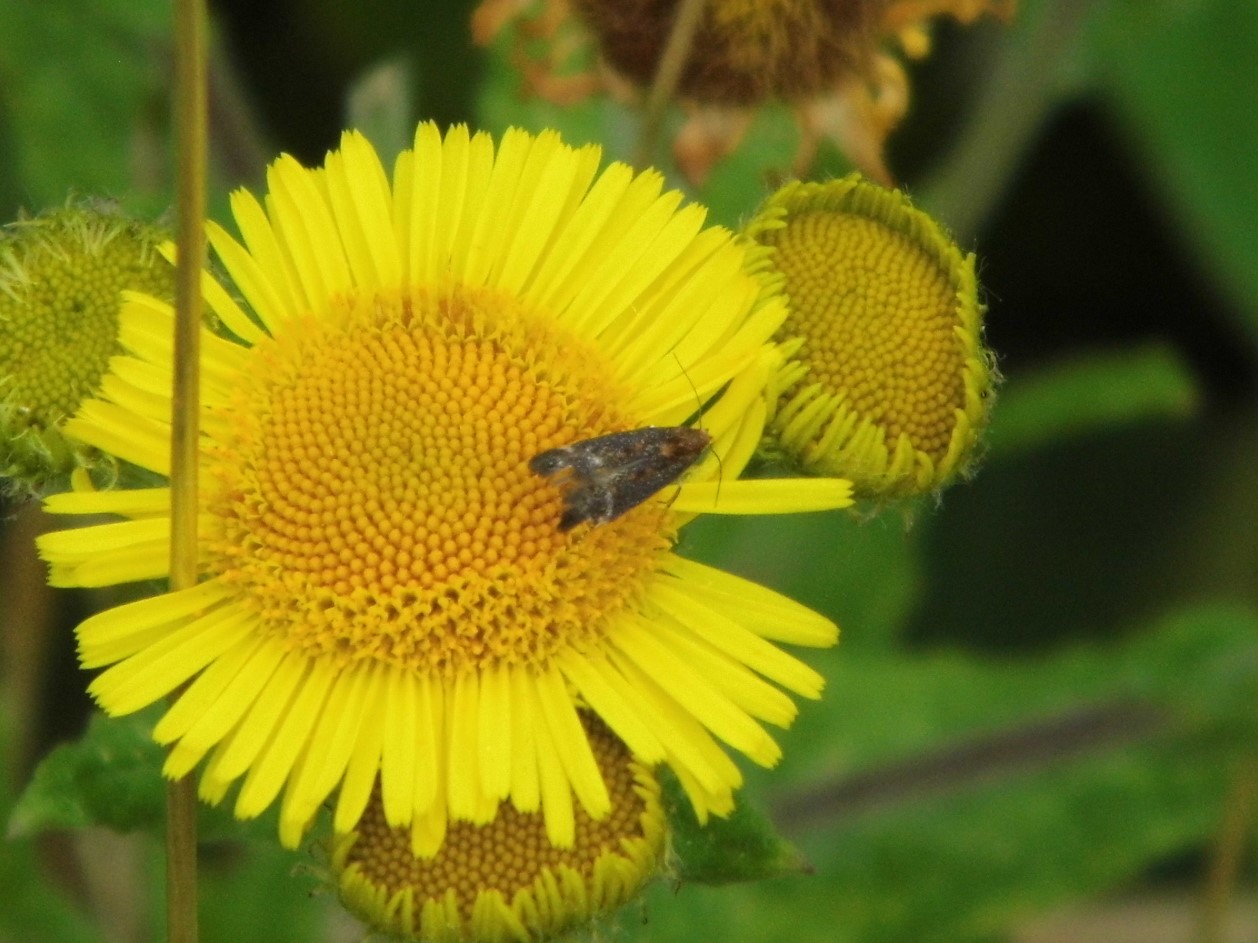
I had a nice stroll around the meadow, without adding too much. I did notice a poplar tree that resembles Black Poplar, which would be new if it isn't a hybrid and is in a natural state. It also appears to have a yellow rust on it, although I think there are two possibilities, so that isn't straight forward either. I found an unfamiliar micro moth on Fleabane, which once home I identified as Dark Fleabane Neb (Apodia bifractella), a rare species in Norfolk and it looks like a new TG20 record.

After this I headed into Trowse Woods, and was only a few feet in when I noticed a 14-spot Ladybird. I had recently looked through my old ladybird records, so I knew that this was a new patch record, my 900th species here. Note that my numbering is based on the order I identify things, not necessarily when I see them. Whilst this may be counter-intuitive, the other option would be to re-do all of my numbering if I were to retrospectively identify something I saw earlier in the year, which does happen. In reality it is the overall number of species that interests me more than the order anyway.

The weather was rather overcast and humid, making the woodland seem rather opressive. I had a look in one of the large 'craters' just in case the Bearded Tooth fungus that used to grow here had returned. It hadn't, but there was a bit of fungi, including some bright Yellow Shield fungi (Pluteus chrysophaeus). This wasn't new, having seen it in a similar place last year with the Fungus Study Group. Whilst stood still, a shrew ran out from under a log. I didn't see it well enough to rule out Pygmy Shrew, although I suspect it was a Common Shrew. It darted out again, but knowing how active they have to be I left it to go about its shrewy business.


I emerged in the glade at the top of the woods to the strong scent of Buddleia. Disappointingly there were few butterflies or hoverflies around, a single Red Admiral soon flew off. I took the path along towards Whitlingham Hall, stopping to photograph some Robins' Pincuchion galls to add to my gall guide. As I reached the Lime tree avenue the smell of a barbeque reached me, coming from the packed Whitlingham camp site, which has been so successful there is currently a planning application to make it permenant and build three lodges into the woodland edge. A couple of Swallows near the Little Broad were the only birds of note.

 900. 14-spot Ladybird
 901. Dark Fleabane Neb (Apodia bifractella)
Possibly two more?! Firstly is this Black Poplar? The rust will probably require microscopy and some specialist literature.


THORPE: Goosander and a few more additions

4th August 2015

On Monday Drew Lyness found an eclipse male Goosander at Thorpe Green (it turns out that it had been seen the previous day by locals but mis-identified as a juvenile Great-crested Grebe). The unusual timing of the sighting was also further added to by the fact that it was coming to bread. Photos of it in the water show one leg clearly, but not both. I'm not aware of anywhere in Norfolk that keeps captive Goosander (Pensthorpe have Red-breasted and Hooded Mergansers), and nor have there been many 'dodgy' records from other places, so I'm inclined to believe that this is a wild bird, but let me know if you are aware of a possible source for it. Unfortunately I was at work, but Kayn took some excellent photos that are on his blog here. Cathy kindly went and looked for it in the afternoon, but it had gone from the green, presumably onto the river nearby.

On Tuesday we got up early so that I could check Thorpe Green before work. Unfortunately it was too early, as the Mute Swans were the only birds that were present. With no news either way during the day I went for another look late afternoon, by which time there was lots of ducks but no Goosander. I then went and checked Thorpe Broad plus the bits of the river visible from it, with similarly negative results. As far as I'm aware it was last seen on Monday evening on the river, but it could well still be in the area, or maybe even on the Wensum in the city, so keep an eye out!

Also on Monday Chris Durdin had led one of his guided walks around Thorpe Marsh. Whilst there the participants had looked at the Common Skullcap plants, but instead of finding the leaf beetle they found a larva of the Skullcap sawfly. I spent some time inspecting the leaves, but failed to find any larvae, but as luck would have it I did find another two beetles!

I didn't add anything new to my patch list on this visit, but have added three, possibly four species by virtue of an omission and identifying some species I had previously not found names for.

896. Small Nettle - Missed off my plant list but definitely seen.
897. Arge melanochra - a scarce/overlooked Sawfly seen at Thorpe in June and confirmed recently by Tony Irwin

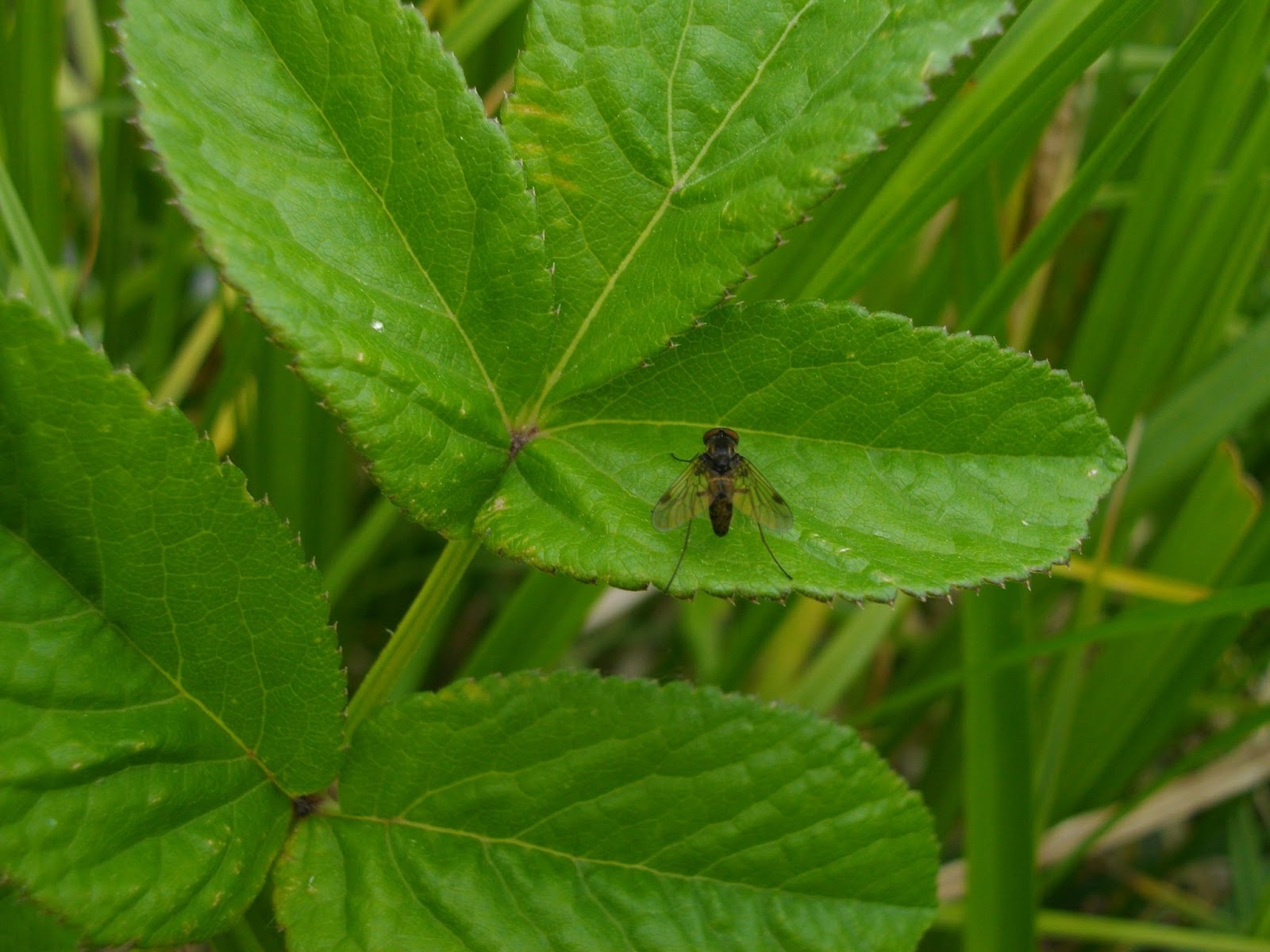
898. Black Robber Fly - Seen in June but not counted whilst eliminating any possible confusion species.


And quite possibly 899. I think this is the cranefly Ptychoptera contaminata, but I still need to see if I can rule out any similar species.

Hairy caterpillar guide

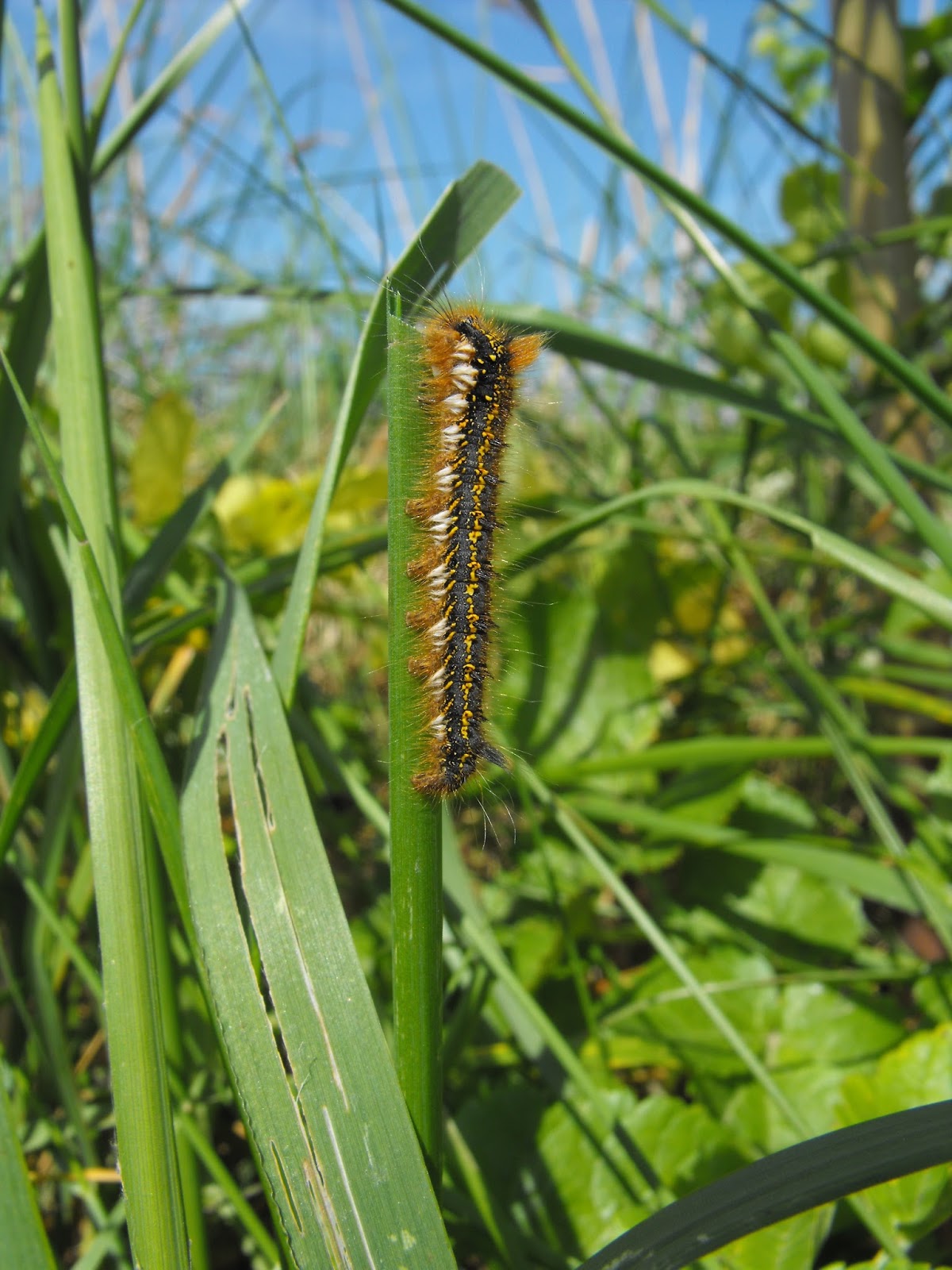
Barry's comment on my previous post reminded me that I now have photos of the four large (i.e. 2 inches plus) hairy caterpillars that are most often encountered by naturalists in Norfolk. So here is a brief guide to help you answer the question, "ooh, what's that big hairy caterpillar?"

Caterpillar A is Garden Tiger Moth. These caterpillars are common and sometimes known as "Woolly bears". They are dark, with gingery hairs at the front and underneath. There are a row of white spots along the side, although these aren't obvious, and long whitish hairs on top. They are often found in late summer walking across paths, and occur in a range of habitats.


Caterpillar B is the Fox Moth. The top photo shows a young caterpillar, which is black with orange bands. However as the caterpillar gets older it turns into a caterpillar that could be viewed as an upside down Tiger Moth caterpillar, as the gingery hairs are on top and the dark hairs below. It does have long pale hairs, but not as long as the Tiger Moth. This species is also encountered walking across paths, but it much more restricted in its habitat, being mostly found on dunes or heaths. Winterton Dunes is a good place for these.

Caterpiller C is the Drinker moth. They are often found on tall grasses. The caterpillar is largely black, but with a horizontal line of white hairs above a line of gingery hairs. The back is patterned with gold speckles and black bobbles, with black tufts of hairs at each end.

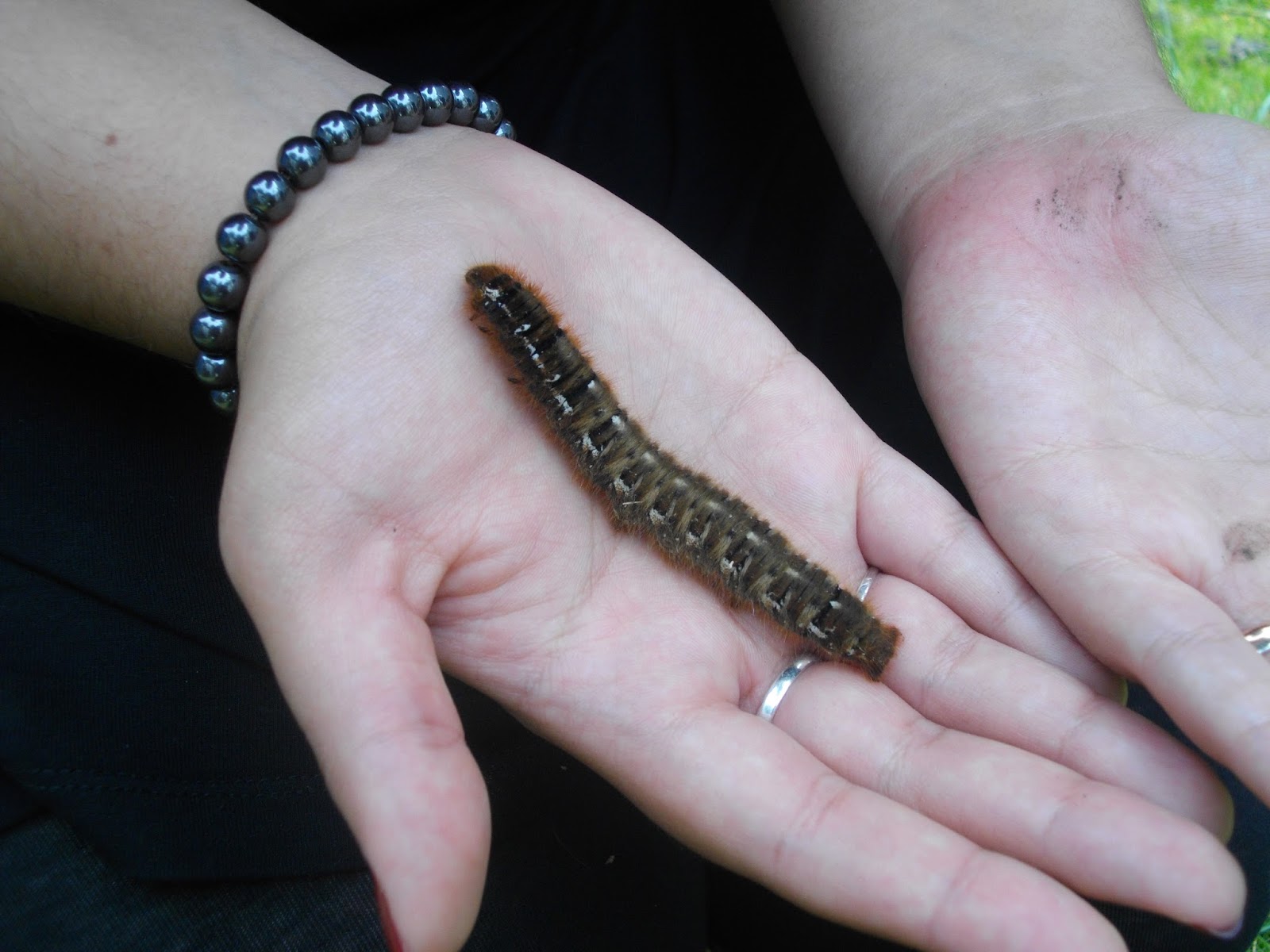
Finally caterpillar D, the Oak Eggar moth. The back of the caterpillar is dark, with squarish areas of pale brown hairs.There is a pale horizontal line along the side, with small orange circles regularly placed along it. The bottom half of the body and the facial area is gingery. This one was found in a garden, but it can be found in a range of habitats.

So there we go, happy caterpillar hunting!

NORWICH: Oak Eggar caterpillar

2nd August 2015

Whilst we were out on Sunday Cathy received a call from her parents to say they had found a large hairy caterpillar in the garden. From the description I suspected that it might be a Drinker moth, but we asked them to keep it until we got back from Heigham Holmes. When we called in it became apparent that it wasn't a Drinker caterpillar, something I see fairly regularly, but in fact an Oak Eggar caterpillar, something I've only seen once before. Not only that, it was a huge one, quite probably longer than most of the hawk moth caterpillars that I've seen before. I tried to get it to walk past a ruler, but it wouldn't play ball and kept climbing on the ruler. Nonetheless it gives an idea of how big it was. It was only when I wondered about the lack of a big oak tree nearby when I found out that they don't actually eat Oak, and are named because the cocoon looks a bit like an acorn.


EAST NORFOLK: Heigham Holmes open day

2nd August 2015

When I'm thinking where I'd like to visit I tend to give a bit of weight towards areas that I haven't been before, or places where access is limited. On Sunday the National Trust hosted an open day at Heigham Holmes, which ticked both boxes. Heigham Holmes is an area of grassland and grazing marsh, cut off by the river and various channels, making it an island. Whilst several events are held throughout the year, there is only general access one day a year, when a field is used for parking and the floating swingbridge is manned to allow pedestrians to walk onto the island.

We arrived around 12, and whilst waiting for the swingbridge to be closed we watched a family of Swallows perching and swooping around the river edge. It was a nice sunny day, and we walked along a wide track to some old farm buildings in the centre of the site. Here we stopped for a cup of tea and spoke to some people from the NWT Trinity Broads, who showed us the different types of pondweed found on a recent survey.


After stopping for lunch we completed a circuit around the site and then back to the bridge. I didn't see any 'new' species, but we did see three Little Egrets, Grey Heron, loads of Gatekeepers, Brown Hawker and an area of Bur-Marigold. The day was well attended (an estimate was 600 visitors) and we both enjoyed being able to explore a hitherto unvisited part of Norfolk.

SUFFOLK: Framlingham Castle

31st July 2015

Not much wildlife seen today, so just enjoy some photos from Framlingham Castle in Suffolk, where we went to experience some Tudor history.


THORPE MARSH: Birds and beetles

30th July 2015

Birding after a period of rain can sometimes be productive, with birds having dropped in to avoid the rain, or emerging to forage having been sheltering. I tell myself this everytime I head out locally following some rain, and very seldom do I see anything interesting! The scrape currently has vegetation growing on it and around it, so any birds there were out of view, although as the cows were in attendance there was probably not much there anyway. A pair of Linnet were calling from a bramble on the marsh. The broad was almost empty, 2 Mute Swans, a Moorhen and a Great-crested Grebe were the only species on the water. A Common Sandpiper took off from the west side of the broad and flew to the central spit, and a Common Tern flew over.


The overcast conditions meant that there were no dragonflies or damselflies flying, and few butterflies. Several Lesser Marsh Grasshoppers showed better than usual, allowing me to get a few photos to upgrade the one currently in my orthoptera guide. I added four species to my all-taxa patch list on this visit, taking me to 895 species in total. The additions were:

892 - Anthocomis rufus - A small red beetle, related to the Malachite Beetle.

893 - Turnip Sawfly - A distinctive orange and black sawfly. As well as turnips the larvae also feed on umbellifers.

894 - Skullcap Leaf Beetle - Having noticed a large patch of Common Skullcap growing, I found this beetle on the leaves.

895 - Common Hemp Nettle - Not yet in flower, but Chris informs me that it was present in the same location last year, so I must have just overlooked it in the past.

EAST NORFOLK: Burgh Castle

29th July 2015

On Wednesday Cathy & I decided to visit the old Roman fort at Burgh Castle, which neither of us had been to before. Three of the four walls still remain of the fort, which is owned by the Norfolk Archaelogical Trust and described as "the best preserved Roman monument in East Anglia". Having parked up we took the path along several fields before heading across the final one to the fort itself. As we went we checked the ladybirds we saw, looking for Adonis Ladybird. This is a species that I haven't seen yet, but is apparently commonest near the coast. We didn't see any, but did see several Small and Essex Skippers.

We reached the fort and had a look around the walls before admiring the view across the river and out onto the marshes. The Berney Arms pub and windmill were opposite, and Cantley Beet Factory was also visible on the horizon. We walked down to the riverbank to get a better look, and I noticed a plant that resembled Wild Radish but with different seedpods. A check at home revealed that the plant was the brilliantly named Bastard Cabbage. I don't why it's actually called that, but I'd like to think that it was named by an angry Victorian taxonomist sick of only having cabbage soup to eat. A shower of rain passed overhead, followed by a period of bright sunshine that brought out more butterflies. Standing near the edge of one of the walls a Brown Hawker flew up to us at eye level, no more than a couple of feet away.


On our way back we saw more dragonflies, with both Brown and Migrant Hawkers perching on the hedge in front of us. We diverted into Burgh Castle church, which had an interesting display about the history of the fort, plus some excellent stained glass windows. There are often conflicts when churches host bats, so it was good to see that the church was embracing its bat population. On Wednesday 12th August they are having a bat walk with Philip Parker. Not only can you hear about the bats, there are also infra-red cameras installed to allow you to see them exiting the church. It starts at 7pm and costs £7 if you live nearby and fancy it.

 Brown Hawker


Migrant Hawker
 This interesting chap is St Fursey
Victoria and Alfred - to celebrate two great monarchs 1000 years apart

NORTH NORFOLK: Fritillaries and Leafhoppers

27th July 2015

Despite showers being forecast I was eager to go to Holt Country Park to look for the valezina form of Silver-washed Fritillary. Whilst this species is usually orange, in some colonies a small percentage of the females are instead a bronzey-green colour. Fortunately the colony at Holt, probably the best known one in Norfolk, has this form present. I had failed to see it on previous visits, so I wasn't confident of seeing one, particularly because it was raining as we drove through Edgefield, but by the time we arrived at Holt the rain had stopped and a few butterflies were on the wing.

Last year we saw quite a few Silver-washed Fritillaries on the Buddleia at the back of the car park, and similarly on this visit two were almost immediately visible. Both were vibrating their wings, presumably heating up their flight muscles after a period of inactivity. We took a slightly circuitous route to the pond along a path that had held a valezina a week ago, but didn't see any butterflies at all. Stopping at the pond we scanned the vegetation and saw another normal-type Fritillary. Then bingo, a beautiful bronzey valezina landed on the Hogweed in front of me. I called Cathy round and we both admired the butterfly as it gave excellent views. Further round the same island of vegetation Cathy found a second one, with both showing at the same time to confirm it was a second individual.


Whilst we were here I remembered that one of the wardens was monitoring hoverfly records, so I made an effort to photograph as many species as possible. Of those that are identifiable without examination or a specimen we found eleven, quite good for a small area on an overcast day. These included three Volucella species and two new ones for me, Helophilus trivittatus and Sericomyia silentis. On our way back to the car we saw another couple of orange Silver-washed Fritillaries nectaring on thistles, plus a Red Longhorn Beetle and a Speckled Bush-cricket.


Whilst in North Norfolk we decided to carry on to Sheringham Park. Here I wanted to look for one of my target species for the year, the attractive Rhododendron Leafhopper. We had checked quite a few Rhododendrons without finding any, and then I saw some white leafhopper nymphs. We wondered if it was too early in the season, but Cathy quickly answered that question by finding some adults lower down on the same plant. Rhododendron Leafhoppers are green with red streaks and a black line through the eye, and are well worth a closer look if you see one. The NBN map for this species doesn't show any records for Norfolk, but their presence here is well known, even being mentioned on the Sheringham Park website. We ended a successful trip with chip butties at the park cafe.


WHITLINGHAM: Lesser Stag Beetle

26th July 2015

Looking ahead to the weather for my impending time off, I was less than pleased to see that it was basically rain showers for most of the week. With this in mind I decided to get a couple of hours in at Whitlingham on Sunday morning before the rain hit. Wildfowl numbers were similar to the previous week, so the avian highlights were a Kingfisher (perched up on the main island), two Buzzards that flew over and four Swifts, still lingering on in Norwich for a few more days.

In addition to looking for any storm-driven birds, I wanted to check for Willow Emerald damselflies along the south shore of the Great Broad. These damselflies are spreading rapidly now, and were present at Thorpe Marsh, Cow Tower, Cringleford and UEA last year, but not seemingly at Whitlingham. Last Sunday I had seen an Emerald Damselfly sp. (i.e. Common or Willow) fly up into an Alder, but not managed to see it well enough to confirm it was definitely a Willow Emerald. Later that day I checked my emails to find a message from a local birder who had seen a Willow Emerald in pretty much the same spot the day before. I'm being good and not counting it, and there was no sign on this visit, so the wait for my 18th patch odonate goes on.

Another thing I was checking for was for Ladybirds infected with a fungus, but I'll probably do a separate post about that particular quest! I did find a few more new species to add to my patch list, which will hopefully hit 900 in the next few weeks. Of the new species the most pleasing were Short-winged Conehead, Lesser Stag Beetle and the hoverfly Volucella inanis.


NORWICH: Scabious Mining Bees

23rd July 2015

I decided to make the most of the warm weather and head to Earlham Cemetery after work. On the first Buddleia I came to I saw a large hoverfly, the distinctive Volucella inflata, a relative of the hornet-mimic Volucella zonaria that is being seen frequently at the moment. I photographed it and have now got confirmation that it is a new species for the cemetery list. This is no mean feat, as Norfolk's hoverfly recorder lives close by and has recorded quite a few species here!


During the sunny spells I checked some of the uncut areas of the cemetery for butterflies. Two Large Skippers were still flying, and of the smaller skippers that I checked, all four were Essex Skipper. A female Common Blue butterfly was also nice to see.


My main reason for visiting the cemetery was to look for Large Scabious Mining Bees (Andrena hattorfiana). This is quite a rare species, and in Norfolk is at the northern limits of its British range. There are several colonies on the coast, but the main stronghold is the Brecks, making the Norwich colony a bit of an outlier. After a bit of searching I found the main area of Field Scabious, and straight away saw the bees. They have pale yellow hairs on the back legs, but on almost all of the bees they had turned a lovely salmon-pink colour due to the scabious pollen. Despite there also being lots of Black Knapweed nearby, the Scabious Mining Bees kept strictly to the Scabious flowers. This was another interesting species that it was nice to see so close to the city centre.