The Whitlingham Bird Report for 2025 is now available to download from the Bird Reports page or from here

WHITLINGHAM: Early hirundines

28th March 2016

The forecast gale-force winds and rain showers arrived on Sunday night and continued into Monday morning. By the afternoon they began to slacken off, so I headed down to Whitlingham for an hour. In recent years the period after a storm has typically been good for seeing hirundines, and so it proved here. I noticed a Swallow swooping and stalling above the waves whipped up on the Great Broad. Scanning further round I saw more birds, at least seven Swallows and five Sand Martins in total. This was my earliest patch Swallow (previous record 31st March 2010) and join earliest Sand Martin (with 28th March 2015). I briskly walked to the east end of the broad to scan Thorpe Broad for the Common Scoter, which wasn't visible, before heading home.


THORPE MARSH: Common Scoter

27th March 2016

I hadn't planned to go out on Easter Sunday, not least because Eastergeddon had been forecast, with more rain and high winds than you could shake a stick at. I was slightly surprised therefore to see that it was a bright if slightly windy day. I had a call from Justin, who had just found a drake Common Scoter on Thorpe Broad, so I made up a flask of tea and set off for Thorpe. Common Scoters turn up fairly regularly inland, especially in late March/early April, but there haven't been too many at Whitlingham in recent years - the most recent one as far as I know was the one I found on the Great Broad in December 2012.

After arriving at Thorpe I walked briskly along the riverbank to the bird screen, where Justin was still watching the scoter. It was favouring the far edge of the eastern 'arm' of the broad, from the central spit eastwards. There was still some patchy sunshine, and the beak shape and yellow triangle showed nicely. After watching the Common Scoter for a while I completed a lap of the site, seeing an Oystercatcher, 2 Kingfishers and getting uncharacteristically good views of a Cetti's Warbler. It was then time to head home and eat some chocolate.


BRECKLAND: Early spring plant hunt

26th March 2016

Having always lived in the eastern half of Norfolk there are many Breckland species that I've never seen. A couple of years ago Cathy & I had visited a site on the edge of Thetford to look for a couple of Breckland-specialist speedwells, without success, and at some point I intended to return and look for them. The early Easter weekend presented a good opportunity, so having seen the bad weather forecast for Sunday and Monday, I decided to go on a Brecks plant hunt on Saturday. Cathy wasn't particularly interested in another speedwell hunt, but my friend Ian, a more experienced botanist than me, did want to go, so I picked him up and headed off down the A11.

Upon our arrival at Thetford we started inspecting the relatively short section of verge where Fingered Speedwell and Breckland Speedwell can be found. Both of these are very small, and finding them is complicated by the other more numerous small blue flowers like Early Forget-me-not and Common Field Speedwell. We saw several plants of Fingered Speedwell, but didn't find anything that we were happy with for Breckland Speedwell. I did photograph some leaves that may be Breckland Speedwell, but I'm not sure unfortunately.

 Fingered Speedwell

Many of the Breckland plants flower in late spring, but there are a few others that can be found in late March. Next on my target list was the native Grape Hyacinth, the wild relative of the commonly planted Garden Grape Hyacinth. It is largely restricted to road verges in Suffolk and Cambridgeshire, so we headed to one such roadside nature reserve over the border into Suffolk. Initial signs didn't look promising, but eventually we found about ten flowering spikes. The wild Grape Hyacinth is smaller and darker, but otherwise quite similar to the more familiar version.


We headed to Icklingham, calling in briefly at Rampart's Field. There wasn't much in flower here, but we did see Rue-leaved Saxifrage. Icklingham Triangle was also rather lacking in flowers, although covered in Cladonia lichens. Ian did manage to find some of the small white flowers of Shepherd's Cress amongst the moss and lichen.


We then checked a few more roadside nature reserves, finding Grape Hyacinths at one more site. One of the verges was another site for Breckland Speedwell, but we struggled to pick any out amongst all of the Ivy-leaved Speedwell and Field Speedwell spp. The drizzle was starting to become more persistent, so we decided to call it a day and head for home.


WHITLINGHAM: A sunny spring day

25th March 2016

A bright and sunny Good Friday held lots of possibilities, with several inland Common Scoters about, a pair of my patch-nemesis duck (Garganey) arriving at Strumpshaw, Sand Martins beginning to appear and lots of insects emerging. I briefly went shopping to stock up on hot cross buns (meeting hoverfly recorder Stuart Paston in the process) before heading down to Whitlingham for a stroll.

Upon arrival a Peacock butterfly flew across the car park, however it was to be my only butterfly sighting of the day. Whilst Whitlingham can be a blaze of colour in late spring, in March and April there are large expanses without many flowers, so it is not one of the better places locally for early spring butterflies. I studiously checked each patch of Lesser Celandine and Coltsfoot for hoverflies, but the first interesting insects I noticed were a patch of metallic blue beetles. I had seen a photo of a similar group of beetles taken by Perry Hampson along the North Walsham-Dilham canal, and I suspected that they were a type of Flea Beetle (Altica sp). I tried to move a stick near one and the closest beetles jumped up in the air, firming up my suspicions. County beetle recorder Martin Collier has confirmed that they are indeed one of the Altica species. Unfortunately there are several, and they can only be identified to species level by dissection, so I'm just recording them to genus.


Further along the Little Broad I heard my first singing Chiffchaff of the year, and a Kingfisher called as it whizzed past. Some more flower checking led me to find two small ladybirds, a red 24-spot Ladybird and a yellow 22-spot Ladybird. I also noticed some white spots on White Dead Nettle leaves, caused by a fungus. There are a couple of possibilities, so hopefully I can identify it. The standard reference work for microfungi on plants is very good, but relies completely on descriptions. Ideally I would like to see a picture first, to make sure I was in the right area, before then moving on to the detailed description. There doesn't seem to be much demand - maybe I'll have to write it myself! I hope to learn a bit more about microfungi on the NNNS Microfungi workshop, to be held at Wheatfen on 10th April.

 24-spot Ladybird - a small species that is easy to overlook
Fungal spots on White Dead Nettle - two possible contenders for the species though

I scanned both broads in the hope that an early Sand Martin would be flying about, but with no success. Carrying on along the south shore of the Great Broad I heard a rapid-fire clicking noise. Recognising it as a camera on burst mode I looked around and found a photographer lying on the ground, taking photographs of a pair of Egyptian Geese with two goslings. With no such photographical standards I let him finish and then took a record shot as they disappeared off across the broad.

Egyptian Geese with first goslings of the year. Take a good look now in case it doesn't make the Bird photograph of the year awards shortlist.

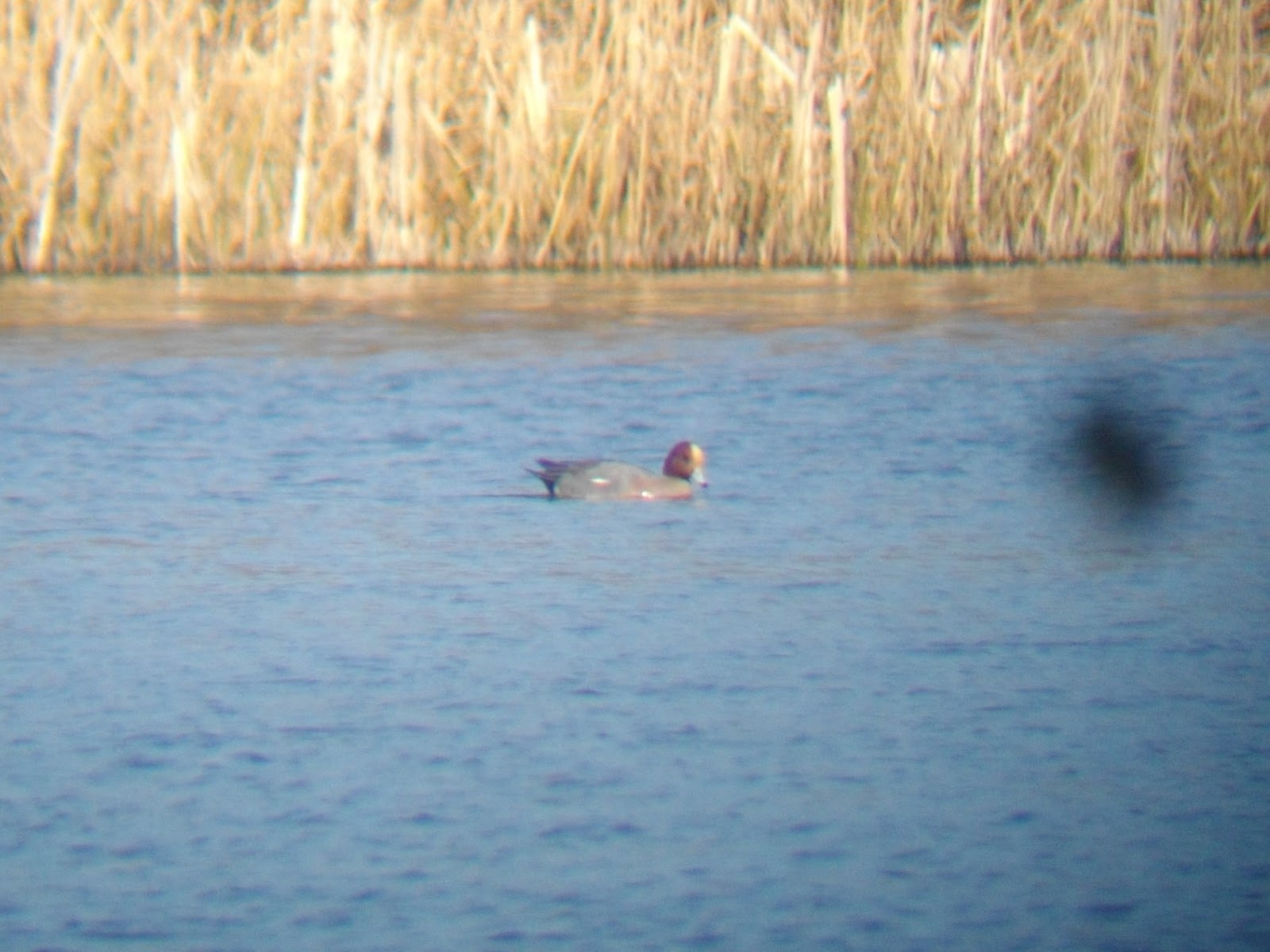
Because of the sunshine the CP was very busy, especially with dog walkers and families. On the water it was fairly quiet, so I decided to count the migratory species. I counted 82 Tufted Ducks, 1 Teal, no Gadwall or Pochard, but interestingly seven Wigeon. This was my first ever March record here, surprisingly. Several people had heard them flying over Norwich during the night, so presumably these ones just stopped in on their way out of the county. 

Over the river at Thorpe some children were out on the spit in the middle of the broad, so no birds on there. The recent management work has opened up the area nearby, but there are fences and signs clearly telling people that the area is off limits, so it is frustrating that people choose to ignore the signs and trespass on part of the nature reserve. Benches are provided on the shingle area to the west of the broad for people wanting to sit and observe the broad. There were a few birds left in the near corner of the broad, including four Gadwall and around 35 Tufted Ducks.

Having completed my circuit I had heard five singing Chiffchaffs, four at intervals around the Great Broad and another just across the river near Thorpe Green. A silent sixth bird gave great views as it caught flies a few feet from my head. I also got close views of a Goldcrest as it flicked through the undergrowth. As it turned out I only saw one new patch species, Hairy-footed Flower Bee, but I still had an enjoyable walk in the sunshine.

WHITLINGHAM: Coot, revisited.

23rd March 2016

Some readers may remember that back of 1st January I called in at Whitlingham and saw a colour-ringed Coot. I'd not ever seen a ringed Coot before, so I was interested to find out where this one had come from. I reported it, and found that it had been ringed in Norway. This seemed reasonable, hundreds of Coot winter at Whitlingham and I presumed that these came from northern Europe. I had also recorded several Norwegian-ringed Black-headed Gulls in almost the exact same place. I noted the details and didn't think any more of it.

On Wednesday, nearly three months on, I received a message from Kane Brides. Kane works for the WWT, and amongst various projects he co-ordinates the colour ringing of Coot in Europe. He said that the Whitlingham sighting was a great record, could he have permission to use the photo I had submitted to the Norwegian scheme, and mention it to other ringers? I had no problem with this, so said fine. It was only later in the evening when I saw his message on Twitter that I discovered that this Coot was actually the first Norwegian-ringed Coot to be sighted anywhere in the UK! I think it's worth mentioning here, partly to show that there is still much to find out about the movements of even common bird species, and also to highlight the sort of thing that anyone could find on their inland patch.

You can see the ringing summary for Coot on the BTO website here: http://app.bto.org/ring/countyrec/resultsall/rec4290all.htm. Note the origin of foreign ringed birds are shown in yellowy orange, whilst the purple dots are British-ringed birds that have been found abroad.

A Coot, excited to be in Norfolk

MID-NORFOLK: Lenwade fungus foray

19th March 2016

The second Norfolk Fungus Study Group foray of the year was held at the slightly unusual venue of Lenwade Dinosaur Adventure Park. One of the group members works at the park, and in the past there have been several wildlife-related events held there, including an autumn fungus foray, so we had been invited to survey the woodland areas for spring fungi.


Having been signed in we headed back down the entrance track to have a look at some of the woodland edge. Dog's Mercury was flowering and looked healthy. With a mycologists hat on it would have been better with Dog's Mercury Rust on! The first few fungi were common ones that you would expect to find in any woodland, such as Turkeytail, Hazel Woodwart, Bracken Map, Cramp Balls and Jelly Ear. The most interesting species found was a large mass of jelly that was identified as Leafy Brain fungus (Tremella foliacea).

Having exhausted this area we headed into the park proper, adding the beginnings of a fungal plant disease called Rhododendron Bud Blast, that turns the buds blackish. Heading along the dinosaur trail we saw our first gilled fungus of the day, a tiny white Mycena sp. growing from a dead Oak leaf. Some Glistening Ink Caps were also of note. Whilst walking around this area I heard a Nuthatch calling, and there were some patches of Wild Garlic, although much too early for flowers yet.

After stopping for a drink at the picnic area we briefly checked around the animal enclosures, where a Winter Polypore was growing on one of the logs on a wood pile. We then headed up into a private bit of woodland, which proved particularly fruitful. An interesting looking plant with Comfrey-like flowers turned out to be Creeping Comfrey, a garden plant that seems to have naturalised in part of the wood. 


A pile of cut logs turned up several interesting species. Several Artist's Brackets had been galled by the Yellow Flat-footed Fly - I had never seen this before 2016, but have now seen it on both NFSG forays so far. A tiny white cup fungus and an Eyelash fungus were both unidentifiable in the field, whilst an interesting crust fungus appears to be Serpula himantioides. In total we saw over 30 species, possibly as many as 40 if some of the smaller ones can be determined, so a worthwhile exercise and a few new records for the park. As we returned to the main square I heard some croaking noises. Walking over to a nearby pond I saw my first spawning frogs of the year, complete with noisy males! As the drizzle returned I left the frogs to it and headed home.

 Serpula sp.
Galls on the underside of Artist's Bracket

WHITLINGHAM: March wildfowl counts

13th March 2016

A particularly busy weekend meant that it was around three o'clock before I got down to Whitlingham to carry out the March wildfowl counts. It was still bright, but with a chilly breeze. Starting as always with the Little Broad I heard a few Siskins flying about nearby, and located a singing Treecreeper. It showed well, although as usual the branches and catkins meant I struggled to get an unobscurred photo before it spiralled out of sight.


Reaching the slipway I happened to look up and saw a bird of prey overhead. Earlier in the day a Marsh Harrier had been photographed heading along Prince of Wales road, so I thought it could be that, but a better look showed that it was a Buzzard. It was circling above the visitors' barn, and in fact was still circling a couple of hours later as I finished the count. A quick scan revealed no colour-ringed gulls, but I did spend a bit of time looking at the plumage of the Common Gulls.


Only one Egyptian Goose was present (and that on the meadow opposite the CP rather than on the Great Broad), suggesting that the females are incubating. A selection of species and the equivalent count last year [in brackets] are listed below:
  • Mallard 47 [48]
  • Gadwall 23 [11]
  • Tufted Duck 121 [77]
  • Pochard 6 [0]
  • Coot 29 [45]
  • Cormorant 12 [17]
  • Black-headed Gull 365 [159] 
As you can see from the figures, whilst duck numbers seemed low at the time, the wintering species are actually more numerous than this time last year. Mallard numbers are level, whilst for some reason Black-headed Gull numbers have held from February (c390) whilst last year there was a strong drop-off from 410 in February to 159 in March.

If I had heard a singing Chiffchaff today it would have equalled my earliest patch record, but I didn't. There was no sign of other early arrivers such as Sand Martin or Little Ringed Plover either, but it shouldn't be too long now...

MID-NORFOLK: Skylarks at Yaxham

13th March 2016

On Saturday Cathy & I attended a wedding in Swanton Morley. It was the last wedding of my high school friendship group, so rather than drive back to Norwich afterwards we stayed over nearby at Yaxham Mill. It would have been closer to stay in Dereham, but Yaxham offered more rural and interesting accomodation.

We got up on Sunday morning and could immediately hear Skylarks singing close by. We went for breakfast in a room at the base of the old mill, and as the day was bright they left the outside door open. Whilst eating we could hear the chirrupping of House Sparrows opposite the room, whilst the Skylarks were still singing all around the mill. The half-hour we spent having breakfast, being serenaded by Skylarks and House Sparrows, was a really relaxing experience. I head out of the city quite regularly, but usually do do something specific or to do some species recording, so sometimes it takes something like an event like this to allow you to just stop and enjoy the sights and sounds of the countryside.


WHITLINGHAM: Woodland plants and fungi

5th March 2016

The weather was overcast and rainy, but I went out anyway, hoping to hear an early Chiffchaff as a harbinger of spring. There was no-one else parked in the largest car park, and I didn't meet another person until I was nearly level with the island, which is almost unheard of here regardless of time of day or weather. There were no ringed Black-headed Gulls on the slipway, and Tufted Duck numbers had declined to around 60. A pair of Great-crested Grebes were in full summer plumage but showing no inclination to display to each other. 

At times like this it is a bonus to have a wider interest than just birds, so rather than complete a lap of the broad I detoured off onto the picnic meadow. Whilst a rain shower passed over I spent the time looking at dead birch leaves, hoping to see some microfungi on them. I found something slightly larger, Common Grey Disco, a small grey cup fungus with white rims, growing on a fallen branch. I also found some Jelly Ear growing on the birch, which is an unusual host for this species. Throughout the visit I saw more Jelly Ear than I've ever seen in a single day, including some very large specimens.


I decided to continue round to some of the parts of my patch that I visit the least, heading south along the lime tree avenue and past Whitlingham Hall. Here there are some fields that probably represent my best chance of seeing a Yellowhammer on patch, but today, as usual, there was nothing new for me. A Stock Dove flew rapidly past. Continuing along the road I turned off along the path towards Trowse, stopping to look at some Peltigera lichen.


Entering Trowse Woods I stopped to admire the Snowdrops. The few in the country park are a double-flowered variety, but these ones along with the ones in Whitlingham Woods are single-flowered. A large plant with pale green flowers stood out, and once closer I recognised it as a type of Hellebore. The leaves looked similar to Green Hellebore, but Brian Evesham kindly identified it as Lenten Rose (Helleborus orientalis), a garden throwout. Further along a larger and yellowy-green plant stood out from the Snowdrops. The flowers were at the end of a long stem, reminding me of Few-flowered Garlic, but not quite right. Again my more learned botanist friends came to the rescue. It looked like Spring Snowflake, but Ian Senior noticed that actually there were two flowers (and the bud of another to come), making it Summer Snowflake.


Lifting my eyes up from the woodland floor I noticed a Great-spotted Woodpecker fly into a nearby tree. The 'whip-whip, whip-whip' call of a Nuthatch sounded loudly nearby, and I managed to set eyes on my first Nuthatch of the year. In the distance a Great-spotted Woodpecker (a different bird to the one I had just been watching) was drumming. Trowse Woods holds the first (and perhaps still the only?) tree with an interesting fungus called Beeswax Bracket on. I tried to refind the tree, having been shown it in 2012, and to my satisfaction I did find it. The fruiting bodies are now old and rather dry (when fresh they oozed a yellow substance that gives the fungus its name). 


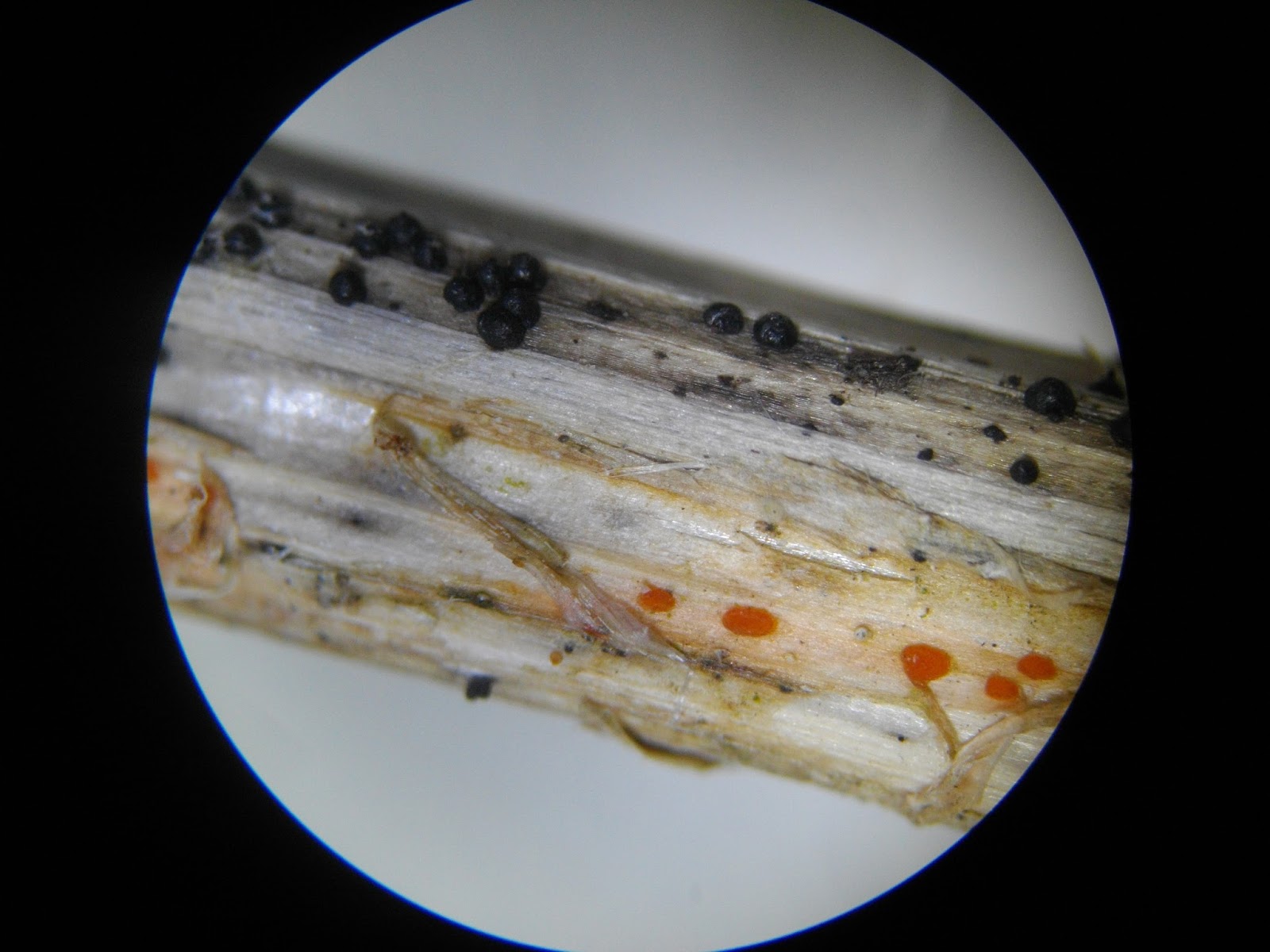
A final fungal find was some tiny orange discs on a dried umbellifer stem. These are probably beyond me, so I shall look to pass them on to a more experienced mycologist. I stood for a while near the edge of the wood, and was rewarded with a flock of Redwings, moving silently along the edge of the wood, latterly accompanied by some rather noisier Long-tailed Tits. Exiting the wood onto Whitlingham Lane I walked back to the car park. My final action was to watch a flock of Black-headed Gulls that had moved in. A heavy hailstorm swept through, so I had to dash to the car to finish my vigil, which ended early as half of the flock were spooked off by a passing car.

WHITLINGHAM: February sunset

28th February 2016

On Sunday evening I took a late afternoon stroll around Whitlingham, hoping to see a Barn Owl or a Little Egret heading to roost. I didn't see either (a flyover Grey Wagtail was the most interesting bird of the visit), but it was still worth the trip out for the sense of calm and the nice sunset. The first Egyptian Goose goslings should appear soon (there are broods at Taverham and Holkham already), so worth keeping an eye out.


NORWICH: Not just a small brown moth

(but no, it wasn't an M&S, luxury patterned small brown moth either)

24th February 2016

Working on the third floor of a building in Norwich city centre, I don't tend to get many insects in the room. Occasionally something interesting will land on the window, the best of which came last year when I caught a bug that turned out to be only the second Norfolk record. On Wednesday afternoon I noticed a small ichneumon wasp on the window. I looked at it, and (to the chagrin of some naturalists I'm sure) decided that there was no way I'd be identifying that to species level, so I should open the window and let it out. Whilst doing this, I noticed a small brown moth on the windowsill. I delayed the release of the ichneumon until I had potted* the moth to have a better look.

What followed was a series of ups and downs. To be honest, whilst interesting, it wasn't exciting enough to justify the term 'emotional rollercoaster', but probably a scaled down version would be appropriate. Maybe emotional homemade BMX ramps. I like moths, so finding one was an up. I didn't recognise it, so it was probably a species I hadn't seen before, so that was a bigger up. As I put it into a pot it became evident the moth was dead, which was a down, and so on. I photographed it and retained the pot in case it was something really rare.

Later that evening I transferred my photos onto the computer and set about identifying the moth. My first port of call was the excellent Norfolk Moths website. As well as having a page for every species recorded in Norfolk, it has a section called Flying Tonight? This is really useful, because it uses all of the moth records in the database to display them in order of most seen for a particular period. So if you are new to moth trapping and put a trap out in your garden in May, using the flying tonight option you can bring up a list of the 100 most common species for May, and chances are you will find most of the moths you've just caught. The problem is, in winter not many moths are recorded, particularly micro moths** of which this was one.

My next port of call was the Field Guide to the Micro Moths of Great Britain and Ireland (Sterling & Parsons) with illustrations by renowned wildlife artist Richard Lewington. I couldn't find my moth there either. Was I overlooking something obvious, or was my moth particularly rare? Option three was turn to social media for help. If you are on Twitter and use the hashtag #teammoth, moth experts from around the country come to your aid with ID help. I decided to keep my tweet a bit more local by not using the hashtag, knowing that some of my Norfolk friends are very knowledgeable moth folk. And so it proved, my moth was identified within minutes by Andy & Ian as Duponchelia fovealis, a moth with only around ten Norfolk records.

Duponchelia fovealis

This wsn't quite the end of the story though. I went back on the Norfolk Moths website to report my sighting to the county moth recorder, and noticed that in the species account was the line "The larvae feed on house plants, causing sufficient damage to be a serious pest in some areas, occurrence should be reported to MAFF Plant Health and Seeds Inspectorate". Blimey. However, when I thought about it, MAFF no longer exists, having been subsumed into DEFRA, and my specimen wasn't likely to cause sufficient damage to anything, what with it being dead and all. I asked for advice on the Norfolk Moth Survey Facebook page, and was given the contact details for an ecologist at FERA, who has passed my query on to one of their moth specialists. I haven't heard back yet, but I like to think he is sitting at a desk with two large red buttons in front of him, one reading "PANIC" and one "IGNORE". I'll update the post if I hear back!


* Often an insect looks interesting, but flies off before you get a good look, so it pays to keep a small plastic pot nearby.
** Moth books and websites tend to split moths into macro moths and micro moths. This division is somewhat arbitrary, as there are some big micros and small macros, but it is generally understood, and if you can work out which one your specimen is likely to be, it saves searching through the whole lot.

WHITLINGHAM: Bittern!

23rd February 2016

The short winter days can be frustrating, with no opportunity to look for wildlife in the evenings. Now we are near the end of February this situation is starting to change, allowing the possibility of brief excursions. On Tuesday I got a phonecall from Justin, telling me that he was watching a Bittern at Whitlingham. This bird has been reported a couple of times so far this year, but presumably been present for much of the winter, unobtrusively going about its business amongst the reeds. I decided to make the most of the sunshine and slightly later sunset by hurrying down to Whitlingham after work.

I power-walked along the southern edge of the broad, stopping to look at my first patch Oystercatchers of the year standing on one of the floating rafts. A Kestrel flew low over the picnic meadow. The reedy areas along the northern shore of the conservation area bay cannot all be viewed from one place, so I stopped in several places and scanned, hoping that the different angles might help locate the Bittern. With no luck west of the island, I carried on past the island and set up my telescope on the area of reeds just to the east.

The area I was focusing on hosts quite a large Magpie roost over the winter. As I was going to be staring in that direction for some time, I decided to count the roosting Magpies. Some were alrady in the bushes, so I started by counting all of the perched up birds (around 30), and then counting the rest as they flew in. I ended up with a count of 148, easily my highest ever, although a way short of the record count here. With the light beginning to fade, I started to walk back, but stopping again west of the island to scan. And there it was, the Bittern, standing amongst the reeds. It took a step right to the edge of the broad then turned side on, clambering onto some debris before launching into flight. Its legs dangled down like a giant Water Rail, suggesting that it wasn't flying far. A brilliant end to a very pleasant evening.


WHITLINGHAM: Bat checks and wildfowl count

21st February 2016

Whitlingham has two locations where bats hibernate over the winter, and monitoring of these hibernacula is carried out by a licenced bat worker from the Norwich Bat Group. A small number of bat group members are allowed to attend these checks to learn more about bat monitoring, and on Sunday I joined them. Firstly we checked the old Lime Kiln in Whitlingham Woods, where we found three Daubentons Bats and one Natterer's Bat. We then headed back down Whitlingham Lane to the old railway tunnel off Trowse water meadow, where there was one Daubenton's Bat. Overall these numbers were lower than normal, probably due to the mild conditions.

Following the bat checks, I returned to the country park to carry out February's WeBS counts. A flock of 47 Greylag Geese were grazing on the field opposite the car parks. Ten Pochard were on the Little Broad, and slightly surprisingly they were the only ones I saw on my visit. A selection of species and the equivalent count last year [in brackets] are listed below:
  • Mallard 32 [58]
  • Gadwall 27 [93]
  • Tufted Duck 145 [155]
  • Coot 69 [217]
  • Cormorant 31 [16]
  • Black-headed Gull 313 [410] 
That rather illustrates the current low numbers of waterbirds, albeit with similar Tufted Duck numbers to last year, and more Cormorants.

Once I had completed the count I returned to the slipway to check for ringed gulls. I only saw the regular Norwegian-ringed bird, so I spent a bit of time reading the metal rings on the Mute Swans. I read four, one of which I had read the previous week, taking my overall tally this year to seven. The BTO have responded to my reports of all of them, and predicatably they were all ringed at Whitlingham, at varying times between 2009 and 2014. A metal-ringed Canada Goose had also been ringed in 2014 at Whitlingham.

YARE VALLEY: Wheatfen fungus foray

20th February 2016

On Saturday the Norfolk Fungus Study Group met for the first time this year at Wheatfen. There was a good turn out, and David the long-serving warden took us through the woods to an area called Tuck's Wood that is off-limits to the public in the hope that we could contribute some additional species to the site records. Despite the time of year we found lots of species, several of which I've not come across before. As expected most of them were growing on wood, with a tendency towards brackets and crust fungi rather than gilled species. Several specimens were taken for determination, so hopefully there will be a few more additions to my preliminary list too.

The first new species for me is called Glue Crust (Hymenochaete corrugata). It would be very easy to miss, but gets its name from the habit of growing between branches, sticking them together.


The next new one was Hypoxylon petriniae, a rather non-descript brownish crust fungus on Ash.


The third new species was one I've wanted to see for a while. It was an old specimen of Shaggy Bracket (Inonotus hispidus), which was black and hairy-looking. Nearby I was also shown an Artist's Bracket with galls underneath. These galls are caused by a scarce fly called Agathomyia wankowiczii. It is one of very few (possibly the only one?) insects to cause galls on a fungus rather than on plants. It is also useful as it only grows on Ganoderma applanatum, which can otherwise be difficult to separate in the field from the commoner Ganoderma australe.


Finally from the initial batch of new species was Fenugreek Stalkball. Apparently these small stalkballs do smell of Fenugreek when dried, but these were wet and didn't.


Whilst we were concentrating on fungi I did see a new flowering plant, Opposite-leaved Golden Saxifrage, which is very common around part of the reserve. Alex Prendergast also identified a Scaly Male Fern as D. a. cambrensis (Golden Scaly Male Fern), which I've not knowingly seen before. Some members stayed for lunch and a microscopy session in the afternoon, but I headed home after a successful morning.


THORPE MARSH: Guided walk & Chinese Water Deer

19th February 2016

Every month Chris Durdin leads a guided walk around Thorpe Marsh on behalf of the Norfolk Wildlife Trust. Because the walks are typically during the week I am usually at work, but as I was off today I decided to go along. After a sharp frost the weather warmed up nicely, and around 15 people were present. It was good to see several readers of my blog and/or people that I have communicated with via email but not met in person before. At the end of Bungalow Lane were some House Sparrows, a species that I haven't seen actually on my patch in over five years. We also stopped to look at some Cherry Plum blossom, a species often confused with Blackthorn.

We walked along Bungalow Lane and then west along the wooded edge of the marsh, stopping to admire a small Scarlet Elf Cup growing on the edge of the path. Scanning the broad the highlight were two drake Shoveler amongst the commoner ducks. A Cormorant was drying its wings on the spit, and I was able to describe how you would check the gular angle to determine the subspecies - this one was a sinensis bird. We paused to listen to a nearby Cetti's Warbler, which predictably stopped calling, and saw some Yellow Brain fungus growing on a riverside Ash tree.

We stopped to scan from the shingle broad edge, and one of the group spotted a Chinese Water Deer walkin galong the edge of the broad. A large queen bumblebee flew past, unfortunately not stopping long enough to identify it. High over towards Broadland Business Park a Buzzard was soaring, being mobbed by a Carrion Crow. As I watched it in the telescope it flew past two more distant Buzzards. We also saw a Sparrowhawk flying over the railway line. Our next stop was to see some egg-laying scars left by Willow Emerald Damselflies, and some Snipe were put up off the marshes. 


Our final sighting of note was of two Great-spotted Woodpeckers. I spotted them in the wooded area and initially thought they were a pair as they followed each other around, mimicking each other as if in courtship. It was only when Chris got better views of them and saw that they both had red on the back of the head that it became evident they were actually both males, and having a territorial battle. We watched them follow each other around the trees for a while before heading back along Bungalow Lane and across the railway. It was a very pleasant walk, and one I would recommend to others, particularly if you are not familiar with the area. The next walk is on Wednesday 30th March, and the remaining dates can be found on the right hand side of the Thorpe Marsh website here.