The Whitlingham Bird Report for 2025 is now available to download from the Bird Reports page or from here

WHITLINGHAM: October bird counts & leaf mines

15th October 2016

After leaving Marham I dodged the football traffic and headed to Whitlingham to carry out the October WeBS count. There was more birds on the Little Broad than in recent visits, with Gadwall in their favoured areas of weed at the west end and five Moorhens, probably a family group. On the slipway I noticed one of the Black-headed Gulls had a white ring on its right leg. A closer look showed that it was J5JE, a Norwegian bird now returning for its fourth winter here - it spends the summers near Oslo.


Selected combined bird counts (2015 in brackets):
Mute Swan 34 (27)
Greylag Goose 15 (39)
Mallard 54 (83)
Tufted Duck 24 (29)
Pochard 1 (6)
Teal 4 (8)
Gadwall 25 (43)
Cormorant 49 (41)
Coot 163 (103)
Great-crested Grebe 8 (4)
Little Grebe 1 (2)
Black-headed Gull 175 (99)

So looking through those, Mute Swan, Tufted Duck and Cormorant numbers are all similar to last year. Since the summer there has been a definite lack of Greylags around, this is the second count this year with none on the Great Broad, the 15 were two on Thorpe Broad and 13 on the river (no counted within WeBS but part of my 'Whitlingham area' count as part of the same catchment). Wintering duck numbers are still relatively low (Mallard, Gadwall, Pochard, Teal), but Coot and Black-headed Gull numbers are significantly up, perhaps in part due to the recent easterly winds.

Having been looking at leaf mines earlier in the day I was still looking out for them, seeing a couple of new ones, the 'snail trail' mines of Kent Bent-wing (Phyllocnistis xenia) in poplar, and a creased mine of Phyllonorycter stettinensis on Alder.


There was a bit of fungi about too, including these Ink Caps. They are probably Haresfoot Inkcap, although there are one or two other similar species.


WEST NORFOLK: Marham Fen leaf mines

15th October 2016

On Saturday I ignored thoughts of returning to the coast to attend a daytime meeting of the Norfolk Moth Survey. Along with a group of Norfolk and Suffolk moth recorders, the NMS had arranged for leaf-mine experts Brian Pitkin and John Langmaid to join us to record some of the overlooked species best found as larvae. 

The location of the morning meeting was Marham Fen, a site that I hadn't visited before. The periphery of the site was wooded, with large amounts of Hawthorn and Buckthorn. Nearer the centre was some open meadowland, and some wetter areas that presumably gave it the name. Being one of, if not the least experienced leaf-miners the visit was a bit of a steep learning curve, but the main thing to take away was the variety of different mines and foodplants so that I can find them (and hopefully identify them!) for myself at a later date.


After a couple of hours we had amassed a list of over 40 species of leaf-mining moths, of which probably a third related to occupied mines (i.e. we could see the larvae) and the rest vacant but still distinctive mines. Most of the group went to a pub in Shouldham for lunch, before moving on to Narborough railway line in the afternoon. I had the WeBS counts to do and didn't want to overload myself with new names, so headed back to Norwich after a brief sandwich. Thanks to Ken and the rest of the group for making me welcome.

In non-lepidopteran highlights there was a good passage of Redwings over and I saw an interesting green crab spider, Diaea dorsata.


WHITLINGHAM: New fungus, moss and lichens

12th October 2016

Despite there in theory being a couple of hours of daylight still after work, the overcast conditions and rain showers meant that it felt dusk-like as I headed down to Whitlingham on Wednesday evening. A Bearded Tit had been heard calling from the north shore of the conservation area earlier in the day, so I was eager to have a look for it. I did stop to check a Long-tailed Tit flock for Yellow-browed Warbler, but as of yet I've not seen one around Norwich, despite the huge influx. Despite loitering a while I didn't see or hear the Bearded Tit - it may have moved on, or could have just been silent. Whilst waiting I counted 41 Cormorants in to roost, and heard Bullfinch, Kingfisher and Grey Wagtail.

Whilst looking for alternative viewpoints I noticed an area of short grass and walked over to it. This turned out to be a good move, as it held at least four new patch species (more if I can identify them!). These included Orange Mosscap (Rickenella fibula), Bank Haircap Moss and two Cladonia lichens.


NORFOLK: The birds and the bees. And fungi.

9th October 2016

A week of easterly winds and a generally promising weather chart for rare birds had whipped up something of a frenzy amongst birders, to the point where anything less than a full-scale Sandgrouse invasion risked being a disappointment. To be fair, Shetland has now had a nice array of very rare birds, including Britain's first Siberian Accentor. Norfolk so far has had the sort of birds you would expect, just in higher numbers.

With this background, I had Sunday to go out and had to decide how to spend my time. In the end I decided to head to the north Norfolk coast. I started at Cromer, where after a short walk I ended up near the lighthouse and a small crowd waiting for a Dusky Warbler. It could be heard calling from some Sycamores along the clifftop, but was typically staying out of view. Eventually I got a few flight views, before a better look as it moved through some bracken, and then finally in one of the Sycamores. This was a new Norfolk species for me, having previously only seen one in Yorkshire.

Driving west along the coast road I considered stopping at Muckleburgh Hill, but the sun had come out and I wanted to look for some bees at Walsey Hills. Ivy Bees have colonised several places along the coast, but at Walsey there are some other Colletes bees, probably Heather Bee (Colletes succinctus) alongside the Ivy Bees. Handily David the warden was about, so he showed me the nest holes near the NOA observatory and then some good areas of Ivy to check.

When the sun came out the ivy was covered in insects, including Red Admirals, Painted Lady, Wasps, Honey Bees and at least seven species of hoverfly. I did eventually find one Colletes bee, probably a pale Ivy Bee, collecting Ivy pollen. I also kept an eye out for fungi, seeing some small brownish oysterlings that I recognised as Resupinatus trichotis. Back up at the observatory more bees were visible. including a nice buff-banded Ivy Bee and some slightly slimmer, paler looking ones that looked like Heather Bees. There is another member of this family, Sea Aster bee, that looks similar to the other two, hence my slight reticence to commit to definite IDs. It began to rain, so I had a quick look at a Jack Snipe on Snipe's Marsh through David's 'scope before heading off.


Next stop was Stiffkey, where I started off in the woods. There had clearly been an arrival of Goldcrests, with 50+ in scattered amongst the trees. I love Goldcrests, but it wasn't too long before I was getting a crick in the neck, checking and then rechecking each one as they flitted about. A few Chiffchaffs provided some variety. I left the woods and walked along the edge of the Sueada. With not much going on there I then headed west along the coast path towards Warham. At this point I had a decision to make, whether to go for a long walk or move on. In the end a text from Gary telling me he had seen a Ring Ouzel made my mind up for me - I headed back to Norwich to spend a bit of time at Whitlingham instead.

I wasn't particularly optimistic about seeing the Ring Ouzel - when Gary had seen it it had appeared to land somewhere near the picnic meadow. Before heading there I decided to check the areas of short cropped turf around the campsite, and by pure luck heard the Ring Ouzel call and fly across the campsite into the lime tree avenue. I scanned the trees as best I could, then checked the field the other side and the meadow at the top of the avenue, but didn't see it again. Three Green Woodpeckers together was a bonus, and good to see that they bred successfully. On my way back I noticed an orangey fungus growing on a log. A closer look showed that it was Wrinkled Peach, although not very wrinkled, so a good visit, and the right call to come back.


NORFOLK: Wasps

8th October 2016

Saturday was a non-wildlifey day, but whilst at my mum's house in North Walsham I noticed a large wasp on some wood. Presumably a queen wasp, but which species. Wasp patterns vary, so ideally you want pictures that show the thorax, abdomen and the face straight on. At home I checked the face and body patterns against the pictures in Chinery* and it was a queen German Wasp.


On Sunday whilst at Whitlingham I saw another interesting looking wasp. It looked long, thin and much more blackish than normal. I wondered if it was a Median Wasp, but again photographing the face and body I established that it was in fact a male Common Wasp. There are quite a lot of different social wasps, so if you aren't allergic to them, why not have a closer look and see which ones are on the ivy flowers near you?


* Insects of Britain & Western Europe by Michael Chinery, one of the most popular insect books alongside the newish photographic guide by Paul Brock.

SOUTH NORFOLK: Flordon Common fungi

1st October 2016

The Norfolk Fungus Study Group foray today was at Earsham Hall on the Norfolk/Suffolk border, and I didn't really have time to go there. Handily an alternative was offered, Tony had decided to visit Flordon Common and so a splinter group of Tony, Ian, Tim, Tom and myself headed there for a few hours instead. I had never been to Flordon before, but was aware of it because it had been a NNNS Research Group project, with a detailed write-up in the 2009 volume of Transactions.

We met at a layby near to the entrance to the common , which was marked with a footpath sign but no interpretation board or anything saying 'Flordon Common', so it could easily be missed.


Upon entering the common we headed straight for a small area of short-cropped grassland where Tony had seen an unusual Waxcap the week before. It turned out there were quite a few of the small orangey-red caps. Tony had confirmed that they were Glutinous Waxcaps (Hygrocyube glutinipes), but this species is usually yellow. There is a scarcer red form (var rubra), but given that these were orangey, we don't know where the line is drawn between the two forms! Two Blackening Waxcaps were also present here.


Whilst Tim looked through a cow pat for beetles, Ian had ranged a bit further and located some more fungi. Two of them were species I had only seen once or twice before, Mycena amicta and Fiery Milkcap (Lactarius pyrogalus). The other one was a Parasola sp, which will need further work to identify to species. Further along we were momentarily stumped by some small yellowish fungi growing beneath a bush, until someone mentioned that it was Hawthorn. It turns out that there is a species that grows on old buried Hawthorn berries, and this was it, Tubaria dispersa.


The next species of note (so ignoring some small yellow discs growing on a cow pat) was an attractive Scalycap growing from the base of an Alder. Given the host I guessed at 'Alder Scalycap', but actually it was the closely related Golden Scalycap (Pholiota aurivella). Whilst near the stream bank I noticed some red fibrous-looking things below the water. Being the curious type (and hoping to have discovered a new species of freshwater seaweed) I waded in for a closer look. It turns out they were the end of Alder roots - whether they are this colour in the ground or only in water I don't know. Either way very interesting.


Aware of time restraints we had a quick look around an area of wet vegetation, noting Cramp Balls (Daldinia concentrica) on Alder rather than its usual host, Ash. Back near the road we found a few more fungi near a Willow tree, including Goldleaf Shield (Pluteus romellii). We exited the common and walked along the road before re-entering along a drier edge. Here we saw more Glutinous Waxcaps and several other small fungi, but the main feature of interest was some of the plants, which included Good King Henry, Vervain, Cotton Thistle and Dwarf Mallow. In a wetter area nearby Devil's Bit Scabious and an Eyebright sp, possibly E. pseudokerneri, were still flowering. A nice site, and probably worth a spring visit for insects judging from the number present on an autumn day.


Blogger links currently missing

In case anyone noticed, Blogger is currently having some sort of technical problem which means that all of my links to other peoples blogs down the side pane have vanished. Hopefully these will be restored soon. I have added a few blogs temporarily onto another link bar, although I don't know if they will also be affected.

WHITLINGHAM: South Yare Wildlife Group fungus list

If anyone who attended the SYWG fungus foray at Whitlingham from Sunday would like the final list of fungi, you can either see it below or download a pdf version here. Not everything that we found ended up being identified to species, but considering the dry weather and the relatively short distance we travelled this is a decent return.


Whitlingham C.P.
South Yare Wildlife Group
25/09/2016


# Scientific name Vernacular name
1 Scleroderma citrinum Common Earthball
2 Stereum gausapatum Yellowing Curtain Crust
3 Chroogomphus rutilus Copper Spike
4 Panaeolus fimicola Turf Mottlegill
5 Bolbitius titubans Yellow Fieldcap
6 Marasmius oreades Fairy Ring Champignon
7 Polyporus leptocaphalus Blackfoot Polypore
8 Panaeolina foenisecii Brown Mottlegill
9 Lycoperdon pratense Meadow Puffball
10 Meripilus giganteus Giant Polypore
11 Trametes gibbosa Lumpy Bracket
12 Trametes versicolor Turkeytail
13 Kretzschmaria deusta Brittle Cinder
14 Rhytisma acerinum Tar Spot
15 Calocera cornea Small Stag's-horn
16 Ganoderma australe Southern Bracket
17 Xylaria longipes Dead Moll's Fingers
18 Xylaria polymorpha Dead Man's Fingers
19 Pleurotus ostreatus Oyster Fungus
20 Xerula radicata Rooting Shank
21 Xerocomus sp. Boletus sp.
22 Hypoxylon fragiforme Beech Woodwart
23 Hypomyces chrysenteron Bolete mould
24 Paxillus rubicundulus Alder Roll-rim
25 Agrocybe rivulosa Wrinkled Fieldcap


Slime moulds
1 Fuligo septa Flowers of Tan
2 Lycogala terrestre Wolf's Milk Slime Mould

WHITLINGHAM: South Yare Wildlife Group fungus foray report

25th September 2016

This morning the South Yare Wildlife Group held a fungus foray at Whitlingham Country Park. It was well attended, with a mixture of members and non-members of all ages. Anne Crotty, Neil Mahler & I were present to attempt to put names to the finds, and despite the recent dry weather we did find a range of specimens. This is an account of the walk - we took a few specimens away to look at microscopically so I shall post the full list for any participants to download once we have looked at those.

Having congregated in the car park we set off along Whitlingham Lane, stopping to look at our first fungus of the day, a Common Earthball (Scleroderma citrinum). A little bit further along some very blackened remains of a small bracket fungus were visible on a nearby log, almost certainly old specimens of Yellowing Curtain Crust (Stereum subtomentosum).

Common Earthball

We turned right onto the picnic meadow and followed the path around the edge. Neil saw the remains of an old Dryad's Saddle bracket (Polyporus squamosus), but deemed it not worth looking at. This is a common species at Whitlingham, although as it happened we didn't see another one on our walk round. Near a locked gate Anne spotted a Copper Spike fungus (Chroogomphus rutilus), a distinctive species associated with pine that neither of us had seen here before.

Copper Spike

We found quite a few specimens as we went round, much of the either Yellow Fieldcaps (Bolbitius titubans) at various stages, or Turf Mottlegills (Panaeolus fimicola). There were several other species that couldn't be identified in the field, including a Brittlestem (Psathyrella sp.), whilst a small grey-capped species nearby was probably Willow Shield (Pluteus salicilis), a species that grows with Willow but might have been associated with wood brought in from elsewhere for den building. Some earthballs covered in a pinky-orange mould were also of interest.


Willow Shield

Heading into the woodland edge we soon came across a Beech stump surrounded by fungi. The large brackets surrounding the base and on the top of the stump were Giant Polypore (Meripilus giganteus), whilst Turkeytail (Trametes versicolor) was growing on top, and Lumpy Bracket (Trametes gibbosa) was growing from the top and partway down. A fourth species, an easily overlooked black fungus called Brittle Cinder (Kretzschmaria deusta) was also growing on the stump.


Other species from this section of the walk included several Boletes, probably from the genus Xerocomus or Xerocomellus, that we couldn't identify to species. Dead Moll's Fingers (Xylaria longipes) and Dead Man's Fingers (Xylaria hypoxylon) were both seen, along with Small Stagshorn (Calocera cornea) and Oyster Mushroom (Pleurotus ostreatus). Several slime moulds were present, including Wolf's Milk (Lycogala terrestre) and Flowers of Tan (Fuligo septica). High up on a Beech tree some Ganoderma brackets were growing.

Small Stagshorn
 Wolf's Milk slime mould

Emerging from the woodland we looked out over the Great Broad, and whilst looking at the blue-green algae along the water edge Dan pointed out some Nuttall's Waterweed, a new species for me here. Under some Alders there was some large fungi that at first look appeared to be Brown Roll Rims. This species is however associated with birch, so it is likely that this is the closely related and fairly recently described Alder Roll Rim (Paxillus rubicundulus). This is a species I've never recorded before, so I hope to check the spore size and confirm this one.

 Alder Roll Rim (subject to checking the spore size)

We made one last detour, to a woodchip pile nearby where some Wrinkled Fieldcaps (Agrocybe rivulosa) were growing. This is a recent colonist to the UK, having only been recorded here since 2004, but it is now fairly widespread. We then headed back to the visitors centre for a cup of tea and to sort out who was going to look at a few of the trickier species we found. There was a bonus on the way back to the car when I spotted some Yellow Sorrel growing in the car park. There are several similar species so I'll need to go back and have another look to confirm which one it is, but I've not seen any of them here before.

Wrinkled Fieldcap

Thanks to Dan for arranging the walk, and to everyone who came. If you are interested in a complete list of our finds then please check back here later in the week, when we will have compiled the final list.

WHITLINGHAM: Fungus foray on Sunday

This Sunday the South Yare Wildlife Group are visiting Whitlingham for a fungus foray. Non-members are welcome (members are free, non-members £2). For full details, see the poster below.


WHITLINGHAM: September WeBS count

18th September 2016

Whilst I had been at Hickling looking at fungi there had been a very good passage of seabirds, so on Sunday morning I got up early and went to the coast hopeing to catch the tail end of it. As is often the case Sunday didn't match up to the previous day, with Arctic Skua, Great Skua and lots of Red-throated Divers the highlights. Eventually I gave up and headed home for lunch, before then heading to Whitlingham to carry out the WeBS count.

Selected counts (2015 totals in brackets) were:
Mute Swan 21(61)
Greylag Goose 10 (163)
Canada Goose 4(3)
Egyptian Goose 10 (4)
Mallard 74(63)
Gadwall 0 (1)
Tufted Duck 7 (3)
Pochard 2 (0)
Coot 97 (45)

There wasn't anything particularly unusual for the time of year, although both Mute Swan and Greylag numbers are well down on last year. Coot numbers jumped from 47 in August (similar to 2015 when 44) to 97. Last years October count was 103, so it will be interesting to see if this is just an early arrival or whether numbers will be higher this winter. Two Buzzards were seen over the thin strip of woodland between the lime tree avenue and the ski slope.

Despite keeping my head down and concentrating on birds I did add three patch species, Marsh Cudweed (which seems to be having a good year, I've seen lots of it elsewhere), the hoverfly Rhingia campestris and a powdery mildew on Water Mint. Parent Bug and 22-spot Ladybirds were also noted. Once again several people thought my telescope was a camera - this happens on every count and I'm becoming very weary - if you don't know the difference between them please google it and pass on the knowledge.

 22-spot ladybirds (they feed on mildew)
 Marsh Cudweed
Parent Bug

BROADS: Hickling fungus foray

17th September 2016

Saturday turned out to be a great day to be seawatching, but as often happens in autumn, I already had plans. I headed to Hickling Broad, where along with seven other members of the Norfolk Fungus Study Group we had arranged to be taken by boat across to the south of the reserve to survey some of the areas usually off limits. Meeting in the main car park, we transferred into two cars then headed to the boathouse at Whiteslea Lodge. As we got out of the cars I found some Alder Tongues - the second time I've seen them in the past few weeks having never seen any previously.

Donning life jackets we got on the boat and were whisked across to the staith near Rush Hills (ee could have walked from Potter Heigham, but this way was more time efficient). From here we crossed into the tower hide woodland, pausing on the way to look at some weird ridged jelly-like blobs. We figured that they were eggs of something, but had no idea what. Tony Irwin has since identified them as the eggs of a Caddisfly.

Mycologists on a boat (photo: Neil Mahler)

To begin with we weren't finding many larger fungi, but a large patch of Leopard Earthballs were of interest. Better was to come, with two new species for me - some small white spindles growing from a dead fly (the exact species still to be determined) and some Parasitic Boletes, growing up from the mycelium of Common Earthballs.


Walking along the edge of a ditch we saw more Parasitic Boletes, along with lots of Crested Coral. Some red-capped boletes with bright yellow pores were probably Ruby Boletes, subject to checking. Emerging out of the woods and into a paddock we indulged in the glamorous work of checking the animal dung for fungi. There were several smaller species, but also the impressive Snowy Ink Cap.


Exiting the field we stopped for lunch, and I found a branch covered in one of the toothed crusts - probably Radulomyces molaris. I noticed a Common Darter resting on the fence, even more obliging than usual. 


On our way back to the boat Neil found two False Ladybird beetles, another new species for me. As we rejoined the main path a Knot Grass caterpillar was on some vegetation, and after getting the boat back we found another interesting caterpillar, this time a Reed Dagger. Before heading back to the car park we saw two interesting plants, the non-native Buttonweed and the rare broadland speciality Holly-leaved Naiad.


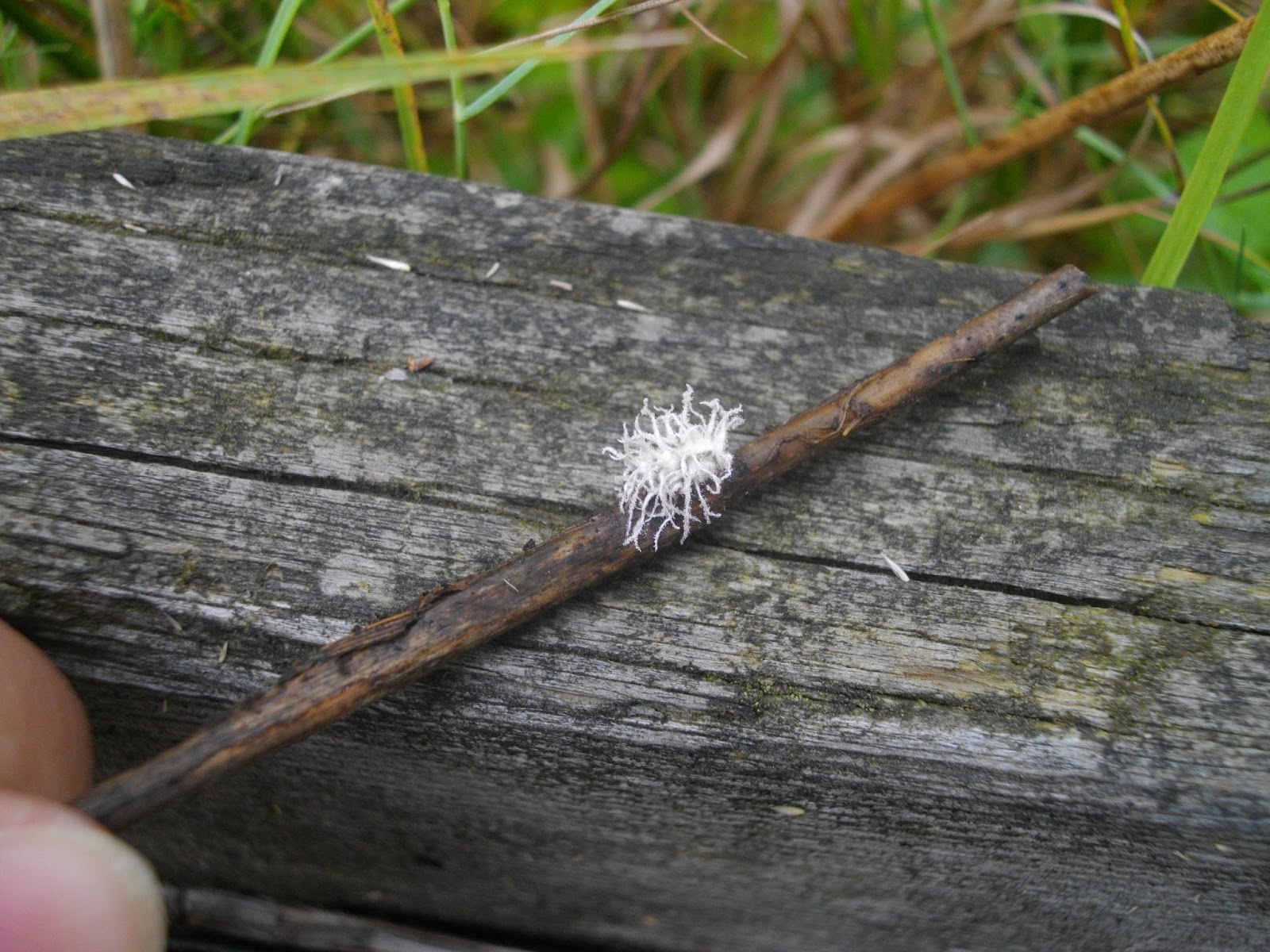
Before leaving we had a quick look in an area of reeds, mostly for Reed Bonnets. We didn't find this particular species, but did find another interesting one, some fuzzy white growths froma dead spider. I checked Milk Parsley leaves for late Swallowtail caterpillars, and in doing so noticed a leaf miner in several plants. Subject to confirmation this is quite a rare fly, only described in 1985, and only recorded on NBN from two 10km squares nationally! Before heading home we had a look at a specimen of Black Tooth, a first for Norfolk found by Anne Crotty.