The Whitlingham Bird Report for 2025 is now available to download from the Bird Reports page or from here

SOUTH NORFOLK: Bracon Ash churchyard survey

12th August 2017

On Saturday afternoon I met Graham Moates at Bracon Ash church to carry out an impromptu wildlife survey at the churchyard. It is one of the churches that has been signed up to a churchyard conservation scheme, and there have been some nice areas left wild. I'd not visited before, but Graham had visited to survey small mammals and thought that it warranted wider recording,


Whilst I waited to Graham to arrive I noticed some Enchanter's Nightshade growing in the boundary ditch, so I went and had a closer look. I found several caterpillars feeding on it, which I thought might be some sort of Pug moth. This put me on the wrong track and I was struggling to identify them, but fortunately Steve on Twitter pointed out that they were the larvae of a sawfly, Tenthredo colon, a new species for me.


After a quick look inside the church, which is notable for housing the Heydon family masuoleum, we moved over to an area of creeping thistles. Here insects included Common Yellow-faced bee, Speckled Bush-cricket and Hairy Shieldbugs. One of the most pleasing sightings was of an ichneumon wasp that can be identified from photos! This applies to only a handful of the thousands of species. The females of Apechthis compunctor can be told from similar species because the ovipositor is short and down-curved at the tip, which was visible in some of my photos.


 Apechthis compunctor

Further round I heard a Roesel's Bush-cricket, but couldn't find it. Luckily I did locate it before we left to prove I wasn't hearing things! We also heard some Dark Bush-crickets and I confirmed a scorpionfly was Panorpa germanica. Moving round to the back of the churchyard a Volucella inanis hoverfly was seen, whilst Cinnamon Bug (Corizus hyoscyami) was a first for Graham.


Another focus while we were there was leaf mines and galls, and a subtle but pleasing one to find was Maple-seed Pigmy (Ectoedemia louisella), which mines the samara (seeds) of Field Maple.


Two other insects of note were tiger craneflies. Nephrotoma flavipalpis has a nice orangey head and large black areas on the yellow abdomen, whilst I think the second one here is Nephrotoma flavescens because of the 'ace of spades' mark on the head.


This was a very interesting visit, and in a couple of hours we generated over 50 invertebrate records. There is no reason why many rural churchs with wild areas wouldn't be just as or even more productive, particularly slightly earlier in the summer with more flowers out.

TARGET SPECIES: Dune Tiger Beetle

10th August 2017

When deciding where to go for our wedding anniversary this year, Cathy very kindly said that we should go somewhere to see one of my target species, so we went to Titchwell to look for Dune Tiger Beetles. In something of a change the weather was actually quite pleasant, so we were abe to have a nice walk in the sunshine.

Heading along the main path we stopped briefly to look at the Spoonbills and scan the nearest islands, but then kept on towards the beach. Just before we reached the dunes I noticed some small Colletes bees (probably C. fodiens) on some Ragwort, but then noticed several Epeolus bees, interesting looking parasitic bees associated with Colletes. I managed to get quite a few photos of them, but all but one of the pictures were of males, and with this species pair it is only the females that are field-identifiable. I think my photo is enough to show that it is a Black-thighed Epeolus, but I have sent the photos to a bee expert for checking. I also noticed another small bee with greenish eyes, that might be Osmia spinicornis. If I sound tentative with these IDs it is because I am - this year I have paid much more attention to solitary bees and I'm learning quickly, but still lack the experience to know if I'm right or not!

 Colletes sp
 Epeolus sp (female)
 Epeolus sp (male)
Osmia spinicornis (probably)

Once on the beach we walked west along the line where the dunes meet the beach, scanning the ground for beetles. For much of the way along we were constantly distracted by Dune Robberflies, but eventually I spotted my target, Dune Tiger Beetle. It ran off, but with a bit of fieldcraft I managed to get excellent views.


Once we had both seen the beetle we walked over to some exposed pools. On the way Cathy showed me how to tell the sex of a crab using the triangle on the underside of the carapace, something that I had been unaware of. As well as a number of small crabs, shrimps and Gobies we saw several good-sized Starfish and several jellyfish, at least one of which was a Blue Jellyfish.


On the way back I saw a new rhopalid bug, Stictopleurus punctatonervosus, on a Ragwort plant by the pathside.


The great grass snake debacle

In a break from the usual posts, here is a rant about some shoddy reporting. In order to understand why this has annoyed me, you will need to understand the following introductory bit.

There are three native species of snake in the UK - Adder, Smooth Snake and Grass Snake (Natrix natrix). The Grass Snake has quite a few different subspecies across Europe. The subspecies of the snakes found in the UK is Natrix natrix helvetica. Research on Grass Snake subspecies has divided them up into three main groups, and one of these, Natrix natrix astreptophora, had recently been elevated to full species rank. The results of a new paper were released on Monday, suggesting that the other two distinct subspecies should also be split, creating the Barred Grass Snake (Natrix helvetica) and the 'nominate' Grass Snake (Natrix natrix s.s. - the s.s. means in the strictest sense as opposed to in the broader sense it used to be used in). The effect of this work in a UK context is therefore quite clear - we don't have any extra species, 'our' Grass Snake simply changes name to Barred Grass Snake (Natrix helvetica).

There are two more things that I should mention. The analyses the genome of grass snakes from across Europe, and a few of an Italian lineage were found in the sample from Great Britain. However, it is specifically noted that these unusual snakes, also found in an area in Germany, are called "a few isolated records "of "obvious cases of translocated individuals" Basically these are escapes or releases from the pet trade and most were excluded from the analysis. Secondly it is worth pointing out that just because this study recommends the promotion of these sub-species to full species rank doesn't mean it will take place. It probably will, but not always.

OK, so if you are following me so far then you will realise that this paper has some implications for European naturalists and conservationists, but in the UK it just means a name change. To be honest in a European context it's a non-story, for example can you remember the time Yellow-legged Gull became a full species being in all the papers?

Now to the crux of the matter. I first heard about this story when Natural England tweeted about it on Monday. The name of the story varied slightly, but a typical headline or byline is:
"New species of grass snake discovered in the UK" or "There are now four species of snake native to the UK"
Eager to read more I did the natural thing and followed the link to read more information. The link led to this article: https://phys.org/news/2017-08-barred-grass-snake-species.html. Reading down the article, a potential issue arose. Whilst it said that the 'new' species was found in Great Britain (no surprise remember as Barred is the new name for our subspecies), the main research looked at two hybrid zones (i.e. where both species meet), and they were in Germany, nowhere near us.

Sometimes scientific papers are kept behind a paywall, so without paying a hefty fee you cannot read the research. Fortunately this was not one of them. Again I followed the link to the original paper on nature.com (read it here: https://www.nature.com/articles/s41598-017-07847-9) and it confirmed my suspicions from the summary. Nowhere did the paper say that both species occurred in the UK. The media report was wrong.

To be fair to Natural England, when it was pointed out to them by several people, they checked it, agreed and took down the original tweet before retweeting it as general research. However by then it had been published by the BBC, Guardian, Express, Telegraph, Daily Mail and presumably pretty much everyone else. The story was re-tweeted by Springwatch, the Wildlife Trusts and various other organisations, not to mention many individuals.

So what happened here? It appears that the initial press release about the paper suggested that both species of Grass Snake are found in southern England. All it would have taken is for a journalist to have read the actual paper and they would have realised this was incorrect, but none of these news sources, trusted by millions, did that. Is it a time thing, a training thing, or do they just not have scientifically minded journalists? In this case it doesn't have any real implications, but the practice of publishing a press release without checking it certainly does in general. I don't have time to check the sources behind each story - that's exactly what I expect journalists to do.

Here we are, two days later, and the stories are all still up, and still being retweeted. Enough other people have figured out the mistake, why haven't the stories been changed?

BRECKLAND: Santon area plants

5th August 2017

The fourth and final part of Saturday's Breckland excursion. When the rain began to pour down we had thought that the Brandon Artemisia visit would be the last site before we headed home, however as the sun started to come out we decided to check out a couple of woodland rides near Santon Downham to look for more rare plants and bees.

We went to an area where I had seen Broad-leaved Helleborines in the past, and they were still present, with over 40 flowering spikes seen. The species that I had particularly hoped to see were the Knawels, and through careful searching I manged to find one small plant of the commoner of the two, Annual Knawel, growing at the edge of a path.


We carried on along the ride, seeing a range of plants including Bur Medick, Bifid Hemp-nettle, and Tower Mustard (the latter a new one for me). A shower passed over and there were few insects about, but I did find an adult Tortoise Shieldbug to go with the late instar one found at Brandon.


We then tried another ride and an area where Ian had seen Perennial Knawel a few years ago. We didn't find it, with three Knawel clumps all turning out to be Annual Knawel, albeit nicer ones than my straggly plant. An Adonis Ladybird and a Hummingbird Hawkmoth completed a very successful days wildlife watching.


BRECKLAND: Field Wormwood and Wasp Spider

5th August 2017

Having returned from our Weeting plant walk and bought a cake from the cake stall, it began to rain. We retreated to the car for lunch as the rain pelted down. The rain looked set, but we agreed to call in to the Artemisia reserve at Brandon on our way home. This unlikely nature reserve is a small rectangle of grassland on an industrial estate - the last bastion of the rare Field Wormwood.


As we parked up the Field Wormwood was immediately visible from the car, but as the rain was beginning to relent all four of us decided to go and have a closer look. We managed to find some flowering, although it wasn't much more spectacular than the ones that weren't. The reddish stems were probably the nicest bit about it actually.


There were a few more plants of interest such as Blue Fleabane and Lucerne, whilst I found a young Tortoise Shieldbug, an adult Crucifer Sheildbug and quite a few Stripe-winged Grasshoppers. As we were about to leave Vanna called out "Argiope", which just got here a blank look from me. She pointed out the Argiope, and it clicked that it was a Wasp Spider (Argiope bruennichi). It was probably a youngish female as the colours weren't as bright as they can be, but a new species for me and a nice one at that. The rain even abated to allow Vanna to sketch the spider. It had an orthopteran wrapped up in silk - probably one of the Stripe-winged Grasshoppers, although there were quite a few Long-winged Coneheads about too.

 Tortoise Sheidlbug late instar
 Cruficer (Brassica) Shieldbug
 Wasp Spider
Long-winged Conehead (this one is an extra-long, i.e. macropterous female)

BRECKLAND: Weeting Heath invertebrates

5th August 2017

This is the second installment of Saturdays Breckland day. Having got out of the car we immediately noticed a colony of Pantaloon Bees (Dasypoda hirtipes) behind the car. This particularly delighted Vanna, who had announced she wasn't particularly interested in the plants and had come to look for bees. As we watched them we noticed several flies following the bees - presumably they were brood parasites. At least two solitary wasp species were also present, Cerceris rybensis and one other.


Having signed in and had a look at the helleborines, we went and had a look at the catch from the moth trap. There was a reasonable selection, albeit probably only 30 species, but four of the macro species were new for me, including a very nice Clouded Buff. The other three new ones were Small Waved Umber, Oblique Striped and Square-spotted Clay.


Once the plant walk had begun I took the opportunity when we stopped to check around the bases of Storksbill and Bedstraw plants. The reason for this is that there are several scarce Leatherbugs and Shieldbugs that are only found around the bases of these plants. This searching paid off almost straight away, when I found three Fallen's Leatherbugs. Later on the warden found a different species, which we couldn't identify in the field. It was probably either Breckland Leatherbug (very rare) or Cryptic Leatherbug. I took a few photos, but as it was through a pot they aren't great.

 Fallen's Leatherbug. Like the Heath Assassin Bug seen at Marsham, the camouflage is very good, but once you get your eye in it becomes easier.
 A different Leatherbug sp.

Members of the group found several caterpillars out on the heath. Hummingbird Hawk Moth was a new caterpillar for me, and a sign that it has been a good year for them. The second hawk moth caterpillar of the year appears to be Small Elephant Hawk, another good one.

 Hummingbird Hawkmoth caterpillar

A thistle on the hill held ten Hairy Shieldbugs, including a mating ball.


The highlight of the visit, although I didn't know it at the time, came when we were shown the White Horehound. The warden told us that it was the foodplant of the very rare Horehound Plume moth, the only Norfolk records being a couple seen at Weeting in 1945. As is my routine whenever I see a rare plant after having a look at the flowers I began looking for leaf mines, plant bugs or caterpillars, and I found a small hairy green caterpillar. Nobody knew what the plume caterpillar looked like, so I photographed it to check at home. Lo and behold it was indeed a Horehound Plume (Wheeleria spilodactylus), rediscovered in Norfolk after 72 years!


Several interesting bees were seen, including Melitta haemorrhoidalis feeding from Harebells, a Colletes sp. on Wild Migonette and Ragwort and another all black one that Vanna is hoping to identify. A couple of Adonis Ladybirds complete d the insect interest.


BRECKLAND: Weeting Heath plants

5th August 2017

A very productive day in the Brecks, so much so that a few posts will be needed to cover everything. I started the day at Weeting Heath, where Wild at Weeting, an end of season celebratory event was being held. Normally this wouldn't really be my cup of tea, but I noticed in the event details that two flora walks were being led, and that these would enable visitors to see some of the rare species on the main part of the heath that is normally off-limits. I had wanted to see two of these plants, Spiked Speedwell and Maiden Pink, for some time, so eagerly booked myself on the first walk. Cathy decided not to come, but Ian, Jeremy and Vanna were all keen to come, so I picked them up and headed to Weeting.

Before leaving on the walk we had a look at the few Broad-leaved Helleborine spikes that grow near to the car park.


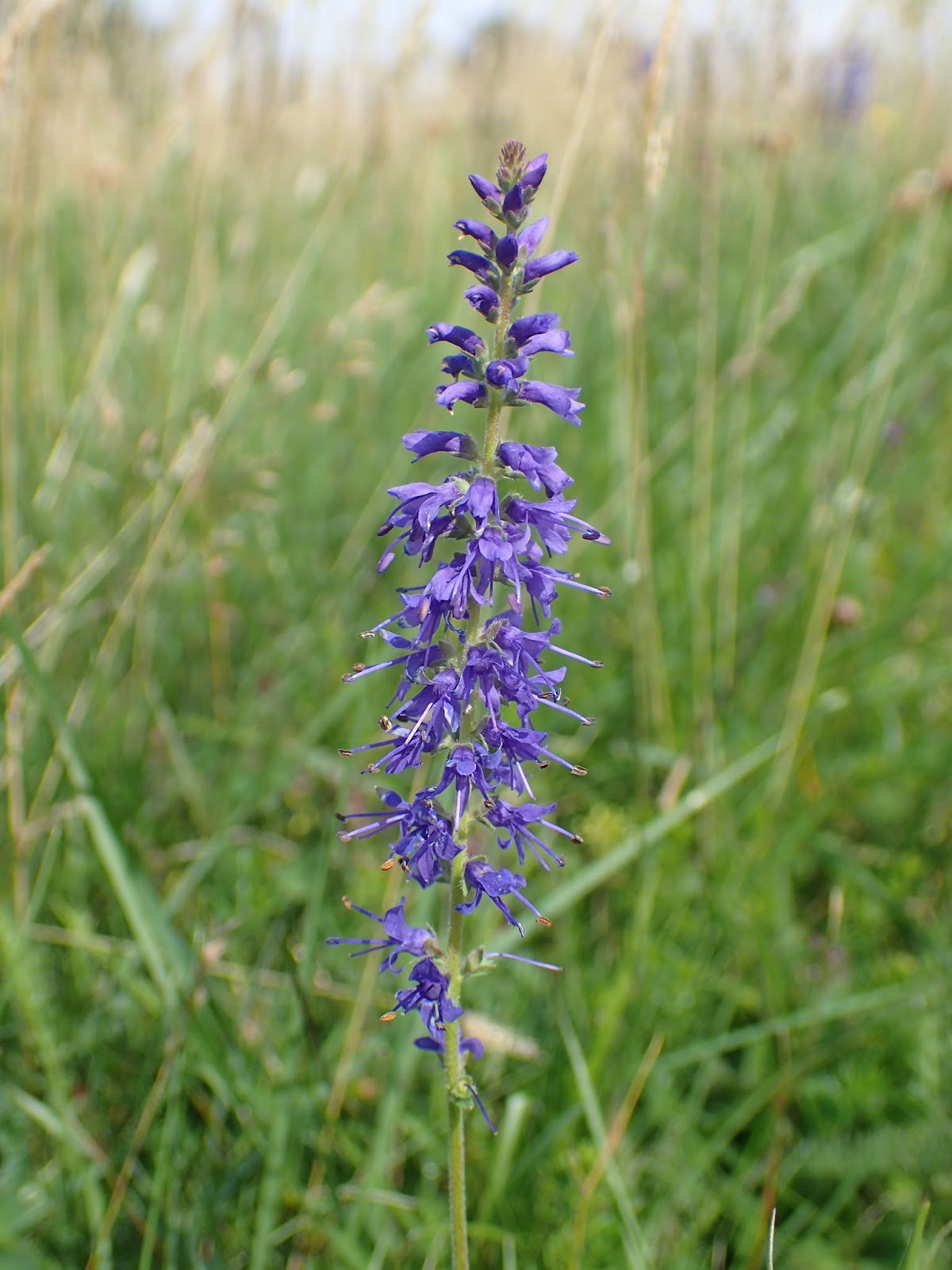
Our first scarce plant was Purple Stemmed Cat's-tail, a rather unremarkable looking grass, followed by the small yellow composite Smooth Cat's Ear. Somewhere along the line botanists obviously liked describing plants in terms of which bit of a cat they thought was most similar. Next up was a clump of Maiden Pink, an attractive plant which might look a bit similar as other pinks are now sold in garden centres. This was a new species for me, and I wasn't disappointed. We then walked across to an enclosure where Spiked Speedwell grows. This was one of my first target species back in 2014, so it was nice to finally see it, and as with the Maiden Pink it was flowering just at the right time for us.


Over the brow of the hill we were taken to see some White Horehound, which was almost over, with only a handful of flowers still. From here we went across to some chalky pits, but some of the earlier spring flora that grows there had gone over. We did see Autumn Gentians, Purple Milk-vetch and Dwarf Thistle which was nice.


On the way back we visited the larger areas of Maiden Pink, before heading to a more recently scraped area where after a search we eventually managed to locate a patch of Sickle Medick (another new plant for me) that the warden had seen the previous day.


We also saw a good range of moths and bugs, which will be the subject of the next blog post. Our thanks go to James the warden for leading the walk and for his knowledge and enthusiasm. We had booked on the right walk too, as by 2pm a thunderstorm hit and we ate our lunch in the car as the rain poured down.