The Whitlingham Bird Report for 2025 is now available to download from the Bird Reports page or from here

NORWICH: Snout & oak gall

6th September 2017

A couple of interesting observations from Lakenham before work on Wednesday. Firstly I spotted a Snout moth resting in a hedge, a common moth this time of year but more often seen amongst the vegetation so sometimes hard to photograph. Secondly on Lakenham Way I saw a gall caused by the gall wasp Andricus grossulariae on Oak. The life cycle of this species, along with some other gall wasps, is a bit unusual. There is a sexual generation that produces small red galls on Turkey Oak catkins, but also an asexual generation that gives rise to the gall I saw today (a sort of frizzy knopper gall).


SUFFOLK: Somerleyton estate fungi

2nd September 2017

On Saturday the Norfolk Fungus Study Group visited the Somerleyton Estate. The border-aware amongst you will be aware that Somerleyton is in Suffolk, but as there is currently no equivalent Suffolk Fungus Study Group there is often one foray held in Suffolk, if nothing else to get a few more records for county recorder Neil Mahler who is a regular attendee at the Norfolk events.

We began at St Mary's church, where after the cows had dispersed we were able to check a nearby field. There was very little fungi about, Puccinia glechoma (a rust on Ground Ivy) was probably the pick of the bunch. Rose Sputnik galls and a Pale Tussock caterpillar were the non-fungal highlights.


Whilst more fungi would have been nice, it did at least mean that we unanimously agreed to move on to our second site, an area of heath and woodland further north on the estate. After convoying to a parking area closer to Fritton Lake we then headed down a path, seeing a Stinking Dapperling. The group dispersed to cover an area of heathland, and although there was quite a bit of fungi about, it was mostly a rather narrow band of common species. Sepia Bolete (Xerocomellus porosporus or Boletus porosporus, I don't know which is the current name and it's largely irrelevant as it will probably have changed again by the time you read this) was nice to see.


After lunch we moved on to a bit of wet woodland, and the early signs weren't particularly promising. Moving a bit further along we finally found a productive area, and the finds began to rack up. Rutstroemia echinophila, a cup fungus growing on Sweet Chestnut husks, was a new one for me. A range of Mycena, Inocybe, Naucoria and Cortinarius upped the species count, with Mycena rhenana growing on an Oak Knopper Gall being of particular interest. 


On the way back Yvonne found some Powdery Piggybacks growing on an old Blackening Brittlegill, which according to my records was my first sighting since 1998, a reminder of how long I've been looking at fungi!


WHITLINGHAM: Parent bugs and a chalcid wasp

31st August 2017

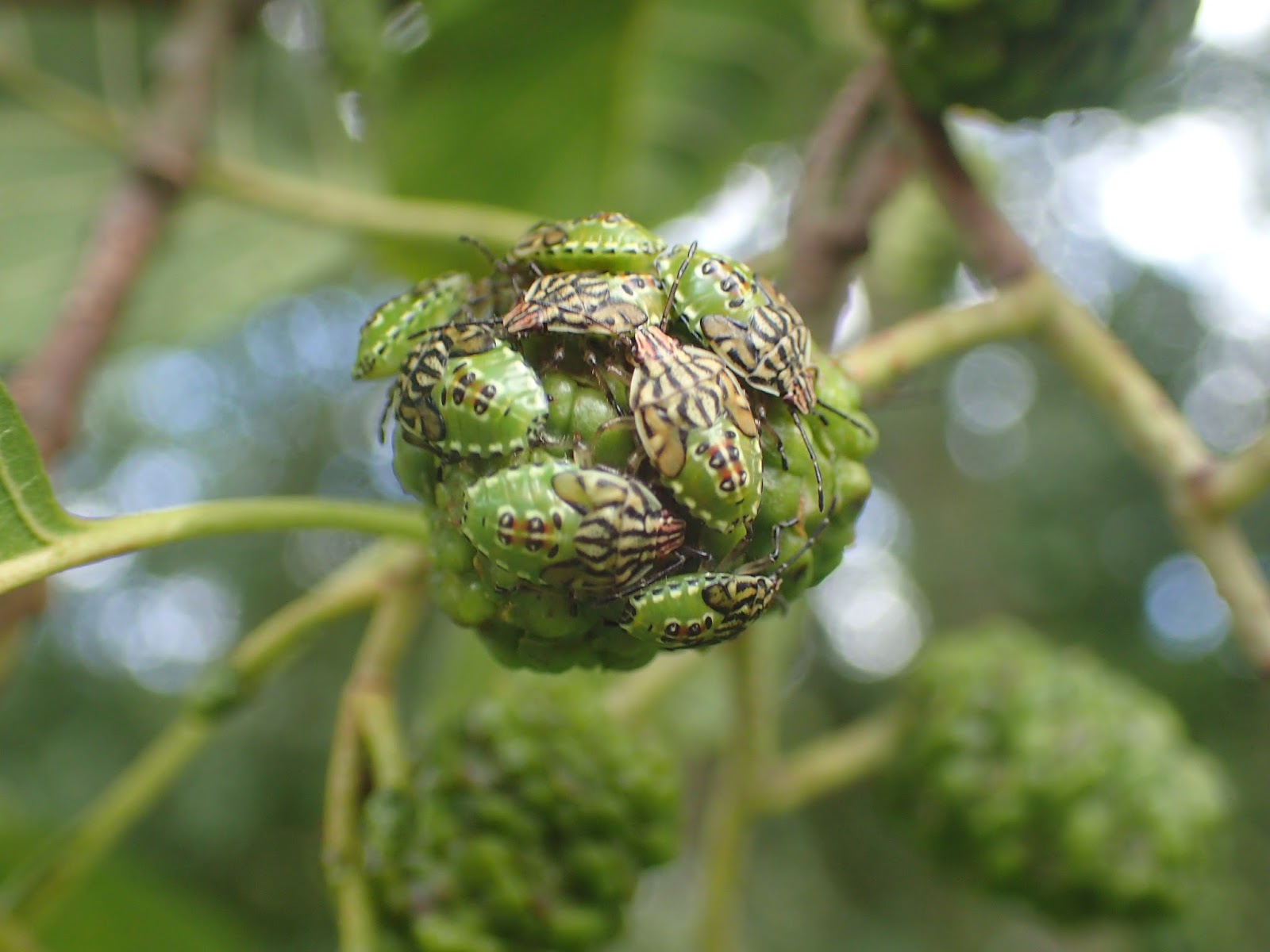
An hour at Whitlingham, and as a singing Chiffchaff was the only bird of note I spent my remaining time checking the trees. One of the first Alders I checked had a brood of late-instar Parent Bugs clustered round in a ball, which was nice to see.


I managed to record three new moths for my patch list, although unfortunately I didn't see any of them as they were all from vacant mines. These were Stigmella tiliae (on Lime), Stigmella lemniscella (on Elm) and Bucculatrix bechsteinella (on Hawthorn). The harvestman Paroligolophus agrestis was one I'd not recorded before, but apparently it is one of if not the commonest harvestman in the UK, so I'm glad I rectified that. The highlight of the walk was a tiny but beautiful chalcid wasp, Ormyrus nitidulus. For scale, it is sitting on half an Oak Knopper Gall.

 Ormyrus nitidulus

NORWICH: Mousehold fungi and leaf mines

30th August 2017

Another brief local trip, this time to Mousehold Heath. It was raining so there were few insects about, so I focused my attention on fungi, leaf mines and galls. There was quite a bit of fungi about, but most of it was a small range of common species like Sulphur Tuft, Tawny Grisette, Ochre Brittlegill, Blusher and Common Earthball.

 Tawny Grisette
Ochre Brittlegills

Of the rest, a gall on Yew was new, as was an Agromyzid leaf mine in Silver Birch. I thought I'd found a new leaf-mine in Bracken, but it later turned out that there are two species that make near-identical mines so it remains an either/or. The highlight was a leaf beetle, Gonioctena olivacea, found on Broom.

 Taxomyia taxi
 Agromyza alnibetulae
 Leaf-mine in Bracken
Gonioctena olivacea

NORTH NORFOLK: Bank holiday part 3 - Morston

Our afternoon destination was Morston, apparently along with hundreds of others. Most of them seemed content to stay around the quay or head to Blakeney though, so when we took the coast path towards Stiffkey we were soon away from the crowds. I spotted some Sea Wormwood and had a quick look for Scarce Pug caterpillars without success. I'm not sure if they are found this far east, as the distribution is mainly the north-west of the county.


Our target here was Sea Aster Bee (Colletes halophilus), which as its name suggests is an autumn flying bee that specialises in collecting pollen from Sea Aster, a fact that is very useful as otherwise it looks very similar to other members of the genus. To start off we struggled to find any large areas of Sea Aster, but then on the off chance we checked a bit of saltmarsh and found quite a bit in flower. It was mostly the rayless form, and hence had gone overlooked as we were looking for areas of purple. On the yellow flowerheads we found 15-20 Sea Aster Bees, somewhat tricky to photograph but niec nonetheless. This was my 49th bee species - not a spectacular total but double the number I'd seen at the start of the year.


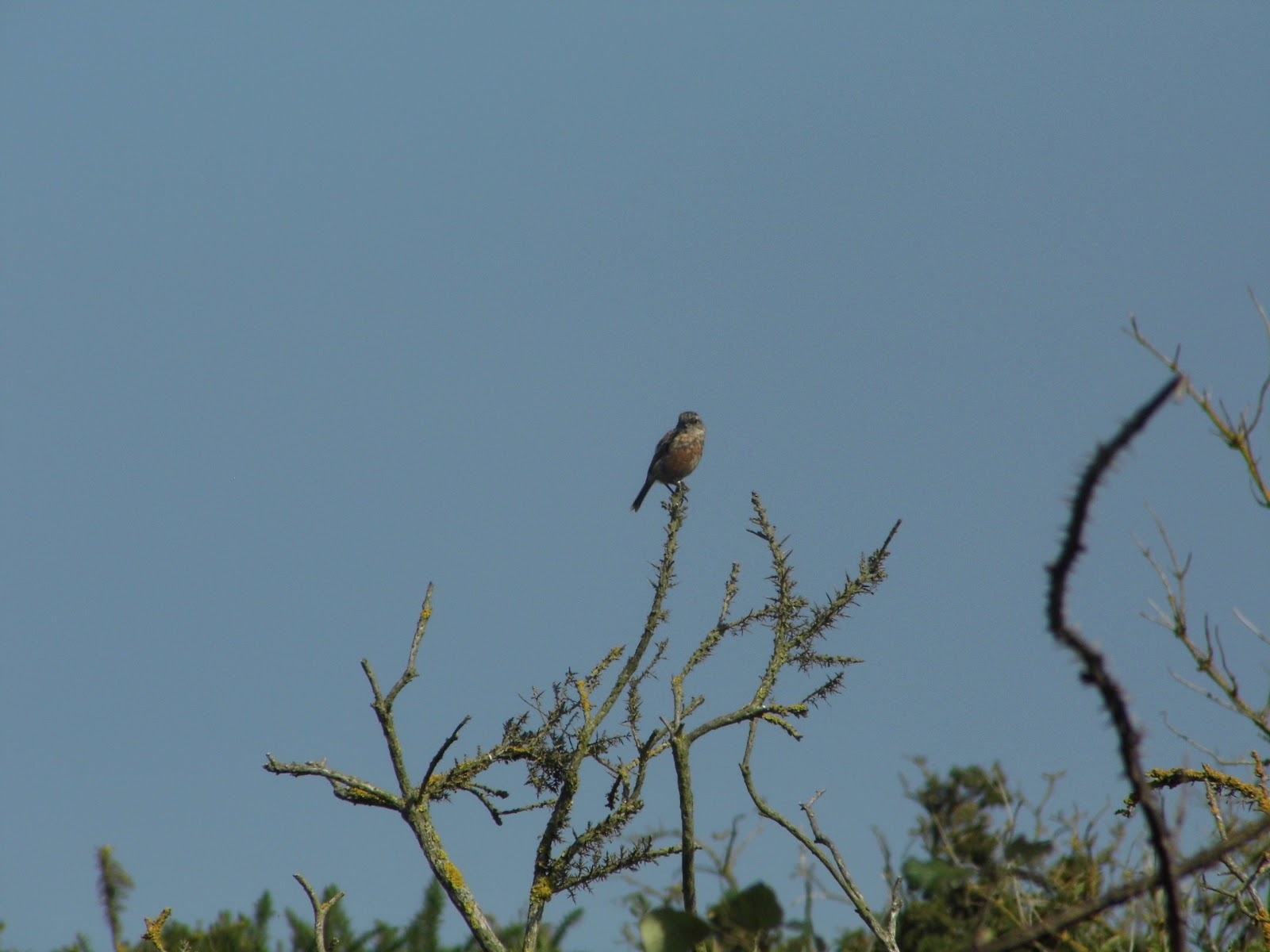
We carried on past the bees to Stiffkey Fen, where we stopped and had lunch. The birds were quite distant, although a flock of 37 Spoonbills stood out. On the way back we paid more attention to the scrub and saw several Stonechats, presumably a family group.


Back at Morston Quay we headed to the toilets and Adam noticed a Frosted Orange moth on the wall. Looking up we realised that there was actually a good range of moths over the ceiling and walls, so once it was empty I quickly moved about and photographed a few. There were more on the outside of the block too. Given the nearby saltmarsh and the coastal location I was hopeful that some of them might be rare, but there was nothing I'd not seen before. Rosy Rustic, Chinese Character and Pale Eggar were some of the scarcer ones. We had a quick look from the observation tower and a tasty sausage roll before leaving.


NORTH NORFOLK: Bank holiday part 2 - Weybourne

Adam & I had arranged our day out in advance, and had hoped that the last week of August might yield a few migrant birds, but the wind direction had largely out paid to this. Instead we decided to head to the coast but concentrate on bees instead.

Our morning destination was Weybourne Cliffs, where I had heard that there was a colony of Heather Bees (Colletes succinctus) over a thousand strong. My previous experience of this species was of a few skittish bees flying about the heather, so this would be a good chance to observe them closer up. In addition, they were likely to be attended by the cleptoparasitic Red-thighed Epeolus (Epeolus cruciger), a species I'd not seen before (I saw the closely related Black-thighed Epeolus at the start of the month at Titchwell).

Starting off on the top of the cliff, we found some Lasioglossum sp and a few Heather Bees nesting in some sandy outcrops. It soon became evident that the main colony was in an area of sandy cliff, about two-thirds of the way up. The best way to view was evidently from the beach, so we went back down and round. Most of the bees were above head height, but enough came down lower for us to get some good views.


We were successful finding the Red-thighed Epeolus too. As well as finding several males and females, there was a dead one, which allowed for close examination. Given that many bees require close (often microscopic) examination, it was useful to get close up views to compare against the other species in the genus. Adam also located a large beetle, which as I hoped turned out to be one of the coastal specialists, Broschus cephalotes.


After spending a while at the colony, we moves across to the western cliffs. These seemed to have nothing nesting in them, so we moved on to scanning Weybourne Camp. I remarked that there should at least be a Wheatear about, at which point Adam found one. That was it for migrants though, so we headed back to the car and onwards.

NORTH NORFOLK: Bank holiday part 1 - North Walsham

28th August 2017

On bank holiday Monday I had arranged to go out with Adam, so I headed back to North Walsham. before we went out we went through some moths that Adam had caught the night before. Most of them were typical for the time of year, but there was a new one amongst them for me, Scarce Bordered Straw. This species is a fairly regular migrant at this time of year, but numbers vary and catching one seems to be pot luck really.


When we went out into the garden to release the moths Adam pointed out a parasitised Large White caterpillar and pupae of the parasitic wasps that had emerged. These small yellow cocoons are made by Cotesia glomerata, and should be looked for wherever you know that Large White caterpillars have eaten your veg!


We then a brief look around the garden so that I could add a few species to Adam's fledgeling garden list. These mostly took the form of leaf-miners, including Amauromyza flavifrons in Red Campion and Stigmella plagicolella in Sloe leaves.


Later in the day I was about to leave when Adam found one of the impressive Sycamore Moth caterpillars in his hedge, as well as an Angle Shades moth.


YARE VALLEY: Strumpshaw moths

26th August 2017

Each year Strumpshaw Fen hold three public moth morning events. I had been busy on the days of the first two, but would have probably chosen to go to this one out of the three anyway as it was slightly later in the year than normal to attract a different range of species. Cathy, Margaret and I arrived a bit early so went and had a look from the vieweing screen, seeing Kingfisher, Bearded Tit, Marsh Harrier and Black Swan. Whilst the group assembled we then stopped as a Shrew sp ran under a nearby table.

As usual Ben had put out two traps, one in the woodland and one in the wetter habitat in front of reception hide. Between the two traps around 60 species were caught, but for the first time at one of these events I didn't see any new species. There were two that I hadn't seen in Norfolk before, Lesser Swallow Prominent (Suffolk) and Six-striped Rustic (Kent), plus several species that I had only seen once before like Chevron and a Clay Triple-lines that Ben brought from his garden trap in Brundall. Other things like Burnished Brass are always nice to see.

 Lesser Swallow Prominent
 Chevron
 Clay Triple-lines
Burnished Brass

I had hoped to have a quick look for other insects after we had gone through the traps, but a steady rain had begun to fall so there wasn't much point. I did find some 'sputnik' galls on Dog Rose near the reserve entrance, caused by the cynipid wasp Diplolepis nervosa, along with another Hawthorn Shieldbug. Thanks as always to Ben for running the event.


NORWICH: Cow tower Willow Emeralds

25th August 2017

Another brief Norwich excursion, when after work on Friday I detoured through the cathedral grounds and round the river. The main purpose of the walk was to check for Willow Emerald damselflies at the pond near Cow Tower, and I was pleased to find four, including a mating pair. There were also several male darters, although I didn't see them well enough to determine if they were Common or Ruddy. A red shieldbug was also seen near the pond, which as suspected was a mid-instar Hawthorn Shieldbug.


NORWICH: Train Wood highlights

22nd August 2017

After work on Tuesday I decided to take a rather circuitous route home, taking in a bit of Train Wood. There wasn't much in the way of flowering plants in the wooded area, so I cut through and emerged onto the main tarmac path running behind the industrial estate. Here there was more to draw my attention, and amongst the numerous Canadian Goldenrod I found some stands of Tansy. As I don't see it too much I decided to focus on it, and this paid of with three new species for me - Tansy Aphid (if you look closely you can see the demonic red eyes), a Tansy leaf miner (Phytomyza tanaceti) and a plant bug, Megacoleus molliculus.


A bit further along I searched another clearing and came up with two more new species, another leaf miner (Agromyza frontella), this time in Hop Trefoil, and a rhopalid bug, Liorhyssus hyalinus.


To show that I was using some of my other senses I located a calling Great-spotted Woodpecker, then used my sense of smell to track down a group of Stinkhorns in the pathside vegetation. A very productive diversion home all in all.