The Whitlingham Bird Report for 2025 is now available to download from the Bird Reports page or from here

THORPE MARSH: Bearded Tit at last

22nd December 2017

Having been birding a fair bit in the last few days my intention was to stay in on Friday, but a call from Justin telling me that a Bearded Tit was currently showing at Thorpe Marshes changed that. I headed to Thorpe and made for the reedbed, where predictably there was no sign of it, but Justin was still on site so he came round to show me where he had seen it. After a short while a stunning male Bearded Tit appeared in the reeds. It showed well, although its constant movement meant that my attempt at photos were largely of different bits of it obscurred by reeds. I did get one photo that I was happy with (the 2nd one here) - it isn't particularly sharp or detailed, but captures the moment well I feel. This was my second new patch bird of the year (Hawfinch was the first) and my 147th Whitlingham and Thorpe bird overall. Whilst standing near the reedbed a Grey Wagtail flew over and the flock of Siskin moved along the Alders, but I returned home rather than do a full lap.


NORWICH: Waterloo Park - a new fly for Norfolk

21st December 2017

This autumn there have been sightings of two Ring-necked Parakeets in the north-western part of Norwich, but they have been rather mobile and despite several attempts I've not caught up with them yet. On Thursday morning they had been seen on Angel Road, close to where I live, so after returning from Thorpe I had lunch and then popped out for a quick look round. There was no sign of them in the roadside trees, lamp-posts and TV arials, so I decided to give Waterloo Park a quick look. There was no sign in there either, but on a whim I decided to have a look at the Globe Thistles to look for leaf mines. I found some, so took some pictures and returned home. It didn't take long to identify them as Phytomyza bipunctata, but to my surprise it turned out that this was the first Norfolk record of this species. An unexpected but pleasing end to my walk.


THORPE MARSH: More standing near reeds and c-r Black-headed Gulls

21st December 2017

On Thursday morning I popped in to Thorpe Marsh to have another look for the Bearded Tit. After a while standing and scanning the reedbed I there was no sign of any, so I decided to do a quick circuit before returning for a final look. It didn't appear to have been too disturbed, which was borne out when I saw the overwintering Stonechat perched up on a dead umbellifer. Further round I had a look on the broad, but the mist meant that visibility was poor.


Along the riverbank I noticed some Mycena growing on a fallen Ash, which when dried gave an Iodine smell. Along with spore size this confirmed them as Mycena arcangeliana (Angel's Bonnets). Some nice purple Chondrostereum purpurpeum (Silverleaf fungus) was also growing nearby.


After my lap I did return to the reeds for a bit. I then decided to head to Thorpe Green to check for colour-ringed gulls. I managed to pick out two, both regular overwinterers, white J0AJ and green J6U2.


YARE VALLEY: Rockland at dusk

20th December 2017

On Wednesday, Ricky & I travelled to Rockland to meet up with Jim. Before heading to the New Inn for a pint and a catchup we decided to have a look on the broad and marshes, before waiting to see if any harriers would come in to roost. There was an early highlight when we saw a white Muscovy Duck at the staithe, one of a local pair. Obviously this was tinged with worry about where the other one was, but we found it herding Moorhens in a field nearby.


In the scrub by the path a Chiffchaff called and we could hear a Redpoll flying around close by but unseen. A dead Chinese Water Deer was lying on the marsh but there was no sign of any interesting scavengers. Further along a Woodcock flushed from a belt of wet woodland and flew out onto the marshes. Where the dyke joins the broad we stopped to scan the open water. I said how rubbish I found  Rockland Broad for ducks, which undoubtedly helped Jim pick out a smart drake Goldeneye.

Walking down towards the river the light began to fade, and mist obscurred our view beyond the trees. A Tawny Owl had called distantly, and a Marsh Harrier flew past, but otherwise we were entertained by two Chinese Water Deer chasing each other and the constant pinging of Bearded Tits from the reeds behind the dyke. We headed back to the village for an enjoyable drink and snacks, having had a very pleasant evening out.

THORPE MARSH: Dusk watch

19th December 2017

After seeing the Bittern at Whitlingham I hurried round to Thorpe to see if my luck would continue. I spent a bit of time listening for the Bearded Tit(s) (one had been seen by the RSPB Strumpshaw volunteers on 13th, and two had been heard in November by Mark C). With no sight or sound I continued on to the marsh where I waited until just past sunset to see if anything emerged or roosted. A handful of Meadow Pipits flew in and a Snipe flew out, but that was about it. I left before dark though, so perhaps more would have happened then. Several Water Rails squealed (I managed to see one of them) and several Cetti's Warblers were also giving subdued bursts of sub-song.

WHITLINGHAM: Bittern in the sunshine

19th December 2017

I began a brief visit to Whitlingham with a check around the productive woodchipped area, where I noticed a group of Lepista sordida - which according to my records I had only seen twice before, back in 1995.


Walking along the south shore of the Great Broad a Kingfisher flew along the ditch, a few feet away. This would usually be the highlight of my visit, but a bit further along I was scanning the reeds on the far side of the broad when I noticed some movement. It was a Bittern, regular here in winter but elusive and always a pleasure to see here. Even better, whilst watching the Bittern a Kingfisher flew through my binocular view and landed close by. A quick scan of the sunny reeds now revealed a Grey Heron, a Kingfisher and a Bittern. Without doubt one of my favourite patch visits of the year.


Photographed through my binoculars so not great quality, but it is facing in different directions in the photos so you can see something has moved!

BEER: Long-eared Owl and Red Robin

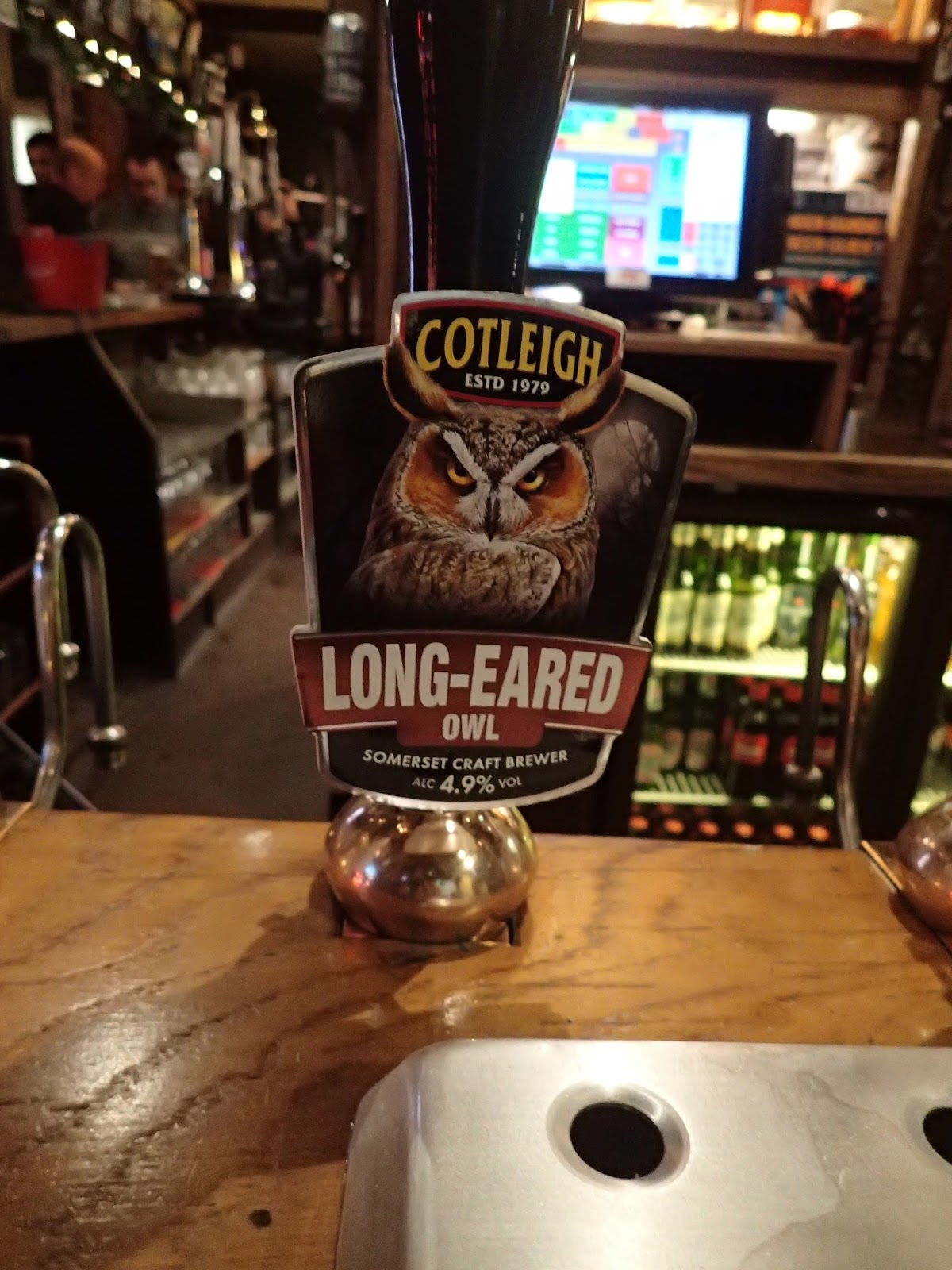
Over the past week I've managed to sample a couple of new birdy beers. If you are in Norwich then it's always worth calling in at the Murderers on Timberhill, but now even more so as you can sample a pint of Long Eared Owl ale from Cotleigh Brewery (a staple source of beers named after birds).


If you frequent further along the Yare Valley then the New Inn at Rockland St Mary currently have Red Robin, a seasonal beer from the Green Jack Brewery, which I'd recommend.


If you see any other bird-beers whilst out and about in Norfolk this festive period then please leave details in the comments!

MID NORFOLK: Foxley Wood fungus foray

16th December 2017

The last fungus study group foray of the year was held at Foxley Wood, and there was a respectable turnout given the icy weather and various illnesses going around. We were also joined by Rob Yaxley, who has been getting more interested in fungi this autumn, and also used to visit Foxley regularly.

Steve found some Crepidouts epibyrus growing on leaves near the car park, before we headed off towards the older part of the woods. Our first stop was a log pile, where some Leafy Brain fungus was of note. We continued on into an area of mature Hazel, where we spread out to find as much as possible. Twig Parachute, Spring Hazelcup and some frozen Witches' Butter were the highlights here.


A bit further along the path were some Crimped Gill brackets, a species only added to the Norfolk list in the past five years but now relatively common, a late Fly Agaric, some Green Elf Cups and the contorted variant of Pipe Club. There were two new species for me, Dingy Twiglet and the sclerotia of Typhula phacorrhiza.


We had a room at Bawdeswell village hall booked for lunch, a planning meeting and a presentation of notable fungal finds this year, so after a couple of hours we turned back and headed for Bawdeswell. The village hall was very modern and the staff friendly - certainly worth considering if you are looking for a venue out this way. We thrashed out a prospective foray programme for next year and went over some of the interesting things that members of the group had found.

Many thanks go to Steve Pinnington for organising the forays this year, and of course to Tony Leech and everyone else who has attended and helped identify all of the species we find.

WHITLINGHAM: December wildfowl count

9th December 2017

I had been looking forward to the final WeBS count of the year. Duck numbers had been building, and a cold spell forecast for the days before increased the chances of encountering some of the scarcer wildfowl. As the weekend drew closer the weather forecast was updated to include heavy snow on Sunday. Whilst rain is a mere inconvenience on a count, snow is a big problem, because it can completely obscure the visibility. I also found myself coming down with a heavy cold, so I ended up dragging myself out of bed early on Saturday to get the count done. As it happened we didn't get much snow on Sunday after all, but there we are.

Arriving at the car park I got an unusual sense of barren-ness, but soon twigged that it was because the hedges had been cut low and so you could see out and across the field opposite. Scanning across the Little Broad I picked out a Kingfisher, always a good start to the count. There were few Tufted Ducks or Gadwall here, but there were five Shovelers at the east end.


Moving across to the Great Broad the highlight of my visit came when a Stoat scampered across the path near the ruins of Trowse Newton Hall. This was a rare sight here (not surprising given how well used the site is) - my first since 2012. Despite the cold weather there was nothing out of the ordinary, not even a Goldeneye. Justin counted Thorpe Broad simultaneously as many of the birds along the western shore wouldn't have been visible from Whitlingham, so these species counts are our combined counts:
  • Gadwall 256 (2016: 252)
  • Teal 151  (2016: 42)
  • Tufted Duck 326 (2016: 387)
  • Pochard 48 (2016: 31)
  • Coot 151 (2016: 371)
To summarise, Gadwall numbers very similar to last year and Aythya numbers reasonably close too. The increase in Teal is likely to be as a direct result of the spell of cold weather, bringing extra birds in and also making birds that would have otherwise been out of sight on small pools into the open water. The key difference then is the Coot, with less than half of last years count. Going back to 2015 the December count was 264, so clearly there is a good deal of variance, but by either count this year looks like a poor one for Coot.


WHITLINGHAM: Kittiwake (deceased) and fungi

3rd December 2017

On Sunday Karl & I took his boys for a walk around Whitlingham. This meant I wasn't thoroughly scanning the broad for birds, but the most interesting sightings wasn't going anywhere in a hurry as it was dead. This Kittiwake, found at the end of the Little Broad is only the third record I am aware of from Whitlingham - hopefully the fourth one is in better health.


There was quite a bit of fungi about, including the coral fungus Ramaria decurrens, which was a new one for me here.

 Blistered Cup (Peziza vesiculosa)
 Hebeloma sp.
 Ochre Coral (Ramaria decurrens)
 Mycena sp.
 Oyster Mushroom (Pleurotus ostreatus)
Yellow Brain (Tremella mesenterica)

NORTH NORFOLK: Bacton Woods fungi

25th November 2017

Saturday saw the penultimate fungus study group foray of the year, held at my old local woods, Bacton (Witton) Woods. Before heading off I popped round to see Jeremy and Vanna, who had a shieldbug for me. The commonest Shieldbug that I'd yet to see was Juniper Shieldbug, a species which has increased its range in recent years. They seem to be hard to find just by checking conifers, but Jeremy has discovered several that have emerged from hedge clippings, and he had kindly kept hold of one for me. They are nicely patterened things, and noticeably smaller than the closely related Hawthorn and Birch Shieldbugs.


After saying goodbye I headed back to North Walsham and on to Bacton Woods, my breath visible within the car as a reminder of the low temperatures. As we headed off into the woods Stewart pointed out some Wood Sanicle leaves that held mines of Phytomyza brunnipes. We started adding species to the days list, mostly common things like Clouded Funnel, Tanwy Funnel, Jelly Ear and Candlesnuff. After a while we were still within sight of the cars - not great for covering a large site but a good indicator that there is lots of fungi about.


Crossing the main path we continued to acrue records, but some of them were a bit more unsual. Neil found some pale yellow strongly decurrent toadstool types that were determined as a pale yellow variant of Trumpet Chanterelle (Cantharellus tubaeformis). Bearded Dapperling (Cystolepiota seminuda) was another good find. Other highlights included Boletus ferrugineus, Conifer Shield, Violet Domecap and a tiny pink bonnet, Mycena smithiana.


We stopped for lunch at the pond, before heading up through a coniferous area and into some Beech woodland. Whilst scanning the leaves I noticed a tortrix moth, Acleris sparsana, along with some common beech leaf mines. David found some egg cases of the spider Paidiscura pallens, on the underside of a leaf. In total the list pushed towards 100, albeit probably 20 of those were plant fungi (mildews and rusts) found by Stewart.


NORWICH: Earlham Cemetery fungi and hedgehog

19th November 2017

On Sunday I attended the second of two fungus-themed Friends of Earlham Cemetery walks. Despite visiting in autumn over a number of years these walks continue to provide things of interest - even Ian who visits very regularly still finds new species on almost every visit! Our group was swelled by several members of the fungus study group, with Steve and Gill making their first visit and David also in attendance.

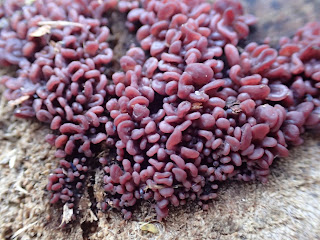
Our aim was to go across to the Farrow Road section of the cemetery, but obviously we stopped quite a bit on the way as we came across various fungi. A small group of Glutinous Earthtongues were pointed out, one of two species (along with Hairy Earthtongue) that can be identified in the field. Other species nearby included Deceiver, Fragrant Funnel, Butter Cap and Wood Blewit. We stopped a bit further along to look at a good crop of Purple Jelly Discs growing on a cut stump.


Further along we had a look at one of several productive bits of short grassland where we saw Geoglossum umbratile, Snowy Waxcap and some Pinkgills. Nearby we checked on the Striated Earthstars, where one fresh one was growing near some older fruiting bodies. We also had a debate about the smell of a brown fungus with a yellow edge. Ian and I felt it was Cucumber Cap, but others felt the smell was more rubbery. In the end I took one and after staining a section I easily found the large triangular cystidia that give this species it's generic name, Macrocystidia.


Finally reaching the far part of the cemetery we stopped to admire a 'fairy ring' of Field Blewits. My photos don't do them justice, they have a rather dull buffish cap but a very noticeable (in the field at least) purple stem. Grey Knight, Meadow Coral and Wrinkled Clubs were all seen, followed by Agaricus langei, confirmed later by Steve.


It was already beginning to get dark by the time we reached the far end of the cemetery, and looking into the long grass we saw a Hedgehog running about! It is getting late in the year for them, but this one seemed a good size and was foraging for food so we let it carry on (I'm aware that in some school of thought we should have picked it up and weighed it, but we didn't feel that was necessary in this case).


As the light faded further, as well as the knowledge that the gates would be locked fairly soon, we headed back via a scarce inkcap that Ian had found the previous day. It was quite a distinctive species, Coprinus impatiens, so I was glad we managed to see it before leaving. I also noticed some London Plane trees so checked for London Midget moth leaf mines and found some, the first records from this tetrad for 13 years.


Thanks to Ian as always for leading the walk.

WHITLINGHAM: November wildfowl count

19th November 2017

Time for the November WeBS count, and I was hoping to catch up with a Goldeneye, knowing that there had been up to three earlier in the week. I arrived to a country park split in half, partly bathed in warm sunshine and partly in shadow with glistening frost.

The broads had good numbers of ducks, but not much in the way of variety. Combined Little Broad/Great Broad/Thorpe Broad counts included:

Tufted Duck 343 (2016: 194, 2015: 141)
Gadwall 143 (2016: 112, 2015: 29)
Mallard 65 (2016: 64, 2015: 67)
Shoveler 12 (2016: 11, 2015: 0)
Coot 146 (2016: 254, 2015: 157)
Little Grebe 7 (2016: 11, 2015: 0)

As you can see from the figures below Tufted Duck numbers are much higher than last year, but Coot numbers are down (although similar to 2015). The undoubted highlight of my visit was watching two Kingfishers chasing each other in the sunshine, always a pleasure to see them. On the river the local Muscovy has cruising back and forth, and the Mallard x Pintail hybrid was on the Great Broad.


Apart from birds I saw Phytomyza chaerophylli on Cow Parsley and the two Hazel Stigmella mines, Stigmella floslactella and Stigmella microtheriella.

THORPE MARSH: Leaf miners and ducks

18th November 2017

On Saturday I popped down to Thorpe Marsh to look for some Bearded Tits that had been heard in the small reedbed on the previous day. After crossing the railway I decided to check some Cow Parsley for the leaf mine of Phytomyza chaerophylli, a common but overlooked species which I found in the first patch I checked.


Heading round towards the marsh I stopped near the reeds and listened for a while, but there was no sign of any Bearded Tits. It was rather windy, so I wasn't surprised not to see them. Whilst on my vigil I kept an eye on birds moving along the tall trees near the railway line. A flock of Fieldfares flew west, and a large Goldfinch flock with a scattering of Siskins were feeding in the Alders.

After a while I gave up and moved off, checking the flood and marsh before moving on to the broad. There were loads of ducks, including around 160 Tufted Duck and the returning Pochard x Ferruginous Duck.


On my way back it struck me that I couldn't recall any apple trees at Whitlingham, so I should check the crab apple near the mooring basin. This was a good idea, as I noticed some old mines of Apple Leaf-miner moth, Lyonetia clerkella.


NORWICH: Waterloo Park leaf mines and flies

11th November 2017

After a packed autumn this weekend was nominally a non-wildlife one, but on my way home from the city centre I decided to pop into Waterloo Park for a quick look round. It was too cold for many insects to be around the flowerbeds, but I headed to the end where there is a small arboretum-style area of trees. I picked out a couple of Hornbeams, and after a quick (unsuccessful) check for Hawfinches, I had a look at the leaves. I was instantly rewarded with three leaf mines; Nut-tree Pigmy (Stigmella microtheriella) which I have previously seen on Hazel, and two new ones, Hornbeam Midget (Phyllonorycter teneralla) and Dark Hornbeam Midget (Phyllonorycter esperella).


Further across I was checking a Silver Birch and was showered with Birch Catkin Bugs! There were a few flies on sunny tree trunks and leaves, including an orange Phaonia sp, something similar but skinnier and finally a Lance Fly sp (Lonchaidae). I should have probably come and checked out this area over the summer really.