The Whitlingham Bird Report for 2025 is now available to download from the Bird Reports page or from here

NORWICH: Earlham Cemetery lichens and micro moths

12th May 2018

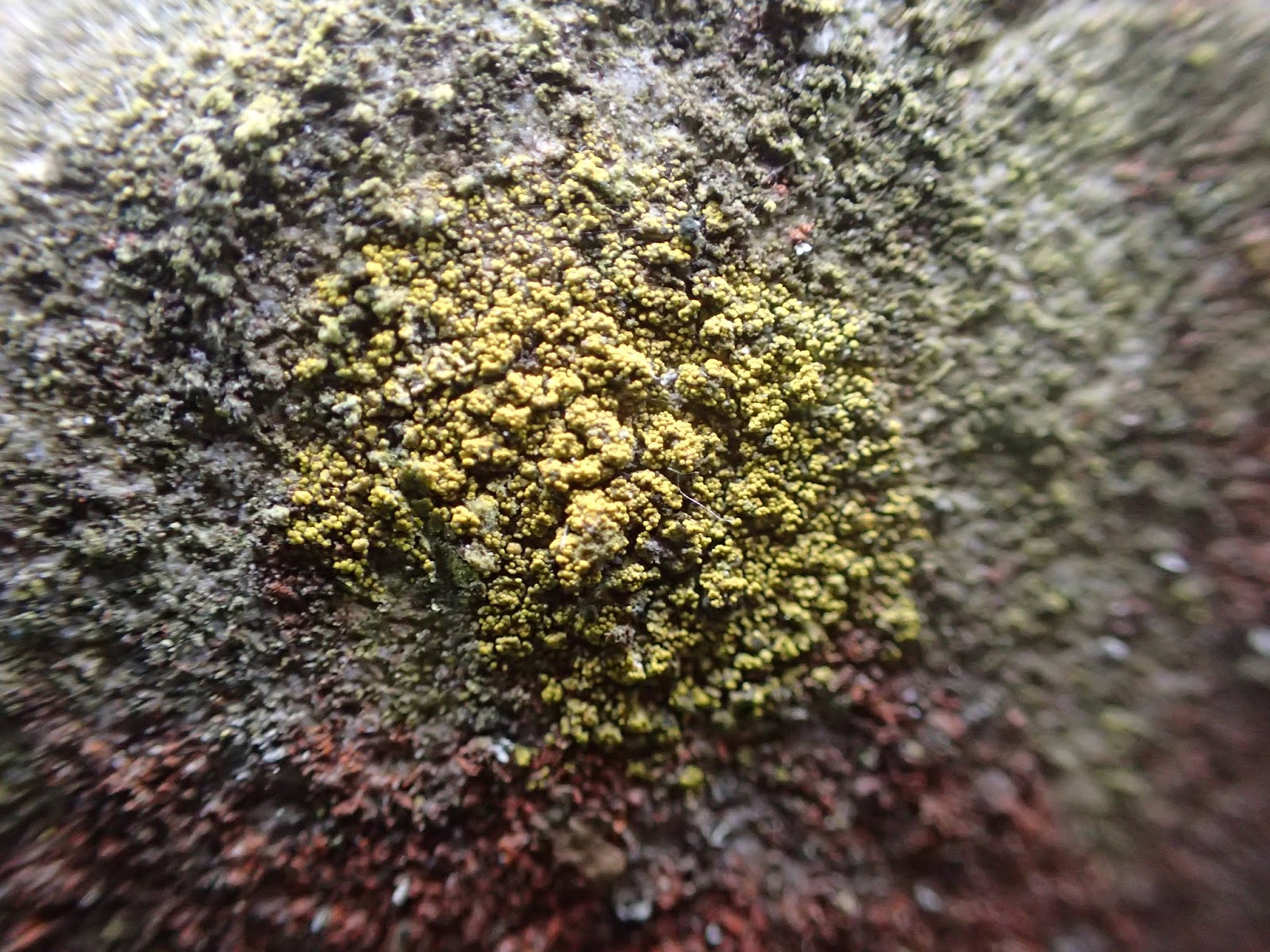
Most of the monthly Friends of Earlham Cemetery walks are led by a member of the group, but for this one Peter Lambley, the county lichen recorder, had agreed to take us round. Despite the drizzly weather there was a good turnout, and we managed to record about 25 lichens in total. Many of them were fairly common species associate with gravestones or trees, but I did see three new species, Candelariella medians, Lecanora polytropa and Lecanora soralifera.

 Candelariella medians
 Lecanora polytropa
 Lecanora soralifera

There were few insects about because of the overcast conditions, but Will did catch a hoverfly, Cheilosia bergenstammi, one of many similar shiny black species, and a Bee-fly was roosting on some vegetation. I spotted an old Birch Polypore and checked for Ochre Cushion fungus, which sometimes grows underneath and was indeed present. 


Two moth larvae were the highlight of the visit. Firstly I noticed an Eriocrania mine on a birch tree, a destinctive group of species because of the time of year and spirals of frass. They can be quite difficult to ID to species level, but fortunately this one has a distinctive larva, which emerged the following day to confirm it as Eriocrania unimaculella. This was a new species for the 10km square. I was actually more pleased to find the second one though, because it was very well camouflaged. I found several horn-shaped larval cases, covered in lichen, at the base of a tree. These were Virgin Smoke (Luffia ferchaultella), so called because only females have been found in Britain - apparently they breed parthenogenetically rather than sexually.


NORWICH - a week of wildlife

8th-11th May 2018

The sustained spell of sunshine meant many plants were flowering and lots of insects were on the wing around Norwich. Accordingly I varied my route to and from work to take in as many patches of flowers as possible, and recorded a range of species.

My week actually began with a fungus twitch. At the start of the bank holiday Dave Andrews had tweeted photos of a phallic-looking fungus growing in a Norwich curchyard. He had naturally assumed it was a Stinkhorn, Phallus impudicus. The time of year would be unusual for that species however, and when I looked at it I realised it was actually a Semi-free Morel, Mitrophora semilibera. I'd not seen this species before, so luckily it was still standing (in fact I saw six fruiting bodies), although the fruiting bodies had started to deteriorate in the heat. On the way home I noticed some galls on Rowan, caused by Eriophyes sorbi.


On the next day I was pleased to find a Nomada sp sunning itself on some riverside trees. The size and uninterrupted bands made me think it was Nomada goodeniana, but the tegulae etc should be yellow, so perhaps I need to reconsider that. My first Large Red Damselfly was seen nearby, as were several Syrphus ribesii hoverflies.


At work I noticed a small deceased insect on a windowsill, which Tony Irwin kindly identified for me as the barklouse Loensia variegata. Finally on my way home I saw a yellow flower that I didn't recognise, which turned out to be Woad. This plant is well known as the source of the blue dye used for body painting in the past (a good excuse to rewatch the Horrible Histories 'warrior boast battle' here: https://www.youtube.com/watch?v=-SUeX-5QTAM)


Thursday morning was damp, but fortunately the evening was warmer, so I diverted through Waterloo Park. My target was a sawfly, Blennocampa phyllocolpa, that causes the leaves of roses to roll in at the sides. Andy Musgrove assured me that it was probably on every area of roses in Norfolk, but I hadn't seen it on the random plants checked on my route over the past few days. I managed to find the leaf rolls on a bush near the pavilion steps, and did see an adult, although it didn't stay for a photo.


Whilst waiting in vain for the sawfly to return, a nice Sulphur Tubic, Esperia sulphurella, landed on me, whilst a Holly Blue and a mating pair of Parent Bugs were also noted. Whilst photographing the Parent Bugs several Birch Catkin Bugs fell on me - if you haven't ever seen one then standing under a birch tree for 30 seconds will probably remedy that (they are very common).


On Friday I stopped near a patch of sunny leaves to see what was basking. There were loads of Syrphus hoverflies, but once again all that I checked were S. ribesii. There are two similar, and apparently common, other Syrphus species, S. torvus and S. vitripennis, but as yet I've recorded neither. The bug Dryophilocoris flavoquadrimaculatus was found, more Large Red Damselflies had emerged, and a distinctive-looking fly was almost certainly Anthomyia procellaris.


Less obvious species noted were Horse Chestnut Scale Insect on Sycamore and Elder Aphid, Aphis sambuci, on Elder. There were also aphids on the Sycamore, but I've not identified them yet, perhaps better to wait until they have grown a bit.


 Elder aphid
 Aphid sp on Sycamore

I had received a text from Adam to say that he had heard a Cetti's Warbler near Cow Tower on his way into work. That would be a good 'inner ring road' Norwich bird, so I took a rather large detour there on my way home in the hope that it would still be around. Unfortunately it was either quiet or had gone. The breeze had got up, limiting the potential for insects, but I did find the leaf mine of Lynonetia clerkella on Hawthorn, the caddisfly Limnophilus rhombicus, the hoverfly Dasysyrphus venustus and a bee, probably Andrena scotica. A brood of Egyptian Geese capped off my week of wildlife commutes.


NORWICH: Mousehold Wood Warbler

6th May 2018

Around Sunday lunchtime a Wood Warbler was found at Mousehold Heath. At one point this species actually bred at Mousehold (early 1990s?) along with things like Red-backed Shrike, but those days are long past and I'd only seen a couple in Norfolk. As I had other plans for the afternoon I initially agreed that I would go and look for it on bank holiday Monday, but after our evening meal Cathy suggested that as it was a nice evening I should go and have a look in case it wasn't there on the next day, which proved particularly wise as after an early morning sighting it then went missing.

I arrived at the Gurney Road car park to find a group of LARPers* or similar were about to begin a quest. I was about to head off north-west as per the bird news service directions when a local birder entered the car park and said that he had just been watching the Wood Warbler in trees south of the road. Several other birders, including Ricky, emerged from the woods and a small group of us headed across the clearing near the golf course. Unfortunately there was no sign of the Wood Warbler, those who had already got glimpses earlier in the day or were time-pressured left, leaving just Pete and I to search for it.

Having waited a bit longer near the trees where the Wood Warbler was last seen, we decided to cross back to the car park in case it had doubled back to its original location. As we started to take that path we met another birder returning, having spent an hour unsuccessfully looking for it, so instead we checked some mature trees along the edge of the woodland in case it had gone that way. There was no sign of it, although there was a nice display of Lycogala slime mould (L. terrestre or epidendrum).


We decided to have one last look south of the road, and headed back to the area where it was last seen. Whilst listening out I became aware of the many insects flying in the evening sunshine, including lots of Nomada bees, which seem to be having a good year (either that or I'm just more aware of them these days). Unfortunately they were very skittish, so I couldn't get close enough to identify them. I scanned a nearby Oak and noticed some lekking Green Longhorn moths (Adela reaumurella). This interesting behaviour usually takes place highup, as these were, and involves many moths circling around a stationary one. The hoverfly Epistrophe eligans and Birch Leaf Roller Weevil (Deporaus betulae) were also noted.


I was getting to the stage where I was going to have to give up and go home, when I heard a short burst of Wood Warbler song. Heading tentatively in the direction of the sound I heard a second burst, coming from a large Sycamore on the edge of the golf course. I looked around for Pete, who was further into the woods, and waved to attract his attention. Shortly after he reached me the Wood Warbler flew up into a large Oak and began to sing out in the open at the top. I tried to take a record shot, but in the end gave up and just enjoyed watching it. I texted out the location details in case anyone was still looking for it, by which time it had moved into a different Oak and stopped singing. A very enjoyable evening out and an excellent Norwich bird, so thanks to the finder.

Wood Warbler...honest


* LARP = Live Action Role Play. People dress up as fantasy characters and then act out a sort of game in real life. Of course it could have just been some very eccentric people.

SOUTH NORFOLK: High Ash Farm Bluebell day

5th May 2018

On Saturday High Ash Farm opened up Foxes Grove, a usually private area of woodland, for a Bluebell day. We try to go and see Bluebells somewhere each year, so as Caistor St Edmund is close to the city we thought that this would be an ideal time to try to take Rose out in the sling. Having picked up Margaret the four of us continued on to the field car park put on for the event close to the woods.

It was a lovely sunny day, and there was plenty to see along the hedgerow as we walked down towards the woods, including Dock Bug, Dark-edged Beeflies, Sphaerophoria hoverflies and the bug Rhopalus subrufus. Walking along the edge of the woodland we got our first view of the Bluebells, and I noticed an interesting cranefly, Limnophila schranki, in some ditchside vegetation.


Entering the woods I was pleasantly surprised by the amount of Bluebells, and the undulating terrain meant that they were particularly impressive. We had a very pleasant walk, and naturally we also noted lots more wildlife, including several butterflies, hoverflies and galls. Cathy found a Meadow Longhorn moth (Cauchas rufimitrella), and Small Nettle Weevil (Nedyus quadrimaculata), Yellow-tail moth caterpillar and another caterpillar, possibly Autumnal Rustic, were also of note.


 Caterpillar on Bluebells - possibly Autumnal Rustic
 Meadow Longhorn Moth
 Yellow-tail moth caterpillar
 Small Nettle Weevil

Heading back to the car we were entranced by a Coal Tit that flew into a tree in front of us and carried out some Goldcrest-like flitting just above head height. Some Nomada bees along a sandy bank were of the need-to-examine-to ID type, and we ended the visit with a common but hitherto unrecorded by me sawfly, Aglaostigma aucupariae.