The Whitlingham Bird Report for 2025 is now available to download from the Bird Reports page or from here

EAST NORFOLK: Roe Deer & Hoopoe

Mid-April 2019

Adam & I met up in North Walsham for a look around a few sites in East Norfolk. We started by heading for a lake that sometimes attracts Ospreys on passage - no luck this time but we did see a pair of Marsh Harriers. The winds had been stifling the arrival of migrants, and a walk along the dune scub at Waxham turned up nothing better than a Blackcap, although we did see the two Ring Ouzels that had been present in that area for a while. Good views of a Roe Deer were the highlight of the visit.


Neither of us had seen a Hoopoe for several years, so we decided to head to Winterton, stopping briefly on the Horsey straight to see the Tundra Bean Goose and Great White Egret. At Winterton we walked quite a way down the south dunes, seeing only a pair of Stonechat and some Skylarks, before hearing that the Hoopoe had last been seen near the toilet block. Deciding to check the north dunes we were on the verge of giving up when someone gave us a thumbs up and pointed in the direction they had come from. A few more minutes searching and we located the Hoopoe, which showed well until accidentally flushed by some walkers.


On the way back we called in at a site that used to hold Lesser-spotted Woodpeckers on the off-chance, but there was no sign of any, albeit by then it was mid afternoon so this wasn't a surprise.

SUFFOLK: Oxlips and Tachinids

Mid-April 2019

Having contemplated what ancient woodlands fairly near Norwich were buggy friendly, I suggested that we go a bit further afield to Bradfield Woods. This site, managed by Suffolk Wildlife Trust, is a national nature reserve that has apparently been coppiced continuously since 1252 and is rich in wildlife. I'd never visited before, and as a bonus it holds a good population of Oxlips.

We arrived around lunchtime so started with a picnic near the visitors centre, before heading off around the black trail. There was a good range of flora right from the car park, including things like Wood Anemone and Wood Spurge. We hadn't gone very far when Cathy found our first Oxlips (a new species for me), and we ended up seeing loads of them. Further alongs were some Early Purple Orchids, but they were in bud rather than open flower.


It was an overcast day so not great for insects, but I did see a few hoverflies flying around, along with some tachinids. Getting a closer look I assumed that it would be Tachina ursina, however it had some yellowy-orange areas on the side of the tergites which that species doesn't have. In fact it was Tachina lurida, a species that when I checked with the county recorder turned out to be new to Suffolk. Phasia hemiptera, another tachinid, was also seen. Bradfield was a lovely place, and given that we probably only explored about a third of the woods is somewhere we might well return to in the future.


WHITLINGHAM: White-cheeked Pintail hybrid

Mid-April 2019

A late afternoon walk at Whitlingham with Cathy & Rose meant that I caught up with the White-cheeked Pintail x Mallard hybrid that has been moving between Whitlingham and Strumpshaw. It has been hanging around the slipway fairly regularly, but I hadn't seen it up until that point. Whilst there I also read the rings of five Mute Swans, which have probably travelled a combined total of zero km, but you never know.


NORWICH: Two interesting garden species

8th April 2019

A walk around the garden turned up two new species for me, including one that was new to Norfolk. Firstly whilst looking for hoverflies on the Mahonia growing up against our wall, I noticed there were some red spots on the leaves. Looking underneath I saw that this was a rust fungus, and a quick check identified it as Mahonia Rust, Cumminsiella mirabilissima.


Looking in a patch of buttercup leaves nearby I noticed a leaf mine that appeared to be going into the midrib. Buttercups have several fly mines, including Phytomyza ranunculi which is probably the second commonest Agromyzid mine after Phytomyza ilicis in Holly, but none of the common ones go to the midrib. My suspicion was confirmed by Barry Warrington, this was Phytomyza stolonigena, which has no previous Norfolk records in the recording scheme database.


NORWICH: Hoppers and Leatherbugs

30th March 2019

At the weekend we popped round to Jeremy and Vanna's garden to pick up a bit of frogspawn for our pond. The garden has an excellent range of planting for wildlife and I usually see something new each time I visit, and this was no exception. In the back the main attraction was an oddly-shaped leafhopper called Asiraca clavicornis, which looks like a sort of tiny lobster/leaf insect hybrid.


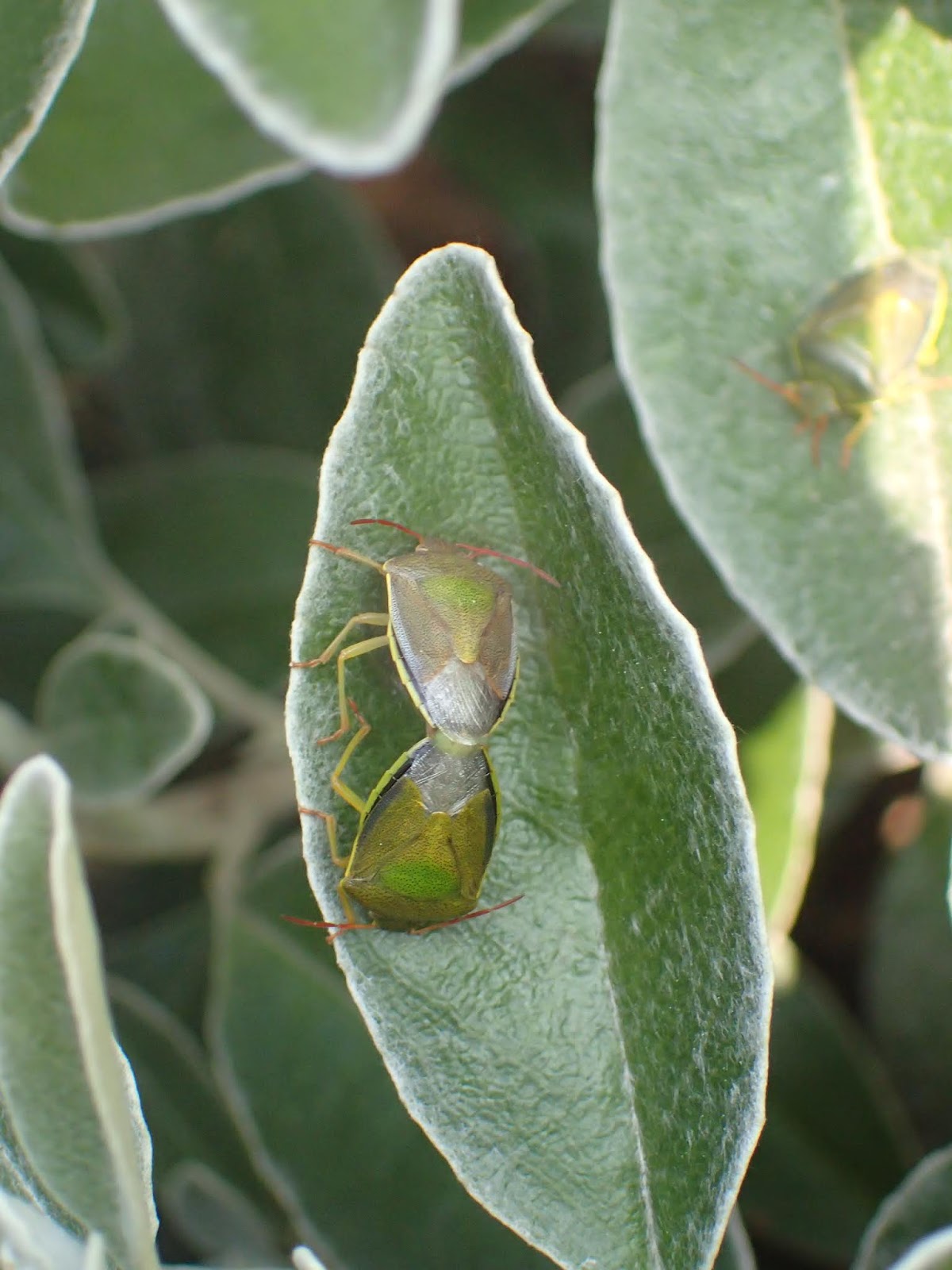
Other more common species included quite a few Gorse Shieldbugs and some Dock Bugs. This latter species was to prove my undoing, because as we had a look around the front, Cathy found a pale brown Coreid bug and I dismissed it as a young Dock Bug, only for Vanna to see it and point out that it was in fact Rhombic Leatherbug, a species I've never seen before! Once she had pointed it out the the shape and upwards tilting edges were obvious, but how many times might I have lazily overlooked this previously (although thinking about it perhaps not as I tend to photograph at least the first one I see each day to verification of iRecord and they have all been Dock Bugs). Anyway, thanks to Cathy and Vanna for that. Slender-horned Leatherbug is the next one on my list (although I've also not seen Dalman's, Cryptic and Boat Bugs either). A Forget-me-mot Shieldbug was a nice bonus too.

 Gorse Shieldbugs
 Dock Bug
 Not a Dock Bug! Rhombic Leatherbug
 Forget-me-not Shieldbug

There was still time for a few other bits - Sage Leafhopper and the stiltbug Berytinus signoreti were both new, as would a Brown Lacewing sp had I been able to identify it to species. Thanks as always to Jeremy and Vanna for their hospitality.


WHITLINGHAM: PATCH TICK 150! Garganey

28th March 2019

I'd not taken my phone to work, but wasn't particularly bothered as I don't get many calls anyway. Arriving home and checking for messages I found a missed call and a message to say there was a pair of Garganey at Whitlingham! My patch nemesis, and if they were still present then my 150th patch bird. After a gibbered explanation (and a reassurance that no, nobody had died) I set off for Whitlingham, cursing the late night shoppers that were adding to the usual rush hour traffic.

The Garganey had been viewed from the east end of the Little Broad, near the pagoda, so I headed straight there and scanned the Little Broad. They were nowhere to be seen. Had they gone to roost, flown off or just moved? I went across to the Great Broad and scanned as much as I could see. Nine Wigeon were present, the temporarily resident drake plus a group of eight near the island, but on this occasion I wasn't impressed. There was no sign of the Garganey.

Moving back to the Little Broad I decided I would give it ten minutes before having to return home to sort our food. Scanning across I noticed two small ducks swimming across the broad. The light was beginning to dim so I got them in the telescope and hoorah, it was indeed the Garganey! I headed to a better vantage point and was about to digiscope myself a record shot when they flew up and after a coupele of laps of the broad they disappeared from view. At one point they appeared to be being chased by a Mallard, but by the second lap they were chasing it. Fortunately for people arriving later they relocated to the Great Broad and were also present on the day after, although often elusive. 

My 150 patch birds has taken a whopping 13 years since my first visit here in 2006, and there are probably ten or so fairly common 'flyovers' that I would hope to add at some point (e.g. Bewicks & Whooper Swans, Curlew, Golden Plover, Black-tailed Godwit, Yellow Wagtail, Yellowhammer...). Many thanks to Justin Lansdell who found the birds.

NORWICH: First singing Blackcap of the year

26th March 2019

Having not heard any Blackcaps singing at Whitlingham on the 24th, I heard my first singing one on Lakenham Way on the 26th. Looking at my records this is very close to my 2017 date from the same location on 27th March. I wasn't walking down Lakenham Way in 2018 so don't have a comparable date for last year. For many years Blackcaps would be a first or second week of April bird, but like many other spring migrants seem to be arriving earlier (although as with Chiffchaffs it can be tricky to determine which birds are newly arrived and which have overwintered, so it is best to wait for multiple birds to further suggest recent arrivals).

WHITLINGHAM: March WeBS count & insects

24th March 2019

The March WeBS count is always one with a hint of optimism, particularly if it happens late in the month, because pretty much anything could turn up in terms of early migrant species or things moving back to the continent. it also marks the start of the Garganey season, where I attempt to see what used to be a regular species here for the first time. A White-tailed Eagle was also touring Norfolk so add an extra incentive to keep looking up.

In terms of waterbirds the count was rather quiet:
  • Mallard 9 (presumably some were over at Thorpe Green)
  • Gadwall 1
  • Teal 2
  • Tufted Duck 117
  • Pochard 1

And actually it was quite quiet elsewhere. Chiffchaffs were calling, and an inspection of some gardens along Whitlingham Lane looking for a House Sparrow seen recently by Gary at least turned up a nice singing Coal Tit, not a species I see too regularly here for some reason. Greenfinch, Green Woodpecker and Pheasants were also seen nearby.

Of the non avian stuff, I checked a Burdock seedhead and was rewarded with the larva of the moth Metzneria lapella, whilst the sawfly Aglaostigma acupariae was a new one for the site and will need adding to my Whitlingham Sawflies guide. A small colony of Andrena bicolor were feeding on Lesser Celandines but very little was on the Sallow catkins. Dark-edged Bee-flies and Hairy-footed Flower Bees were also noted. A Small Tortoiseshell was belatedly my first butterfly of the year.


NORTH NORFOLK: Southrepps Common

16th March 2019

I hadn't attended the first two Norfolk fungus study group meetings of the year, and there was briefly a worry over this one as the site, Southrepps Common, changed hands shortly before we were due to visit. Thankfully the Norfolk Wildlife Trust who now manage the common were happy for us to visit and so the foray went ahead. Spring forays usually don't turn up many of the larger gilled fungi, but through a combination of fungi growing on wood and plant fungi we compiled a list of around 100 species, which was excellent (I only saw about 70 of those as the group spread out and various people took specimens home to determine).

Some of the more interesting or photogenic species were Hypoderma hederae, Propolis farinosa, , Radulomyces molaris and Stictis elongatispora.


There wasn't too much about in the way of insects, but with a bit of hunting we did find some intersting bits and bobs. Hoverflies are one of my favourite invertebrate families, so Cheilosia albipila, a species associated with Marsh Thistles, was the highlight, followed by the beetle Notiophilus biguttatus and stem mines in Broom caused by the moth Leucoptera spartifoliella. After lunch we cheched out the dry woods of School Common, adding a few more species and flushing a Woodcock.


BROADS: Wroxham Barns

2nd March 2019

During a family visit to Wroxham Barns we were watching the birds around a pond and contemplating if I would be able to see a Swoose on a future visit as a Mute Swan being followed about by a white farmyard-type domestic Greylag. The swan was almost in the water when I noticed that it had a leg ring! We lingered a bit but it showed no inclination to get back out of the water. Fortunately after a look around the farm we returned and it did climb out. As I was looking after Rose, Cathy agreed to go over and read the ring. I haven't submitted it yet, but from the details I suspect it is going to be an RSPCA rescue, so it probably hasn't travelled anywhere, which is a bit of an anticlimax.


NORWICH: Early Egyptian Geese goslings

25th February & 1st March 2019

On my way home from work I glanced down into the river and noticed a pair of Egyptian Geese with four goslings. This species breeds in any month of the year in the UK, although presumably with varied success. I remembered having seen goslings in February before, and having checked my records I had seen goslings earlier than this twice before - on 13th Feb last year at Flitcham and 18th Feb 2010 at Holkham. Later in the week I found a family with three goslings in Wensum Park. Given that this isn't very far upstream of where I had my first sighting I suspect it is the same birds.


SOUTH NORFOLK: Raveningham Estate

24th February 2019

Raveningham Hall estate and gardens was somewhere that I was vaguely aware of but had never visited. Having been spurred on by seeing a trip report on another blog we decided to pay a family visit whilst the Snowdrops were still out (the gardens are only open for certain events during the year). My first impressions were that it was a picturesque location, but not as big as it had appeared from the map. Indeed standing in the middle of the woodland you could see out in each direction. As it happened though there was plenty to see so this wasn't an issue.

We started by looking out over the lake, which would probably make a good patch for someone if access was more uniform. Over the far side we saw some Wigeon and a pair of Oystercatchers, whilst a Mistle Thrush fed in the parkland beyond. Walking around the woods we came upon the 'stumpery' which was interesting, and several Nuthatches called nearby. A singing Chiffchaff was heard distantly.


After walking around the woods and seeing the Snowdrops we returned to the main gardens, which were understandably rather flower-light because of the time of year. I saw my first Hairy-footed Flower Bees of the year, along with the leaf mines of Phytomyza hellebori. The cafe was busy so we headed down to Raveningham Church, which had I done my research I would have known holds some interesting lichens. Afterwards we headed back to the cafe for a simple but tasty lunch, and on a short walk around the rest of the estate we found quite a few Pine Ladybirds.


THORPE MARSHES: Early spring bits and bobs

23rd February 2019

I made time for a couple of hours at Thorpe Marshes on Saturday - the sunny weather made for a pleasant visit but also meant that there wasn't much birdlife visible on the marsh as there were a lot of other people about. There were about 120 Tufted Ducks, 3 Goldeneye and a Pochard on the broad, whilst a Sparrowhawk was flying up over the ridge. A couple of Meadow Pipits flew up from the marsh, a Linnet was in song and a Nuthatch called across the river somewhere in Whitlingham Woods.

There were few flowers out to attract insects, Lesser Celandines along Bungalow Lane were the main ones. I focused on the small woodland area, hoping I might find a moth resting on the bark, and found a few bits and pieces. A Drinker Moth caterpillar seemed very early, whilst joint highlights were the larvae of a False Ladybird beetle (looking like a cross between a Woodlouse and a Trilobite!) and an unusual red creature, which has since been identified as the larvae of a type of thrip (one of the Phlaeothripidae)


NORWICH: Garden Pheasant

Late February 2019

Whilst sat in the living room Cathy looked out of the window and asked if there was a Pheasant on the roof of the house opposite. It seemed an odd question (we live on a Norwich housing estate with no fields anywhere near), but looking out it was indeed a Pheasant. I scattered some seed around the garden in the hope it would fly down, but it left the rooftop and we didn't see it again.


BRECKLAND: Hawfinches and hybrid ducks

Mid-February 2019

Adam & I try to get in a day birding most holidays, and decided to head down to the Brecks for this one. We opted to give Santon Downham a miss, so our first stop was by a roadside overlooking a block of forest. The weather was still overcast so we weren't confident of our chances of seeing Goshawk, but it didn't take too long before one was up. It didn't display, but instead flew back and forth a few times over the trees giving excellent views. As I stood there listening to a Skylark I realised that it was my first of the year, as was a Mistle Thrush that called and then flew off in front of us.

Next up we tried another block of forest where a feeding station has been set up in an area where Willow Tits are still present. The table was attracting a steady stream of the Blue, Great, Coal and Marsh Tits (and Dunnocks), but unfortunately we didn't see or hear any Willow Tits. A Hairy Shieldbug landed on Adam's leg whilst we waited. Eventually we decided to just walk a bit further along the ride, seeing a Muntjac and a Great Spotted Woodpecker, but not a lot else.


Our main target was a Kumlein's Gull that had been appearing sporadically in the gull roost at Lackford Lakes, but with a few hours before the gulls were due to start arriving we decided to go to Lynford first. We checked out Lynford Water in case there were any Goosander, but only saw common species (although the sound of a huge flock of Siskin was impressive). In the arboretum we quickly found some Hawfinch and got great views as they fed under the trees in the paddock. We were rather bemused that some nearby photographers seemed more interested in photographing Great Tits on some rather oddly positioned feeders on the bridge (oddly placed because people had to keep walking past them), but on our way back we found that most of them had just been taking time out from photographing Crossbills drinking from the flooded meadow.


After missing a turning we eventually found Lackford Lakes, a reserve that neither of us had visited before. We had a cup of tea in the visitors centre before heading out for a look around the reserve. The first hide we called into was packed, so we moved round to the next one, which overlooked an area called the Slough. Around 400 Lapwings were roosting, along with some common waterbirds. Whilst looking through the ducks I noticed two of the 'Mallard' accompanying the Pochard had pinkish bills. A closer look revealed that they were hybrids. Recalling my Peter Scott Wildfowl book I suspected these were Rosybill x Mallard, an ID that hybrid bird guru Dave Appleton agreed with.


With our visit already a success thanks to the hybrid ducks, we walked back to the sailing lake to watch the gulls come in. The roost was large, but lots of the birds were Black-headed Gulls rather than their larger relatives. After an hour or so we decided to call it quits - one 1st-winter Caspian Gull had flown in but there was no sign of the Kumlein's Gull. It was a light evening and we knew it might arrive later on, but both of us needed to be back home in reasonable time. Whilst watching the gulls we were also entertained by several Goldeneye, whilst a Kingfisher, Red Kite and Sparrowhawk all flew past during our vigil.

All in all we had a very pleasant day out with some unseasonably warm weather in the afternoon - thanks to Adam for doing the driving.