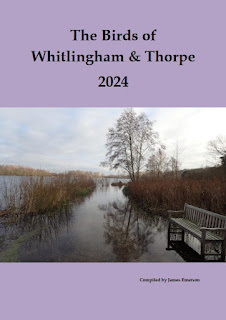
The Whitlingham Bird Report for 2025 is now available to download from the Bird Reports page or from here

Showing posts with label Whitlingham. Show all posts

WHITLINGHAM BIRD REPORT 2025

February 2026


The 2025 Whitlingham Bird Report is now available here

As always a big thank you to everyone who has supplied photos or recorded birds at Whitlingham, Thorpe and Trowse in the past year. Particular thanks to Rob Chittenden, Ed Mackrill and David Ratcliffe, whose photos make up the bulk of the images.


WHITLINGHAM: January 2025 birds

January 2025

There were two birds of particular note at Whitlingham during January, firstly a Red-necked Grebe first seen on St Andrews Broad at Thorpe Marshes, which moved across to Whitlingham Great Broad where it remained until the end of the month. This was the first 'twitchable' bird here since February 2010 (there was a report from 31st Dec 2013, but it wasn't present the next day and no further details about it ever emerged). The second notable record was a White-fronted Goose, a rare species locally although wintering annually in the mid-Yare valley. Several were seen flying over on 19th Jan, but one landed and spent some time on the meadow south of Whitlingham Lane before moving onto the Great Broad. The highlight of the WeBS count was a couple of Goosander.


WHITLINGHAM BIRD REPORT 2024

The Whitlingham area bird report for 2024 is now available to read and download here. A big thank you to everyone who reports sightings from the area and who has allowed their photos to be used in the report, particularly Robin Chittenden and Ed Mackrill, who have supplied many of the pictures.


WHITLINGHAM: May update

11th May 2024

A case of what might have been, with Black Terns present at Colney GPs and both Black and Arctic Terns at Rockland, but not at Whitlingham. A flock of 21 terns did drop in, but after lots of scanning I concluded that they were all Common Terns. I heard Reed Warbler, Garden Warbler, Blackcap, Chiffchaff, Willow Warbler but not Sedge Warbler or Whitethroat. One brood of Grey Herons had fledged, whilst there were more Cormorants on nests than on my April visit. A Muntjac ran across the field south of Whitlingham Lane, and I found a newly emerged Hairy Dragonfly.


WHITLINGHAM: Early Cuckoo record & breeding Cormorants

7th April 2024

Highlight of this visit to Whitlingham was a very early Cuckoo. It wasn't calling, but I happened to see it in one of the willows on the main island. Once I was happy that I wasn't seeing things I put out news on the Norwich birding Whatsapp group, as it would have been the earliest ever site record. It then transpired that it had actually been first seen (and heard calling) the previous day, but the finder hadn't mentioned the site name! It was heard calling by several people in the next few days afterwards too. For the second year Cormorants are again breeding in the trees on the island.


WHITLINGHAM: Evening visit

19th March 2024

I seldom get down to Whitlingham in the evenings, but on this occasion I had been invited to a celebration evening in the visitor barn to officially open the new cafe and 'changing places' toilet facility. I headed down after work and was treated to some lovely views of a Barn Owl quartering the field south of Whitlingham Lane. It was then into the barn to meet some of the volunteers that help run the CP, listen to a few speeches and sample some canapes. The cafe and decour both looked very impressive, and it was nice to have been invited to have a look.


WHITLINGHAM: March WeBS count and some Bonfire moss

9th March 2024

Some nice weather for the March WeBS count and I had a good chat with Ed Mackrill part way round. A brief bit of Chiffchaff song from the wood near the pumphouse was my first singing one of the year and on the island two pairs of Cormorants were on nests. There were still good numbers of Tufted Duck, plus a drake Goldeneye and two Pochard. A Reed Bunting called from near the Little Broad and there was still a small flock of Redpolls in the area. The only non-avian species of note was 'Bonfire Moss' Funaria hygrometrica growing on an old burnt area. This is a common species and has been recorded here by the Norfolk & Suffolk Bryological Group, but was a new one for me apparently.


WHITLINGHAM: February 2024 WeBS and early nesters

11th Feb 2024

The second WeBS count of the year. The site was still flooded in multiple places, less so than in January but the section of path near the pump house tested my wellies, a Christmas present having had my previous ones for over 20 years. Fortunately there was no leaks, and I walked slowly enough to not slop any water over the tops either. Duck numbers have started to drop, I didn't see any Shoveler at all on the Great Broad although there were a couple visible over the river on St Andrews Broad. There were 188 Tufted Duck and 17 Pochard, plus two Great White Egrets (one on the Little Broad, one on the Great Broad). My first singing Reed Bunting of the year was singing from the river edge, and I got good views of the redpoll flock near the gas works, eventally picking out a Mealy Redpoll amongst them.

I checked last years Grey Heron nests - one was occupied, one was empty and one had been taken over by an Egyptian Goose! In fact there might be two or even three Grey Heron nests close together, it was difficult to see if there were just three adults in close proximity of if they were all on nests.


Before leaving I checked out a bracket fungus growing on a cut wooden post near the visitor barn, that had first been reported to me before Christmas. I'm still not completely sure what it is, but Brownflesh Bracket has been suggested and seems like a reasonable bet.


WHITLINGHAM: New record Shoveler count

13th January 2024

The path around the Great Broad is still flooded in places, with the water level almost reaching the wooden bridges along the south shore. A local resident remarked that it was the highest he'd ever seen the water here and implicated the hard infrastructure (e.g. the car parks), but that would overlook the large swathes of the county that have been flooded for some time. Anyway, knowing what it was like I wore my wellies and carried on.


As it was WeBS weekend I carried out a complete wildfowl count, the undoubted highlight of which was the number of Shoveler present. They started increasing in number during the week, and the 61+ present on Friday had been a new site record, but careful scanning from multiple viewpoints led to me counting (and double-counting!) 83 on Saturday, a mixture of adult drakes, immature drakes and females. So currently a site high count, but who is to say that the numbers won't keep increasing over the next week?

Sadly there was no sign of the Pintail that had been seen on Friday, a bird I've only seen here twice. There were however 2 Goldeneye, 2 Wigeon, 249 Tufted Ducks (including the pink-billed one), 122 Gadwall, 25 Teal and 11 Pochard, so a good selection of ducks. The wintering Great White Egret showed well, as did the 'brown' Cormorant discussed in last years Whitlingham Bird Report. Close-up views of five Lesser Redpoll and a Redwing, a flyover Ring-necked Parakeet and two Sparrowhawks up in the distance were all welcome sitings too.


WHITLINGHAM BIRD REPORT 2023

10th January 2024

I have now completed the annual bird report for Whitlingham & Thorpe 2023 - you can download it here

A big thank you as always to everyone who has reported sightings, provided data or allowed me to use their photographs. A special mention to Robin Chittenden, Ed Mackrill and David Ratcliffe whose photos have enhanced the report significantly. Here's to an interesting patch 2024!


WHITLINGHAM: 1st Jan 2024

Last year due to various things, mostly childcare related, I got very behind at keeping this blog uptodate and then the task of catching up was too much. I am therefore leaving the last 6 months unwritten and starting again with the best of intentions!

1st January 2024

I started the year as usual, staring out of my living room window trying to see what birds were landing in some distant trees or flying past. I managed to see a slightly disappointing 8 species, beginning with Woodpigeon followed by Feral Pigeon, Collared Dove, Herring Gull, Black-headed Gull, Common Gull, Magpie and Starling. A visit to the in-laws produced several additional garden species, notably Goldfinch, House Sparrow, Blackbird, Dunnock and Jackdaw. It was then off to Whitlingham for an after-lunch walk.

The water levels at Whitlingham were probably the highest that I have ever seen them, with the circular path flooded in multiple places. Knowing this I was wearing my wellies and comfortably made it round. Some of the recent ducks had either departed or were too hidden to pick out with binoculars (I didn't see Teal, Pochard or Goldeneye) but I did see two Great White Egrets, Shoveler and Great Black-backed Gull, which were decent first of January birds here. The local aberrant Cormorant was present just before dusk, although as it seems to have moulted a bit it no longer sticks out as much. As I was leaving I also noticed a Carrion Crow with a few pale feathers too. Sighting of the day was perhaps a large Pike, seen well as it lurked under one of the bridges.

If you squint you can see the Pike!
Great White Egret, Grey Heron and 2 Little Egrets

Kestrel

Carrion Crow with a few white feathers

WHITLINGHAM: Delayed June WeBS count

Late June 2023

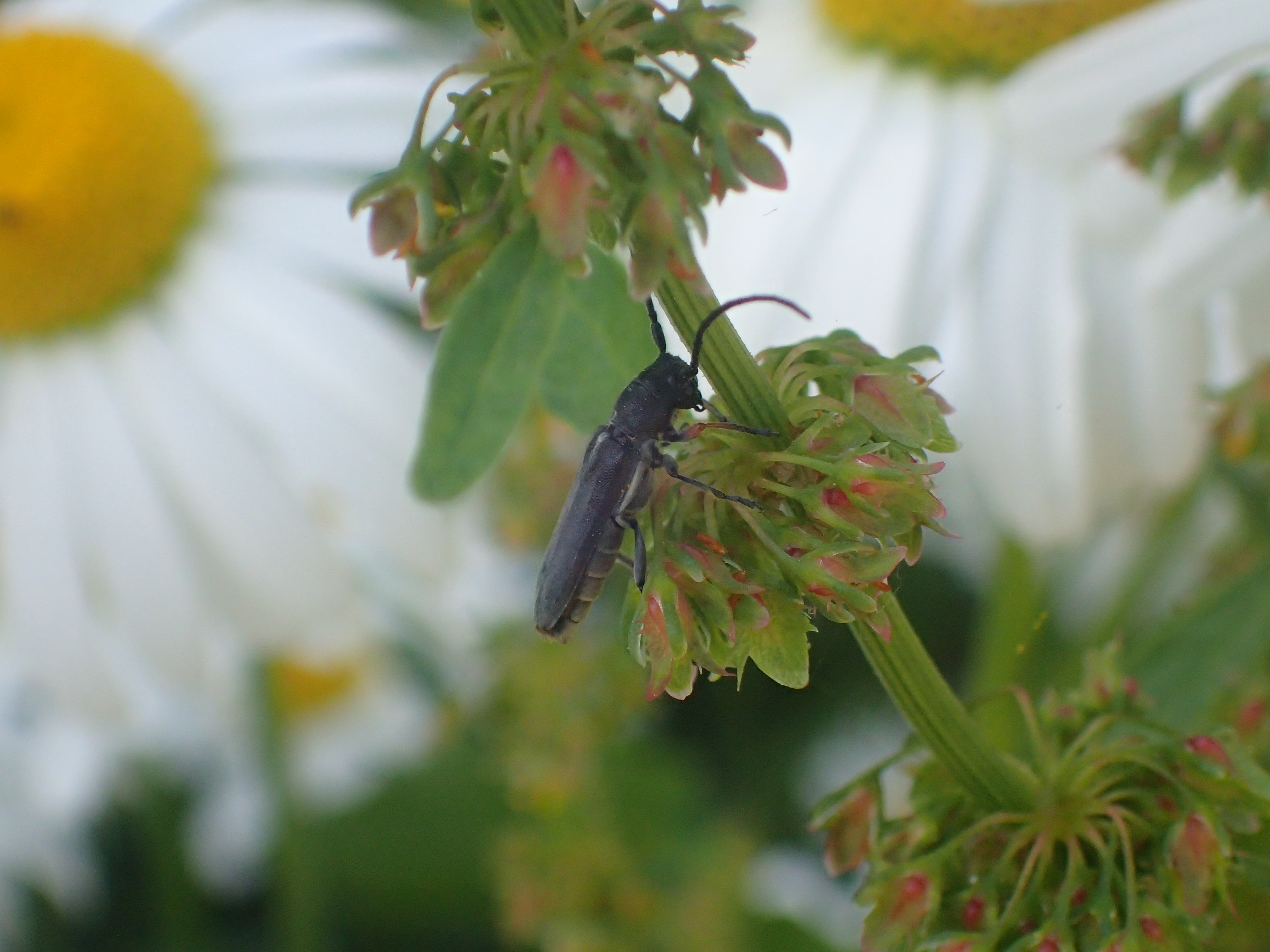
I had to delay June's WeBS count as there had been triathlons using the Great Broad. The wasn't anything particularly notable in terms of birds - 113 Greylag Geese, 57 Mute Swans (plus some cygnets in the conservation area bay) and 47 Egyptian Geese. A couple of Common Terns were also still present. In terms of invertebrates I saw my first patch Umbellifer Longhorn Beetle (Phytoecia cylindrica) and nice crab spider (Misumena vatia) and the smut on Greater Pond Sedge that has been very prevalent this year, Farysia thuemeni.


WHITLINGHAM: New hide, fledged herons and another psyllid

21st May 2023

The most notable thing about May's Whitlingham WeBS count was getting to see the new hide. From a distance it looks very nice, blending in with the landscape. Unfortunately as an actual bird hide there are a few issues. The curved roof means that you cannot stand up near the edges of it, so you can only use it by sitting down. There is one moveable bench to allow you to do this - I really hope that this is treated respectfully and remains there, but the idea of having an unfixed bench on an urban nature reserve is not one I would have suggested.


In terms of birdlife, two sets of juvenile Grey Herons were visible (there were three nests this year, I'm not sure if young fledged from the third one), a Cuckoo was calling and I heard my first Reed and Garden Warblers of the year as both had been absent during my April visit.


I checked quite a few willows for psyllids, and was rewarded with my first Cacopsylla ambigua.

WHITLINGHAM: April WeBS highlights

Mid-April 2023

The April WeBS count turned up the expected range of common wildfowl, plus my first Sedge Warbler, Whitethroat, Common Tern, Swallow, Sand Martin and House Martin of the year. Two Cuckoos were present and at one point I watched one chase the other along the treeline. A Skylark singing opposite the large car park was unusual here despite their presence on nearby farmland. Five Pochard were still present, along with a scattering of Gadwall, Teal and Tufted Duck, whilst a Canada Goose had five goslings. The most notable observation of the visit however were several Cormorants on nests, which as far as I am aware is the first time here and is still unusual in a Norfolk context, despite the large numbers of wintering birds. Grey Herons also nested successfully, with three large young visible in the nest used last year. Other than birds, both Aglaostigma sawflies were seen in several places around the site.


WHITLINGHAM: March WeBS count

12th March 2023

The avian highlight of the March WeBS count was probably displaying Great Crested Grebes, although given the low numbers of Pochard in recent winters 8 of them wasn't to be snuffed at either. Whilst scanning trees on the meadows in the vain hope of seeing an owl perched up I noticed some Mistletoe in the Lime trees, the first time I'd seen it hear (although some is visible north of the river at Thorpe St Andrew). The Coltsfoot was in flower and I also noticed an as yet unidentified fungus on willow buds.