The Whitlingham Bird Report for 2025 is now available to download from the Bird Reports page or from here

Showing posts with label Whitwell Common. Show all posts

NORFOLK: Visits to three Norfolk commons

August 2021 

During August I visited three of Norfolk's commons, so I have grouped them together here.

First up was Billingford Common, a place in south Norfolk that I had not visited before. The star attraction here is Large-flowered Hemp Nettle. We parked up in a layby along a busy road and walked through some long vegetation onto the common, and quickly saw a large patch of hemp nettles. Unfortunately it turned out they were Common Hemp Nettle, a nice but widespread species. We decided that exploring the area wasn't really practical with a young child, so we worked our way through to an open area where we could at least admire the windmill.


Next up was Alderford Common, where I spent a couple of hours after dropping my wife off in Taverham. This was a very productive visit, with numerous insects on Hogweed flowers including Banded General and Gasteruption jaculator. On the open part of the common I searched as much Wild Basil as I could and found my target, leaf mines of the micro moth Stephensia brunnichella at its only modern Norfolk site. A couple of micro fungi and four leafhopper species were all new for me.


Finally for my common excursions, following a meeting of the Norfolk Fungus Study Group at Bawdeswell Village Hall some of the group called in at Whitwell Common. It was very poor in terms of fungi, although we did see the grass fungus combination of Choke and Ergot. The leafhopper Evacanthus interruptus was nice to see, as were several Tenthredo sawflies.


CENTRAL NORFOLK: Whitwell fungi

14th December 2019

The last Norfolk Fungus Study Group meeting of the year is made up of a morning foray, buffet lunch and then AGM/planning meeting in the afternoon. The location of the foray part was at Whitwell Common, which has a nice range of habitats and probably could have occupied us for the whole day had we not been 'on the clock'. I had also forgotten my camera, so the pictures here are just the few taken on my phone. The final list isn't in yet, but we probably racked up over 50 species of fungi, with Amber Jelly (Exidia recisa) probably the pick of the bunch. A couple of interesting slime moulds were also seen. I noticed some long leaf mines in Pendulous Sedge, but unfortunately the occupants had been parasitised so there is no way of properly identifying them beyond Cerodontha sp.


CENTRAL NORFOLK: Whitwell Common

1st November 2015

On Sunday afternoon Cathy & I decided to go for a walk, but without a destination in mind I chose a site from my 'I should really go and have a look around there at some point' list. That site was Whitwell Common, a SSSI near Reepham. We parked up at the small pull in near one of the entrances to the common and had a look at the map on one of several professional-looking display boards. Despite being nominally a common we read that there was no specific public rights of way, but there was a permissive circular trail that was regularly cut. As it turned out, this was the most sensible route anyway as much of the site was quite wet.


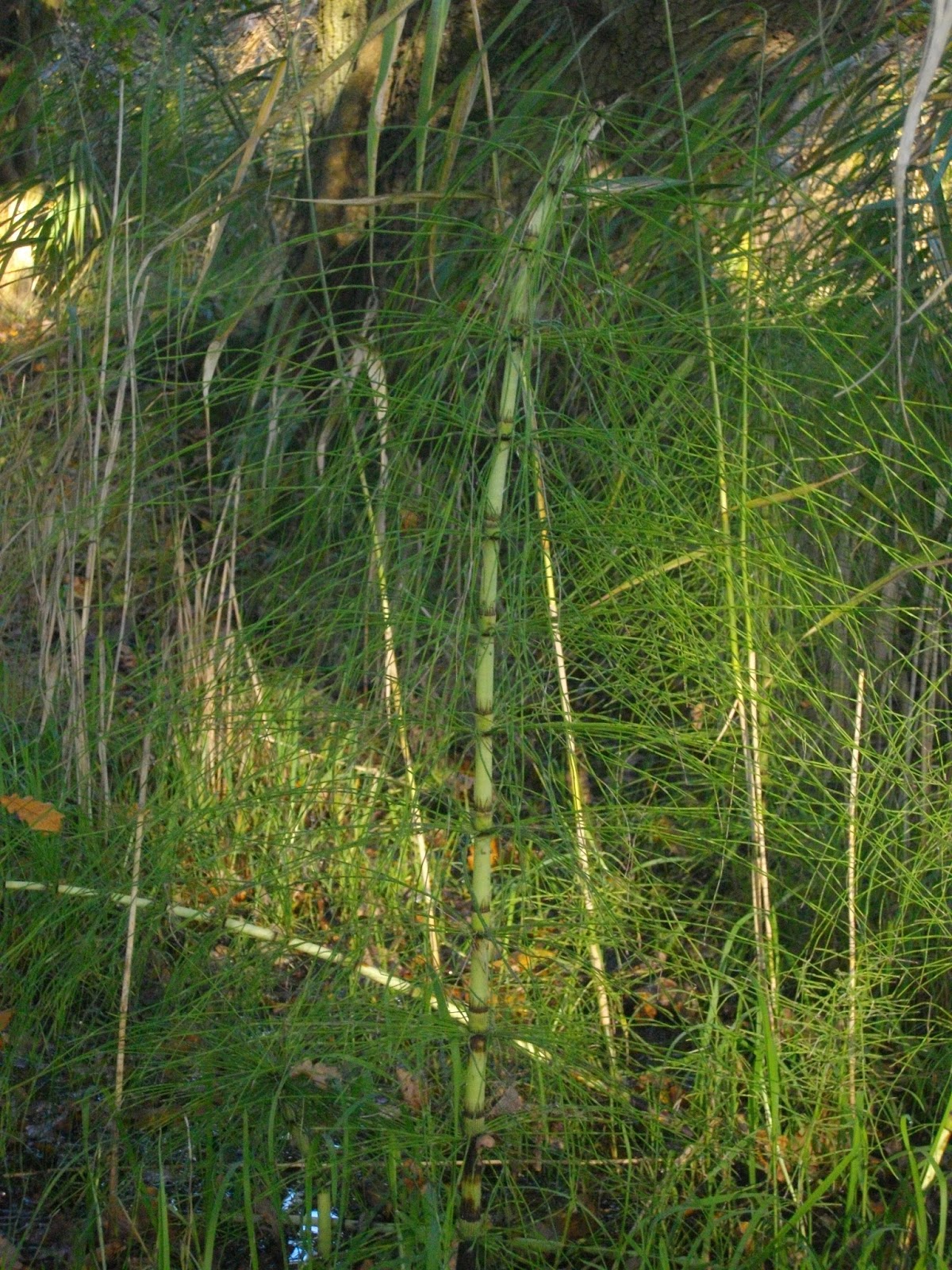
There are quite a few fungus records for Whitwell Common, including Crimson Waxcap, but I didn't notice any grassland fungi, or indeed any dry grassland areas where they would normally grow. I did notice some Giant Horsetail growing in an area of wet woodland between a path and the road. This large version of the commoner horsetails is rather scarce in Norfolk - I had only seen it once before. As we emerged from the wooded area I raised my arm to shield my eyes from the sun, and within seconds a Common Darter dragonfly had landed on my hand. It flew up and returned briefly, before relocating to a nearby branch. This was a very satisfying feeling, somehow connecting with the landscape.

After walking through some wet reedbed areas we crossed a ditch into the woodland. On our left hand side was a small river (I'm not sure which one, but I think it is a tributary of the River Ainse). We saw some bright-pink seeded Spindle trees, but not much else of note until we were almost back at the road, where there was a flush of fungi. I heard a Treecreeper calling, and spotted it working its way up a nearby Oak. This was a nice site, and I'm sure in the spring there would be many more things of interest to look for.