The Whitlingham Bird Report for 2025 is now available to download from the Bird Reports page or from here

Showing posts with label Earlham Cemetery. Show all posts

NORWICH: April Earlham Cemetery visits

Early April 2023

I visited Earlham Cemetery twice in April, firstly for an event organised by the Friends of Earlham Cemetery to look at mosses, and secondly for a few hours on a sunny day looking for hoverflies. Most of the mosses were species that I had seen before, but a couple pointed out by East Norfolk bryophyte recorder Mary Ghullam that I hadn't seen were Hooded Bristle-moss (Orthotrichum cupulatum) and Streblotrichum convolutum (=Barbula convoluta).


On my second visit I failed to find any Criorhina species, but did find a few new bits and bobs. I typically don't pay much attention to bluebottle and greenbottle type flies because many need close examination for ID, but I had seen pictures of one called Eudasyphora cyanella that has a small area of white at the front of the thorax, and I amanged to find one of those. I also saw the tephritid fly Tephritis formosa, a leafhopper Acericerus heydenii, the bug Stygnocoris fuligineus and a caterpillar of the Tree Lichen Beauty moth.


NORWICH: Earlham cemetery beetles

Late December 2022

It had been a while since I'd visited Earlham Cemetery, so I called in on the way to Whitlingham for a quick look around. I failed to find any barkflies, which was the main thing I was looking for, but I did find some beetles including one of the inconspicuous ladybirds, Rhyzobius lophanthae, and a new species for me the tiny Cartodere bifasciata.


NORWICH: A selection of rare/interesting local fungi

Mid-October 2022

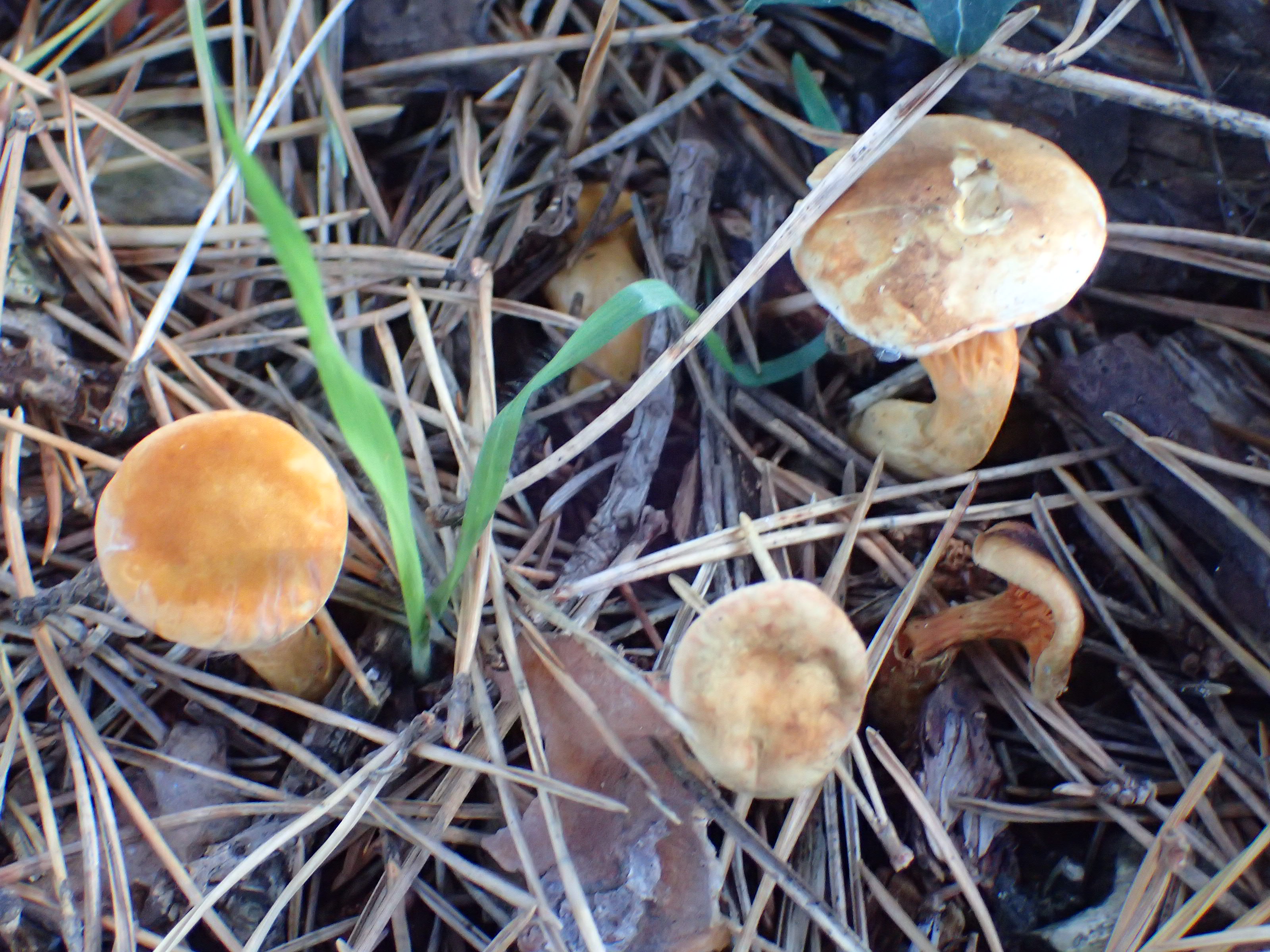
A few interesting fungi around the city during October. At Earlham Cemetery I went and had a look at Hygrophoropsis rufa, which had been identified by Ian Senior. I've seen 'False Chanterelles' (Hygrophoropsis aurantiaca) in the same area in the past, so it seems likely that I'd probably seen H. rufa in the past but not realised it. There was a similar scenario at Sycamore Crescent Wood, where a large woody bracket fungus must have been present near the bridge to Sweetbriar Marshes for many years, but it was only identified this year when Jeremy Bartlett realised that it was Pereniporia fraxinea.


Two species found on my way into work were also new ones. I had seen pictures online of a rather nondescript white fungus called Mealy Domecap (Tricholomella constricta) found by Jeremy Bartlett growing along the edge of a street in the Golden Triangle. Apparently it favours areas 'enriched' by animal urine. As there are plenty of dog walkers nearby I checked a few grassy communal areas near our house and found it within a few minutes! On another morning it was raining so I was looking down, trying to avoid getting soaked, when I noticed several boletes growing on a verge under a Lime tree (Tilia sp). Taking one back and taking a section I realised that it was Boletus (=Xerocomellus) bubalinus, a species new to Norfolk where the cap turns pink with a blue line along the pore layer when cut. This was the first Norfolk record.


Finally I was told about some Aromatic Pinkgills (Entoloma pleopodium) growing in Earlham Cemetery. They had been cut down as part of the mowing regime almost as soon as they had been found, but fortunately Vanna noticed a few fresh ones a week later, so I went back and managed to see them.


NORWICH: Mallota and a rare midget

Late June 2022

Towards the back end of the month Vanna Bartlett found a rare hoverly, Mallota cimbiciformis, around a rot hole in a tree in Earlham Cemetery, probably only the third Norfolk record. As it was a male there was a strong possibility it would be 'guarding' the rot hole, and this turned out to be the case as Vanna went back and saw it there the next day as well. I visited a couple of times, seeing nothing on the first occasion in windy conditions, but getting brief views the second time as it flew in, inspected the rot hole before disappearing up towards the canopy.

Whilst standing waiting near the chosen poplar tree I noticed a couple of leaf mines of the nationally scarce Winter Poplar Midget, Phyllonorycter comparella. This was only the second VC27 record (see https://www.norfolkmoths.co.uk/micros.php?bf=3650). Across the other side of the cemetery I found a tree with a large number of mines, so I took one home to rear through, and a few weeks later was pleased to see an adult moth had emerged.


NORWICH: Earlham Cemetery plant fungi

Mid-April 2022

Earlier in the month Ian Senior had sent me pictures of some Lesser Celandines infected by something that I recognised as the Oomycete Peronospora ficariae. I decided to go and have a look, and whilst there also had a look for another of Ian's finds, Grape Hyacinth Anther Smut (Antherospora hortensis). Along the main drive several Early Dog Violets had Violet Rust, Puccinia violae on them. Seeing quite a lot of Field Wood-rush I checked that too, eventually finding the rust Puccinia obscurata on some of the leaves.


NORWICH: Some invertebrates on Larch

Mid-April 2022

I had lunch in Earlham Cemetery, and spent most of the time staring at a couple of Larch trees in the hope of finding Larch Ladybird, a species that has so far eluded me. It continues to do so, but I did find a few nice things, including a Pine Cone Bug, an Eyed Ladybird and an egg-laying Larch adelphid aka Larch Woolly Aphid), Adelges laricis.


NORWICH: Last trip of the year - Earlham Cemetery for more fungi

27th December 2021

My last trip out of 2021 was to Earlham Cemetery where I met up with Ian Senior to have a look at a interesting patch of fungi that he had found there. They look superificially like Psathyrella but the gill arrangement is rather distorted. It might turn out that this was caused by some sort of infection, but it was certainly worth a look. Whilst there I noticed some Sweet Chestnut leaves with microfungi on them, which Stewart Wright identified as Ramularia endophylla and Camarosporium oreades. I noticed some webs on a Phellinus pomaceus bracket, probably caused by either a fungus gnat or a species of Thrip. On the mossy walls at the edge of the cemetery Ian pointed out some Arrhenia rickenii, and I noticed next to them some tiny specimens of Small Moss Oysterling, Arrhenia retiruga.


NORWICH: Earlham Cemetery invertebrates with Vanna

21st November 2021

Yet another rainy weekend, but this time I met up with Vanna Bartlett to have a look at some of the interesting invertebrates that she has been finding in Earlham Cemetery recently. We started off checking some gravestones for longhorn beetles (without success), but did find a couple of Orsillus depressus, a bug associated with Lawsons Cypress, along with the spider Zygiella atrica. In a different area we saw a very unusually patterned Eyed Ladybird (the biggest UK ladybird), the first time I'd seen this species since childhood. We then moved on to checking branches amongst leaf-litter for my main target, the harvestman Dicranopalpus larvatus. This species was new to Norfolk when first found here by Vanna and is still the only county site for it as far as I know. We managed to find both male and female specimens, which was good.


Exploring the rest of the cemetery I added another new species, Brown Larch Aphid (Cinara cuneomaculata) from Larch branches. A Parrot Waxcap (usually green) had started to turn pink, which apparently is something that happens after a frost. Across the other side of the ring road we followed some directions from Ian (mostly OK with the exception of a left/right mix-up!) to find a group of Grooved Cavaliers (Melanoleuca grammopodia). This was the first time I'd seen this species since 1995!


NORWICH: Earlham Cemetery plant hunt & fungi

4th January 2020

Continuing the theme of Norwich-based excursions, Cathy, Rose and I went to Earlham Cemetery to take part in the Friends of Earlham Cemetery event for BSBI's New Year Plant Hunt. There seemed to be fewer plants in flower than recent times, but I think the final total didn't necessarily back up that observation. We got a brief glimpse of a Muntjac, which pleased Rose (although not as much as the cat that accompanied us around a section of the cemetery).

Highlights of the visit were probably non-floral - we saw some good specimens of Striated Earthstar, before being shown some Lacquered Bracket (Ganoderma lucidum) and the eggs of a Vapourer Moth, laid on the cocoon that the female would have originally emerged from (the females are wingless in this species).


Having left the cemetery and gone shopping, I had a call from Gary White to say that he had found a Waxwing showing well on Edinburgh Road. I took a rather winding way home to look for it, intitially with no success, before hearing it call nearby. A look down the next road along and hey presto, a Waxwing perched up on a TV aerial on College Road. It didn't stay long, flying back towards the original location, but always nice to see this species around the city.

NORWICH: An unusual lumpy fungus in Earlham Cemetery

Mid December 2019

The story of an unusual fungus found at Earlham Cemetery by Ian Senior is both complicated and incomplete, so I will only present a summary here. In November Ian found a Lepista-type fungus (the family that Wood Blewit is currently in) with a very odd bubbly surface. I hadn't seen anything that resembled the pictures so was of no help, but other people did suggest that it might be caused by a parasitic fungus. A small piece was taken by Tony Leech, who was able to identify the host fungus as Lepista ovispora, a scarce species in itself. It appeared that there was indeed a second fungus present, but an attempt to extract DNA was unsuccessful. Meanwhile, a similar 'bubbly' fungus was found at Ashwellthorpe Lower Wood. This did yield DNA, and there was a match with a parasitic fungus barcoded in the USA. It seems very likely that this is the same fungus Ian found.

Anyway, a normal fungus would have probably rotted away by now, but the infection had turned this one to a solid jelly-like consistency and it was still present. I decided to have a look, but didn't find it at first look. I therefore met up with Ian on his lunch break so that he could show me the fungus, definitely passed its best but still very interesting.


Afterwards Ian also pointed out a handful of other interesting things that he had seen recently, including a couple of small orange cup fungi and Greening Coral (Ramaria abietina). I also recorded a new Agromyzid, Phytomyza autumnalis, in Common Knapweed.


NORWICH: Thorow-wax and poplar mines

8th September 2019

After the Heydon Hall fungus foray I headed back to west Norwich to drop Ian off, and he mentioned that there was a Thorow-wax plant growing in Earlham Cemetery. This is a scarce species, and one I'd not seen before, so Ian kindly agreed to show me where he'd found it. Fortunately even though it was past its best it was still quite distinctive.


On my way back to the car I had a look at a couple of large Black Poplar trees. Whilst undoubtedly planted here, 'true' Black Poplars are quite rare nowadays. A couple of mines were visible, the moth Stigmella trimaculella and the Agromyzid Aulagromyza populicola, whilst there were also some nice twisted galls caused by the aphid Pemphigus spyrothecae.


EARLHAM CEMETERY: Plant walk & random invertebrates

30th June 2019

June's Friends of Earlham Cemetery walk was led by Mike Crewe with a focus on plants. There were a few new grasses for me (unsurprising given my lack of expertise with them) but it was also good to pick up some general ID tips from Mike. One of the first yellow composites we saw was Beaked Hawksbeard, which I'd never recorded before but suspect is probably in my lawn! Nomada fabriciana, a leaf mine of the moth Leucoptera laburnella on Laburnum and Puccinia cnici on a thistle were all new records from the walk.