The Whitlingham Bird Report for 2025 is now available to download from the Bird Reports page or from here

Showing posts with label Norfolk Tick. Show all posts

BROADLAND: How Hill heron

25th August 2018

After dropping Cathy & Rose off in the city I had a free afternoon and decided to visit How Hill to look for the Purple Heron that had been seen there recently. Having parked up I called in at Toad Hole Cottage to get a ticket for the nature trail, and was told that the heron had been seen a few hours previously but spent a lot of time out of sight in the reeds. I tried to keep focussed and walk straight to the hide that overlooks Crome Broad in the far corner of the reserve, but inevitably stopped regularly due to the large amounts of insects on the Angelica flowers. There were loads of hoverflies, including Sericomyia silentis, Platycheirus rosarum and Melangyna compositarum/labiatarum.


A couple were just leaving the hide when I got there, but after that I had at least 30 minutes of solitude, and 20 minutes in the Purple Heron did the honourable thing and flew up out of the reeds in front of the hide, before flying low to the left. This was only my second Purple Heron and my first Norfolk one, having seen one at Minsmere years ago. Later I was joined by several other birders, but the heron didn't show again before I left. One of them, Nathan, came back the following morning and managed to get a good flight shot which is on the RBA gallery here.

On my way back I could pay more attention to leaf mines, noting a good suite of Alder species and a handful of Agromyzids. A couple of Willow Emerald damselflies were also of note. The best find was a mine of  the moth Leucoptera lutella in Bird's-foot Trefoil. This is a Nationally Scarce A species that Stewart pointed out to me at Burgh Common recently.


EAST NORFOLK: Return to Shangri-La

13th January 2017

Having failed to see the Hume's Warbler at Waxham on the previous weekend, I was keen to revisit and give it another look. Adam had also been unsuccessful, so I agreed to head back to North Walsham on Saturday morning to pick him up then head to Waxham. I had a quick poke about in his garden before we set off, noting Stigmella anomalella mines in a Rose sp and more interestingly feeding signs of a Psychoides moth sp on Polypody ferns.


At Waxham we noticed a small group of birders looking into the Shangri-La garden. The Hume's Warbler had been seen there earlier in the morning, but there was no sign of it now. Deja vu began to creep in. Some people on Twitter had given me up-to-date information, which suggested that it was mostly favouring the area south of the garden, was calling very infrequently and was feeding low down, so we decided to search the areas of Alexanders along the coast footpath just south of Shangi-La.

After about 45 minutes with no sight or sound of the Hume's Warbler we retraced our steps and decided to try a bit to the north. A small group were looking intently into the ivy covered trees in a way that suggested they might have seen it, but they hadn't. After searching theare just north of the chalet we turned round and returned to head back to the area we started at. This time we got lucky, as a tour group had located the Hume's Warbler. It called and flew past us, and after a quick move along the path we got nice close views of it in some Alexanders before it flew up into the trees. Another call and some more good but brief views and it then vanished again.

Leaving Waxham we decided to call in at Happisburgh where a flock of Shorelarks have been frequenting the area around the lighthouse. The large field seemed to hold hardly any birds, although a Meadow Pipit was new for the year for me. Whilst Adam scanned the field I looked out to see, seeing two Red-throated Divers flying south. Further along we met Gary & Alysia, who also hadn't seen the Shorelark. After a catch up we continued on, seeing some Skylarks and a Stonechat. On the way back I noticed four Snow Buntings on the beach, suggesting that the Shorelark might have also been somewhere out of sight along the shore.

On the way home we saw drive-by Turnstones at Walcott and a Sparrowhawk over the road between Edingthorpe and North Walsham.

NORTH NORFOLK: Cley Dowitcher and Soldierflies

16th July 2017

On Sunday I knew I would have a few hours free after dropping Cathy off in the city, and I thought I would head out to east Norfolk to look for another one of my target species, Fen Mason Wasp. Those plans changed in the morning, when news came through that Jake had found a Long-billed Dowitcher at Cley. Whilst reasonably regular in the UK, there hadn't been a Norfolk record since 2007, so I decided that I would go and have a look.

Heading north out of the city the roads were wet, and as I carried on towards Holt it began to rain. Not ideal, but at least the weather wasn't likely to do my chances of seeing the Dowitcher any harm. I parked up at the visitors centre in the assumption that the east bank car park would be full, althoug as it turned out I could have parked there and saved myself a bit of time.

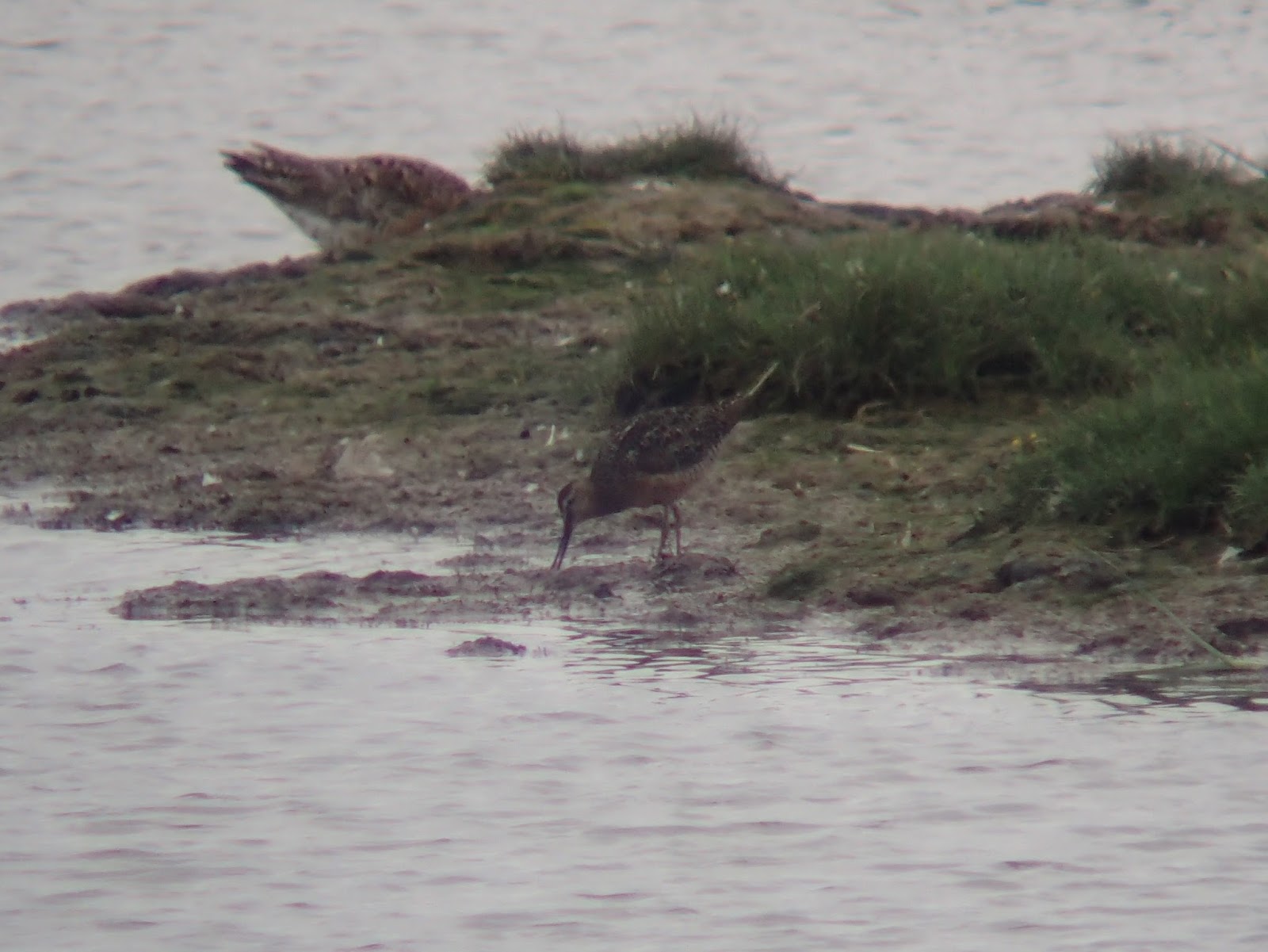
A small group of birders including Paul Woolnough were stood level with the serpentine, watching the Long-billed Dowitcher alongside a few Black-tailed Godwits and Redshank. It showed reasonably well, although the overcast conditions made photographs poorer than normal.


After a while I carried on past Arnold's Marsh and had a quick look amongst the Birdsfoot Trefoil. Six-belted Clearwing moths seem to show well on the equivalent plants at Minsmere, but here there was no sign of any. At that point I got a phonecall from John Furse who was on East Bank and asked how I was getting on, adding that I was about a month late if I wanted to see the clearwings.

On my way down the path I had deliberately avoided looking too closely at the plants as I knew I'd be distracted by the insects. On the way back I made up for this by checking as much Hogweed and Ragwort as possible, finding three species of soldierfly and a new hoverfly to complete a wildlife-filled weekend.

 Barred Snout female
 Barred Snout male
 Flecked Snout male
 Green Colonel
Anasimyia contorta

NORFOLK: The birds and the bees. And fungi.

9th October 2016

A week of easterly winds and a generally promising weather chart for rare birds had whipped up something of a frenzy amongst birders, to the point where anything less than a full-scale Sandgrouse invasion risked being a disappointment. To be fair, Shetland has now had a nice array of very rare birds, including Britain's first Siberian Accentor. Norfolk so far has had the sort of birds you would expect, just in higher numbers.

With this background, I had Sunday to go out and had to decide how to spend my time. In the end I decided to head to the north Norfolk coast. I started at Cromer, where after a short walk I ended up near the lighthouse and a small crowd waiting for a Dusky Warbler. It could be heard calling from some Sycamores along the clifftop, but was typically staying out of view. Eventually I got a few flight views, before a better look as it moved through some bracken, and then finally in one of the Sycamores. This was a new Norfolk species for me, having previously only seen one in Yorkshire.

Driving west along the coast road I considered stopping at Muckleburgh Hill, but the sun had come out and I wanted to look for some bees at Walsey Hills. Ivy Bees have colonised several places along the coast, but at Walsey there are some other Colletes bees, probably Heather Bee (Colletes succinctus) alongside the Ivy Bees. Handily David the warden was about, so he showed me the nest holes near the NOA observatory and then some good areas of Ivy to check.

When the sun came out the ivy was covered in insects, including Red Admirals, Painted Lady, Wasps, Honey Bees and at least seven species of hoverfly. I did eventually find one Colletes bee, probably a pale Ivy Bee, collecting Ivy pollen. I also kept an eye out for fungi, seeing some small brownish oysterlings that I recognised as Resupinatus trichotis. Back up at the observatory more bees were visible. including a nice buff-banded Ivy Bee and some slightly slimmer, paler looking ones that looked like Heather Bees. There is another member of this family, Sea Aster bee, that looks similar to the other two, hence my slight reticence to commit to definite IDs. It began to rain, so I had a quick look at a Jack Snipe on Snipe's Marsh through David's 'scope before heading off.


Next stop was Stiffkey, where I started off in the woods. There had clearly been an arrival of Goldcrests, with 50+ in scattered amongst the trees. I love Goldcrests, but it wasn't too long before I was getting a crick in the neck, checking and then rechecking each one as they flitted about. A few Chiffchaffs provided some variety. I left the woods and walked along the edge of the Sueada. With not much going on there I then headed west along the coast path towards Warham. At this point I had a decision to make, whether to go for a long walk or move on. In the end a text from Gary telling me he had seen a Ring Ouzel made my mind up for me - I headed back to Norwich to spend a bit of time at Whitlingham instead.

I wasn't particularly optimistic about seeing the Ring Ouzel - when Gary had seen it it had appeared to land somewhere near the picnic meadow. Before heading there I decided to check the areas of short cropped turf around the campsite, and by pure luck heard the Ring Ouzel call and fly across the campsite into the lime tree avenue. I scanned the trees as best I could, then checked the field the other side and the meadow at the top of the avenue, but didn't see it again. Three Green Woodpeckers together was a bonus, and good to see that they bred successfully. On my way back I noticed an orangey fungus growing on a log. A closer look showed that it was Wrinkled Peach, although not very wrinkled, so a good visit, and the right call to come back.


NORTH NORFOLK: Great Knot

2nd July 2016

On Saturday afternoon I headed back to Titchwell, hoping to catch up with the Great Knot that has been accompanying the Knot flock for the past few weeks. As I drove between Docking and Brancaster the scene in front of me seemed the very definition of atmospheric. The water on the road was evaporating in the strong sunlight, and as I crossed the brow of the hill a Red Kite drifted over the road. Either side fluffy cumulous clouds hung in the sky, but ahead lines came down from menacing grey clouds, showing that it was raining hard offshore. A flash of lightning lit up the sky, reminding me uneasily that early in its stay the Great Knot had been spooked by a big storm.

It was about 16:30 when I reached Titchwell, and I was surprised to see how few people were around the car park and visitors centre. There were a few people standing on the main path scanning towards the Knot flock, so I set up my telescope and looked out. There were two tightly packed groups, so in the end I conceded and asked if the Great Knot was amongst them. It was, but right at the back and only the head and a bit of the back was visible. Relocating to the Parrinder Hide the Great Knot was more visible, albeit not more active. After a while (and one of those crunchy nature valley bars) I headed back to the main path, seeing a Spotted Redshank and a leg-ringed Avocet before heading home.


WEST NORFOLK: Third time lucky - Pallid Harrier

13th February 2016

I called in briefly at Whitlingham around midday, mainly to check out the gulls. This was largely scuppered as the model yachters were using the slipway again, so the gulls were on the water. I scanned through as many as I could find in the hope that the Mediterranean Gull present on Monday would be amongst them, but I couldn't see it. I headed along the south shore as far as the island, scanning the bay and the reed edges, 6+ Shoveler and c30 being the pick of the birds. On my way back the gulls were beginning to return, but no rings were visible.

After returning home for lunch I then headed to Roydon Common, hoping to see a Pallid Harrier. Twice in December I had looked for this overwintering bird at Flitcham. On the first occasion it wasn't seen all day, and the second time the area was closed for a royal shooting party. I had decided I wouldn't try a third time, but in recent weeks the same bird had been seen coming into the harrier roost at Roydon daily, and this seemed a better bet.

Doing my research I noticed that the Pallid Harrier arrived at Roydon at varying times, anywhere between 15:00-17:00. To be on the safe side, and also because it was an overcast day, I aimed to arrive about three. With no sign of any raptors, I passed ten minutes checking the pony dung for Nail fungi. I didn't find any (again), but I did find some Dung Roundheads. A lichen-covered tree also turned up some bright pink splodges of Illosporiopsis christiansenii, which is probably common everywhere but rather under-recorded.


I decided to head along to a viewpoint overlooking the area that the harriers roost and wait until dusk. It was only about 15:20 when we looked up at a Kestrel flying over. Suddenly another bird of prey appeared below it - a ringtail, and more specifically the Pallid Harrier! It had appeared over the ridge from the south, which we weren't expecting, and soared around close to us, giving exceptional side, underpart and upperpart views as it glided round. It flew into the distance and landed on the ground, barely visible. A bit later on the Pallid Harrier gave prolonged flight views before perching on a post. It really was a beautiful bird, and I was glad that I had made the effort to look for it again. I also saw a ringtail Hen Harrier and a Barn Owl before heading back to Norwich. My photo attempts were rubbish, so I've attached a drawing instead.

BROADS: White-winged Black Tern at Ormesby

5th September 2015

Around lunchtime I found out that a juvenile White-winged Black Tern had been found at Ormesby Broad. I had seen this species before, but not in Norfolk, so as I had some time free I thought I'd go and have a look. In addition to the straight-forward reasoning that I thought I'd enjoy watching it, White-winged Black Tern is probably one of only a handful of county rarity species that could realistically turn up (pun not intended) at Whitlingham, so having a good look at a juvenile seemed to be a useful exercise.

Arriving at Ormesby Broad (there is sometimes a bit of confusion around place names here - the place is Rollesby, north of the bridge is Ormesby Broad, south of the road is Rollesby Broad and further south is Ormesby Little Broad) the White-winged Black Tern was immediately on show although distant. James Lowen was already there, and having seen a photo very similar to one I took I think I was stood next to Kayn without introducing myself, so sorry if that was the case. Hirundines, mostly Swallows, swept over the broad in waves, although they were completely outmaneuvered by the tern, which twisted and dived with seemingly effortless abandon. It briefly perched up on the only frame available, but spent most of the time in flight. I did get a very distant record shot, but also took the opportunity to make a couple of sketches and take a few notes.


NORTH NORFOLK: Burnham Citril Finch

10th May 2015

On the way back from Ashwellthorpe I got a phone call from Ricky, asking if I wanted to go and see the Citril Finch at Burnham Overy. I had been aware of it in the morning, but because I'd been out I hadn't realised that it had settled down and shown well during the afternoon. Cathy kindly gave her assent, so after a quick bite to eat Ricky picked me and Andrew up and we set off for Holkham.

Parking up at Lady Anne's Drive we noted a couple of Brent Geese flying past, along with some noisy Oystercatchers and lots of Woodpigeons. We took a brisk walk along the pines until we emerged at a dell at the edge of the dunes. A small crowd (given the rarity f the bird) of around 30-40 people were watching the Citril Finch as it fed and hopped around part way up a dune. At times it showed well on the bare sand, although it also spent quite a bit of time obscurred behind a bramble.


After watching the Citril Finch for a while we set off back to the car, stopping every so often to scan the freshmarsh in the evening sunshine. On our way back we saw three Barn Owls. The first was flying over the marshes, but the second two were both perched up in trees near the road. The first was a typically pale individual (see photo) but the second bird, which unfortunately flew off as we neared it was buffer on the underparts. Many thanks to Ricky for the lift.

NORTH NORFOLK: Obligatory Shrike post

11th October 2014

Having not been to see Norfolk's first Steppe Grey Shrike* last Sunday, I had been admiring the many photos of it to hit the web. Thankfully it did the decent thing and stayed until the weekend, so Cathy & I headed to Burnham Norton to have a look. Luckily for us the forecast storms didn't happen until the evening and we got excellent views of the Steppe Grey Shrike with just a little bit of rain. This also allowed us to bust the myth that cows lay down when it's going to rain, as only one cow was laying down before and during the rain. The moral of the story? Don't trust cows. Oh, and take a waterproof coat with you when you go out in the autumn.


"Rain? We only sit down for hail or earthquakes"

* The name 'Steppe Grey Shrike' is a bit of a misnomer and may be changed in the future, along with much of the Grey Shrike taxonomy. Currently it is treated as a subspecies of Southern Grey Shrike.

NORTH NORFOLK: Spectacled Warbler

5th June 2014

Late spring has seen a flurry of birds in Norfolk, including Britain's 8th Spectacled Warbler at Burnham Overy. It was found on Monday, but trips to North Norfolk after work make for a long day, so I decided to leave it. A few days later and the bird was still present and my resolve softened, so after work on Thursday Cathy, Margaret and I headed off for a look. On our way a Barn Owl flew across the road near South Creake. We parked at Burnham Overy and set off along the coastal footpath. On our way to the dunes we saw a Spoonbill and a couple of Grey Partridges, as well as this tortoise beetle (a different species to the one I saw at Thorpe).

Cassida vittata

Eventually we reached the dunes and a small group of birders focused on some Suaeda. We heard a brief bit of song and after a while up popped the Spectacled Warbler. It was constantly on the go, foraging around the suaeda and occasionally flying up to a bush in the dunes. We saw it a number of times, but never long enough to try to take any photos of it. By now we were starting to get hungry, so we headed back, getting excellent views of a Little Tern next to the path, and brief views of a Bearded Tit. The sun was still shining and Burnham Overy looked idyllic as we got back to the car.


NORTH NORFOLK: Black-headed Bunting

29th May 2014

Monday's Black-headed Bunting had been untwitchable, but it was followed two days later by a more accessible one in West Runton. As luck would have it the bird was still present on Thursday, so after I finished work Cathy & I went to have a look. There was no sign of the bunting when we arrived, or for quite a while after. Chris pointed out that it was shaping up to be a dull blog entry if we didn't see it, but luckily for us (and you dear reader) eventually the Black-headed Bunting did appear, and sat in full view albeit distantly. As an added bonus it didn't rain whilst we were there either. Whilst waiting for it the only other birds in the brambles were a Whitethroat and a Linnet, whilst some Gannets were passing out to sea.


YARE VALLEY: Rockland Whiskered Tern

24th April 2014

On my way home from work I found out that a Whiskered Tern had been reported from Rockland Broad. Checking that it was still present, we decided to go and have a look. Understandably there was a bit of a Yare Valley birders convention going on, with Paul W. in the car park and Justin and Ben already on their way back. On the way along the path we heard our first Cuckoo of the year calling in the distance. Upon arrival at the hide we soon saw the Whiskered Tern twisting and turning along the far shore of the broad. We got good but distant views, leaving before we were overwhelmed by the smell of urine in the hide. On the way back we tried to avoid inhaling midges from the small clouds floating at regular intervals along the path.

[Edit] We were nearly back to the car when mild confusion hit, as I overhead two birders saying "Osprey". Following their looks I could only see a Woodpigeon flying over, and must have given them a funny look as one of them explained to me they were actually looking at an Osprey plane, a weird American aeroplane with propellers pointing upwards to allow vertical take-off. So now I know!

Later on the tern flew off north-west, so it remains to be seen whether it will be relocated closer to Norwich. Incidentally in the past few days Common Sandpiper, Cuckoo, Reed Warbler and Garden Warbler have all been seen/heard at Whitlingham, but we are still awaiting Grasshopper Warbler, Lesser Whitethroat and Nightingale.

NORTH NORFOLK: Holt Roller

18th June 2013

A Roller found near Holt on Sunday afternoon was a bird that I particularly wanted to see, but it wasn't until Tuesday evening that I had time to go for a look. I managed to borrow the car from Margaret after work, and Cathy & I headed to Edgefield. The bird had been commuting between the woods to the west of the main road and the Lowes to the east, so our first job was to ascertain where the bird was. A birder at the car park told us that the bird was on the lowes, so we set off east. 1.5 miles later we arrived to find a small group of birders. I'm pretty sure that it would have been quicker to walk from Holt C.P. car park, but I guess if the bird had been at Edgefield it would have been much further so worth hedging our bets.

Anyway, we were there, and a birder kindly allowed us a view of the Roller through his 'scope. It was perched up in a deciduous tree and we were able to watch it fly from tree to tree. At one point it flew down to a manure heap (I'm not convinces it actually was a manure heap, where would all the manure come from? But it did look like one), seized an item of prey and then went back to eat it. Views were good although distant, nicely complemented the Upper Hollesley bird, which had shown well but not flown around much.

We took a different route back to the car, seeing a Woodlark and Wood Horsetail at its only Norfolk site. This was my second Norfolk tick of the year, following on from the Thetford Dipper.

Wood Horsetail

NORTH NORFOLK: Felmingham thrush survey

4th January 2013

This morning I headed off to Felmingham to survey a core square for the BTO's Winter Thrush Survey. Having not seen any Redwings or Fieldfares at all so far this year, I wasn't overly optimistic. Arriving at the church I parked up and set off along the main road. I was almost a quarter of the way round my route before I encountered a single thrush, and I don't remember the last time I was so pleased to see a Blackbird. Continuing along down a minor road I saw a huge flock of Woodpigeons in the fields (at least 600+), and some Starlings (which I happily counted, giving the a lack of anything else). A Sparrowhawk and some finches livened the route slightly, but four more Blackbirds was the last of my survey birds. Whilst competing my route across a field I heard a couple of Skylarks passing overhead, and then three loose skeins comprising around 90 Pink-footed Geese flew south-east.


NORTH NORFOLK: Surf Scoter & R-c Starling

17th November 2012

Whilst at home today I got a phone call from Gary mid-morning to tell me that a juvenile Surf Scoter had been found off the cliffs between Sheringham and Weybourne. Ducks are probably my favourite group of birds, and Surf Scoter was one of the three species on the Norfolk list that I hadn't seen (Canvasback and Blue-winged Teal are the others), so I decided to get the next train to Sheringham to go and have a look. After a long walk along the cliffs (failing to see a Richard's Pipit that was seen sporadically throughout the day) I reached the right place, where a couple of birders were watching the Surf Scoter with a small group of Common Scoter. The flock were actively feeding, but when seen in profile the head and beak of the Surf Scoter really stuck out. A little while later Neil and Gary arrived, and after watching the scoter for a bit longer we headed back.

On my way to the scoter I had been told that a Rose-coloured Starling had been found in Northrepps, so we headed that way. A birder at the village hall car park gave us directions to the garden that the bird was frequenting, and we found a small group of birders watching the juvenile Rose-coloured Starling in a small tree, where it showed well. Interestingly the bird had at least one dark adult covert, and the end of the beak had turned pink. We also clocked up a Cormorant and a Lapwing over the house, and saw a flock of Pink-footed Geese fly over near Southrepps on our way back to North Walsham to round off an excellent days birding.


Many thanks to Dave Appleton for finding the Surf Scoter, and to the owner of the garden that the Rose-coloured Starling was in.

YARE VALLEY: Caspian Tern at Buckenham

19th July 2012 

Caspian Terns have a bit of a reputation for being tricky to pin down, so today's after work jaunt with Neil was done with more hope than expectation. We headed for Buckenham, which seemed to be the centre-point of this birds wanderings. We parked at the station and headed down to the fishermen's car park at around 16:45. The tern hadn't been seen for a couple of hours, but almost immediately a birder on the bank picked it up flying swiftly along the river towards Strumpshaw. 15 minutes or so later and it was back. This time the Caspian Tern left the river and flew behind us over the marshes, giving crippling views against the dark skies as it drew level with us. It then headed towards the mill, circled and headed off towards Cantley Beet Factory. It was noticeable just how quickly and powerfully it flew with a definite sense of purpose as it disappeared into the distance. 

With the Caspian Tern flying at will up and down the Yare Valley between Strumpshaw and Breydon, it is surely not out of the question that it will venture further west to Whitlingham if it lingers much longer. Fingers crossed!

THE FENS: Squacco Heron

1st July 2012

Squacco Heron is a bird I have wanted to see in Norfolk for some time, so when news came out that the bird was still present* we set off for Welney.  Upon arrival we found room in the reedbed hide and were soon given excellent views of the upper half of the bird as it fed in the waterside vegetation, occasionally vanishing behind the large stands of docks.  After watching the Squacco Heron for a while we left to free up some space, seeing various butterflies and damselflies on the walk back to the observatory.  Here we spent some time watching the House Martins come right up to the window as they flew into their nests.  The WWT guide-in-the-hide told us that the Squacco had been in the area for a week as she had seen it beside a road nearby in the rain on Sunday past, but that it had only been seen on the reserve yesterday.

 Good view, poor photo as always
A more typical view, showing the plumes

* Usually I'm all for going and looking for a reported bird and trying to find it, but Welney has that dubious combination of being the furthest Norfolk reserve from home, and the most expensive to get into, so it makes sense to wait for news.

NORTH NORFOLK: Bee-eater

20th May 2012

Bee-eater!  I've wanted to see one of these for ages, and despite an initial setback when it flew off from Glandford ford, Cathy, Margaret & I managed to get excellent views as the bird relocated to wires near the sewage works.  Afterwards we headed to Cley for some food, only to meet Bill Oddie in the carpark!  After a brief chat we left him in peace and headed up to the visitors centre for lunch.  In a quick scan of Pats Pool from the centre I saw a large flock of Dunlin, a 1st-summer Little Gull and some Avocet chicks.


YARE VALLEY: Savi's Warbler

16th May 2012

The chance to hear and even better actually see a Savi's Warbler within 10 miles of home was too good to pass up, and I managed to get a lift after tea on Wednesday to go and have a look.  I arrived at Tower Hide around 18:30, and was surprised that there were only four others in the hide.  Within a few minutes the Savi's began reeling, and I managed to get reasonable telescope views as it moved about the reeds.  It then disappeared from view, only to return briefly then drop down to the right.  Over the next hour the Savi's reeled for short periods, but seemingly from further right, out of sight in the reedbed.  The reeling was quite distinct from Grasshopper Warbler, I'm pretty sure I could call one if one were to ever turn up in my neck of the woods. Whilst there, a Bittern was booming close by and a Cuckoo flew past the hide, as well as the usual Marsh Harriers etc.  Congratulations to Ben on his find, and thanks to the RSPB for releasing news.  

The public service announcement:  Obviously as a Schedule 1 species, if you do go and have a listen stick to the Tower Hide, no tape luring or doing anything generally that would disturb it.


YARE VALLEY: Storks!

28th April 2012

Most of Saturday was not great.  I spent the majority of the day waiting in a near-empty house for an engineer to come out (he never appeared), finally leaving and watching Norwich City play Liverpool, losing 3-0.  Once the match was over Cathy kindly suggested we go and look for two White Storks that had been found near Acle earlier in the day. We found Damgate Lane easily enough, and scanning from just over the bridge I managed to pick out one of the Storks behind some cattle.  It was then obscured as a cow walked in front of it, but after a while the cows moved off to the left, leaving the two White Storks standing next to each other on the marshes in the pouring rain, ensuring that the day ended on a positive note.