The Whitlingham Bird Report for 2025 is now available to download from the Bird Reports page or from here

Showing posts with label Slime mould. Show all posts

WHITLINGHAM: October count & some fungi

9th October 2022

The October WeBS count was probably most notable for all the birds that weren't present, as there was no sign of wintering birds at all. I did manage to read eight Mute Swan rings but that was about it.

A loop back through the wooded edge of Whitlingham Lane at least turned up some nice fungi. Coprinellus xanthothrix was a new one for me, whilst nice but regular finds included Raspberry Slime Mould (Tubifera arachnoidea), Yellow Shield and Veiled Oyster. 


NORWICH: Catton Park winter fungi

18th December 2021

Suffering from a bit of cabin fever I went to Catton Park for a quick walk. It was foggy, which at least made a change from the rain that has been something of a feature of late. A flock of Pink-footed Geese were calling from above the park, otherwise a few slime moulds were of interest and there was a large group of Stump Puffballs, a fresh patch of Oak Bleeding Crust and a Wrinkled Peach, which I'd not recorded here before.


NORWICH: Early April at Mousehold Heath

Early April 2021

A family walk at Mousehold Heath was notable for the large number of Green Tiger Beetles seen - at least 20, probably quite a few more than that. They were very active, often first seen flying past and landing on a sandy bank. I kept an eye out for bees in the hope of finding my first Ashy Mining Bee, but only found a handful of species, including Orange-tailed Mining Bee. We also saw a couple of False Puffballs (Entiridium lycoperdon), slime moulds that form whitish half-spheres on tree trunks. Judging from social media it is having a good year. On our way back Cathy noticed a Treecreeper on a tree trunk close to the path, which showed very well.


NORTH NORFOLK: Fungi at Guybon's Wood

17th November 2018

The penultimate fungus study group foray of the year saw us in north Norfolk to visit Guybon's Wood, part of the usually private Swanton Novers complex. Tony, Steve & Yvonne were all absent, so the rest of us had to pull our weight to ensure we maximised our recording time.

We had a good mixture of regular attendees and less experienced folk, and spreading out we soon started to call out species, gamely recorded by Steve & Gill. Neil located a Pseudoclitocybe known as The Goblet, one of the identification features of which is that it can have forked gills. I had a look and saw a forked gill - it's always nice when species match their descriptions. Bleeding Conifer Crust was also seen nearby, along with a carpet of Slender Clubs and several Pipe Clubs.


Having Stewart with us meant we also recorded quite a bit of microfungi on plants, of which Laurel Speckle was new for me. I found a tiny orange cup on Larch twigs that I was able to key out at home as Larch Disco. Something I think I've seen before but not identified was Powderpuff Bracket (Postia ptychogaster), and some Sycamore leaves had been heavily marked by Cristulariella depraedens.


Whilst making sure we didn't leave anyone behind, we saw Mike taking photographs of the canopy. With our naturalists outlook we initially assumed there was a bird up there, before realising that actually it was just really beautiful light.


I recorded a few Agromyzids and we also saw an interesting scale insect that I've not got round to identifying yet. After a stop for lunch we located several slime moulds, christening the first Baked Bean Slime Mould (more formally Badhamia foliicola), Trichia decipiens and Ceratiomyxa fruiticulosa.


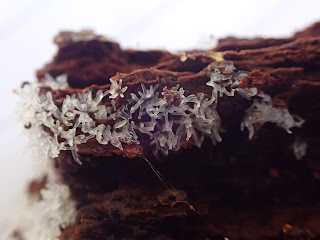

The species list continued to grow - I spotted some old Birch Polypores with undersides covered in Ochre Cushion, whilst Yellowing Russula was a species I don't see often. Fenugreek Stalkballs seem to have had a good year, whilst some Ash keys yielded two new species for me, both tiny black specks of different sizes. Lilac Dapperling (Cystolepiota bucknallii) was also new, a powdery purple fungus with a smell of coal gas. We began to head back, but it wasn't long before over half of the group were out of sight. It's always a risk leaving a dawdling group (what if they see something really exciting?) but keen to get home I decided to head back at a normal pace. I had a cup of tea at the car and they had still not emerged from the edge of the woods, so I think I took the correct option. Some of them might still be there now.


NORTH NORFOLK: Moths and a Gatekeeper aberration

16th July 2016

One of my target species this year is the Lappet Moth. Lappets are quite rare in Norfolk, and our hopes for seeing one were pinned on the open day at Holme NOA where one was caught last year. We arrived at the headquarters of the Norfolk Ornithologists Association to see a small group assembled ready to go through some traps. The first moths we were shown had been caught on the outside of one of the traps, and were a positive start - two of them were new for me, Kent Black Arches and Small Emerald.

The first trap we went through had been brought from Hunstanton, and contained mostly common species. The first Holme trap had a few nice species in, including several Ruby Tigers, but nothing new. There were two more traps to check, so we went to have a look. A Pine Hawkmoth and some Early Thorns were of note, and a Shore Wainscot was another new moth. Unfortunately there was no Lappets, but there we go. Back at the observatory we were shown a Barred Red that Trevor had caught, and some Large Thorns that had been bred from eggs.

Whilst with the traps a female Common Crossbill had been calling from a pine tree nearby, and back at the car park a Grasshopper Warbler reeled from close by. "It was showing well in that Hawthorn 30 seconds ago" was the message from other birders.


After lunch we called in at Holt Country Park to look for a plant I'd been told about, but there we failed to find it and after staring at leaf litter for a while we decided to give up. Near our car I had seen the hoverfly Seriocomyia silentis and there were two other sightings of note. Firstly my first Gatekeeper of the year was made more interesting by the presence of some extra black dots. Lepidopterists have long been fascinated by anything a bit out of the ordinary, and gave many of them names. This Gatekeeper appears to be an aberration named 'ab excessa.' The second interesting species was a slime mould, but a rather unusual looking one, probably from the genus Stemonitis, growing on some piling at the back of the car park.