The Whitlingham Bird Report for 2025 is now available to download from the Bird Reports page or from here

Showing posts with label Ladybirds. Show all posts

SOUTH NORFOLK: Shotesham lichen meeting

30th March 2024

Norfolk lichen recorder Rob Yaxley had organised a few informal meet-ups to survey churchyard lichens, and I managed to attend one at Shotesham, a village a few miles south of Norwich. We looked at three churches (two 'proper' ones and a ruin) and as expected racked up a good lichen list. The presence of quite a few experienced naturalists meant that we also turned up various other species across a wide range of groups. The pictures below are a small selection of highlights, but things that spring to mind include a lichenicolous fungus that appears to be new to Norfolk (Spiloma auratum), my long-awaited first Bristly Millipedes, the inconspicuous ladybird Rhyzobius litura, Ashy Mining Bee and smut fungi on aconite and sweet violet and the pseudoscorpion Chthonius isochneles.


FENLAND: Welney swan feed

Mid February 2023

We headed out to the edge of the fens for a family trip to Welney, timed to see the midday swan feed. If you've never been there is a large, heated hide set up to provide views out over the flooded fenland, providing close-up views of Whooper Swans (the shyer Bewick's Swans are often visible in fields on the approach road but seldom come in for the feed) and large numbers of Pochard. Some species new for the year included Pintail, Dunlin, Black-tailed Godwit and Cattle Egret, although the Tree Sparrows weren't on the feeders when we were looking.


After lunch we went for a brief walk along to some of the other hides. We had a look at some Xanthoria/Caloplaca lichens, searched unsuccessfully for Mousetail and saw a few invertebrates. These included Water Ladybird, the larva of Endothenia gentianeana/marginata in an old Teasel seedhead (you have to examine them closely to see if they have a feature called an anal comb - I didn't) and cases of a snail - Bithynia tentaculata I think.


NORWICH: Earlham cemetery beetles

Late December 2022

It had been a while since I'd visited Earlham Cemetery, so I called in on the way to Whitlingham for a quick look around. I failed to find any barkflies, which was the main thing I was looking for, but I did find some beetles including one of the inconspicuous ladybirds, Rhyzobius lophanthae, and a new species for me the tiny Cartodere bifasciata.


NORWICH: Some invertebrates on Larch

Mid-April 2022

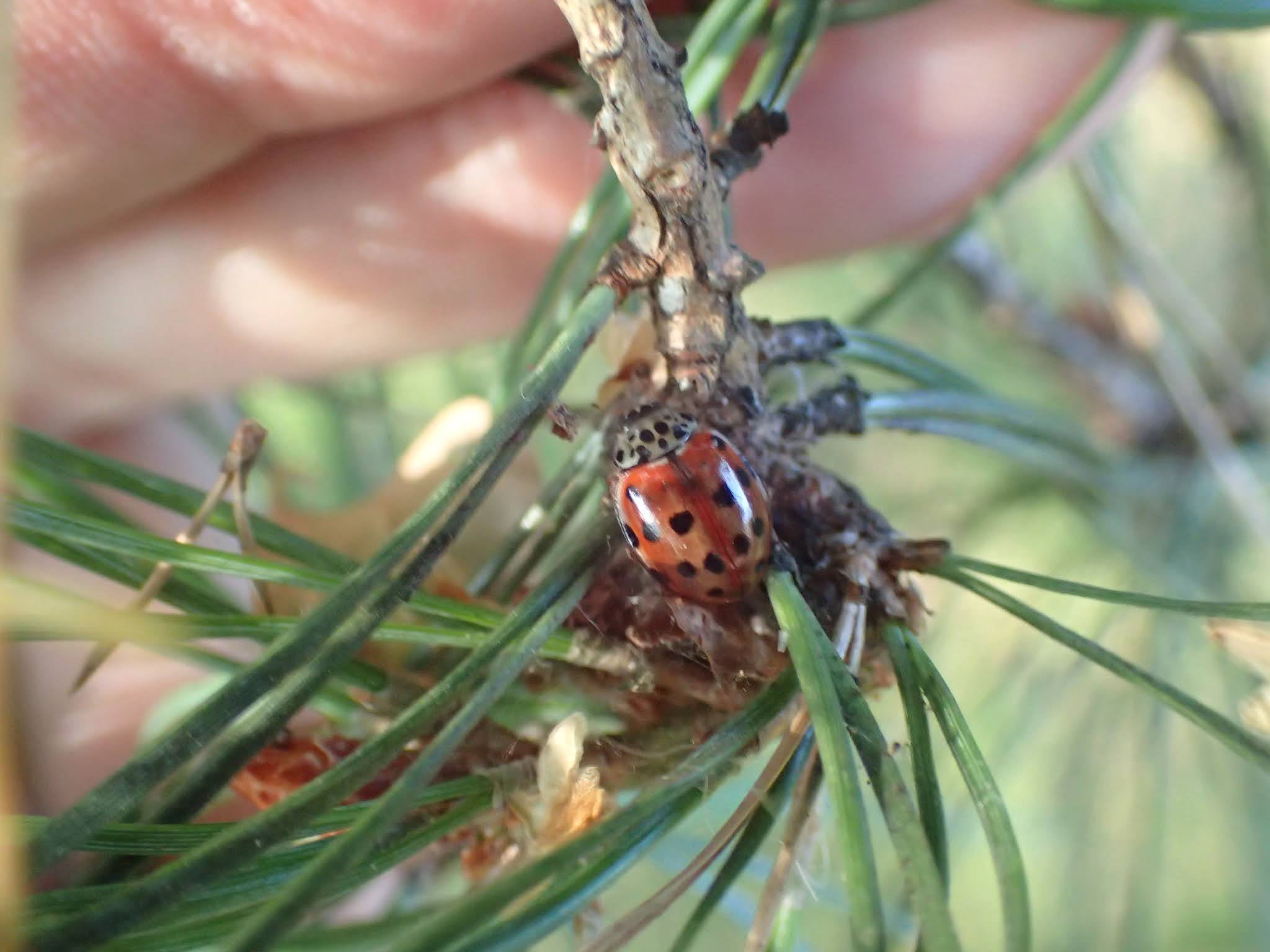
I had lunch in Earlham Cemetery, and spent most of the time staring at a couple of Larch trees in the hope of finding Larch Ladybird, a species that has so far eluded me. It continues to do so, but I did find a few nice things, including a Pine Cone Bug, an Eyed Ladybird and an egg-laying Larch adelphid aka Larch Woolly Aphid), Adelges laricis.


WHITLINGHAM: Orange Ladybirds and Scarlet Elf Cups

5th March 2022

Another rainy day. With an hour free I called in firstly at Trowse Woods, then at Whitlingham to read a few Mute Swan rings. At Trowse the highlight was finding a large number of Orange Ladybirds, around 80 in groups of up to 15 on twigs of a couple of large deciduous trees. I also saw some Scarlet Elf Cups, which I took home and incubated until they produced budding from the spore ends, an apparently definitive feature for Sarcoscypha austriaca (which is what almost all of the Norfolk ones turn out to be).


At Whitlingham I saw the local Mandarin, Black-headed Gull Blue 2K91 and 6 ringed Mute Swans before it was time to head back.


NORWICH: Rhyzobius lophanthae

Late September 2020

The rainy weather meant there wasn't much to see on my Norwich wanderings, but a Black Rustic attracted to a spotlight was a species I don't see too much.

Highlight of the week was another new inconspicuous ladybird, Rhyzobius lophanthae. This species is associated with cypress hedges, so was something that I expected to see at some point, but it was still nice to discover one in Waterloo Park. Unfortunately the overcast conditions mean the pictures are rubbish, but in the field you could see the difference between the orangey-red head and hairy black elytra.


NORWICH: Mid-September commute wildlife

 Another miscellany of species found on my walks to and from work in Norwich.

Giant Willow Aphids along Lakenham Way
Angle Shades - a common moth but one of my favourites
Phytomyza cytisi - leaf mines of a fly on Laburnum
Box-tree Moth
Laburnum Leaf-miner, Laucoptera laburnum leaf mine (showing circular frass feeding pattern)
Cream-streaked Ladybird
Oxystoma pommonae - a weevil found on Scot's Pine
Balclutha punctata - a leafhopper found on Scot's Pine

NORWICH: Early September commute wildlife

 Early September 2020

A few interesting sightings from my walks to and from work. Box-tree Moths are spreading around Norwich, which is probably a bad thing because they can defoliate bushes very quickly and get through mutliple life cycles in a year. I'd seen the caterpillars at my inlaws recently, but saw my first Norfolk adult moths at a security light. Nearby I was puzzled by some leaf mines on Sycamore leaves. Leaf mine guru Rob Edmunds confirmed that they were Horse Chestnut Leaf Miner larvae. This species has been recorded mining Sycamore and Norway Maple, but I had only ever recorded it on Horse Chestnut.


Checking the security light later in the week was productive, as in addition to a few common moths there was a Lunar Yellow Underwing, a species subtley different to Lesser Yellow Underwing and more commonly found in the Brecks. I also found a Blackcap sitting by the path near Micawber's Tavern. I went over in case it was injured, but it was able to scold me and hop off, so hopefully it was fine. At the end of the week I had a close look at a pine tree in Waterloo Park and found my first Scymnus suturalis, a species of inconspicuous ladybird associated with pines. There was also a nicely patterned micro moth, which I think is one of the samara-mining Ectoedemias.


NORWICH: Dot ladybird and a lacebug

 Mid-July 2020

Since the release of the recent Richard Lewington illustrated ladybirds field guide there has been a bit of an upturn in interest in 'inconspicuous' ladybirds - the half of our ladybird species that are very small and often not very clearly marked. One person taking an increased interest in these is Vanna Bartlett, and indeed she has written about them in the latest Norfolk Natterjack (the NNNS quarterly bulletin, sent out to members but made available to everyone as back issues via www.norfolknaturalists.org.uk > publications > Natterjack) and on her Arthropedia blog here: https://arthropedia.co.uk/inconspicuous-ladybirds/

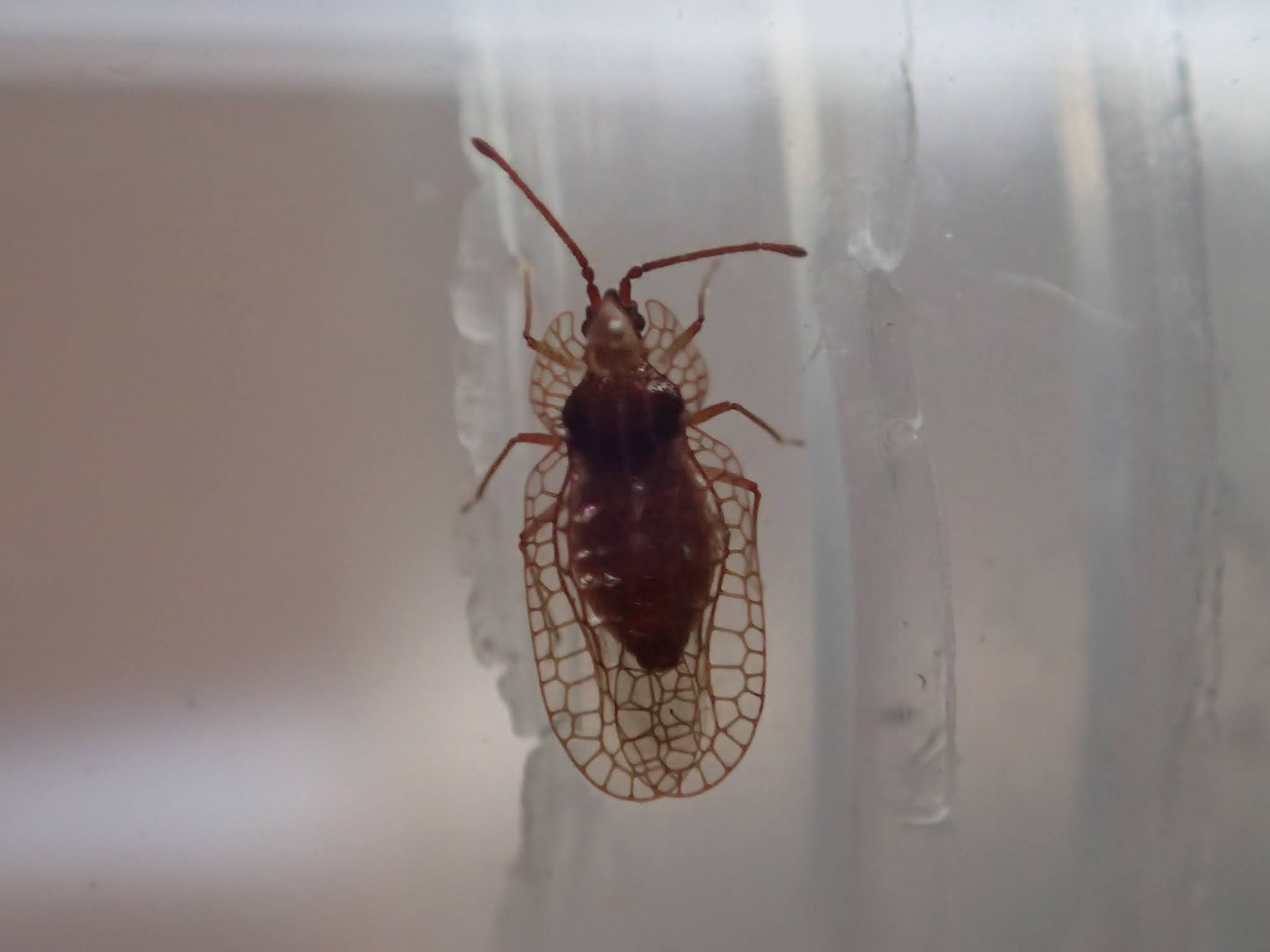
One evening Vanna called me to say that she had found one of smallest inconspicuous ladybirds, an all black species (albeit with tiny hairs), given the appropriate name of Dot Ladybird. In addition, she had also found a lacebug, another group that I am interested in, so I popped round after tea to have a look at both. The ladybird was just as tiny as you would expect, looking all black to the naked eye but covered in golden hairs under a microscope. I had seen several lacebugs, two on thistles and Andromeda Lacebug, but this one, Derephysia foliacea, was a new one for me.


NORWICH: Garden lockdown list day 72 - an egg-laying butterfly

DAY 72 - 1st June 2020

The undoubted highlight of today was watching a Large White butterfly laying eggs on the Rocket plants (ideally it would have been on some of the wild mustard plants rather than our salad, but hey-ho). Having initially seen it from indoors, Rose & I went outside and we were able to watch it flying around and occasionally laying an egg. Afterwards I had a hunt and managed to locate several of them. The hoverfly Helophilus pendulus and 14-spot ladybird were new for the lockdown list.


146. Helophilus pendulus (a hoverfly)

147. 14-spot Ladybird